VENTILATOR
HYPERINFLATION
Submitted by Ghazia tarannum
Bpt 4th year
Sub- 402 Physiotherapy in Cardiopulmonary Conditions
Submitted to Dr. Jamal Ali Moiz
Centre for physiotherapy and Rehabilitation Sciences
Jamia Millia Islamia, New Delhi
Introduction
• Ventilator Hyperinflation (VHI) is a physiotherapy intervention that enables the
deliverance of larger than baseline tidal volumes (Vt) via adjustment of the
ventilator in the intubated and ventilated patient.
• Ventilator hyperinflation (VHI) is a technique used by physiotherapists in
intensive care patients who are receiving mechanical ventilation. The aims of VHI
are similar to that of manual hyperinflation (MHI) and are primarily implemented
in order to improve respiratory function by mobilizing secretions and restoring
lung volume. Since first being described in the literature in 2002.
• The use of VHI techniques has increased, with recent surveys suggesting they are
utilized within 20% to 40% of tertiary hospitals.
• Despite this interest, there has been little research into VHI to guide education and
practice. Clinical studies that have investigated VHI techniques have all utilized
different methods to deliver the technique and there is considerable variability
among clinicians in how VHI is delivered.
• The short-term effectiveness of manual hyperinflation (MHI) in improving
oxygenation and pulmonary compliance, re-expanding areas of atelectasis, and
clearing pulmonary secretions has been widely demonstrated.
• However, there is controversy in whether patients ventilated on high levels of
positive end-expiratory pressure(PEEP) should be disconnected from the
ventilator to receive MHI, because disconnection would cause loss of functional
residual capacity, decrease in oxygenation and shear stress of distal lung units. To
prevent adverse effects of disconnection, the ventilator may be used to deliver
increased tidal volume, a technique called ventilator hyperinflation (VHI).
Purpose
• The purpose of VHI is to deliver higher than normal tidal volume breaths to
enhance secretion removal, improve oxygenation and re-inflate atelectatic lung
tissue.
• The effects are to:
- Optimize alveolar ventilation
- Mobilize pulmonary secretions
-Improve lung compliance
• Staff must be trained and competent in the use of VHI on ventilated and
tracheostomized patients and be familiar with these guidelines including inclusion
criteria, contraindications, and precautions as well as set up.
Indication for VHI
• Secretion retention that does not respond to suction and positioning
• Patients who are PEEP dependent
• Prior / post endotracheal suctioning
• Segmental/lobar atelectasis
• Poor cough mechanism
Absolute Contraindication
• Undrained pneumothorax
• Severe bronchospasm
• Head injury with ICP > 25mmHg
• Severe arterial hypotension
• Subcutaneous emphysema of unknown cause
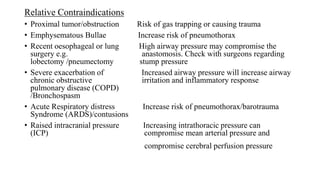
Relative Contraindications
• Proximal tumor/obstruction Risk of gas trapping or causing trauma
• Emphysematous Bullae Increase risk of pneumothorax
• Recent oesophageal or lung High airway pressure may compromise the
surgery e.g. anastomosis. Check with surgeons regarding
lobectomy /pneumectomy stump pressure
• Severe exacerbation of Increased airway pressure will increase airway
chronic obstructive irritation and inflammatory response
pulmonary disease (COPD)
/Bronchospasm
• Acute Respiratory distress Increase risk of pneumothorax/barotrauma
Syndrome (ARDS)/contusions
• Raised intracranial pressure Increasing intrathoracic pressure can
(ICP) compromise mean arterial pressure and
compromise cerebral perfusion pressure
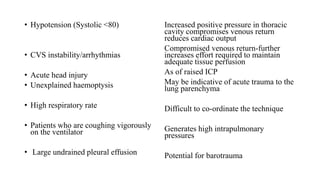
• Hypotension (Systolic <80)
• CVS instability/arrhythmias
• Acute head injury
• Unexplained haemoptysis
• High respiratory rate
• Patients who are coughing vigorously
on the ventilator
• Large undrained pleural effusion
Increased positive pressure in thoracic
cavity compromises venous return
reduces cardiac output
Compromised venous return-further
increases effort required to maintain
adequate tissue perfusion
As of raised ICP
May be indicative of acute trauma to the
lung parenchyma
Difficult to co-ordinate the technique
Generates high intrapulmonary
pressures
Potential for barotrauma
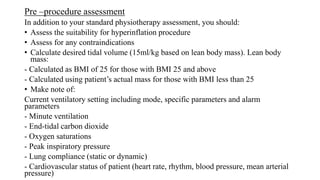
Pre –procedure assessment
In addition to your standard physiotherapy assessment, you should:
• Assess the suitability for hyperinflation procedure
• Assess for any contraindications
• Calculate desired tidal volume (15ml/kg based on lean body mass). Lean body
mass:
- Calculated as BMI of 25 for those with BMI 25 and above
- Calculated using patient’s actual mass for those with BMI less than 25
• Make note of:
Current ventilatory setting including mode, specific parameters and alarm
parameters
- Minute ventilation
- End-tidal carbon dioxide
- Oxygen saturations
- Peak inspiratory pressure
- Lung compliance (static or dynamic)
- Cardiovascular status of patient (heart rate, rhythm, blood pressure, mean arterial
pressure)
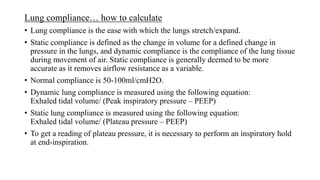
Lung compliance… how to calculate
• Lung compliance is the ease with which the lungs stretch/expand.
• Static compliance is defined as the change in volume for a defined change in
pressure in the lungs, and dynamic compliance is the compliance of the lung tissue
during movement of air. Static compliance is generally deemed to be more
accurate as it removes airflow resistance as a variable.
• Normal compliance is 50-100ml/cmH2O.
• Dynamic lung compliance is measured using the following equation:
Exhaled tidal volume/ (Peak inspiratory pressure – PEEP)
• Static lung compliance is measured using the following equation:
Exhaled tidal volume/ (Plateau pressure – PEEP)
• To get a reading of plateau pressure, it is necessary to perform an inspiratory hold
at end-inspiration.
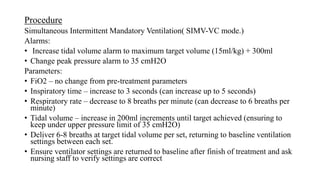
Procedure
Simultaneous Intermittent Mandatory Ventilation( SIMV-VC mode.)
Alarms:
• Increase tidal volume alarm to maximum target volume (15ml/kg) + 300ml
• Change peak pressure alarm to 35 cmH2O
Parameters:
• FiO2 – no change from pre-treatment parameters
• Inspiratory time – increase to 3 seconds (can increase up to 5 seconds)
• Respiratory rate – decrease to 8 breaths per minute (can decrease to 6 breaths per
minute)
• Tidal volume – increase in 200ml increments until target achieved (ensuring to
keep under upper pressure limit of 35 cmH2O)
• Deliver 6-8 breaths at target tidal volume per set, returning to baseline ventilation
settings between each set.
• Ensure ventilator settings are returned to baseline after finish of treatment and ask
nursing staff to verify settings are correct
Pressure Control + (PVC+)/ Mandatory minute ventilation (MMV)
• Change ventilation mode to SIMV auto flow
• Set Vt (tidal volume) to that being achieved on the PCV+ mode
• Follow steps 1-13 above returning the ventilator parameters to PCV+ between
each cycle. Check after each cycle that the PC setting is correct
• Ensure the return of all parameters to pre intervention settings (PCV+/PC
level/FiO2/RR/Tinsp/Paw alarm/Vt alarm) by the Senior Nurse
• Document settings utilized and outcome measures
Pressure support (PS)
• Maintain the FiO2 at pre-set levels.
• Adjust Vt(ventilation mode) alarm to target Vt plus 300 mls (15ml/kg).
• Change Paw alarm to 35cm/H2O, Change MV alarm to 20L/min.
• Note pre-treatment minute ventilation (Vm) and EtCO2, aim to keep similar.
• Change Slope time from 0.2 to 0.7, then gradually increase PS in 2cm/H2O increments until either
Target Vt or maximum Paw (35 cm/H2O ) reached.
• Aim for 8 breaths at target volume, include vibes if indicated.
• Senior Nurse to return ventilator settings to pre-treatment parameters (PS, and Slope) between
cycles and Senior Physiotherapist to suction as required following pre-oxygenation if required.
This may occur following interruption of the VHI breaths or at the end of the cycle of breaths.
• Aim for 3 sets of 8 VHI breathes.
• Ensure the return of all parameters to pre intervention (PS, Slope, FiO2 Paw & high Vt alarms) by
the Senior Nurse.
• Document settings utilized and outcome measures.
• Ensure patient is breathing at an adequate minute ventilation when returned to pre VHI PSV
setting and if necessary get Senior RN to return to SIMV settings.
Monitor for:
• Minute ventilation (try to maintain as per pre-treatment throughout)
• End-tidal carbon dioxide (try to maintain as per pre-treatment throughout)
• Blood pressure
• Oxygen saturations
• Patient distress
• Peak airway pressures
• Intracranial pressure (if being monitored)
• Inspiratory and Expiratory flow rates
Troubleshooting:
• Alarms may sound due to changes in inspiratory: expiratory ratio – if so, reduce
respiratory rate and increase inspiratory time more gradually
• If peak pressure is high before target volume reached, increase inspiratory time
and reduce respiratory rate.
• Studies comparing MHI to VHI have found no statistically significant differences
between techniques when comparing for:
- Secretion clearance
- Static and dynamic compliance
- Oxygenation
- Cardiovascular stability
• It appears VHI is as safe and effective as MHI, but with many advantages as
detailed above.
• However, there are very few studies, with low numbers of subjects (poor power),
high levels of bias (crossover trials rather than RCTs), and no studies looking at
any effects longer than 30 minutes after treatment.
• It is not clear if either VHI or MHI have any long-term positive outcomes, but
VHI is safe and effective in the short-term management of secretions, and can
provide short-term gains in lung compliance.
Advantaged of VHI when compared to MHI
• Maintenance of PEEP and thus prevention of ‘de-recruitment’ of alveoli
• Accurate control of ventilation parameters
• Reproducibility of technique – remember that MHI has been demonstrated to have
significant inconsistencies in application of technique
• Reduced infection control risk to patient and to staff as no requirement to
disconnect ventilator circuit
- Only one person is required to administer, compared to two with MHI if using in
conjunction with other techniques (e.g. suctioning or manual techniques)
- Cost savings due to less staff requirements, and also equipment savings, as it uses
no extra equipment
Uses of VHI
• In mechanical ventilation, the ventilator settings have the potential to influence
secretion movement and commonly result in airflow that may result in impaction
of secretions in distal airways.
• For VHI and/or MHI to be utilized to promote secretion mobilization, inspiratory
and/or expiratory flow rates are modulated in order to bias secretion movement
towards proximal airways.
• (VHI) has been shown to be effective in improving respiratory mechanics, and gas
exchange in mechanically ventilated patients.
• VHI has been a safer method to provide therapeutic hyperinflation in mechanically
ventilated patients.
• VHI helps in prevention of nosocomial pneumonia.
Refrences
• Berney.S, Denehy.L (2002) Acomparison of the effects of manual and ventilator hyperinflation on static lung compliance
and sputum production in intubated and ventilated intensive care patients. Physiotherapy Res Int; 7:100-8.
• Paratz.J, Lipman.J, McAuliffe.M (2002) Effect of manual hyperinflation on hymodynamics, gas exchange, and respiratory
mechanics in ventilated patients. J Intensive Care Med; 17:317-24.
• Hedensetiema.G, Tokics.L, Lundquist.H, et al. (1994) Phrenic nerve stimulation during halothane anesthesia. Effects of
atelectasis, Anesthesiology; 80:751-60.
• Lindberg.P, Gunnarsson.L, Tokics.L (1992) Atelectasis and lung function in the post-operative period. Acta Anaesthesiol
Scand; 36:546-53
• McCann UG, Schiller HJ, Carney DE, et al. (2001) Visual validation of the mechanical stabilizing effects of positive end
expiratory at the alveolar level. J Surg Res; 99:335-42
• Andeerson.A, Alexanders.J, Sinani.C, Hayes.S & Forgarty.M (2015) Effects of ventilator vs manual hyperinflation in adult
receiving mechanical ventilation: a systematic review of randomised clinical trials. Physiotherapy. 43:103-110
• Respiratory Physiotherapy Team- St George’s University Hospitals NHS Foundation Trust (2016) Ventilator Hyperinflation
(VHI)- Guidelines for the use of Ventilator Hyperinflation with adults. Retrived form:
• Thomas.P.J (2015) The effects of mechanical ventilation settings during ventilator hyperinflation techniques: a bench -top
analysis. Anaesthesia and Intensive Care. 43(1):81-87
• Dennis.D, Jacob.W & Budgeone.C (2012) Ventilator versus mannual hyperinflation in cleaning sputum in ventilated
intensive care unit patients. Anaesthesia and Intensive Care. 40(1):142-149

Ventilator hyperinflation,

  • 1.
    VENTILATOR HYPERINFLATION Submitted by Ghaziatarannum Bpt 4th year Sub- 402 Physiotherapy in Cardiopulmonary Conditions Submitted to Dr. Jamal Ali Moiz Centre for physiotherapy and Rehabilitation Sciences Jamia Millia Islamia, New Delhi
  • 2.
    Introduction • Ventilator Hyperinflation(VHI) is a physiotherapy intervention that enables the deliverance of larger than baseline tidal volumes (Vt) via adjustment of the ventilator in the intubated and ventilated patient. • Ventilator hyperinflation (VHI) is a technique used by physiotherapists in intensive care patients who are receiving mechanical ventilation. The aims of VHI are similar to that of manual hyperinflation (MHI) and are primarily implemented in order to improve respiratory function by mobilizing secretions and restoring lung volume. Since first being described in the literature in 2002. • The use of VHI techniques has increased, with recent surveys suggesting they are utilized within 20% to 40% of tertiary hospitals.
  • 3.
    • Despite thisinterest, there has been little research into VHI to guide education and practice. Clinical studies that have investigated VHI techniques have all utilized different methods to deliver the technique and there is considerable variability among clinicians in how VHI is delivered. • The short-term effectiveness of manual hyperinflation (MHI) in improving oxygenation and pulmonary compliance, re-expanding areas of atelectasis, and clearing pulmonary secretions has been widely demonstrated. • However, there is controversy in whether patients ventilated on high levels of positive end-expiratory pressure(PEEP) should be disconnected from the ventilator to receive MHI, because disconnection would cause loss of functional residual capacity, decrease in oxygenation and shear stress of distal lung units. To prevent adverse effects of disconnection, the ventilator may be used to deliver increased tidal volume, a technique called ventilator hyperinflation (VHI).
  • 4.
    Purpose • The purposeof VHI is to deliver higher than normal tidal volume breaths to enhance secretion removal, improve oxygenation and re-inflate atelectatic lung tissue. • The effects are to: - Optimize alveolar ventilation - Mobilize pulmonary secretions -Improve lung compliance • Staff must be trained and competent in the use of VHI on ventilated and tracheostomized patients and be familiar with these guidelines including inclusion criteria, contraindications, and precautions as well as set up.
  • 5.
    Indication for VHI •Secretion retention that does not respond to suction and positioning • Patients who are PEEP dependent • Prior / post endotracheal suctioning • Segmental/lobar atelectasis • Poor cough mechanism
  • 6.
    Absolute Contraindication • Undrainedpneumothorax • Severe bronchospasm • Head injury with ICP > 25mmHg • Severe arterial hypotension • Subcutaneous emphysema of unknown cause
  • 7.
    Relative Contraindications • Proximaltumor/obstruction Risk of gas trapping or causing trauma • Emphysematous Bullae Increase risk of pneumothorax • Recent oesophageal or lung High airway pressure may compromise the surgery e.g. anastomosis. Check with surgeons regarding lobectomy /pneumectomy stump pressure • Severe exacerbation of Increased airway pressure will increase airway chronic obstructive irritation and inflammatory response pulmonary disease (COPD) /Bronchospasm • Acute Respiratory distress Increase risk of pneumothorax/barotrauma Syndrome (ARDS)/contusions • Raised intracranial pressure Increasing intrathoracic pressure can (ICP) compromise mean arterial pressure and compromise cerebral perfusion pressure
  • 8.
    • Hypotension (Systolic<80) • CVS instability/arrhythmias • Acute head injury • Unexplained haemoptysis • High respiratory rate • Patients who are coughing vigorously on the ventilator • Large undrained pleural effusion Increased positive pressure in thoracic cavity compromises venous return reduces cardiac output Compromised venous return-further increases effort required to maintain adequate tissue perfusion As of raised ICP May be indicative of acute trauma to the lung parenchyma Difficult to co-ordinate the technique Generates high intrapulmonary pressures Potential for barotrauma
  • 9.
    Pre –procedure assessment Inaddition to your standard physiotherapy assessment, you should: • Assess the suitability for hyperinflation procedure • Assess for any contraindications • Calculate desired tidal volume (15ml/kg based on lean body mass). Lean body mass: - Calculated as BMI of 25 for those with BMI 25 and above - Calculated using patient’s actual mass for those with BMI less than 25 • Make note of: Current ventilatory setting including mode, specific parameters and alarm parameters - Minute ventilation - End-tidal carbon dioxide - Oxygen saturations - Peak inspiratory pressure - Lung compliance (static or dynamic) - Cardiovascular status of patient (heart rate, rhythm, blood pressure, mean arterial pressure)
  • 10.
    Lung compliance… howto calculate • Lung compliance is the ease with which the lungs stretch/expand. • Static compliance is defined as the change in volume for a defined change in pressure in the lungs, and dynamic compliance is the compliance of the lung tissue during movement of air. Static compliance is generally deemed to be more accurate as it removes airflow resistance as a variable. • Normal compliance is 50-100ml/cmH2O. • Dynamic lung compliance is measured using the following equation: Exhaled tidal volume/ (Peak inspiratory pressure – PEEP) • Static lung compliance is measured using the following equation: Exhaled tidal volume/ (Plateau pressure – PEEP) • To get a reading of plateau pressure, it is necessary to perform an inspiratory hold at end-inspiration.
  • 11.
    Procedure Simultaneous Intermittent MandatoryVentilation( SIMV-VC mode.) Alarms: • Increase tidal volume alarm to maximum target volume (15ml/kg) + 300ml • Change peak pressure alarm to 35 cmH2O Parameters: • FiO2 – no change from pre-treatment parameters • Inspiratory time – increase to 3 seconds (can increase up to 5 seconds) • Respiratory rate – decrease to 8 breaths per minute (can decrease to 6 breaths per minute) • Tidal volume – increase in 200ml increments until target achieved (ensuring to keep under upper pressure limit of 35 cmH2O) • Deliver 6-8 breaths at target tidal volume per set, returning to baseline ventilation settings between each set. • Ensure ventilator settings are returned to baseline after finish of treatment and ask nursing staff to verify settings are correct
  • 12.
    Pressure Control +(PVC+)/ Mandatory minute ventilation (MMV) • Change ventilation mode to SIMV auto flow • Set Vt (tidal volume) to that being achieved on the PCV+ mode • Follow steps 1-13 above returning the ventilator parameters to PCV+ between each cycle. Check after each cycle that the PC setting is correct • Ensure the return of all parameters to pre intervention settings (PCV+/PC level/FiO2/RR/Tinsp/Paw alarm/Vt alarm) by the Senior Nurse • Document settings utilized and outcome measures
  • 13.
    Pressure support (PS) •Maintain the FiO2 at pre-set levels. • Adjust Vt(ventilation mode) alarm to target Vt plus 300 mls (15ml/kg). • Change Paw alarm to 35cm/H2O, Change MV alarm to 20L/min. • Note pre-treatment minute ventilation (Vm) and EtCO2, aim to keep similar. • Change Slope time from 0.2 to 0.7, then gradually increase PS in 2cm/H2O increments until either Target Vt or maximum Paw (35 cm/H2O ) reached. • Aim for 8 breaths at target volume, include vibes if indicated. • Senior Nurse to return ventilator settings to pre-treatment parameters (PS, and Slope) between cycles and Senior Physiotherapist to suction as required following pre-oxygenation if required. This may occur following interruption of the VHI breaths or at the end of the cycle of breaths. • Aim for 3 sets of 8 VHI breathes. • Ensure the return of all parameters to pre intervention (PS, Slope, FiO2 Paw & high Vt alarms) by the Senior Nurse. • Document settings utilized and outcome measures. • Ensure patient is breathing at an adequate minute ventilation when returned to pre VHI PSV setting and if necessary get Senior RN to return to SIMV settings.
  • 14.
    Monitor for: • Minuteventilation (try to maintain as per pre-treatment throughout) • End-tidal carbon dioxide (try to maintain as per pre-treatment throughout) • Blood pressure • Oxygen saturations • Patient distress • Peak airway pressures • Intracranial pressure (if being monitored) • Inspiratory and Expiratory flow rates Troubleshooting: • Alarms may sound due to changes in inspiratory: expiratory ratio – if so, reduce respiratory rate and increase inspiratory time more gradually • If peak pressure is high before target volume reached, increase inspiratory time and reduce respiratory rate.
  • 15.
    • Studies comparingMHI to VHI have found no statistically significant differences between techniques when comparing for: - Secretion clearance - Static and dynamic compliance - Oxygenation - Cardiovascular stability • It appears VHI is as safe and effective as MHI, but with many advantages as detailed above. • However, there are very few studies, with low numbers of subjects (poor power), high levels of bias (crossover trials rather than RCTs), and no studies looking at any effects longer than 30 minutes after treatment. • It is not clear if either VHI or MHI have any long-term positive outcomes, but VHI is safe and effective in the short-term management of secretions, and can provide short-term gains in lung compliance.
  • 16.
    Advantaged of VHIwhen compared to MHI • Maintenance of PEEP and thus prevention of ‘de-recruitment’ of alveoli • Accurate control of ventilation parameters • Reproducibility of technique – remember that MHI has been demonstrated to have significant inconsistencies in application of technique • Reduced infection control risk to patient and to staff as no requirement to disconnect ventilator circuit - Only one person is required to administer, compared to two with MHI if using in conjunction with other techniques (e.g. suctioning or manual techniques) - Cost savings due to less staff requirements, and also equipment savings, as it uses no extra equipment
  • 17.
    Uses of VHI •In mechanical ventilation, the ventilator settings have the potential to influence secretion movement and commonly result in airflow that may result in impaction of secretions in distal airways. • For VHI and/or MHI to be utilized to promote secretion mobilization, inspiratory and/or expiratory flow rates are modulated in order to bias secretion movement towards proximal airways. • (VHI) has been shown to be effective in improving respiratory mechanics, and gas exchange in mechanically ventilated patients. • VHI has been a safer method to provide therapeutic hyperinflation in mechanically ventilated patients. • VHI helps in prevention of nosocomial pneumonia.
  • 18.
    Refrences • Berney.S, Denehy.L(2002) Acomparison of the effects of manual and ventilator hyperinflation on static lung compliance and sputum production in intubated and ventilated intensive care patients. Physiotherapy Res Int; 7:100-8. • Paratz.J, Lipman.J, McAuliffe.M (2002) Effect of manual hyperinflation on hymodynamics, gas exchange, and respiratory mechanics in ventilated patients. J Intensive Care Med; 17:317-24. • Hedensetiema.G, Tokics.L, Lundquist.H, et al. (1994) Phrenic nerve stimulation during halothane anesthesia. Effects of atelectasis, Anesthesiology; 80:751-60. • Lindberg.P, Gunnarsson.L, Tokics.L (1992) Atelectasis and lung function in the post-operative period. Acta Anaesthesiol Scand; 36:546-53 • McCann UG, Schiller HJ, Carney DE, et al. (2001) Visual validation of the mechanical stabilizing effects of positive end expiratory at the alveolar level. J Surg Res; 99:335-42 • Andeerson.A, Alexanders.J, Sinani.C, Hayes.S & Forgarty.M (2015) Effects of ventilator vs manual hyperinflation in adult receiving mechanical ventilation: a systematic review of randomised clinical trials. Physiotherapy. 43:103-110 • Respiratory Physiotherapy Team- St George’s University Hospitals NHS Foundation Trust (2016) Ventilator Hyperinflation (VHI)- Guidelines for the use of Ventilator Hyperinflation with adults. Retrived form: • Thomas.P.J (2015) The effects of mechanical ventilation settings during ventilator hyperinflation techniques: a bench -top analysis. Anaesthesia and Intensive Care. 43(1):81-87 • Dennis.D, Jacob.W & Budgeone.C (2012) Ventilator versus mannual hyperinflation in cleaning sputum in ventilated intensive care unit patients. Anaesthesia and Intensive Care. 40(1):142-149