 Vital capacity – capacity of the lungs expressed in cubic
cm of air that can be forcibly exhaled after full
inspiration. 4600 ml
 Expiratory reserve volume – additional amount of air
that can be expired from the lungs after normal
expiration. 1100 ml
 Tidal volume – amount of air that passes in and out of
the lungs. 500 ml
 Inadequate ventilation, whether due to
sedation and neuromuscular paralysis in the
operating room, an obstructed or
compromised airway, altered mentation, loss
of consciousness, or respiratory failure can
lead to brain injury or death within minutes.
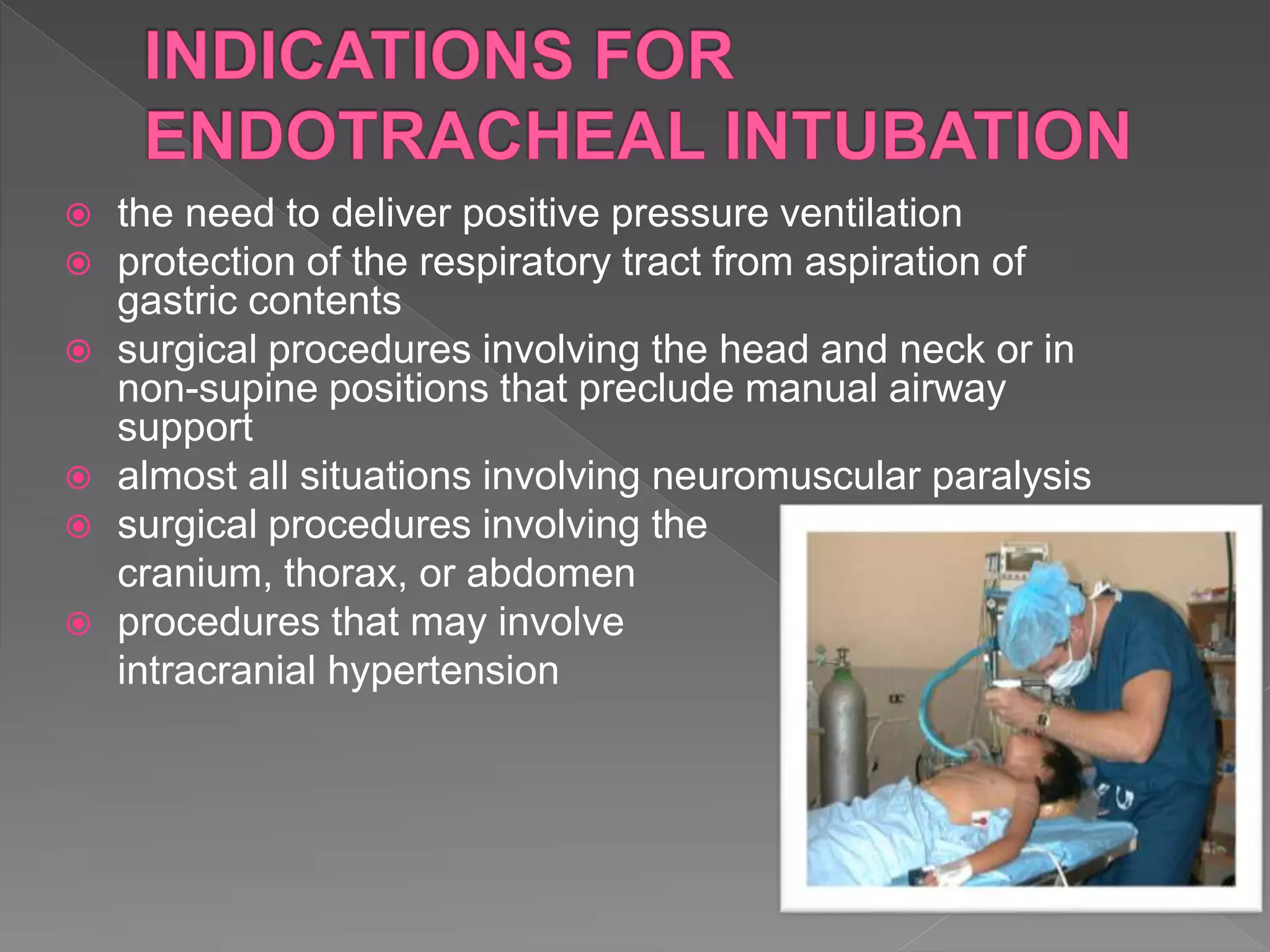
 the need to deliver positive pressure ventilation
 protection of the respiratory tract from aspiration of
gastric contents
 surgical procedures involving the head and neck or in
non-supine positions that preclude manual airway
support
 almost all situations involving neuromuscular paralysis
 surgical procedures involving the
cranium, thorax, or abdomen
 procedures that may involve
intracranial hypertension
Some non-operative indications are:
 profound disturbance in consciousness with
the inability to protect the airway
 severe pulmonary or multisystem injury
associated with respiratory failure, such as
sepsis, airway obstruction, hypoxemia, and
hypercarbia
 Objective measures may also be used to help
determine the need for intubation:
› respiratory rate > 35 breaths per minute
› vital capacity < 15 ml/kg in adults and 10 ml/kg in
children
› inability to generate a negative inspiratory force of 20
mm Hg
› PaO2 (arterial partial pressure of oxygen) < 70 mm
Hg
› A-a gradient (Alveolar-arterial) > 350 mm Hg on
100% oxygen
› PaCO2 (arterial partial pressure of carbon dioxide) >
55 m Hg (except in chronic retainers)
› dead space > 0.6 L
I. Subjective criteria
a. Resolution of acute disease
b. Adequate cough
c. Patient should be awake, alert and following
commands, able to protect the airway
d. GCS =/>13
e. No continuous sedation infusions
f. Clear oropharyhnx; no active bleeding
g. Minimal end-expiratory concentration of inhaaled
anesthetics
h. Appropriate gag and cough reflex
 II. Objective Criteria
a. Vital signs
1. Stable blood pressure with minimal or no inotropic support
2. Heart rate < 140 bpm
b. Gas exchange function
1. ABG on 40 % FiO2, PaO2 > 60 mmHg, PaCO2 <55
2. P/F ratio >150 – 300 mmHg
3. maintenance of a normal pH
a. Mechanical function
1. FVC >10 – 15 ml/kg
2. FEV 1 >10 ml/kg
3. Vital Capacity > /= 15ml/kg
a. Adequate hemoglobin (>/= 8 – 10 g/dl)
b. No significant respiratory acidosis
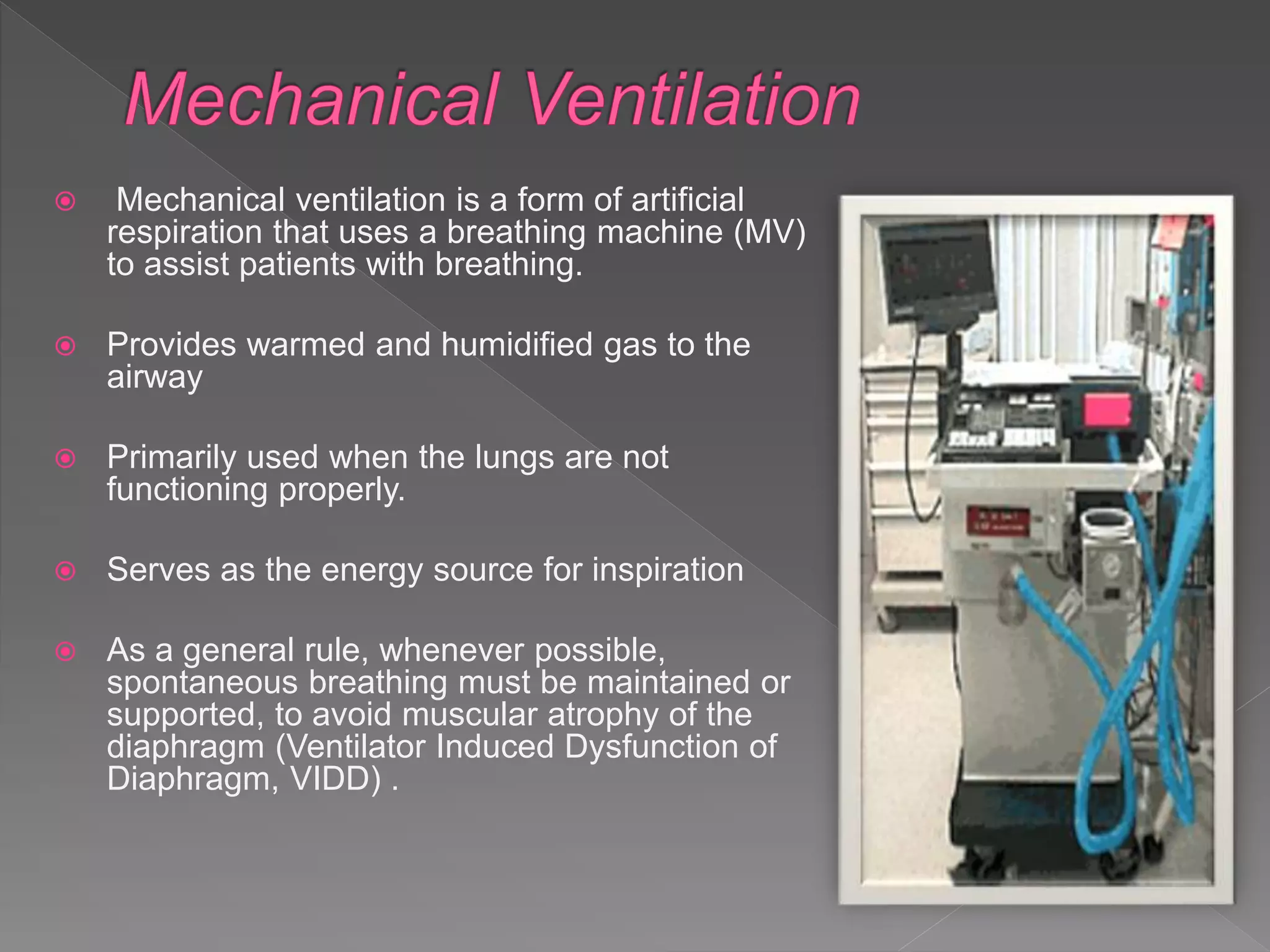
 Mechanical ventilation is a form of artificial
respiration that uses a breathing machine (MV)
to assist patients with breathing.
 Provides warmed and humidified gas to the
airway
 Primarily used when the lungs are not
functioning properly.
 Serves as the energy source for inspiration
 As a general rule, whenever possible,
spontaneous breathing must be maintained or
supported, to avoid muscular atrophy of the
diaphragm (Ventilator Induced Dysfunction of
Diaphragm, VIDD) .
 For adult patients and older children
› Tidal volume(Vt) is calculated in milliliters per kilogram.
Traditionally 10 ml/kg was used but has been shown to
cause barotrauma, or injury to the lung by overextension,
so 6 to 8 ml/kg is now common practice in ICU. Hence a
patient weighing 70 kg would get a Vt of 420–480 ml. In
adults a rate of 12 strokes per minute is generally used.
 mechanical ventilator is responsible for assisting in a patient's
breathing, it must then also be able to deliver an adequate
amount of oxygen in each breath.
 In adult patients who can tolerate higher levels of oxygen for a
period of time, the initial FiO2 may be set at 100% until arterial
blood gases can document adequate oxygenation.
 An FiO2 of 100% for an extended period of time can be
dangerous, but it can protect against hypoxemia from
unexpected intubation problems. For infants, and especially in
premature infants, avoiding high levels of FiO2(>60%) is
important.
 PEEP is an adjuvant to the mode of ventilation used to help
maintain functional residual capacity (FRC). At the end of
expiration, the PEEP exerts pressure to oppose passive
emptying of the lung and to keep the airway pressure above
the atmospheric pressure
 The presence of PEEP opens up collapsed or unstable
alveoli and increases the FRC and surface area for gas
exchange, thus reducing the size of the shunt.
 may also be useful to decrease the work of breathing. In
pulmonary physiology, compliance is a measure of the
"stiffness" of the lung and chest wall
 PEEP can cause significant haemodynamic
consequences through decreasing venous return to
the right heart and decreasing right ventricular
function. As such, it should be judiciously used and
is indicated for adults in two circumstances.
 If a PaO2 of 60 mmHg cannot be achieved with
a FiO2 of 60%
 If the initial shunt estimation is greater than 25%
 PEEP is usually set with the minimal positive
pressure to maintain an adequate PaO2 with a
safe FiO2.
 As PEEP increases intrathoracic pressure, there
can be a resulting decrease in venous return and
decrease in cardiac output.
 A PEEP of less than 10 cmH2O (1 kPa) is usually
safe in adults if intravascular volume depletion is
absent. Lower levels are used for pediatric patients
I. ACMV – inspiratory cycle is initiated either by the
patient’s inspiratory effort or by a timer signal
within the ventilator
› Commonly used for initiation of MV – ensures a
backup minute ventilation in the absence of an intact
respiratory drive
› Initial settings – FI02 – 1
Vt = 10 – 15 ml /kg
f = frequency – 12 – 15/min
PEEP – 0 -5 cmH20
II. Synchronized Intermittent Mandatory
Ventilation (SIMV)
› Allow the patient to breathe spontaneously
› If the patient fails to initate a breath , the ventilator
delivers a fixed –tidal-volume breath and resets the
internal timer for the next inspiratory cycle
› Allows patients with intact respiratory drive to
exercise inspiratory muscles between assisted
breaths, making it useful for weaning intubated
patients
 Settings as ACMV
III. Pressure control ventiation (PCV)
> time trigerred , time cycled and pressure limited
> preferred mode of ventilation for patients with pre
existing barotrauma or post op thoracic surgical
patients in whom the shear force across a suture
line should be limited
Settings – FIO2 = 1.0
PEEP = 5 – 10 cmH20
f = 12 – 15/min
IV. Pressure support ventilation (PSV)
> patient triggered, flow cycled and pressure
limited
> specifically designed for use in the weaning process
> during the PSV, the inspiration is terminated when
inspiratory airflow falls below a certain level
> patient receives ventilatory assist only when the
ventilator detects an inspired effort
> tolerated by patients who are being weaned
indications for intubation and extubation. MV.pptx

indications for intubation and extubation. MV.pptx

  • 2.
     Vital capacity– capacity of the lungs expressed in cubic cm of air that can be forcibly exhaled after full inspiration. 4600 ml  Expiratory reserve volume – additional amount of air that can be expired from the lungs after normal expiration. 1100 ml  Tidal volume – amount of air that passes in and out of the lungs. 500 ml
  • 3.
     Inadequate ventilation,whether due to sedation and neuromuscular paralysis in the operating room, an obstructed or compromised airway, altered mentation, loss of consciousness, or respiratory failure can lead to brain injury or death within minutes.
  • 4.
     the needto deliver positive pressure ventilation  protection of the respiratory tract from aspiration of gastric contents  surgical procedures involving the head and neck or in non-supine positions that preclude manual airway support  almost all situations involving neuromuscular paralysis  surgical procedures involving the cranium, thorax, or abdomen  procedures that may involve intracranial hypertension
  • 5.
    Some non-operative indicationsare:  profound disturbance in consciousness with the inability to protect the airway  severe pulmonary or multisystem injury associated with respiratory failure, such as sepsis, airway obstruction, hypoxemia, and hypercarbia
  • 6.
     Objective measuresmay also be used to help determine the need for intubation: › respiratory rate > 35 breaths per minute › vital capacity < 15 ml/kg in adults and 10 ml/kg in children › inability to generate a negative inspiratory force of 20 mm Hg › PaO2 (arterial partial pressure of oxygen) < 70 mm Hg › A-a gradient (Alveolar-arterial) > 350 mm Hg on 100% oxygen › PaCO2 (arterial partial pressure of carbon dioxide) > 55 m Hg (except in chronic retainers) › dead space > 0.6 L
  • 8.
    I. Subjective criteria a.Resolution of acute disease b. Adequate cough c. Patient should be awake, alert and following commands, able to protect the airway d. GCS =/>13 e. No continuous sedation infusions f. Clear oropharyhnx; no active bleeding g. Minimal end-expiratory concentration of inhaaled anesthetics h. Appropriate gag and cough reflex
  • 9.
     II. ObjectiveCriteria a. Vital signs 1. Stable blood pressure with minimal or no inotropic support 2. Heart rate < 140 bpm b. Gas exchange function 1. ABG on 40 % FiO2, PaO2 > 60 mmHg, PaCO2 <55 2. P/F ratio >150 – 300 mmHg 3. maintenance of a normal pH a. Mechanical function 1. FVC >10 – 15 ml/kg 2. FEV 1 >10 ml/kg 3. Vital Capacity > /= 15ml/kg a. Adequate hemoglobin (>/= 8 – 10 g/dl) b. No significant respiratory acidosis
  • 11.
     Mechanical ventilationis a form of artificial respiration that uses a breathing machine (MV) to assist patients with breathing.  Provides warmed and humidified gas to the airway  Primarily used when the lungs are not functioning properly.  Serves as the energy source for inspiration  As a general rule, whenever possible, spontaneous breathing must be maintained or supported, to avoid muscular atrophy of the diaphragm (Ventilator Induced Dysfunction of Diaphragm, VIDD) .
  • 12.
     For adultpatients and older children › Tidal volume(Vt) is calculated in milliliters per kilogram. Traditionally 10 ml/kg was used but has been shown to cause barotrauma, or injury to the lung by overextension, so 6 to 8 ml/kg is now common practice in ICU. Hence a patient weighing 70 kg would get a Vt of 420–480 ml. In adults a rate of 12 strokes per minute is generally used.
  • 13.
     mechanical ventilatoris responsible for assisting in a patient's breathing, it must then also be able to deliver an adequate amount of oxygen in each breath.  In adult patients who can tolerate higher levels of oxygen for a period of time, the initial FiO2 may be set at 100% until arterial blood gases can document adequate oxygenation.  An FiO2 of 100% for an extended period of time can be dangerous, but it can protect against hypoxemia from unexpected intubation problems. For infants, and especially in premature infants, avoiding high levels of FiO2(>60%) is important.
  • 14.
     PEEP isan adjuvant to the mode of ventilation used to help maintain functional residual capacity (FRC). At the end of expiration, the PEEP exerts pressure to oppose passive emptying of the lung and to keep the airway pressure above the atmospheric pressure  The presence of PEEP opens up collapsed or unstable alveoli and increases the FRC and surface area for gas exchange, thus reducing the size of the shunt.  may also be useful to decrease the work of breathing. In pulmonary physiology, compliance is a measure of the "stiffness" of the lung and chest wall
  • 15.
     PEEP cancause significant haemodynamic consequences through decreasing venous return to the right heart and decreasing right ventricular function. As such, it should be judiciously used and is indicated for adults in two circumstances.  If a PaO2 of 60 mmHg cannot be achieved with a FiO2 of 60%  If the initial shunt estimation is greater than 25%
  • 16.
     PEEP isusually set with the minimal positive pressure to maintain an adequate PaO2 with a safe FiO2.  As PEEP increases intrathoracic pressure, there can be a resulting decrease in venous return and decrease in cardiac output.  A PEEP of less than 10 cmH2O (1 kPa) is usually safe in adults if intravascular volume depletion is absent. Lower levels are used for pediatric patients
  • 17.
    I. ACMV –inspiratory cycle is initiated either by the patient’s inspiratory effort or by a timer signal within the ventilator › Commonly used for initiation of MV – ensures a backup minute ventilation in the absence of an intact respiratory drive › Initial settings – FI02 – 1 Vt = 10 – 15 ml /kg f = frequency – 12 – 15/min PEEP – 0 -5 cmH20
  • 18.
    II. Synchronized IntermittentMandatory Ventilation (SIMV) › Allow the patient to breathe spontaneously › If the patient fails to initate a breath , the ventilator delivers a fixed –tidal-volume breath and resets the internal timer for the next inspiratory cycle › Allows patients with intact respiratory drive to exercise inspiratory muscles between assisted breaths, making it useful for weaning intubated patients  Settings as ACMV
  • 19.
    III. Pressure controlventiation (PCV) > time trigerred , time cycled and pressure limited > preferred mode of ventilation for patients with pre existing barotrauma or post op thoracic surgical patients in whom the shear force across a suture line should be limited Settings – FIO2 = 1.0 PEEP = 5 – 10 cmH20 f = 12 – 15/min
  • 20.
    IV. Pressure supportventilation (PSV) > patient triggered, flow cycled and pressure limited > specifically designed for use in the weaning process > during the PSV, the inspiration is terminated when inspiratory airflow falls below a certain level > patient receives ventilatory assist only when the ventilator detects an inspired effort > tolerated by patients who are being weaned

Editor's Notes

  • #4 It is, thus, of great importance to know how to evaluate and address a patient who may require ventilatory support. 
  • #8 Source cambridge
  • #14  FiO2 stands for fraction of inspired oxygen, which means the percent of oxygen in each breath that is inspired. (Note that normal room air has ~21% oxygen content).
  • #15 The higher the compliance, the more easily the lungs will inflate in response to positive pressure. An underinflated lung will have low compliance and PEEP will improve this initially by increasing the FRC, since the partially inflated lung takes less energy to inflate further. Excessive PEEP can however produce overinflation, which will again decrease compliance