V E N T IL A T O R
C A R E .
REHANAT
ABBASUM BSN (POSTRN)
SPECIALIZATION IN ICU/CCN
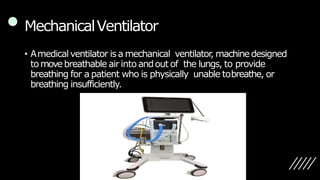
MechanicalVentilator
• Amedicalventilator isa mechanical ventilator
, machine designed
tomovebreathable air into andout of the lungs, to provide
breathing for a patient who is physically unable tobreathe, or
breathing insufficiently.
MechanicalVentilation
• Mechanical ventilation can be defined as the technique through
whichgasismovedtowardandfromthelungs outside throughan
external device connected directly to thepatient.
VENTILATORY CARE
•Caringforapatientwhorequires assistedventilation by
meansof amechanicalventilation.
PURPOSE
Toestablishandmaintaineffective
ventilation
Toprevent complicationassociated
withartificialventilation
To ensure position and patency of
endotrachealandtracheostomytube
EQUIPMENTS
• Bed locker withnecessary articles,
• ventilator
• Suctionapparatus
• Continuous monitoring apparatus
• Resuscitationchartwith defibrillators
• oxygensetup
• Manual ventilation bag (embubag)
• Endotracheal intubationsset
PURPOSE/
OUTCOMES:
Reversal ofhypoxemia
Reversal of acute respiratoryacidosis
Relief of respiratory distress
Prevention or reversal ofatelectasis
Resting of ventilatorymuscles
INDICATIONS
Respiratory Failure
Cardiopulmonary arrest
Trauma (especially head, neck, andchest)
Cardiovascular impairment (strokes, tumors,
infection, emboli, trauma)
Neurological impairment (drugs,poisons,myasthenia
gravis,GBS)
Pulmonary impairment (infections, tumors,
pneumothorax, COPD,trauma, pneumonia,poisons)
CONT
RR>25/min
PCO2>50mmHg
PO2<50mmHg
SpO2<90%
pH <
7.25
Types ofventilation:
. Negative pressure ventilation . Positive pressure ventilation
Types of Positive pressure ventilation
Non Invesive Ventilation:
1. Continuous positive airway pressure
(CPAP).
2. Bi-level positive airway pressure ( Bi
PAP ).
Invesive Ventilation:
1. Use of ETT Tube
2. Use of Tracheostomy Tube
Modes of ventilation:
Invasive MV:
VC : ( Volume Control ) or V/AC ( Volume Assist Control )
PC : ( Pressure Control ) or P/AC ( Pressure Assist Control )
PSV : ( Pressure Support Vantilation)
SIMV : ( Synchronised intermittent Mandatory Ventilation )
PRVC : ( Pressure Regulated Volume Control)
APRV : ( Airway Pressure Release Ventillation )
Automatic Mode : ( Approx height + Ideal Body Weight)
Easy way to remember;
V
entilator
settings
Fraction ofinspiredoxygen(FIO2)
Tidal volume
Respiratoryrate
Positive end-expiratorypressure(PEEP)
Peakflow
Peakinspiratorypressurelimit(highpressurealarm)
Sensitivity
Inspiratory: expiratory ratio
Humidification and t
emparature
Fractionofinspiredoxygen(FIO2)
Percentageof O2in the airdelivered to patient
Usually adjusted to maintain SaO2of greaterthan90%
Instartit issettled to bemorethan60%but later
less then 60%to prevent oxygentoxicity
Tidalvolume
Amountofairtobe
delivered witheach
breath
5to8ml/kgofbody
weight
500ml
Respiratoryrate
Noofbreaths/mindeliveredto
patient.
Determinesalveolarventilation
orminuteventilation,isequalto
the respiratory rate multiplied
bythetidalvolume.
Adjustmentsineitherofthese
parametersaffectthePaCO2.
Positiveend-expiratory
pressure(PEEP)
Control and adjustthe pressure thatis maintained in the lungsatthe endof
expiration
PEEP increases the functional residual capacity by reinflating collapsed
alveoli
Maintaining thealveoli in anopen position
Improve lung compliance
Peakflow
Flow rate, or peak inspiratory flow rate, is the maximum
flow at which a set tidal volume breath is delivered by
the ventilator.
Most modern ventilators can deliver flow rates between
60 and 120 L/min.
isthevelocityofgasflowperunitoftimeandisexpressedasliters
perminute
Peakinspiratorypressurelimit(PIP)
(high pressurealarm)
Highestpressureallowedintheventilatorcircuit.
Withvolumeventilators,oncethehighpressurelimit isreached,thehigh-pressurealarmsounds
andtheinspirationisterminated.
Stepsmustbetakentoidentifiedandaddresstheunderlyingcause(e.g.,coughing,
accumulationofsecretions,kinked
ventilatortubing,pneumothorax,decreasingcompliance,orahighpressurealarmthatissettoo
low).
Shouldbelessthan40mmHg
Sensitivity
Controls the amount of
patient effort needed to
initiate an inspiration,as
measured bynegative
inspiratoryeffort.
Increasing sensitivity
(requiring less negative
force) deceases theamount
ofworkthepatientmustdo
to initiatea
ventilators breath.
Decreasing the sensitivity
increases the amount of
negative pressure that the
patient needs to initiate
inspiration and increasethe
work ofbreathing.
Inspiratory: expiratoryratio( I:E )
•Operate with a short inspiratory time and a long
expiratory time(1:2 or 1:3ratio)
•Allows time for air to passively exit the lungs
Humidificationand temperature
• Inspiratorygasmustbefiltered, warmedandhumidified before
delivery to thepatient
• Humidifier humidifies theinspiredgasbypassingit over or bubbling
itthrough a head water
.
• Condensationshould beseen intheinspiratoryventilator circuit or
the proximal ETT or both which indicates that the inspired gas is
fully saturatedwithwatervapors.
Noninvasive
ventilator
modes
Continuous positive
airway pressure(CPAP)
Bi-level positive
pressure(BiPAP)
Continuous
positiveairway
pressure
(CPAP)
SimilartoPEEP
Suppliespressurethroughouttherespiratorycycle,helpto
improve oxygenation inspontaneouslybreathingpatients.
Usedforintubatedornon-intubatedpatients.
Weaningmodefrommechanicalventilationand to
opentheupperairway
Preventingupperairwayobstructioninpatientswith
obstructive sleep apnea
Bi-level
positive
pressur
e
(BiPAP)
Providedbymeansofnasalmask,nasalprongs,orfull
facemask
Twolevelsofpositivepressuresupport
Aninspiratorypressurereferred toIPAP
AnexpiratorypressurereferredtoasEPAP
Used in patient with acute, short termrespiratory
problemstoavoidintubationandmechanicalventilation
TROUBLESHOOTING
Nevershutalarms
off; silenceonly
Manuallyventilate
if uncertain of
problem
TYPES OFALARMS
•High peakpressure
•Low pressure; lowPEEP/CPAP
•Low exhaled tidalvolume
•Low minuteventilation
•Apnea
•Heater alarm
CAREOFETT/
TRACHEOSTOMY
• Securepositioning ofETT/tracheostomytubewith adhesivePlaster
• Inflatecuff oncecorrect positioninghasbeenconfirmed
• Cuffisinflated with airusingsyringe
MAINTAINING
VENTILATION
Ventilator makecharacteristics
soundduringinspirationandexpiration
which nurse must be capable of
identifying
Effectsofventilationareassess
byobservingptcolor
,chest
movements,BP
,pulserate,oxygen
saturation
Administer sedation as prescribed to
ensuread equate artificialventilation
and promotionof rest
SUCTIONING
Explain procedureto
patient and family
Frequency of suctionto
becarried outdepending on
pt’s pulmonarystate
Trachealsuctionisan
aseptic procedure
Sterile cathetershouldbeuse
Onesterileglove tobeused foreachsuctioning
Sessionsuctionis applied whilecatheteris
Beingwithdrawn
Usingintermittent techniquenotmorethan10
to15seconds
Measure blood,IVinfusionsandfluid
intake everyhour
Measure bloodloss,urine,chest
drainage bottles,
Maintainintakeandoutputeveryshift
Assessbowelactioneverythirdday
8hourlywounddressingshouldbedone
Care of
ventilatored
pt
•Change IVadministration sets and dressing
of puncture sites everyday
•Change suction bottle and connecting tubing
everyday
•Record pt’s conditions and events that have
occurred during each shift in nurse progress
sheet
•Give detailed hand over to nurse on following
shift.
PSYCHOLOGICALASPECTSOF
PATIENTCARE
•promote good relationship with patient and
family
•Encourage them to express fear
, stress factors
and feelings
•Motivate patient and relatives to participate in
daily care activities
WEANING
•the term "weaning" is used to describe the
gradual process of decreasing ventilator
support.
READINESSTOWEAN
• Underlying cause formechanical ventilation resolved
• Hemodynamicstability;adequatecardiacoutput
• Adequate respiratory musclestrength
• Adequateoxygenationwithout ahighFiO2and/orhighPEEP
• Absence offactorsthatimpairweaning
• Mental readiness
• Minimal needfor medicines thatcauserespiratory
depression.
GUIDELINESFORWEANING
• weaning isgenerally initiated inthemorning whenthepatient is
rested
• Theuseof sedativesandnarcoticsduringweaning islimited
• Thenurseraisestheheadofthebed,ensures apatentairway,and
provides suction ifnecessary.
• Thenurse remainswiththepatient throughouttheweaning trial to
provide supportand reassurance
• Attheconclusion ofthetrial,thenursealsoevaluates and
documentsthepatient’s response toweaning
WEANING METHODS
• Synchronized intermittent mechanicalventilation
• Pressuresupport
• T-piecetrials
• CPAP
STOPTHE
WEANING
PROCESS
Respiratory
Respiratory rate>
35or <
8breaths/min
Low spontaneous VT<
5mL/kg
Laboredrespirations
Use of accessory muscles
Abnormalbreathingpattern
Lowoxygensaturation<
90%
Cardiovascular
HRorBPchanges>
20%from baseline
Dysrhythmias
ST-segmentelevation
Bloodpressurechangesmorethan20%frombaseline
Diaphoresis
Neurologic
Decreased level ofconsciousness
Anxiety/agitation
Subjectivediscomfort
A I R W A Y
M A N A G E M E N T
AIRWAY MANAGEMENT
• Positioning
• Devices
• Oralairway:Anoropharyngealairwayisa hardplasticdevicethatisinsertedthrough
themouthandextendstothepharynxtopreventthetonguefromoccludingtheairway
whenmuscletoneisdecreased.Neverinsertin consciouspatient
• Nasopharyngealairway:Anasopharyngealairway(nasaltrumpet)isaflexibletubethat
isinsertednasallypastthebaseofthetonguetomaintainairwaypatency.
• Endotrachealintubation:Anendotrachealtubeisasemi-rigidtubethatisinsertedthroughthe
noseormouthandextendsintothetrachea
• Tracheostomy:Atracheostomytubeisinserteddirectlyintothetracheathroughastomamade
inthe neck
ENDOTRACHEALINTUBATION
• Insertionof anendotracheal tube(ETT)throughthemouthor nose
• Orotracheal routepreferredto reduceinfections
• Usedto:
-Maintain anairway
-Removesecretions
-Prevent aspiration
-Provide mechanicalventilation
INTUBATIONEQUIPMENT
ENDOTRACHEAL
INTUBATION
Right sizetube
6.5to7.5mmfemale;7to8.5mmmale
Checkballoon ontubeforleak
Stylet
Lubricatetube
Laryngoscope andblade
Sniffingposition
Topical anesthetic/ paralyticmedication
Ventilatepatient
Suction oropharynx
Intubate within 30sec
Inflate balloon
Verify placement
VERIFY
PLACEMENT
Auscultate epigastricarea
Auscultatebilateral breathsounds
ETCO2detector
Esophageal detectordevice
Chestx-ray—3to4cmabovecarina
Securetubewhenplacementisverified
Recordcmattheliplineforreference
ENDOTRACHEAL
SUCTIONING
• Suctionasindicatedbyassessment
• Visiblesecretions
• Coughing
• HighPIPonventilator
• Ventilatoralarm
• Conventionalversusclosed
suctionProcedures
• Hyperoxygenatethroughoutprocedure
• Avoid normalsalineinstillation
• (346-362 book vol1 )
VENTILATOR CARE.pptx

VENTILATOR CARE.pptx