Ventilation and Air
Movement
SUBMITTED TO: SUBMITTED BY:
DR. VASHIMANT KUNWAR PARITOSH
PULKIT GOYAL
1
Introduction
 Ventilation strategies
 Natural ventilation
 Types of Natural Ventilation Openings
 Cooling sensation from airflow
 Wind-driven cross ventilation
 Buoyancy-driven stack ventilation
 Underfloor air distribution (UFAD)
 Breathing building
 Wind Turbo Roof Air Ventilator
 Conclusion
 References
5/9/2015
2
Ventilation strategies
 Natural ventilation
 flow driven by wind and temperature
 Forced air – mechanical ventilation
 fan-driven through ducts
 Traditional HVAC
 mechanical cooling, overhead distribution
 Unconventional HVAC
 mechanical cooling, unconventional distribution
 Hybrid ventilation
 combinations of the above systems
5/9/2015
3
Natural Ventilation
 Ventilation driven by natural pressure forces
• wind
• buoyancy - due to temperature differences; the ‘stack effect’
 The ventilation of indoor environments is also necessary to maintain
the required levels of oxygen and air quality in a space.
 For breathing and general fresh air require about 10 ls-1 per person
5/9/2015
4
Types of Natural Ventilation
Openings
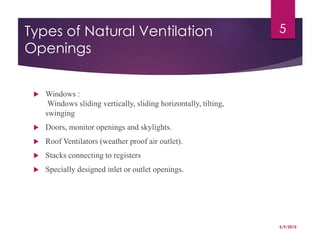
 Windows :
Windows sliding vertically, sliding horizontally, tilting,
swinging
 Doors, monitor openings and skylights.
 Roof Ventilators (weather proof air outlet).
 Stacks connecting to registers
 Specially designed inlet or outlet openings.
5/9/2015
5
Cooling sensation from airflow
0
2
4
6
8
10
0 0.5 1 1.5 2 2.5 3 3.5
Airflow (m/s)
Coolingsensationdeg.C
Source: Natural Ventilation in Buildings, Tony Rofail,
NEERG seminar, 31 Aug 2006, Windtech Consultants
5/9/2015
6
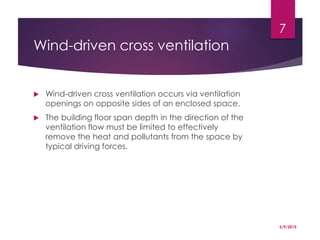
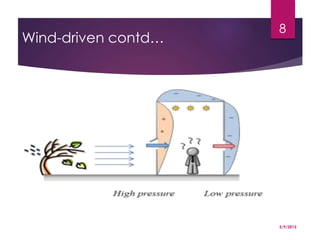
Wind-driven cross ventilation
 Wind-driven cross ventilation occurs via ventilation
openings on opposite sides of an enclosed space.
 The building floor span depth in the direction of the
ventilation flow must be limited to effectively
remove the heat and pollutants from the space by
typical driving forces.
5/9/2015
7
Wind-driven contd…
5/9/2015
8
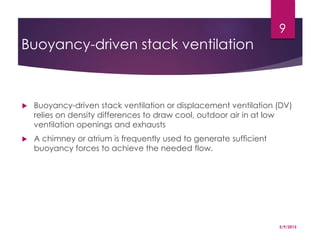
Buoyancy-driven stack ventilation
 Buoyancy-driven stack ventilation or displacement ventilation (DV)
relies on density differences to draw cool, outdoor air in at low
ventilation openings and exhausts
 A chimney or atrium is frequently used to generate sufficient
buoyancy forces to achieve the needed flow.
5/9/2015
9
Buoyancy-driven contd…
5/9/2015
10
Portland Building, UK 5/9/2015
11
Underfloor air distribution
(UFAD)[3]
 Underfloor air distribution (UFAD) is an air distribution
strategy for providing ventilation and space conditioning in
buildings as part of the design of an HVAC system.
 UFAD systems use an underfloor supply plenum located
between the structural concrete slab and a raised
floor system to supply conditioned air through
floor diffusers directly into the occupied zone of the
building.
5/9/2015
12
5/9/2015
13
5/9/2015
14
Wind Turbo Roof Air Ventilator[2]
5/9/2015
15
 It spins with the slightest breeze, creating
an upward draft which draws hot air,
odor, smokes, dampness and other
pollutant particles upwards.
 Creat invisible convection current, and in
the process extract them together with
pollutant particles, which has become
hot due to the buildings exposure to long
hours of sunlight and manufacturing
processes and due to other pollutants
particles within the building.
Contd..[3]
5/9/2015
16
 As the stale and hot air is extracted by the Air
ventilators, it is replaced by fresh air at ambient
temperature entering through the natural openings
Breathing building[1]
5/9/2015
17
Conclusion
 Low cost
 Easy installation
 Protect from high heating
 No water leakage
 Anti-corrosion, anti-acids and bases, anti-oxidation
 Light weight
 Long use
5/9/2015
18
References
1. Breathing building-
http://www.breathingbuildings.com/products/nat
ural-ventilation-explained
2. UADF-
http://cbe.berkeley.edu/underfloorair/applyingTheTechn
ology.htm
3. Wind Turbo Roof Air Ventilator-
http://www.airventilatorindia.co.in/Eco_AirVentilat
or.html,
http://www.realvents.com/Roof_ventilators.html,
http://www.svspoweredventilators.com/
5/9/2015
19

Ventilation or cooling strategies

  • 1.
    Ventilation and Air Movement SUBMITTEDTO: SUBMITTED BY: DR. VASHIMANT KUNWAR PARITOSH PULKIT GOYAL 1
  • 2.
    Introduction  Ventilation strategies Natural ventilation  Types of Natural Ventilation Openings  Cooling sensation from airflow  Wind-driven cross ventilation  Buoyancy-driven stack ventilation  Underfloor air distribution (UFAD)  Breathing building  Wind Turbo Roof Air Ventilator  Conclusion  References 5/9/2015 2
  • 3.
    Ventilation strategies  Naturalventilation  flow driven by wind and temperature  Forced air – mechanical ventilation  fan-driven through ducts  Traditional HVAC  mechanical cooling, overhead distribution  Unconventional HVAC  mechanical cooling, unconventional distribution  Hybrid ventilation  combinations of the above systems 5/9/2015 3
  • 4.
    Natural Ventilation  Ventilationdriven by natural pressure forces • wind • buoyancy - due to temperature differences; the ‘stack effect’  The ventilation of indoor environments is also necessary to maintain the required levels of oxygen and air quality in a space.  For breathing and general fresh air require about 10 ls-1 per person 5/9/2015 4
  • 5.
    Types of NaturalVentilation Openings  Windows : Windows sliding vertically, sliding horizontally, tilting, swinging  Doors, monitor openings and skylights.  Roof Ventilators (weather proof air outlet).  Stacks connecting to registers  Specially designed inlet or outlet openings. 5/9/2015 5
  • 6.
    Cooling sensation fromairflow 0 2 4 6 8 10 0 0.5 1 1.5 2 2.5 3 3.5 Airflow (m/s) Coolingsensationdeg.C Source: Natural Ventilation in Buildings, Tony Rofail, NEERG seminar, 31 Aug 2006, Windtech Consultants 5/9/2015 6
  • 7.
    Wind-driven cross ventilation Wind-driven cross ventilation occurs via ventilation openings on opposite sides of an enclosed space.  The building floor span depth in the direction of the ventilation flow must be limited to effectively remove the heat and pollutants from the space by typical driving forces. 5/9/2015 7
  • 8.
  • 9.
    Buoyancy-driven stack ventilation Buoyancy-driven stack ventilation or displacement ventilation (DV) relies on density differences to draw cool, outdoor air in at low ventilation openings and exhausts  A chimney or atrium is frequently used to generate sufficient buoyancy forces to achieve the needed flow. 5/9/2015 9
  • 10.
  • 11.
  • 12.
    Underfloor air distribution (UFAD)[3] Underfloor air distribution (UFAD) is an air distribution strategy for providing ventilation and space conditioning in buildings as part of the design of an HVAC system.  UFAD systems use an underfloor supply plenum located between the structural concrete slab and a raised floor system to supply conditioned air through floor diffusers directly into the occupied zone of the building. 5/9/2015 12
  • 13.
  • 14.
  • 15.
    Wind Turbo RoofAir Ventilator[2] 5/9/2015 15  It spins with the slightest breeze, creating an upward draft which draws hot air, odor, smokes, dampness and other pollutant particles upwards.  Creat invisible convection current, and in the process extract them together with pollutant particles, which has become hot due to the buildings exposure to long hours of sunlight and manufacturing processes and due to other pollutants particles within the building.
  • 16.
    Contd..[3] 5/9/2015 16  As thestale and hot air is extracted by the Air ventilators, it is replaced by fresh air at ambient temperature entering through the natural openings
  • 17.
  • 18.
    Conclusion  Low cost Easy installation  Protect from high heating  No water leakage  Anti-corrosion, anti-acids and bases, anti-oxidation  Light weight  Long use 5/9/2015 18
  • 19.
    References 1. Breathing building- http://www.breathingbuildings.com/products/nat ural-ventilation-explained 2.UADF- http://cbe.berkeley.edu/underfloorair/applyingTheTechn ology.htm 3. Wind Turbo Roof Air Ventilator- http://www.airventilatorindia.co.in/Eco_AirVentilat or.html, http://www.realvents.com/Roof_ventilators.html, http://www.svspoweredventilators.com/ 5/9/2015 19