By:
Dr Anita Tewari,
Assistant Professor,
Dept. of Veterinary Public Health & Epidemiology,
College of Veterinary Science & Animal Husbandry,
Rewa (486001), M.P.. India
Ventilation and Cooling Systems
for Animal Housing
Introduction: Livestock production is significantly
influenced by animal health and comfort
Diseases: respiratory and enteric diseases, mastitis etc
lead to concentration of dust, particulate matter, ammonia,
other gases and pathogenic micro-organisms
leads to concentration of animals at places causing
accumulation of excreta and expired air in pockets.
Condensation of water on the surface, bedding and floor
makes them wet and animals become uncomfortable.
The stagnant air becomes warmer and more humid in
improperly ventilated animal houses.
Importance of ventilation:
 Air exchange: fresh air in, stale air out:
 Ventilation of animal housing to remove moisture,
gases, dust, odors and pathogens and replacing
them with fresh air is necessary for livestock
productivity.
 Air distribution:
 Ventilation also provides air movement that promotes
cooling, relative humidity control and improves air
quality for confined animals.
The standards of ventilation: 3
 Gases generated:
 CO2, NH3, H2S, methane, CO and fumigation gases
like HCHO, etc.
 The threshold limit value for animals is lower than that for
man.
 Three standards are considered for ventilation.
1. Cubic space:
 The amount of CO2 produced during respiration does not
exceed more than two parts in 10,000 parts of air.
 This would depend on the type, age, and number of
livestock housed therein.
Cont…..
2. Air change:
 More important than the cubic space.
 The number of air changes per hour is calculated by
dividing the total hourly air supply to the house by the
cubic capacity of the house.
3. Floor space:
 More important than the cubic space.
 Height in excess of 3 meters is ineffective from the point
of view of ventilation as the products of respiration tend
to accumulate at the lower levels
Components of Ventilation
system:
 Such as house design, fans, inlets, and controls need
to function well together.
 The air inlet is the most important part of the ventilation
system which is responsible for providing good air
distribution and movement throughout the structure
Ventilation can be of two type:
 Passive/ Natural
 Mechanical
Passive Ventilation
 It is the supply and removal of air through openings in a
building.
 Simplest system & depends on three forces such as wind,
diffusion and inequality of temperature
 Used alone or in combination with some type of mechanical
ventilation.
 In many cases natural ventilation alone is not adequate,
since inside temperatures and air exchange rates fluctuate
with outside changes in temperatures and wind conditions.
 Usage: In confinement livestock production is most common
in large animal housing, with air passage through sidewall and
ridge openings
Broadly 3 types of natural ventilation
 A fixed open ridge with a protective cap is sufficient in
climatic housing for cattle
 A simple chimney type of insulated flue is satisfactory for a
limited area of controlled outlet ventilation.
 Hopper type windows fitted with gussets to prevent direct
draughts serving as principal inlets and small baffled openings
left open during cold or windy weather.
Natural ventilation
Mechanical Ventilation
 It is created by fans, thermostats, and air inlets.
 It is used where the air temperature and movement must
be controlled,
 E.g. housing for animals that are sensitive to cold, sudden
changes in temperature, and drafty conditions.
 swine farrowing and nursery buildings, lambing sheds,
warm dairy cattle barns and calf housing, and milk
houses.
 The most common approach is to use fans to blow air out of
the building, with fresh air drawn in through inlets on the
opposite side.
Cont….
 Advantage:
 it provides improved control over temperature and airflow
within the facility
 even on days when the wind is not blowing.
 The primary disadvantages of mechanical ventilation are
 initial expense and operating cost
 loss of animal heat in the winter, which may require a
supplemental heating system to keep the animals
sufficiently warm.
Mechanical /artificial ventilation can be
effected by four means;
Exhaust ventilation: air is extracted to the outside from the inside
by an exhaust fan operated electrically
Plenum ventilation: fresh air is blown into the room by centrifugal
fans so as to create a positive pressure and replace the ventilated
air proportionately.
Balanced ventilation: this is a combination of exhaust and plenum
system of ventilation.
Air conditioning: it is the simultaneous control of all factors
affecting both physical and chemical conditions of atmosphere
within a structure.
 Depending on the type of ventilation system, there may
be a negative, positive, or neutral pressure inside the
barn compared with the outside:
 The negative pressure system (A), where air is exhausted
with fans and enters the barn through inlets, is by far the
most common system.
 (B) positive pressure system, used with certain types of
furnaces, to supply both airflow and heat in a livestock unit.
 A neutral pressure system (C) exhausts from and blows
air into the barn simultaneously, creating an appro. zero
pressure difference.
 Most of the commercial heat exchangers marketed
today for use in animal buildings use a neutral pressure
system.
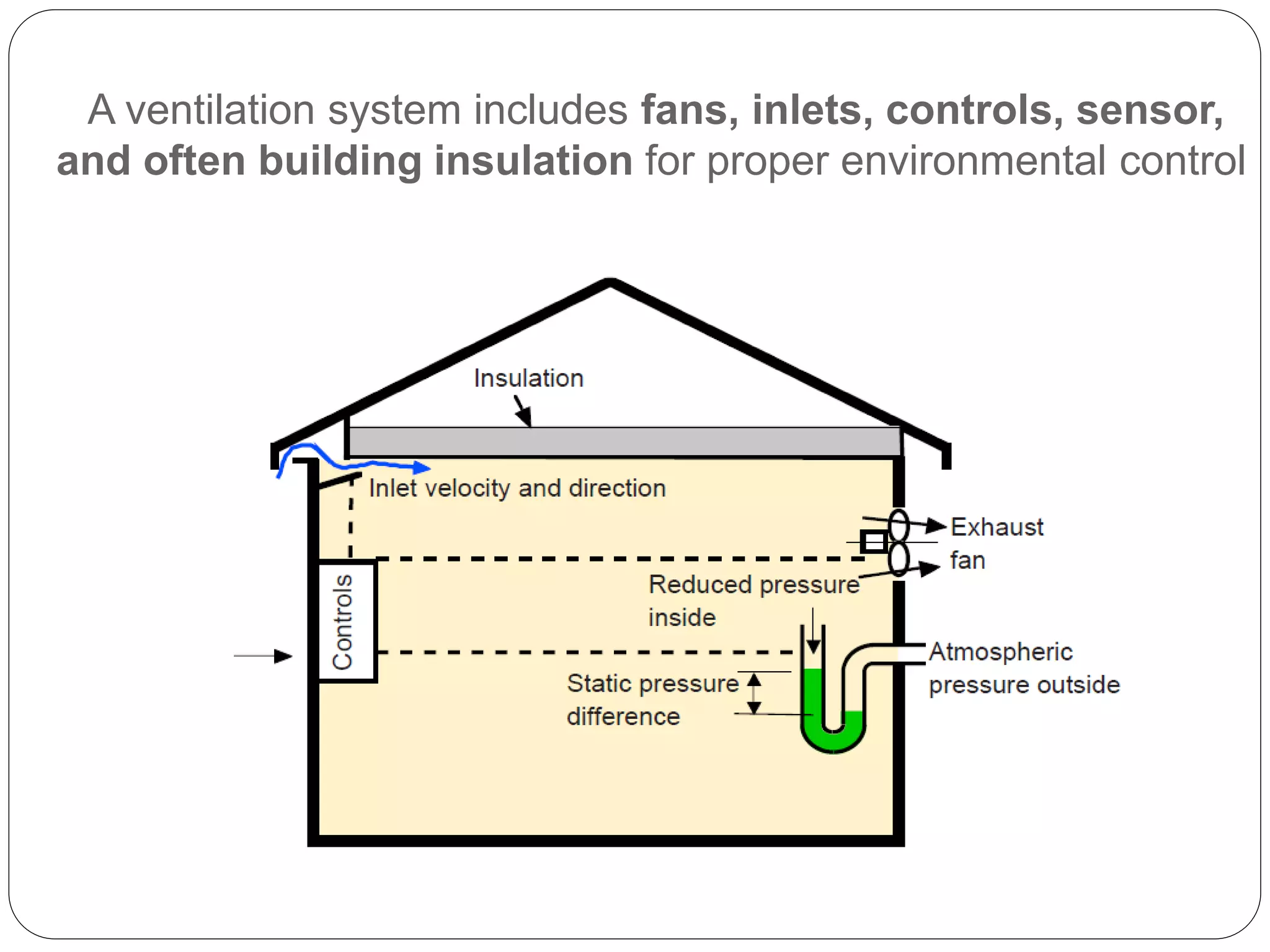
A ventilation system includes fans, inlets, controls, sensor,
and often building insulation for proper environmental control
Ventilation and cooling systems for animal housing

Ventilation and cooling systems for animal housing

  • 1.
    By: Dr Anita Tewari, AssistantProfessor, Dept. of Veterinary Public Health & Epidemiology, College of Veterinary Science & Animal Husbandry, Rewa (486001), M.P.. India Ventilation and Cooling Systems for Animal Housing
  • 2.
    Introduction: Livestock productionis significantly influenced by animal health and comfort Diseases: respiratory and enteric diseases, mastitis etc lead to concentration of dust, particulate matter, ammonia, other gases and pathogenic micro-organisms leads to concentration of animals at places causing accumulation of excreta and expired air in pockets. Condensation of water on the surface, bedding and floor makes them wet and animals become uncomfortable. The stagnant air becomes warmer and more humid in improperly ventilated animal houses.
  • 3.
    Importance of ventilation: Air exchange: fresh air in, stale air out:  Ventilation of animal housing to remove moisture, gases, dust, odors and pathogens and replacing them with fresh air is necessary for livestock productivity.  Air distribution:  Ventilation also provides air movement that promotes cooling, relative humidity control and improves air quality for confined animals.
  • 5.
    The standards ofventilation: 3  Gases generated:  CO2, NH3, H2S, methane, CO and fumigation gases like HCHO, etc.  The threshold limit value for animals is lower than that for man.  Three standards are considered for ventilation. 1. Cubic space:  The amount of CO2 produced during respiration does not exceed more than two parts in 10,000 parts of air.  This would depend on the type, age, and number of livestock housed therein.
  • 6.
    Cont….. 2. Air change: More important than the cubic space.  The number of air changes per hour is calculated by dividing the total hourly air supply to the house by the cubic capacity of the house. 3. Floor space:  More important than the cubic space.  Height in excess of 3 meters is ineffective from the point of view of ventilation as the products of respiration tend to accumulate at the lower levels
  • 7.
    Components of Ventilation system: Such as house design, fans, inlets, and controls need to function well together.  The air inlet is the most important part of the ventilation system which is responsible for providing good air distribution and movement throughout the structure
  • 8.
    Ventilation can beof two type:  Passive/ Natural  Mechanical
  • 9.
    Passive Ventilation  Itis the supply and removal of air through openings in a building.  Simplest system & depends on three forces such as wind, diffusion and inequality of temperature  Used alone or in combination with some type of mechanical ventilation.  In many cases natural ventilation alone is not adequate, since inside temperatures and air exchange rates fluctuate with outside changes in temperatures and wind conditions.  Usage: In confinement livestock production is most common in large animal housing, with air passage through sidewall and ridge openings
  • 10.
    Broadly 3 typesof natural ventilation  A fixed open ridge with a protective cap is sufficient in climatic housing for cattle  A simple chimney type of insulated flue is satisfactory for a limited area of controlled outlet ventilation.  Hopper type windows fitted with gussets to prevent direct draughts serving as principal inlets and small baffled openings left open during cold or windy weather.
  • 11.
  • 12.
    Mechanical Ventilation  Itis created by fans, thermostats, and air inlets.  It is used where the air temperature and movement must be controlled,  E.g. housing for animals that are sensitive to cold, sudden changes in temperature, and drafty conditions.  swine farrowing and nursery buildings, lambing sheds, warm dairy cattle barns and calf housing, and milk houses.  The most common approach is to use fans to blow air out of the building, with fresh air drawn in through inlets on the opposite side.
  • 13.
    Cont….  Advantage:  itprovides improved control over temperature and airflow within the facility  even on days when the wind is not blowing.  The primary disadvantages of mechanical ventilation are  initial expense and operating cost  loss of animal heat in the winter, which may require a supplemental heating system to keep the animals sufficiently warm.
  • 14.
    Mechanical /artificial ventilationcan be effected by four means; Exhaust ventilation: air is extracted to the outside from the inside by an exhaust fan operated electrically Plenum ventilation: fresh air is blown into the room by centrifugal fans so as to create a positive pressure and replace the ventilated air proportionately. Balanced ventilation: this is a combination of exhaust and plenum system of ventilation. Air conditioning: it is the simultaneous control of all factors affecting both physical and chemical conditions of atmosphere within a structure.
  • 15.
     Depending onthe type of ventilation system, there may be a negative, positive, or neutral pressure inside the barn compared with the outside:  The negative pressure system (A), where air is exhausted with fans and enters the barn through inlets, is by far the most common system.  (B) positive pressure system, used with certain types of furnaces, to supply both airflow and heat in a livestock unit.
  • 16.
     A neutralpressure system (C) exhausts from and blows air into the barn simultaneously, creating an appro. zero pressure difference.  Most of the commercial heat exchangers marketed today for use in animal buildings use a neutral pressure system.
  • 17.
    A ventilation systemincludes fans, inlets, controls, sensor, and often building insulation for proper environmental control