1
Building Services
Ar. Inam Ullah
CECOS UNIVERSITY OF INFORMATION TECHNOLOGYAND EMERGING SCIENCES
2
Ventilation
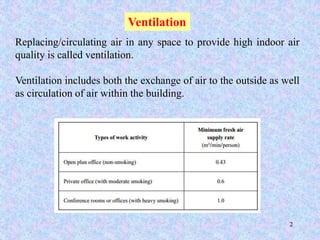
Replacing/circulating air in any space to provide high indoor air
quality is called ventilation.
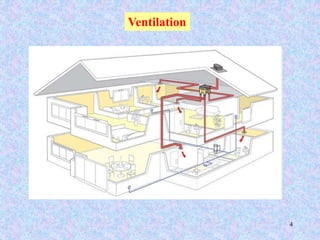
Ventilation includes both the exchange of air to the outside as well
as circulation of air within the building.
3
Ventilation
4
Ventilation
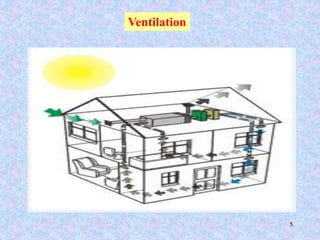
5
Ventilation
6
Purpose of Ventilation
• Maintain human comfort and health.
• Provide sufficient air/oxygen for human/livestock during
overcrowding in the office.
• Remove products of respiration and bodily odor.
• Remove contaminants or harmful chemicals.
• Remove heat generated indoor.
• Create air movement (feeling of freshness/comfort)
• Moisture problems, as indicated by visible fungal growth in
corners.
• Removal of smoking
• Control airborne bacteria
7
Types of Ventilation
 Natural Ventilation
 Mechanical Ventilation
 Hybrid/ Mix Mode Ventilation
8
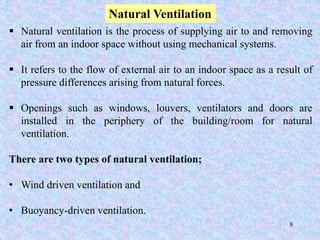
Natural Ventilation
 Natural ventilation is the process of supplying air to and removing
air from an indoor space without using mechanical systems.
 It refers to the flow of external air to an indoor space as a result of
pressure differences arising from natural forces.
 Openings such as windows, louvers, ventilators and doors are
installed in the periphery of the building/room for natural
ventilation.
There are two types of natural ventilation;
• Wind driven ventilation and
• Buoyancy-driven ventilation.
9
Natural Ventilation
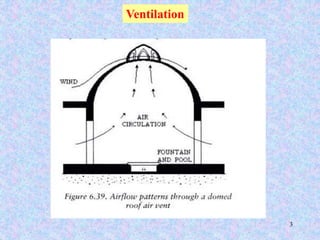
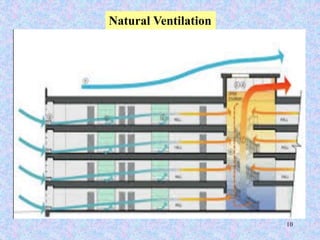
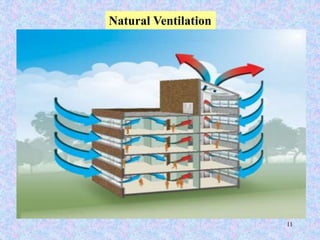
 Wind driven ventilation arises from the different pressures created
by wind around a building or structure, and openings being formed
on the perimeter which then permit flow through the building.
 Buoyancy-driven ventilation occurs as a result of the directional
buoyancy force that results from temperature differences between
the interior and exterior. Since the internal heat gains which create
temperature differences between the interior and exterior are created
by natural processes, including the heat from people, and wind
effects are variable, naturally ventilated buildings are sometimes
called "breathing buildings".
10
Natural Ventilation
11
Natural Ventilation
12
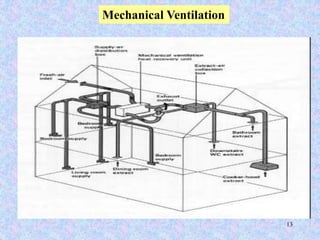
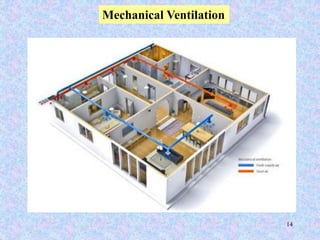
Mechanical Ventilation
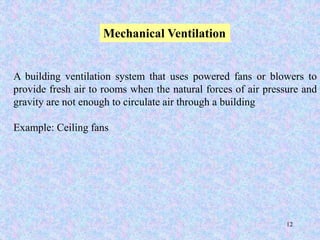
A building ventilation system that uses powered fans or blowers to
provide fresh air to rooms when the natural forces of air pressure and
gravity are not enough to circulate air through a building
Example: Ceiling fans
13
Mechanical Ventilation
14
Mechanical Ventilation
15
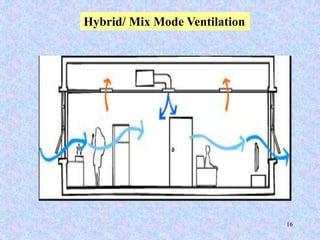
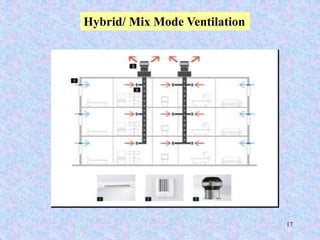
Hybrid/ Mix Mode Ventilation
A hybrid ventilation system allows the controlled introduction of
outdoor air ventilation into a building by both mechanical and passive
means.
There are two variants of hybrid ventilation:
The Changeover Type: spaces are ventilated either mechanically or passively, but
not both simultaneously.
Can switch between mechanical and passive ventilation seasonally, diurnally (Active
Mainly during Day).
The Concurrent Type: both methods provide ventilation simultaneously.
Appropriate controls are needed to prevent “fighting” between the two ventilation
methods.
16
Hybrid/ Mix Mode Ventilation
17
Hybrid/ Mix Mode Ventilation
18
Basic elements of Ventilation
Building ventilation has three basic elements:
Ventilation rate — the amount of outdoor air that is provided into the
space, and the quality of the outdoor air.
Airflow direction — the overall airflow direction in a building, which
should be from clean zones to dirty zones; and
Air distribution or airflow pattern — the external air should be
delivered to each part of the space in an efficient manner and the
airborne pollutants generated in each part of the space should also be
removed in an efficient manner.

Ventilation.pptx

  • 1.
    1 Building Services Ar. InamUllah CECOS UNIVERSITY OF INFORMATION TECHNOLOGYAND EMERGING SCIENCES
  • 2.
    2 Ventilation Replacing/circulating air inany space to provide high indoor air quality is called ventilation. Ventilation includes both the exchange of air to the outside as well as circulation of air within the building.
  • 3.
  • 4.
  • 5.
  • 6.
    6 Purpose of Ventilation •Maintain human comfort and health. • Provide sufficient air/oxygen for human/livestock during overcrowding in the office. • Remove products of respiration and bodily odor. • Remove contaminants or harmful chemicals. • Remove heat generated indoor. • Create air movement (feeling of freshness/comfort) • Moisture problems, as indicated by visible fungal growth in corners. • Removal of smoking • Control airborne bacteria
  • 7.
    7 Types of Ventilation Natural Ventilation  Mechanical Ventilation  Hybrid/ Mix Mode Ventilation
  • 8.
    8 Natural Ventilation  Naturalventilation is the process of supplying air to and removing air from an indoor space without using mechanical systems.  It refers to the flow of external air to an indoor space as a result of pressure differences arising from natural forces.  Openings such as windows, louvers, ventilators and doors are installed in the periphery of the building/room for natural ventilation. There are two types of natural ventilation; • Wind driven ventilation and • Buoyancy-driven ventilation.
  • 9.
    9 Natural Ventilation  Winddriven ventilation arises from the different pressures created by wind around a building or structure, and openings being formed on the perimeter which then permit flow through the building.  Buoyancy-driven ventilation occurs as a result of the directional buoyancy force that results from temperature differences between the interior and exterior. Since the internal heat gains which create temperature differences between the interior and exterior are created by natural processes, including the heat from people, and wind effects are variable, naturally ventilated buildings are sometimes called "breathing buildings".
  • 10.
  • 11.
  • 12.
    12 Mechanical Ventilation A buildingventilation system that uses powered fans or blowers to provide fresh air to rooms when the natural forces of air pressure and gravity are not enough to circulate air through a building Example: Ceiling fans
  • 13.
  • 14.
  • 15.
    15 Hybrid/ Mix ModeVentilation A hybrid ventilation system allows the controlled introduction of outdoor air ventilation into a building by both mechanical and passive means. There are two variants of hybrid ventilation: The Changeover Type: spaces are ventilated either mechanically or passively, but not both simultaneously. Can switch between mechanical and passive ventilation seasonally, diurnally (Active Mainly during Day). The Concurrent Type: both methods provide ventilation simultaneously. Appropriate controls are needed to prevent “fighting” between the two ventilation methods.
  • 16.
  • 17.
  • 18.
    18 Basic elements ofVentilation Building ventilation has three basic elements: Ventilation rate — the amount of outdoor air that is provided into the space, and the quality of the outdoor air. Airflow direction — the overall airflow direction in a building, which should be from clean zones to dirty zones; and Air distribution or airflow pattern — the external air should be delivered to each part of the space in an efficient manner and the airborne pollutants generated in each part of the space should also be removed in an efficient manner.