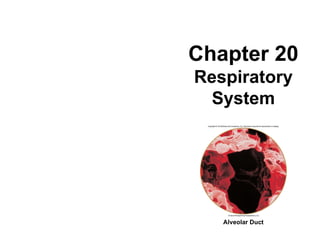
Chapter 20 Respiratory System Alveolar Duct
Respiration Movement of air into and out of the lungs (Ventilation or Breathing) Exchange of O 2  and CO 2  between the lungs and the blood Transport of these gases Exchange of O 2  and CO 2  between the blood and the tissues
Functions of the Respiratory System Gas exchange Regulation of blood pH Voice production Olfaction Protection
Anatomy of the Respiratory System The respiratory system consist of the upper and lower respiratory tract Upper respiratory tract: external nose, nasal cavity, pharynx, and associated structures Lower respiratory tract: larynx, trachea, the bronchi, and lungs
Fig. 20.1
 
Nose Consist of the external nose and the nasal cavity External nose only visible structure Nasal cavity Nares or Nostrils – external openings Choanae – openings to pharynx Vestibule – anterior portion of nasal cavity Hard palate – separates the nasal cavity from the oral cavity Nasal septum – divides nose into right and left parts Conchae – boney ridges in the nasal cavity Meatus – Passageway beneath each conchae
Nose Provides an airway for respiration Moistens and warms the entering air Filters inspired air and cleans it of foreign matter Serves as a resonating chamber for speech Houses the olfactory receptors
The Pharynx Connects the nasal cavity and mouth to the larynx and esophagus inferiorly Common passageway for air, food, and drink Commonly called the throat There are 3 regions:  Nasopharynx: air only posterior to the choanae and superior to the soft palate soft palate separates the nasopharynx from the oropharynx Oropharynx:  air and food soft palate to the epiglottis Laryngopharynx:  primarily food and drink epiglottis to  the esophagus
Fig. 20.2
Larynx (Voice Box) Anterior part of the throat, from the base of the tongue to the trachea The three functions of the larynx are: To provide an airway To act as a switching mechanism to route air and food into the proper channels Epiglottis:  elastic cartilage that covers the laryngeal inlet during swallowing Closure of the vestibular and vocal folds  To function in voice production
Fig. 20.3
Vocal Cords Two pairs of ligaments False vocal cords (vestibular folds) Superior mucosal folds  Have no part in sound production  True vocal cords (vocal folds) Inferior mucosal folds composed of elastic fibers  The medial opening between them is the glottis They vibrate to produce sound as air rushes up from the lungs Laryngitis:  Inflammation of the vocal folds
Fig. 20.4
Sound Production Sound:  Vibration of the vocal folds as air moves past them Loudness:  depends on the amplitude of the vibration, which is determined by the force at which the air rushes across the vocal cords Pitch:  determined by the length and tension of the vocal cords, which changes the frequency of the vibrations  Sound is “shaped” into language by action of the tongue, lips, teeth, and other structures The pharynx resonates, amplifies, and enhances sound quality
Trachea Descends from the larynx through the neck to the fifth thoracic vertebra  Composed of dense regular connective tissue and smooth muscle reinforced with 15-20  C-shaped rings of hyaline cartilage, which protect the trachea and keep the airway open The mucous membrane lining the trachea is made up of goblet cells and pseudostratified ciliated columnar epithelium Goblet cells produce mucus It ends by dividing into the two primary bronchi
Main Bronchi The right and left bronchi are formed by the division of the trachea Right primary bronchus is wider, shorter and more vertical than the left Common site for an inhaled object to become lodged  By the time that incoming air reaches the bronchi, it is warmed, cleansed and saturated with water vapor
Lungs Principal organs of respiration Base rest on diaphragm and the apex extends superiorly to ~2.5 cm above the clavicle Right lung has 3 lobes, while the left has only 2 lobes
The Tracheobronchial Tree Once inside the lungs each main bronchus Subdivides into lobar (secondary) bronchi Then segmental (tertiary) bronchi  Finally giving rise to the bronchioles, which subdivide many times to give rise to the terminal bronchioles ~16 generations of branching from the trachea to the terminal bronchioles
The Tracheobronchial Tree Terminal bronchioles divide into respiratory bronchioles, which have a few attached alveoli Alveoli – small air filled chambers where gas exchange between the air and blood takes place Respiratory bronchioles lead to alveolar ducts, then to terminal clusters of alveolar sacs composed of alveoli Approximately 300 million alveoli Account for most of the lungs’ volume  Provide tremendous surface area for gas exchange ~7 generations of branching occur from the terminal bronchioles to the alveolar ducts
Fig. 20.5
Fig. 20.6
Fig. 20.7
The Tracheobronchial Tree As air passageways become smaller, structural changes occur  Cartilage support structures decrease Amount of smooth muscle increases Epithelium types change Terminal bronchioles are mostly smooth muscle with no cartilage, which allows the bronchioles to alter their diameter when a change in air flow is needed (i.e. during exercise)
Alveoli Alveolar walls: Are a single layer of type I pneumocytes Squamous epithelial cells Compose 90% of the alveolar surface Permit gas exchange by simple diffusion Type II pneumocytes Round or cube-shaped secretory cells that produce surfactant Surfactant reduces surface tension, which makes it easier for the alveoli to expand
Respiratory Membrane Where gas exchange between air and blood occurs It is very thin to facilitate the diffusion of gases Consists of:  Thin layer of fluid lining the alveolus Alveolar epithelium Basement membrane of the alveolar epithelium A thin interstitial space Basement membrane of the capillary endothelium The capillary endothelium
Fig. 20.8
Pleura Thin, double-layered serous membranes Parietal pleura Covers the thoracic wall, diaphragm, and mediastinum Visceral pleura Covers the external lung surface Pleural cavity Negative pressure space between the parietal and visceral pleura Pleural Fluid Fills the pleural cavity Made by the pleural membranes Serves as a lubricant Holds the pleural membranes together
Fig. 20.9
 
Blood Supply to Lungs Lungs are perfused by two circulations: pulmonary and bronchial Pulmonary circulation Pulmonary arteries:  supply deoxygenated systemic blood to be oxygenated Ultimately feed into the pulmonary capillary network surrounding the alveoli Pulmonary veins:  carry oxygenated blood from lungs back to the heart Bronchial circulation Bronchial arteries:  provide systemic oxygenated blood to the lung tissue Supply all lung tissue except the alveoli Bronchial veins:  carry the deoxygenated blood back to the heart
Inspiration:  movement of air into the lungs Muscles involved are the diaphragm and those that elevate the ribs and sternum As the diaphragm and other muscles of inspiration contract and the rib cage rises and thoracic volume increases Expiration:  movement of air out of the lungs Muscles actively involved are those that depress the ribs and sternum (usually only with forceful expiration) Largely a passive process M uscles of inspiration relax, the rib cage descends due to gravity and the thoracic cavity volume decreases Pressure changes in the thoracic cavity change air pressure in the lungs, which in turn causes ventilation largest change in thoracic volume is due to the diaphragm Ventilation
Fig. 20.10
Pressure Changes and Airflow Physical Principles Influencing Pulmonary Ventilation Air flows from areas of higher to lower pressure If pressure is higher at one end of a tube (P 1 ) than at the other (P 2 ),  air will flow down its pressure gradient  Changes in volume result in changes in pressure As volume increases in a closed container the pressure decreases or as volume decreases pressure increases This inverse relationship is known as  Boyle’s law Changes in tube diameter result in changes in resistance Poiseuille’s law:  resistance (R) to airflow is proportional to the diameter (d) of a tube raised to the fourth power (d 4 ) F = F=Airflow (mm/min) P 1  – P 2 R
 
Alveoli Airflow Fig. 20.11
Fig. 20.11
 
Lung Recoil Tendency for an expanded lung to decrease in size due to Elastic fibers in the connective tissue Surface tension Two factors keep lungs from collapsing Surfactant Pleural Pressures
Surfactant Surf ace  act ing  a ge nt Mixture of lipoprotein molecules Acts in reducing surface tension in the alveoli Attraction of water molecules to each other Surfactant reduces the surface tension in alveoli by 10-fold
Pleural Pressure Pressure in the pleural cavity When pleural pressure is less than alveolar pressure alveoli expand Subatmospheric pleural pressure is caused by Removal of fluid from the pleural cavity Lung recoil
Measurement of Lung Function Measurements can be used to  Diagnose disease Track progress of disease Track recovery from disease Measurements include Lung compliance Pulmonary volumes and capacities Minute ventilation Alveolar ventilation
Lung Compliance Measurement of the ease with which the lungs and thorax expand Volume increases for each unit of pressure change in alveolar pressure Liters (volume of air)/Centimeter of H 2 O (pressure) In a normal person  = 0.13 L/cm   H 2 O Higher than normal compliance = less resistance to lung and thorax expansion Emphysema Lower than normal compliance = more resistance to lung and thorax expansion Pulmonary fibrosis, infant respiratory distress syndrome, pulmonary edema, asthma, bronchitis, and lung cancer
Pulmonary Function Tests Spirometry is the process of measuring volumes of air that move into and out of the respiratory system Spirometer – a device used to measure these pulmonary volumes The following factors can cause variations in Pulmonary Volumes and Capacities Sex Age  Body Size  Physical Condition
Pulmonary Volumes Tidal volume (TV) volume of air inspired or expired with each breath (approximately 500 ml at rest) Inspiratory reserve volume (IRV) amount of air that can be inspired forcefully after inspiration of the tidal volume (approximately 3000 ml at rest) Expiratory reserve volume (ERV) amount of air that can be forcefully expired after expiration of the tidal volume (approximately 1100 ml at rest) Residual volume (RV) volume of air still remaining in the respiratory passages and lungs after the most forceful expiration (approximately 1200 ml)
Pulmonary Capacities Sum of two or more pulmonary volumes Inspiratory capacity (IC = IRV + TV) Amount of air that a person can inspire maximally after a normal expiration (approximately 3500mL at rest ) Functional residual capacity (FRC = ERV + RV) Amount of air remaining in the lungs after a normal expiration (approximately 2300mL at rest ) Vital capacity (VC = IRV + TV + ERV) Maximum volume of air that a person can expel from the respiratory tract after a maximum inspiration (approximately 4600mL at rest ) Total lung capacity (TLC = IRV + ERV + TV + RV) Sum of all lung volumes (approximately 5800 ml at rest)
Fig. 20.12
Pulmonary Function Tests Forced expiratory vital capacity individual inspires maximally and then exhales maximally as rapidly as possible volume of air expired at the end of the test is the person’s forced expiratory vital capacity  Forced expiratory volume in 1 second (FEV 1 ) amount of air expired during the first second of the test decreased FEV 1  can be caused by airway obstruction, asthma, emphysema, tumors, pulmonary fibrosis, silicosis, kyphosis, and scoliosis
Minute Ventilation Minute Ventilation equals tidal volume (~500mls) times respiratory rate (~12 breaths/min.) Average ~ 6 L/min Only measures movement of air into and out of the lungs, not amount of air available for gas exchange Dead space Areas of the respiratory system where gas exchange does not take place Includes the nasal cavity, pharynx, larynx, trachea, bronchi, bronchioles, and terminal bronchioles (~150 mLs) Nonfunctional alveoli can also contribute, but are rare in healthy individuals
Alveolar Ventilation Alveolar ventilation (V A ) volume of air available for gas exchange Slow, deep breathing increases AVR and rapid, shallow breathing decreases AVR V A = ƒ X (V T  – V D ) (mLs/min) (frequency, breaths/min) (Tidal Volume – Dead Space) (mLs/respiration)
 
Gas Exchange in the Tissues In the tissues, CO 2  diffuses into the plasma and into RBC. Some of the CO 2  remains in the plasma In RBC, CO 2  reacts with H 2 O to form carbonic acid (H 2 CO 3 ) in a reaction catalyzed by the enzyme carbonic anhydrase (CA) H 2 CO 3  dissociates to form bicarbonate ions (HCO 3 - ) and hydrogen ions (H + ) In the chloride shift, as HCO 3 -  diffuses out of the RBC, electrical neutrality is maintained by the diffusion of chloride ions (Cl - ) into them Oxygen (O 2 ) is released from hemoglobin (Hb).  O 2  diffuses out of RBCs and plasma into the tissues H +  combine with Hb, which promotes the release of O 2  from Hb (Bohr effect) CO 2  combines with Hb.  Hb that has released O 2  readily combines with CO 2  (Haldane effect)
Gas Exchange in the Tissues In the tissues, CO 2  diffuses into the plasma and into RBC. Some of the CO 2  remains in the plasma In RBC, CO 2  reacts with H 2 O to form carbonic acid (H 2 CO 3 ) in a reaction catalyzed by the enzyme carbonic anhydrase (CA). H 2 CO 3  dissociates to form bicarbonate ions (HCO 3 - ) and hydrogen ions (H + ). In the chloride shift, as HCO 3 -  diffuse out of the RBC, electrical neutrality is maintained by the diffusion of chloride ions (Cl - ) into them. Oxygen (O 2 ) is released from hemoglobin (Hb).  O 2  diffuses out of RBCs and plasma into the tissues H +  combine with Hb, which promotes the release of O 2  from Hb (Bohr effect) CO 2  combines with Hb.  Hb that has released O 2  readily combines with CO 2  (Haldane effect)
Gas Exchange in the Tissues In the tissues, CO 2  diffuses into the plasma and into RBC. Some of the CO 2  remains in the plasma In RBC, CO 2  reacts with H 2 O to form carbonic acid (H 2 CO 3 ) in a reaction catalyzed by the enzyme carbonic anhydrase (CA) H 2 CO 3  dissociates to form bicarbonate ions (HCO 3 - ) and hydrogen ions (H + ) In the chloride shift, as HCO 3 -  diffuses out of the RBC, electrical neutrality is maintained by the diffusion of chloride ions (Cl - ) into them Oxygen (O 2 ) is released from hemoglobin (Hb).  O 2  diffuses out of RBCs and plasma into the tissues H +  combine with Hb, which promotes the release of O 2  from Hb (Bohr effect) CO 2  combines with Hb.  Hb that has released O 2  readily combines with CO 2  (Haldane effect)
Gas Exchange in the Lungs In the lungs, CO 2  diffuses from the RBCs and plasma into the alveoli Carbonic anhydrase (CA) catalyzes the formation of CO 2  and H 2 O from carbonic acid (H 2 CO 3 ) Bicarbonate ions (HCO 3 - ) and H +  combine to replace H 2 CO 3  In the chloride shift, as HCO 3 -  diffuse into the RBC, electrical neutrality is maintained by the diffusion of chloride ions (Cl - ) out of them Oxygen diffuses into the plasma and into RBCs.  Some of the O 2  remains in the plasma.  O 2  binds to Hb H +  are released from Hb, which promotes the uptake of O 2  by Hb (Bohr effect) CO 2  is released from Hb.  Hb that is bound to O 2  readily releases CO 2  (Haldane effect)


Respiratory system

  • 1.
    Chapter 20 RespiratorySystem Alveolar Duct
  • 2.
    Respiration Movement ofair into and out of the lungs (Ventilation or Breathing) Exchange of O 2 and CO 2 between the lungs and the blood Transport of these gases Exchange of O 2 and CO 2 between the blood and the tissues
  • 3.
    Functions of theRespiratory System Gas exchange Regulation of blood pH Voice production Olfaction Protection
  • 4.
    Anatomy of theRespiratory System The respiratory system consist of the upper and lower respiratory tract Upper respiratory tract: external nose, nasal cavity, pharynx, and associated structures Lower respiratory tract: larynx, trachea, the bronchi, and lungs
  • 5.
  • 6.
  • 7.
    Nose Consist ofthe external nose and the nasal cavity External nose only visible structure Nasal cavity Nares or Nostrils – external openings Choanae – openings to pharynx Vestibule – anterior portion of nasal cavity Hard palate – separates the nasal cavity from the oral cavity Nasal septum – divides nose into right and left parts Conchae – boney ridges in the nasal cavity Meatus – Passageway beneath each conchae
  • 8.
    Nose Provides anairway for respiration Moistens and warms the entering air Filters inspired air and cleans it of foreign matter Serves as a resonating chamber for speech Houses the olfactory receptors
  • 9.
    The Pharynx Connectsthe nasal cavity and mouth to the larynx and esophagus inferiorly Common passageway for air, food, and drink Commonly called the throat There are 3 regions: Nasopharynx: air only posterior to the choanae and superior to the soft palate soft palate separates the nasopharynx from the oropharynx Oropharynx: air and food soft palate to the epiglottis Laryngopharynx: primarily food and drink epiglottis to the esophagus
  • 10.
  • 11.
    Larynx (Voice Box)Anterior part of the throat, from the base of the tongue to the trachea The three functions of the larynx are: To provide an airway To act as a switching mechanism to route air and food into the proper channels Epiglottis: elastic cartilage that covers the laryngeal inlet during swallowing Closure of the vestibular and vocal folds To function in voice production
  • 12.
  • 13.
    Vocal Cords Twopairs of ligaments False vocal cords (vestibular folds) Superior mucosal folds Have no part in sound production True vocal cords (vocal folds) Inferior mucosal folds composed of elastic fibers The medial opening between them is the glottis They vibrate to produce sound as air rushes up from the lungs Laryngitis: Inflammation of the vocal folds
  • 14.
  • 15.
    Sound Production Sound: Vibration of the vocal folds as air moves past them Loudness: depends on the amplitude of the vibration, which is determined by the force at which the air rushes across the vocal cords Pitch: determined by the length and tension of the vocal cords, which changes the frequency of the vibrations Sound is “shaped” into language by action of the tongue, lips, teeth, and other structures The pharynx resonates, amplifies, and enhances sound quality
  • 16.
    Trachea Descends fromthe larynx through the neck to the fifth thoracic vertebra Composed of dense regular connective tissue and smooth muscle reinforced with 15-20 C-shaped rings of hyaline cartilage, which protect the trachea and keep the airway open The mucous membrane lining the trachea is made up of goblet cells and pseudostratified ciliated columnar epithelium Goblet cells produce mucus It ends by dividing into the two primary bronchi
  • 17.
    Main Bronchi Theright and left bronchi are formed by the division of the trachea Right primary bronchus is wider, shorter and more vertical than the left Common site for an inhaled object to become lodged By the time that incoming air reaches the bronchi, it is warmed, cleansed and saturated with water vapor
  • 18.
    Lungs Principal organsof respiration Base rest on diaphragm and the apex extends superiorly to ~2.5 cm above the clavicle Right lung has 3 lobes, while the left has only 2 lobes
  • 19.
    The Tracheobronchial TreeOnce inside the lungs each main bronchus Subdivides into lobar (secondary) bronchi Then segmental (tertiary) bronchi Finally giving rise to the bronchioles, which subdivide many times to give rise to the terminal bronchioles ~16 generations of branching from the trachea to the terminal bronchioles
  • 20.
    The Tracheobronchial TreeTerminal bronchioles divide into respiratory bronchioles, which have a few attached alveoli Alveoli – small air filled chambers where gas exchange between the air and blood takes place Respiratory bronchioles lead to alveolar ducts, then to terminal clusters of alveolar sacs composed of alveoli Approximately 300 million alveoli Account for most of the lungs’ volume Provide tremendous surface area for gas exchange ~7 generations of branching occur from the terminal bronchioles to the alveolar ducts
  • 21.
  • 22.
  • 23.
  • 24.
    The Tracheobronchial TreeAs air passageways become smaller, structural changes occur Cartilage support structures decrease Amount of smooth muscle increases Epithelium types change Terminal bronchioles are mostly smooth muscle with no cartilage, which allows the bronchioles to alter their diameter when a change in air flow is needed (i.e. during exercise)
  • 25.
    Alveoli Alveolar walls:Are a single layer of type I pneumocytes Squamous epithelial cells Compose 90% of the alveolar surface Permit gas exchange by simple diffusion Type II pneumocytes Round or cube-shaped secretory cells that produce surfactant Surfactant reduces surface tension, which makes it easier for the alveoli to expand
  • 26.
    Respiratory Membrane Wheregas exchange between air and blood occurs It is very thin to facilitate the diffusion of gases Consists of: Thin layer of fluid lining the alveolus Alveolar epithelium Basement membrane of the alveolar epithelium A thin interstitial space Basement membrane of the capillary endothelium The capillary endothelium
  • 27.
  • 28.
    Pleura Thin, double-layeredserous membranes Parietal pleura Covers the thoracic wall, diaphragm, and mediastinum Visceral pleura Covers the external lung surface Pleural cavity Negative pressure space between the parietal and visceral pleura Pleural Fluid Fills the pleural cavity Made by the pleural membranes Serves as a lubricant Holds the pleural membranes together
  • 29.
  • 30.
  • 31.
    Blood Supply toLungs Lungs are perfused by two circulations: pulmonary and bronchial Pulmonary circulation Pulmonary arteries: supply deoxygenated systemic blood to be oxygenated Ultimately feed into the pulmonary capillary network surrounding the alveoli Pulmonary veins: carry oxygenated blood from lungs back to the heart Bronchial circulation Bronchial arteries: provide systemic oxygenated blood to the lung tissue Supply all lung tissue except the alveoli Bronchial veins: carry the deoxygenated blood back to the heart
  • 32.
    Inspiration: movementof air into the lungs Muscles involved are the diaphragm and those that elevate the ribs and sternum As the diaphragm and other muscles of inspiration contract and the rib cage rises and thoracic volume increases Expiration: movement of air out of the lungs Muscles actively involved are those that depress the ribs and sternum (usually only with forceful expiration) Largely a passive process M uscles of inspiration relax, the rib cage descends due to gravity and the thoracic cavity volume decreases Pressure changes in the thoracic cavity change air pressure in the lungs, which in turn causes ventilation largest change in thoracic volume is due to the diaphragm Ventilation
  • 33.
  • 34.
    Pressure Changes andAirflow Physical Principles Influencing Pulmonary Ventilation Air flows from areas of higher to lower pressure If pressure is higher at one end of a tube (P 1 ) than at the other (P 2 ), air will flow down its pressure gradient Changes in volume result in changes in pressure As volume increases in a closed container the pressure decreases or as volume decreases pressure increases This inverse relationship is known as Boyle’s law Changes in tube diameter result in changes in resistance Poiseuille’s law: resistance (R) to airflow is proportional to the diameter (d) of a tube raised to the fourth power (d 4 ) F = F=Airflow (mm/min) P 1 – P 2 R
  • 35.
  • 36.
  • 37.
  • 38.
  • 39.
  • 40.
    Lung Recoil Tendencyfor an expanded lung to decrease in size due to Elastic fibers in the connective tissue Surface tension Two factors keep lungs from collapsing Surfactant Pleural Pressures
  • 41.
    Surfactant Surf ace act ing a ge nt Mixture of lipoprotein molecules Acts in reducing surface tension in the alveoli Attraction of water molecules to each other Surfactant reduces the surface tension in alveoli by 10-fold
  • 42.
    Pleural Pressure Pressurein the pleural cavity When pleural pressure is less than alveolar pressure alveoli expand Subatmospheric pleural pressure is caused by Removal of fluid from the pleural cavity Lung recoil
  • 43.
    Measurement of LungFunction Measurements can be used to Diagnose disease Track progress of disease Track recovery from disease Measurements include Lung compliance Pulmonary volumes and capacities Minute ventilation Alveolar ventilation
  • 44.
    Lung Compliance Measurementof the ease with which the lungs and thorax expand Volume increases for each unit of pressure change in alveolar pressure Liters (volume of air)/Centimeter of H 2 O (pressure) In a normal person = 0.13 L/cm H 2 O Higher than normal compliance = less resistance to lung and thorax expansion Emphysema Lower than normal compliance = more resistance to lung and thorax expansion Pulmonary fibrosis, infant respiratory distress syndrome, pulmonary edema, asthma, bronchitis, and lung cancer
  • 45.
    Pulmonary Function TestsSpirometry is the process of measuring volumes of air that move into and out of the respiratory system Spirometer – a device used to measure these pulmonary volumes The following factors can cause variations in Pulmonary Volumes and Capacities Sex Age Body Size Physical Condition
  • 46.
    Pulmonary Volumes Tidalvolume (TV) volume of air inspired or expired with each breath (approximately 500 ml at rest) Inspiratory reserve volume (IRV) amount of air that can be inspired forcefully after inspiration of the tidal volume (approximately 3000 ml at rest) Expiratory reserve volume (ERV) amount of air that can be forcefully expired after expiration of the tidal volume (approximately 1100 ml at rest) Residual volume (RV) volume of air still remaining in the respiratory passages and lungs after the most forceful expiration (approximately 1200 ml)
  • 47.
    Pulmonary Capacities Sumof two or more pulmonary volumes Inspiratory capacity (IC = IRV + TV) Amount of air that a person can inspire maximally after a normal expiration (approximately 3500mL at rest ) Functional residual capacity (FRC = ERV + RV) Amount of air remaining in the lungs after a normal expiration (approximately 2300mL at rest ) Vital capacity (VC = IRV + TV + ERV) Maximum volume of air that a person can expel from the respiratory tract after a maximum inspiration (approximately 4600mL at rest ) Total lung capacity (TLC = IRV + ERV + TV + RV) Sum of all lung volumes (approximately 5800 ml at rest)
  • 48.
  • 49.
    Pulmonary Function TestsForced expiratory vital capacity individual inspires maximally and then exhales maximally as rapidly as possible volume of air expired at the end of the test is the person’s forced expiratory vital capacity Forced expiratory volume in 1 second (FEV 1 ) amount of air expired during the first second of the test decreased FEV 1 can be caused by airway obstruction, asthma, emphysema, tumors, pulmonary fibrosis, silicosis, kyphosis, and scoliosis
  • 50.
    Minute Ventilation MinuteVentilation equals tidal volume (~500mls) times respiratory rate (~12 breaths/min.) Average ~ 6 L/min Only measures movement of air into and out of the lungs, not amount of air available for gas exchange Dead space Areas of the respiratory system where gas exchange does not take place Includes the nasal cavity, pharynx, larynx, trachea, bronchi, bronchioles, and terminal bronchioles (~150 mLs) Nonfunctional alveoli can also contribute, but are rare in healthy individuals
  • 51.
    Alveolar Ventilation Alveolarventilation (V A ) volume of air available for gas exchange Slow, deep breathing increases AVR and rapid, shallow breathing decreases AVR V A = ƒ X (V T – V D ) (mLs/min) (frequency, breaths/min) (Tidal Volume – Dead Space) (mLs/respiration)
  • 52.
  • 53.
    Gas Exchange inthe Tissues In the tissues, CO 2 diffuses into the plasma and into RBC. Some of the CO 2 remains in the plasma In RBC, CO 2 reacts with H 2 O to form carbonic acid (H 2 CO 3 ) in a reaction catalyzed by the enzyme carbonic anhydrase (CA) H 2 CO 3 dissociates to form bicarbonate ions (HCO 3 - ) and hydrogen ions (H + ) In the chloride shift, as HCO 3 - diffuses out of the RBC, electrical neutrality is maintained by the diffusion of chloride ions (Cl - ) into them Oxygen (O 2 ) is released from hemoglobin (Hb). O 2 diffuses out of RBCs and plasma into the tissues H + combine with Hb, which promotes the release of O 2 from Hb (Bohr effect) CO 2 combines with Hb. Hb that has released O 2 readily combines with CO 2 (Haldane effect)
  • 54.
    Gas Exchange inthe Tissues In the tissues, CO 2 diffuses into the plasma and into RBC. Some of the CO 2 remains in the plasma In RBC, CO 2 reacts with H 2 O to form carbonic acid (H 2 CO 3 ) in a reaction catalyzed by the enzyme carbonic anhydrase (CA) H 2 CO 3 dissociates to form bicarbonate ions (HCO 3 - ) and hydrogen ions (H + ) In the chloride shift, as HCO 3 - diffuses out of the RBC, electrical neutrality is maintained by the diffusion of chloride ions (Cl - ) into them Oxygen (O 2 ) is released from hemoglobin (Hb). O 2 diffuses out of RBCs and plasma into the tissues H + combine with Hb, which promotes the release of O 2 from Hb (Bohr effect) CO 2 combines with Hb. Hb that has released O 2 readily combines with CO 2 (Haldane effect)
  • 55.
    Gas Exchange inthe Tissues In the tissues, CO 2 diffuses into the plasma and into RBC. Some of the CO 2 remains in the plasma In RBC, CO 2 reacts with H 2 O to form carbonic acid (H 2 CO 3 ) in a reaction catalyzed by the enzyme carbonic anhydrase (CA) H 2 CO 3 dissociates to form bicarbonate ions (HCO 3 - ) and hydrogen ions (H + ) In the chloride shift, as HCO 3 - diffuses out of the RBC, electrical neutrality is maintained by the diffusion of chloride ions (Cl - ) into them Oxygen (O 2 ) is released from hemoglobin (Hb). O 2 diffuses out of RBCs and plasma into the tissues H + combine with Hb, which promotes the release of O 2 from Hb (Bohr effect) CO 2 combines with Hb. Hb that has released O 2 readily combines with CO 2 (Haldane effect)
  • 56.
    Gas Exchange inthe Tissues In the tissues, CO 2 diffuses into the plasma and into RBC. Some of the CO 2 remains in the plasma In RBC, CO 2 reacts with H 2 O to form carbonic acid (H 2 CO 3 ) in a reaction catalyzed by the enzyme carbonic anhydrase (CA) H 2 CO 3 dissociates to form bicarbonate ions (HCO 3 - ) and hydrogen ions (H + ) In the chloride shift, as HCO 3 - diffuses out of the RBC, electrical neutrality is maintained by the diffusion of chloride ions (Cl - ) into them Oxygen (O 2 ) is released from hemoglobin (Hb). O 2 diffuses out of RBCs and plasma into the tissues H + combine with Hb, which promotes the release of O 2 from Hb (Bohr effect) CO 2 combines with Hb. Hb that has released O 2 readily combines with CO 2 (Haldane effect)
  • 57.
    Gas Exchange inthe Tissues In the tissues, CO 2 diffuses into the plasma and into RBC. Some of the CO 2 remains in the plasma In RBC, CO 2 reacts with H 2 O to form carbonic acid (H 2 CO 3 ) in a reaction catalyzed by the enzyme carbonic anhydrase (CA) H 2 CO 3 dissociates to form bicarbonate ions (HCO 3 - ) and hydrogen ions (H + ) In the chloride shift, as HCO 3 - diffuses out of the RBC, electrical neutrality is maintained by the diffusion of chloride ions (Cl - ) into them Oxygen (O 2 ) is released from hemoglobin (Hb). O 2 diffuses out of RBCs and plasma into the tissues H + combine with Hb, which promotes the release of O 2 from Hb (Bohr effect) CO 2 combines with Hb. Hb that has released O 2 readily combines with CO 2 (Haldane effect)
  • 58.
    Gas Exchange inthe Tissues In the tissues, CO 2 diffuses into the plasma and into RBC. Some of the CO 2 remains in the plasma In RBC, CO 2 reacts with H 2 O to form carbonic acid (H 2 CO 3 ) in a reaction catalyzed by the enzyme carbonic anhydrase (CA) H 2 CO 3 dissociates to form bicarbonate ions (HCO 3 - ) and hydrogen ions (H + ) In the chloride shift, as HCO 3 - diffuses out of the RBC, electrical neutrality is maintained by the diffusion of chloride ions (Cl - ) into them Oxygen (O 2 ) is released from hemoglobin (Hb). O 2 diffuses out of RBCs and plasma into the tissues H + combine with Hb, which promotes the release of O 2 from Hb (Bohr effect) CO 2 combines with Hb. Hb that has released O 2 readily combines with CO 2 (Haldane effect)
  • 59.
    Gas Exchange inthe Tissues In the tissues, CO 2 diffuses into the plasma and into RBC. Some of the CO 2 remains in the plasma In RBC, CO 2 reacts with H 2 O to form carbonic acid (H 2 CO 3 ) in a reaction catalyzed by the enzyme carbonic anhydrase (CA). H 2 CO 3 dissociates to form bicarbonate ions (HCO 3 - ) and hydrogen ions (H + ). In the chloride shift, as HCO 3 - diffuse out of the RBC, electrical neutrality is maintained by the diffusion of chloride ions (Cl - ) into them. Oxygen (O 2 ) is released from hemoglobin (Hb). O 2 diffuses out of RBCs and plasma into the tissues H + combine with Hb, which promotes the release of O 2 from Hb (Bohr effect) CO 2 combines with Hb. Hb that has released O 2 readily combines with CO 2 (Haldane effect)
  • 60.
    Gas Exchange inthe Tissues In the tissues, CO 2 diffuses into the plasma and into RBC. Some of the CO 2 remains in the plasma In RBC, CO 2 reacts with H 2 O to form carbonic acid (H 2 CO 3 ) in a reaction catalyzed by the enzyme carbonic anhydrase (CA) H 2 CO 3 dissociates to form bicarbonate ions (HCO 3 - ) and hydrogen ions (H + ) In the chloride shift, as HCO 3 - diffuses out of the RBC, electrical neutrality is maintained by the diffusion of chloride ions (Cl - ) into them Oxygen (O 2 ) is released from hemoglobin (Hb). O 2 diffuses out of RBCs and plasma into the tissues H + combine with Hb, which promotes the release of O 2 from Hb (Bohr effect) CO 2 combines with Hb. Hb that has released O 2 readily combines with CO 2 (Haldane effect)
  • 61.
    Gas Exchange inthe Lungs In the lungs, CO 2 diffuses from the RBCs and plasma into the alveoli Carbonic anhydrase (CA) catalyzes the formation of CO 2 and H 2 O from carbonic acid (H 2 CO 3 ) Bicarbonate ions (HCO 3 - ) and H + combine to replace H 2 CO 3 In the chloride shift, as HCO 3 - diffuse into the RBC, electrical neutrality is maintained by the diffusion of chloride ions (Cl - ) out of them Oxygen diffuses into the plasma and into RBCs. Some of the O 2 remains in the plasma. O 2 binds to Hb H + are released from Hb, which promotes the uptake of O 2 by Hb (Bohr effect) CO 2 is released from Hb. Hb that is bound to O 2 readily releases CO 2 (Haldane effect)
  • 62.
    Gas Exchange inthe Lungs In the lungs, CO 2 diffuses from the RBCs and plasma into the alveoli Carbonic anhydrase (CA) catalyzes the formation of CO 2 and H 2 O from carbonic acid (H 2 CO 3 ) Bicarbonate ions (HCO 3 - ) and H + combine to replace H 2 CO 3 In the chloride shift, as HCO 3 - diffuse into the RBC, electrical neutrality is maintained by the diffusion of chloride ions (Cl - ) out of them Oxygen diffuses into the plasma and into RBCs. Some of the O 2 remains in the plasma. O 2 binds to Hb H + are released from Hb, which promotes the uptake of O 2 by Hb (Bohr effect) CO 2 is released from Hb. Hb that is bound to O 2 readily releases CO 2 (Haldane effect)
  • 63.
    Gas Exchange inthe Lungs In the lungs, CO 2 diffuses from the RBCs and plasma into the alveoli Carbonic anhydrase (CA) catalyzes the formation of CO 2 and H 2 O from carbonic acid (H 2 CO 3 ) Bicarbonate ions (HCO 3 - ) and H + combine to replace H 2 CO 3 In the chloride shift, as HCO 3 - diffuse into the RBC, electrical neutrality is maintained by the diffusion of chloride ions (Cl - ) out of them Oxygen diffuses into the plasma and into RBCs. Some of the O 2 remains in the plasma. O 2 binds to Hb H + are released from Hb, which promotes the uptake of O 2 by Hb (Bohr effect) CO 2 is released from Hb. Hb that is bound to O 2 readily releases CO 2 (Haldane effect)
  • 64.
    Gas Exchange inthe Lungs In the lungs, CO 2 diffuses from the RBCs and plasma into the alveoli Carbonic anhydrase (CA) catalyzes the formation of CO 2 and H 2 O from carbonic acid (H 2 CO 3 ) Bicarbonate ions (HCO 3 - ) and H + combine to replace H 2 CO 3 In the chloride shift, as HCO 3 - diffuse into the RBC, electrical neutrality is maintained by the diffusion of chloride ions (Cl - ) out of them Oxygen diffuses into the plasma and into RBCs. Some of the O 2 remains in the plasma. O 2 binds to Hb H + are released from Hb, which promotes the uptake of O 2 by Hb (Bohr effect) CO 2 is released from Hb. Hb that is bound to O 2 readily releases CO 2 (Haldane effect)
  • 65.
    Gas Exchange inthe Lungs In the lungs, CO 2 diffuses from the RBCs and plasma into the alveoli Carbonic anhydrase (CA) catalyzes the formation of CO 2 and H 2 O from carbonic acid (H 2 CO 3 ) Bicarbonate ions (HCO 3 - ) and H + combine to replace H 2 CO 3 In the chloride shift, as HCO 3 - diffuse into the RBC, electrical neutrality is maintained by the diffusion of chloride ions (Cl - ) out of them Oxygen diffuses into the plasma and into RBCs. Some of the O 2 remains in the plasma. O 2 binds to Hb H + are released from Hb, which promotes the uptake of O 2 by Hb (Bohr effect) CO 2 is released from Hb. Hb that is bound to O 2 readily releases CO 2 (Haldane effect)
  • 66.
    Gas Exchange inthe Lungs In the lungs, CO 2 diffuses from the RBCs and plasma into the alveoli Carbonic anhydrase (CA) catalyzes the formation of CO 2 and H 2 O from carbonic acid (H 2 CO 3 ) Bicarbonate ions (HCO 3 - ) and H + combine to replace H 2 CO 3 In the chloride shift, as HCO 3 - diffuse into the RBC, electrical neutrality is maintained by the diffusion of chloride ions (Cl - ) out of them Oxygen diffuses into the plasma and into RBCs. Some of the O 2 remains in the plasma. O 2 binds to Hb H + are released from Hb, which promotes the uptake of O 2 by Hb (Bohr effect) CO 2 is released from Hb. Hb that is bound to O 2 readily releases CO 2 (Haldane effect)
  • 67.
    Gas Exchange inthe Lungs In the lungs, CO 2 diffuses from the RBCs and plasma into the alveoli Carbonic anhydrase (CA) catalyzes the formation of CO 2 and H 2 O from carbonic acid (H 2 CO 3 ) Bicarbonate ions (HCO 3 - ) and H + combine to replace H 2 CO 3 In the chloride shift, as HCO 3 - diffuse into the RBC, electrical neutrality is maintained by the diffusion of chloride ions (Cl - ) out of them Oxygen diffuses into the plasma and into RBCs. Some of the O 2 remains in the plasma. O 2 binds to Hb H + are released from Hb, which promotes the uptake of O 2 by Hb (Bohr effect) CO 2 is released from Hb. Hb that is bound to O 2 readily releases CO 2 (Haldane effect)
  • 68.
    Gas Exchange inthe Lungs In the lungs, CO 2 diffuses from the RBCs and plasma into the alveoli Carbonic anhydrase (CA) catalyzes the formation of CO 2 and H 2 O from carbonic acid (H 2 CO 3 ) Bicarbonate ions (HCO 3 - ) and H + combine to replace H 2 CO 3 In the chloride shift, as HCO 3 - diffuse into the RBC, electrical neutrality is maintained by the diffusion of chloride ions (Cl - ) out of them Oxygen diffuses into the plasma and into RBCs. Some of the O 2 remains in the plasma. O 2 binds to Hb H + are released from Hb, which promotes the uptake of O 2 by Hb (Bohr effect) CO 2 is released from Hb. Hb that is bound to O 2 readily releases CO 2 (Haldane effect)
  • 69.
  • 70.