VENTILATION NFPA Standard 1001 Fire Fighter Professional Qualifications - 2002
Objectives Understand ventilation as a fire service tool Know the principles, advantages, and effects of ventilation (NFPA 1001:3-3.10a)
Objectives Identify the considerations for proper ventilation (NFPA 1001:3-3.10a) Identify the types of ventilation (NFPA 1001:3-3.10a, 4-3.2a) Describe ventilation techniques (NFPA 1001:3-3.10a, 3-3.11a, 3-3.11b)
Objectives Describe the need for roof ventilation (NFPA 1001:3-3.11a, 3-3.11b,4-3.2a) Identify safety considerations when venting (NFPA 1001:3-3.10a)
Objectives Describe the obstacles to ventilation (NFPA 1001:4-3.2a) Identify the factors affecting ventilation Delmar, Firefighter’s Handbook, Chapter 18
Principles, Advantages, and Effects of Ventilation Ventilation is the systematic removal of the byproducts of combustion. It relieves the structure of heat. It channels smoke out of the structure. It removes toxic gases from the structure.
Considerations for Proper Ventilation Vertical ventilation is the removal of heat and smoke through vertical channels. Horizontal ventilation is the removal of smoke and gases through horizontal openings.
Types of  Ventilation Natural Opening of doors and windows Cutting a hole in the roof
 
Types of  Ventilation Mechanical Heating, ventilation, and air conditioning (HVAC) Smoke fans Positive pressure
 
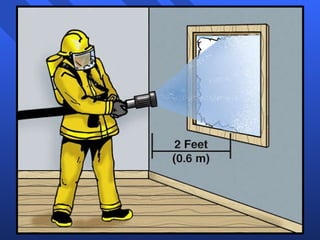
Types of  Ventilation Hydraulic Fog stream out a window or other opening Smooth bore with partially opened nozzle out a window or other opening
 
Ventilation Techniques Break windows Open doors Rope and a tool For ventilating upper floor windows from above Hook or pike pole Halligan Axe
Ventilation Techniques Portable ladder Aerial ladder tip Negative pressure ventilation Positive pressure ventilation Introduction opening should be larger than exhaust opening Cone of air should be larger than opening
 
Roof Ventilation Quickest way is to use building features Skylight Scuttle cover Bulkhead door When making holes, cut directly over the fire when possible
 
Roof Ventilation Types of cuts Expandable cut Produces hole as large as needed
Roof Ventilation Louver cut A series of cuts parallel to the roof joists, keeping them in the middle. When opened, they look like hinged louvers Triangular cut Good for Q-decking over open web bar joists
 
Roof Ventilation Trench cut or Strip cut Defensive in design and execution Used to cut off fire extension Examination holes Kerf cut – cutting blade lowered into  roof material and pulled out Triangular cut – three intersecting  kerf cuts
Safety Considerations Will ventilation permit fire to extend? Will the escape route be cut off? Will ventilation endanger others? Work in teams
Obstacles to Ventilation Access Security devices Height Unfamiliar building layout Timing
Factors Affecting Ventilation Partial openings Partially broken windows Screens Roof material
Factors Affecting Ventilation Dropped or hanging ceilings Building size Weather Opening windows
Lessons Learned Ventilation is a tool that is to be used like any other tool. It must be understood, used to its advantage, and applied carefully.
The End

Ventilation

  • 1.
    VENTILATION NFPA Standard1001 Fire Fighter Professional Qualifications - 2002
  • 2.
    Objectives Understand ventilationas a fire service tool Know the principles, advantages, and effects of ventilation (NFPA 1001:3-3.10a)
  • 3.
    Objectives Identify theconsiderations for proper ventilation (NFPA 1001:3-3.10a) Identify the types of ventilation (NFPA 1001:3-3.10a, 4-3.2a) Describe ventilation techniques (NFPA 1001:3-3.10a, 3-3.11a, 3-3.11b)
  • 4.
    Objectives Describe theneed for roof ventilation (NFPA 1001:3-3.11a, 3-3.11b,4-3.2a) Identify safety considerations when venting (NFPA 1001:3-3.10a)
  • 5.
    Objectives Describe theobstacles to ventilation (NFPA 1001:4-3.2a) Identify the factors affecting ventilation Delmar, Firefighter’s Handbook, Chapter 18
  • 6.
    Principles, Advantages, andEffects of Ventilation Ventilation is the systematic removal of the byproducts of combustion. It relieves the structure of heat. It channels smoke out of the structure. It removes toxic gases from the structure.
  • 7.
    Considerations for ProperVentilation Vertical ventilation is the removal of heat and smoke through vertical channels. Horizontal ventilation is the removal of smoke and gases through horizontal openings.
  • 8.
    Types of Ventilation Natural Opening of doors and windows Cutting a hole in the roof
  • 9.
  • 10.
    Types of Ventilation Mechanical Heating, ventilation, and air conditioning (HVAC) Smoke fans Positive pressure
  • 11.
  • 12.
    Types of Ventilation Hydraulic Fog stream out a window or other opening Smooth bore with partially opened nozzle out a window or other opening
  • 13.
  • 14.
    Ventilation Techniques Breakwindows Open doors Rope and a tool For ventilating upper floor windows from above Hook or pike pole Halligan Axe
  • 15.
    Ventilation Techniques Portableladder Aerial ladder tip Negative pressure ventilation Positive pressure ventilation Introduction opening should be larger than exhaust opening Cone of air should be larger than opening
  • 16.
  • 17.
    Roof Ventilation Quickestway is to use building features Skylight Scuttle cover Bulkhead door When making holes, cut directly over the fire when possible
  • 18.
  • 19.
    Roof Ventilation Typesof cuts Expandable cut Produces hole as large as needed
  • 20.
    Roof Ventilation Louvercut A series of cuts parallel to the roof joists, keeping them in the middle. When opened, they look like hinged louvers Triangular cut Good for Q-decking over open web bar joists
  • 21.
  • 22.
    Roof Ventilation Trenchcut or Strip cut Defensive in design and execution Used to cut off fire extension Examination holes Kerf cut – cutting blade lowered into roof material and pulled out Triangular cut – three intersecting kerf cuts
  • 23.
    Safety Considerations Willventilation permit fire to extend? Will the escape route be cut off? Will ventilation endanger others? Work in teams
  • 24.
    Obstacles to VentilationAccess Security devices Height Unfamiliar building layout Timing
  • 25.
    Factors Affecting VentilationPartial openings Partially broken windows Screens Roof material
  • 26.
    Factors Affecting VentilationDropped or hanging ceilings Building size Weather Opening windows
  • 27.
    Lessons Learned Ventilationis a tool that is to be used like any other tool. It must be understood, used to its advantage, and applied carefully.
  • 28.