Prepared by
Dr. Nedhal Al-Tamimi
Arch. Eng. Dept.,
Faculty of Engineering
Najran University, KSA
naaltamimi@nu.edu.sa
Passive
ventilation
system
Lecture
No. 7
Climatic Design AE 353-2
Scope
of
Presentation
1. Introduction to Ventilation Systems
2. Natural Ventilation
3. The benefits of natural ventilation
4. Types of Natural Ventilation
5. Functional requirements of a Ventilation system
6. General considerations and rules
7. Land Scape Elements for cooling
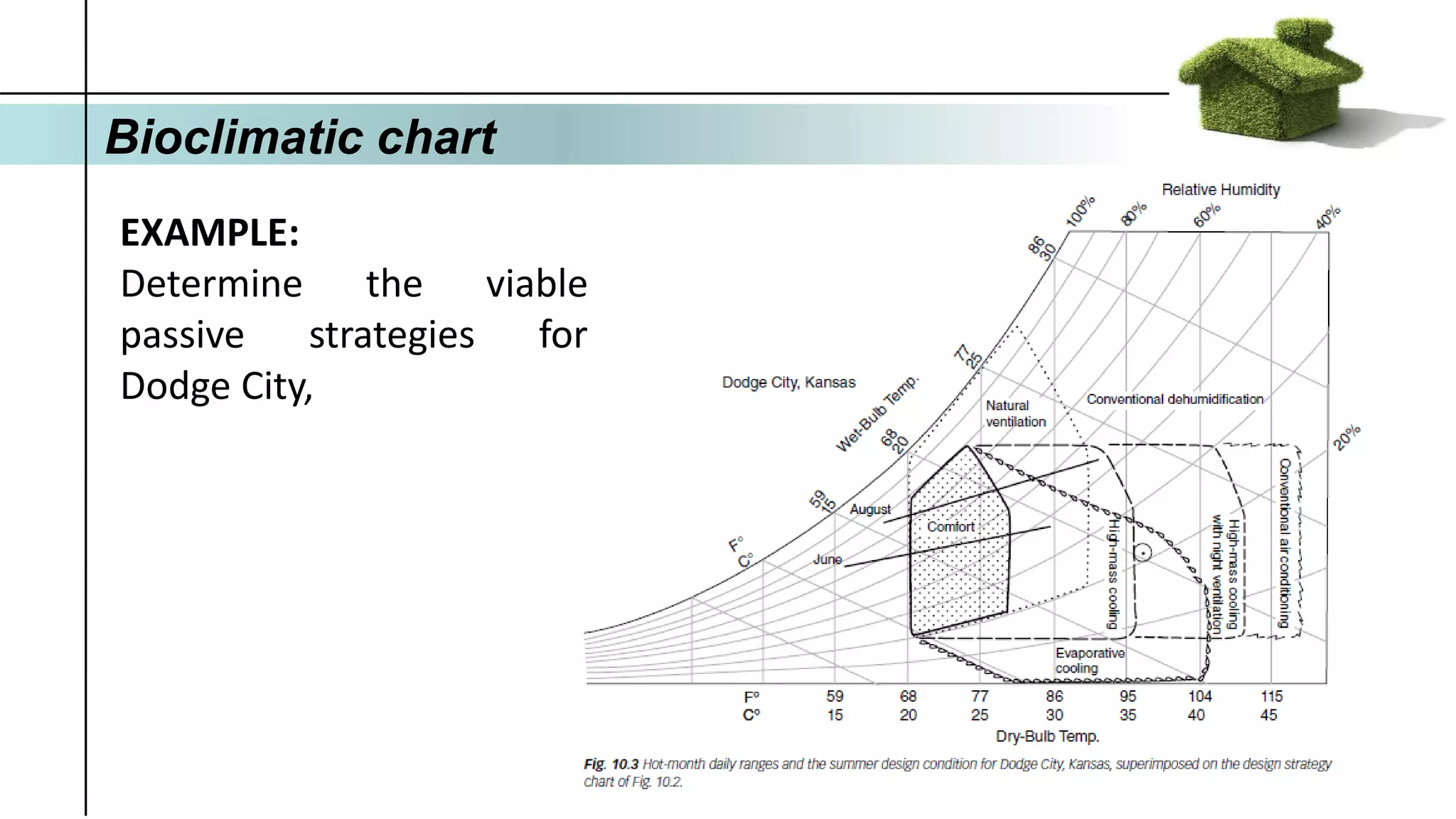
Bioclimatic chart
EXAMPLE:
Determine the viable
passive strategies for
Dodge City,
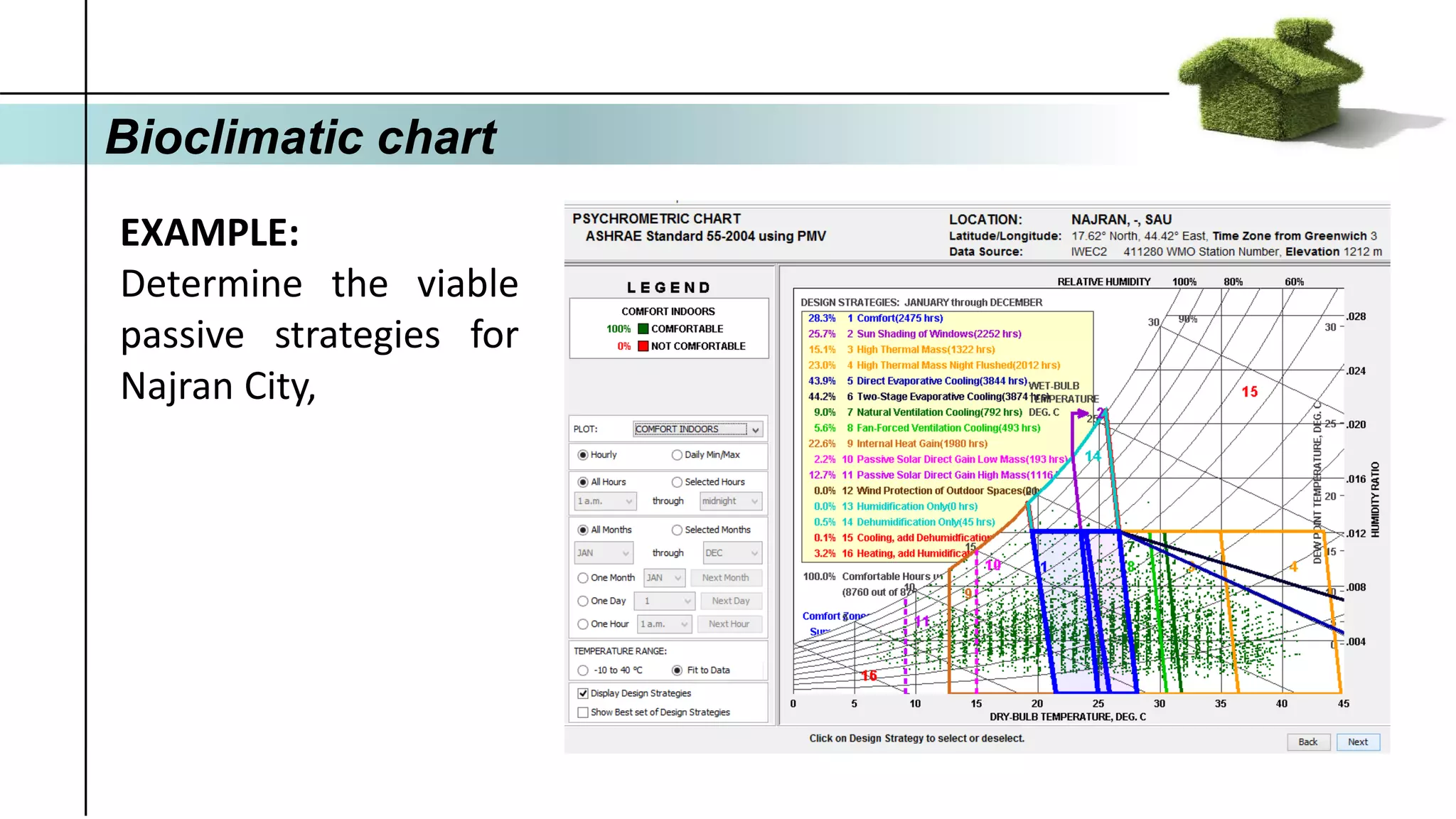
Bioclimatic chart
EXAMPLE:
Determine the viable
passive strategies for
Najran City,
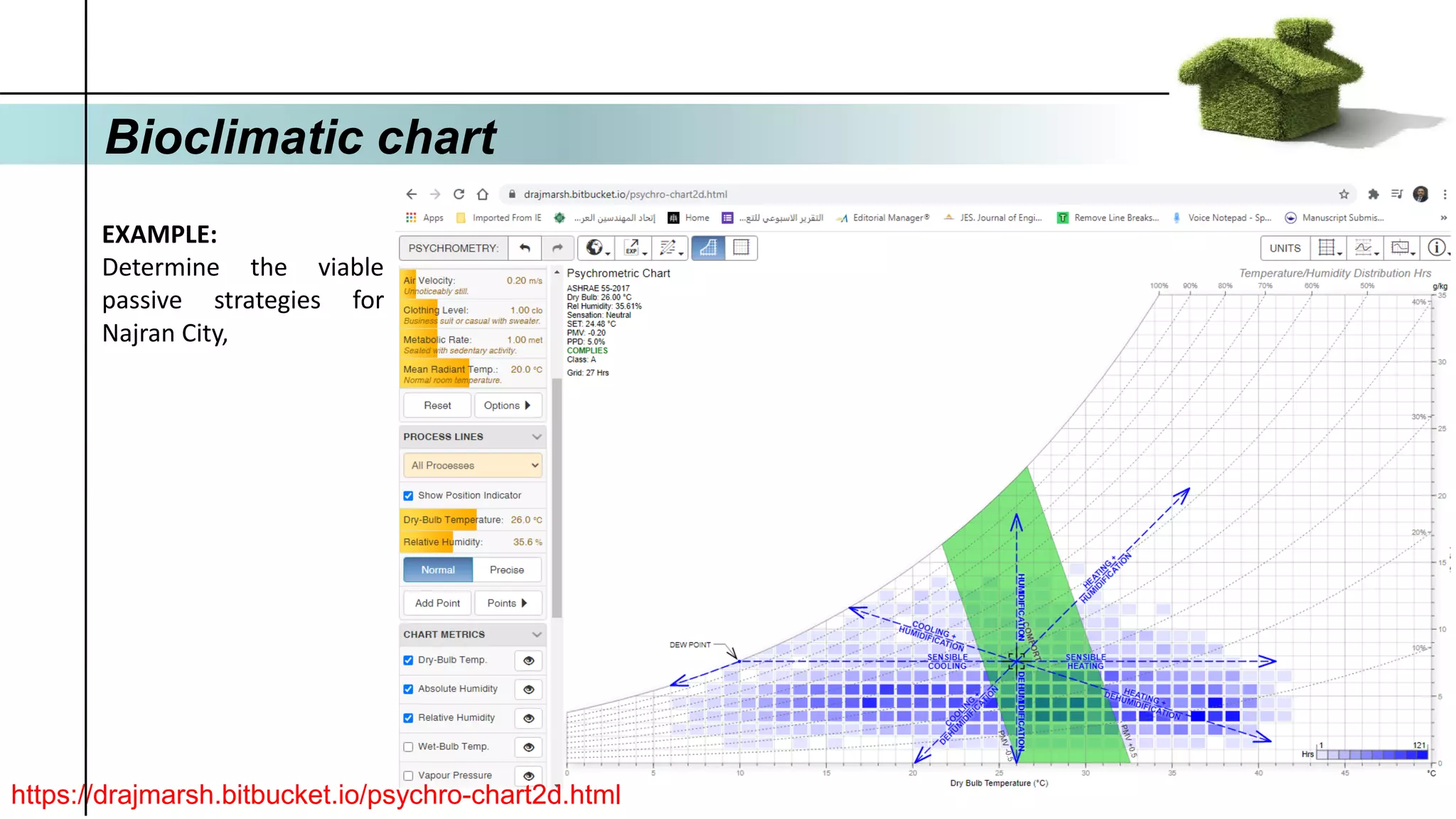
EXAMPLE:
Determine the viable
passive strategies for
Najran City,
https://drajmarsh.bitbucket.io/psychro-chart2d.html
Bioclimatic chart
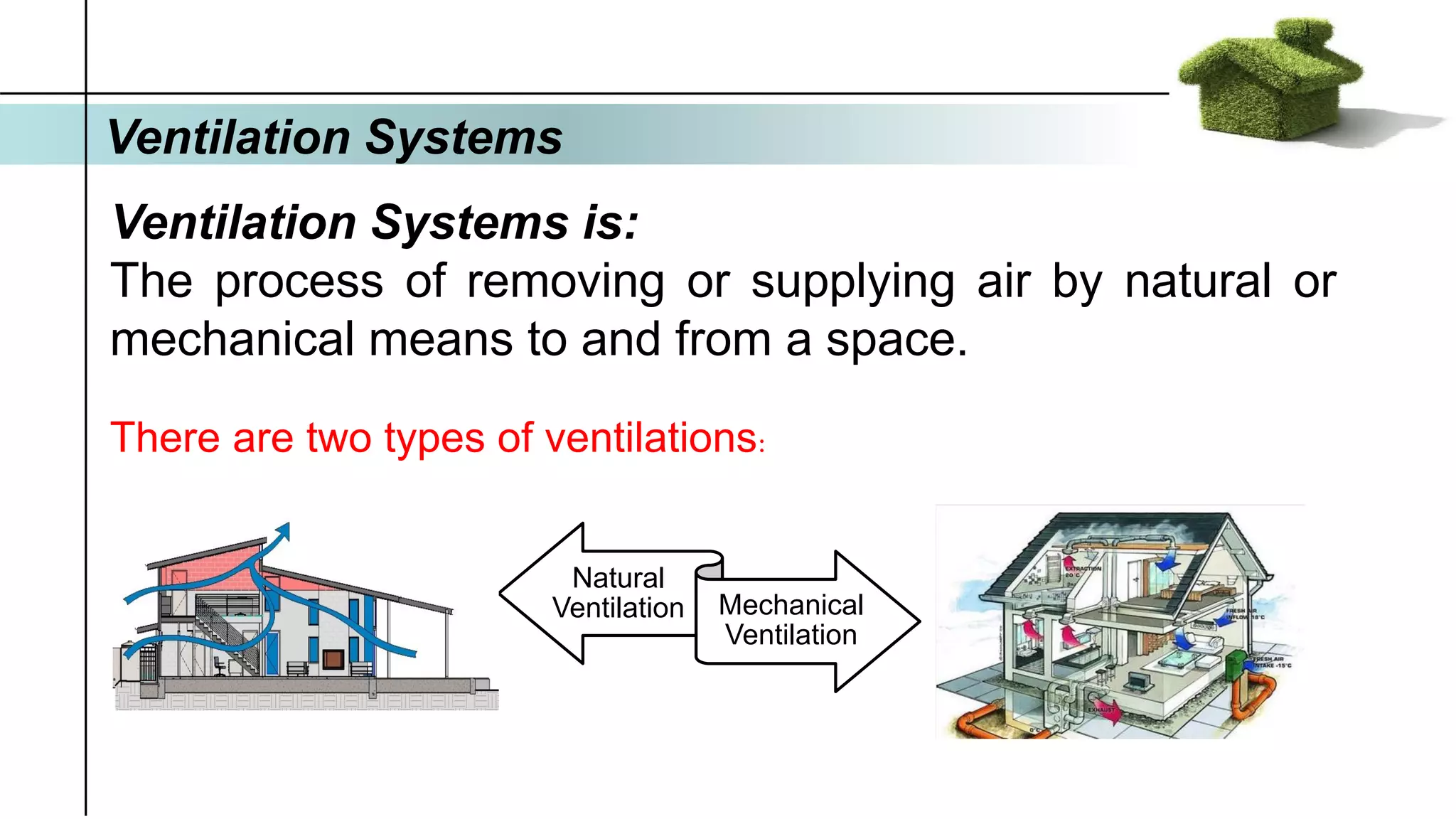
Ventilation Systems
Natural
Ventilation Mechanical
Ventilation
Ventilation Systems is:
The process of removing or supplying air by natural or
mechanical means to and from a space.
There are two types of ventilations:
Natural Ventilation
▪ Natural Ventilation is: the process of supplying and removing
air through an indoor space by natural means
▪ It facilitate outside air to inside of a building through
windows, doors, ventilation or other openings.
▪ Openings should not be less than 1/20th or (5%) of the floor
area.
▪ It refers to the flow of external air to an indoor space as a
result of pressure or temperature differences
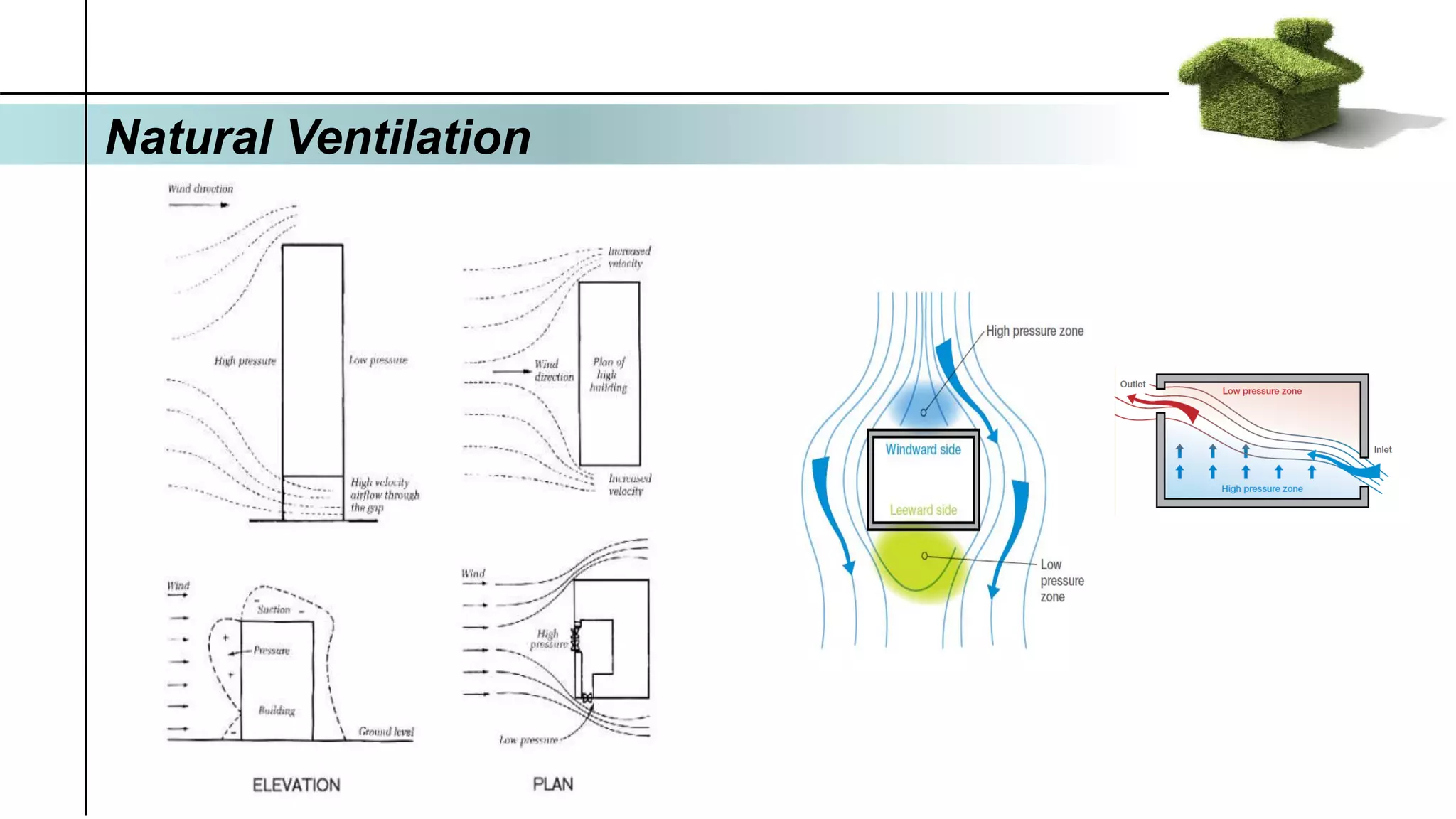
Natural Ventilation
The benefits of natural ventilation
The benefits of natural ventilation include:-
1. Improved Indoor air quality (IAQ) (level of Oxygen,
Carbon Dioxide)
2. Energy savings by lowering the heat level
3. Reduction of greenhouse gas emissions
4. Control the moisture level
5. Remove dust and odors
6. Reduction in occupant illness
7. Increased worker productivity
Types of Passive ventilation system
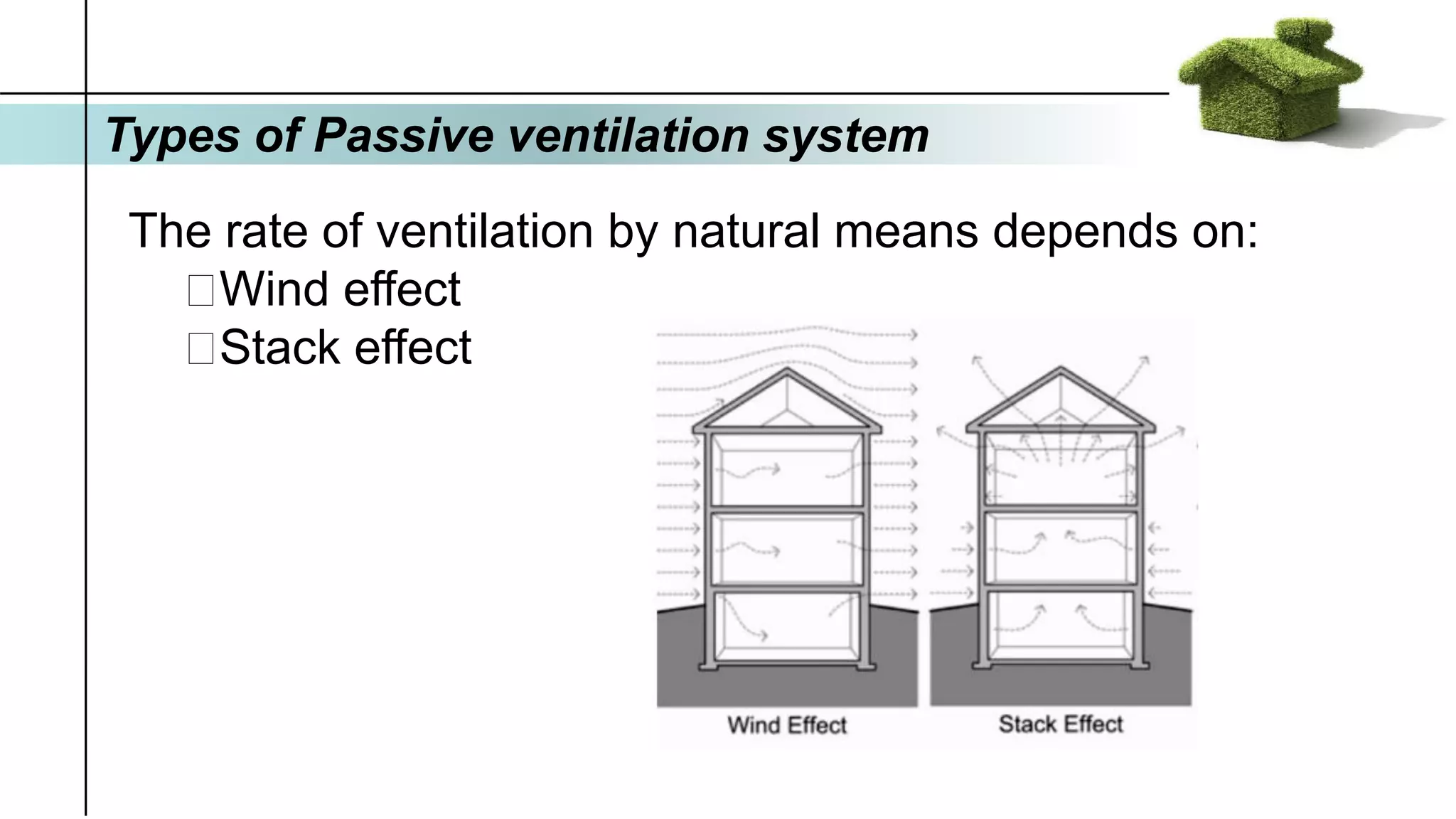
The rate of ventilation by natural means depends on:
Wind effect
Stack effect
Wind effect
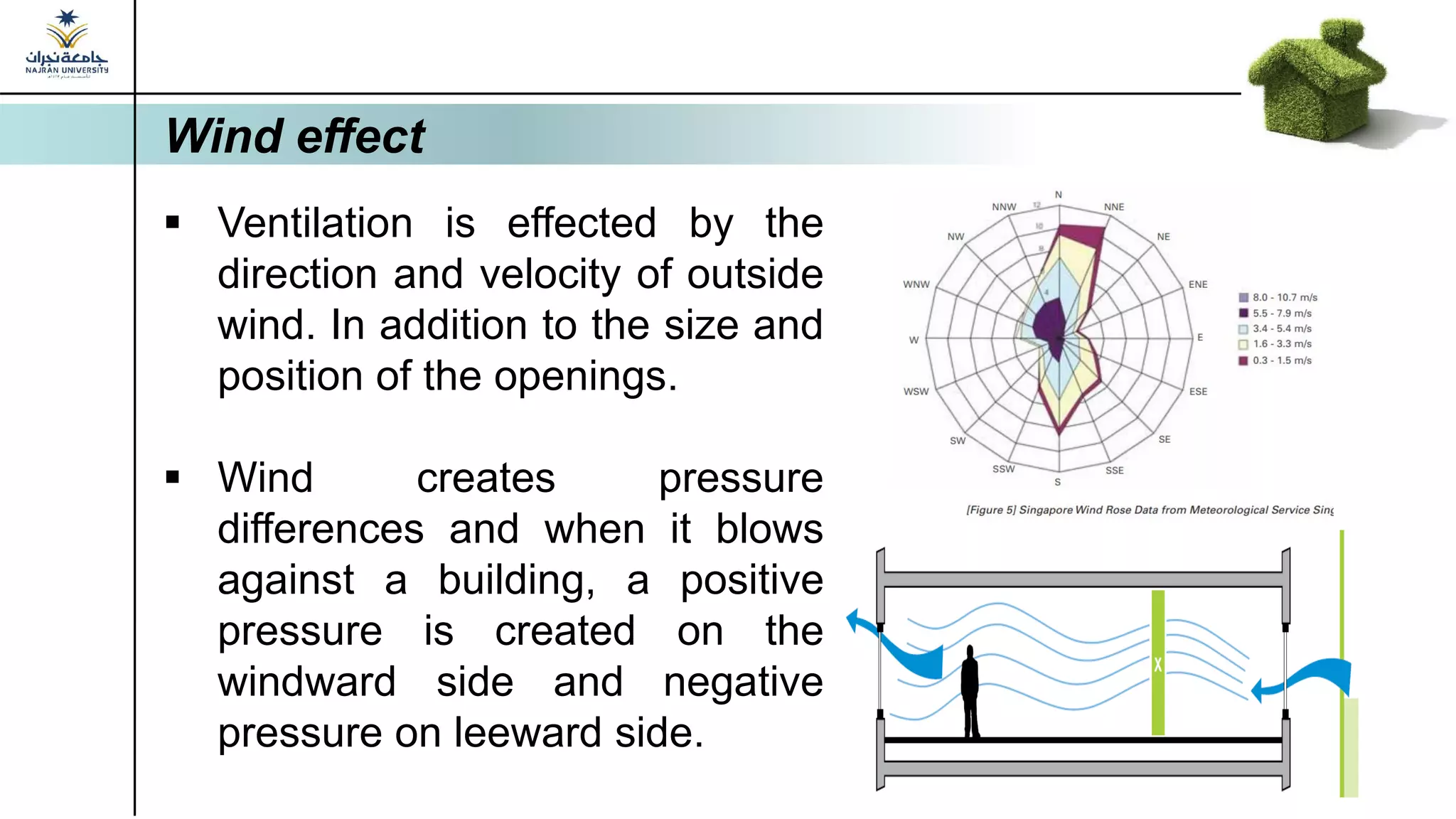
▪ Ventilation is effected by the
direction and velocity of outside
wind. In addition to the size and
position of the openings.
▪ Wind creates pressure
differences and when it blows
against a building, a positive
pressure is created on the
windward side and negative
pressure on leeward side.
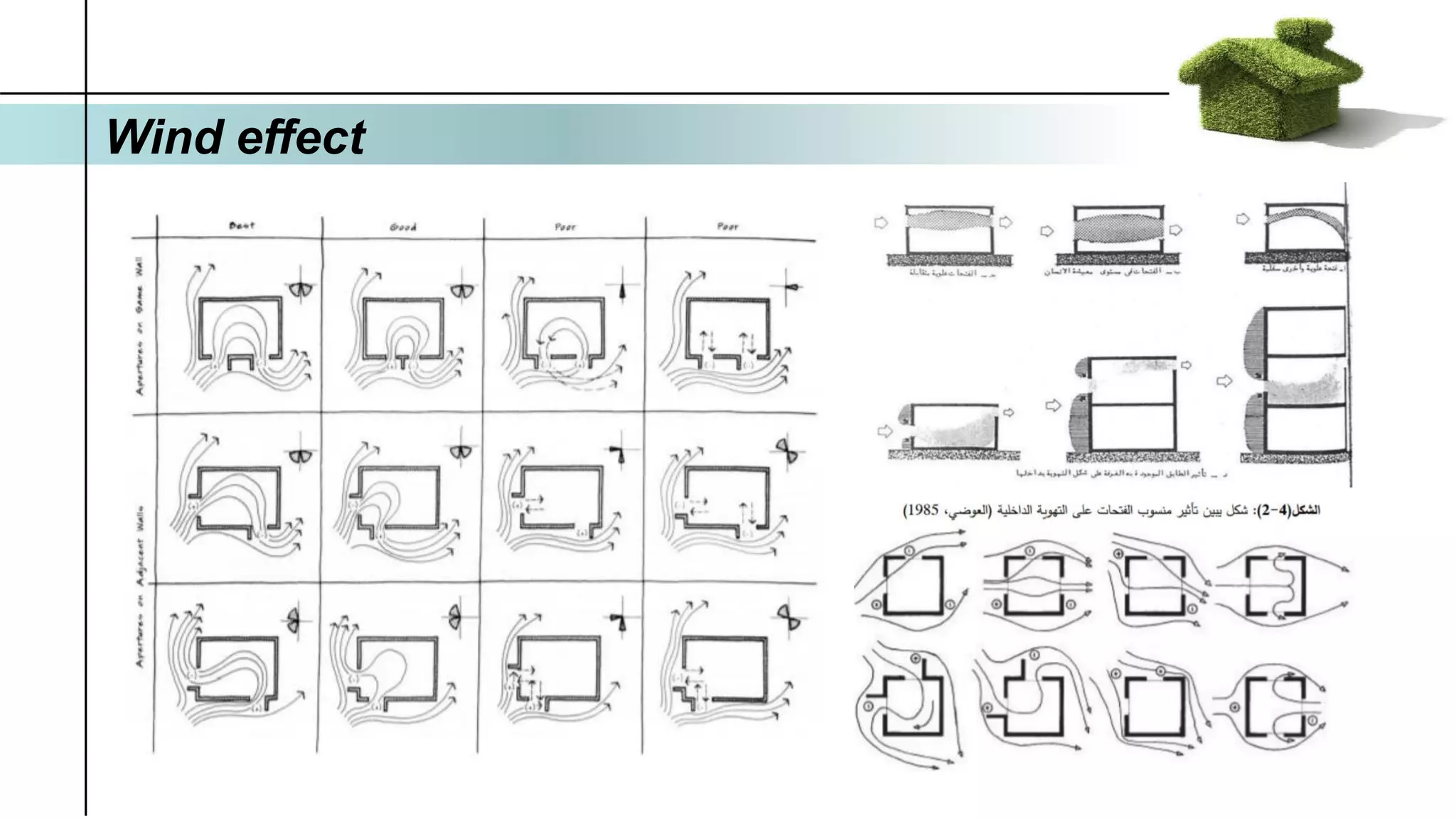
Wind effect
Wind effect
Single opening ventilation
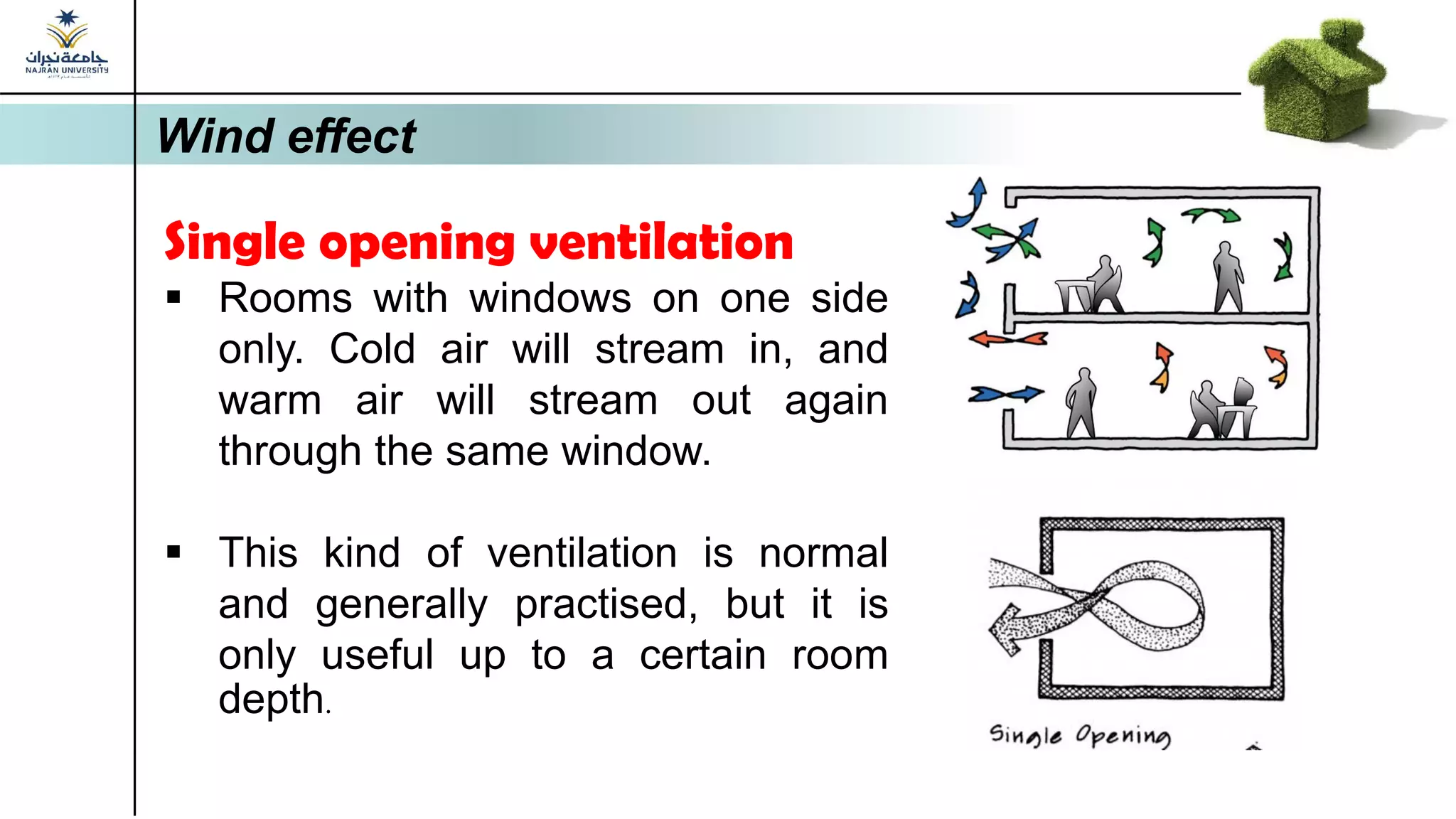
▪ Rooms with windows on one side
only. Cold air will stream in, and
warm air will stream out again
through the same window.
▪ This kind of ventilation is normal
and generally practised, but it is
only useful up to a certain room
depth.
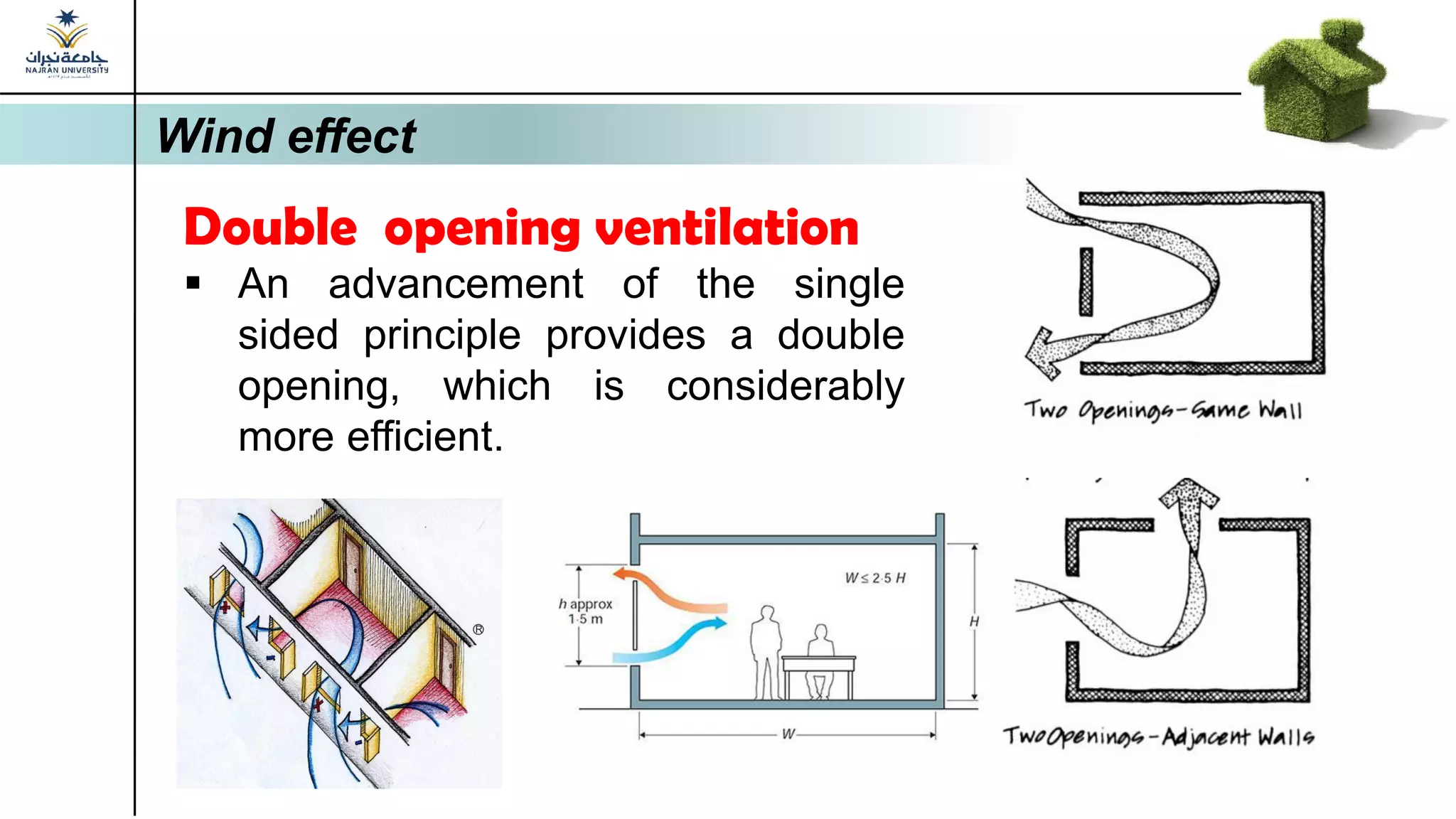
Double opening ventilation
▪ An advancement of the single
sided principle provides a double
opening, which is considerably
more efficient.
Wind effect
Cross ventilation
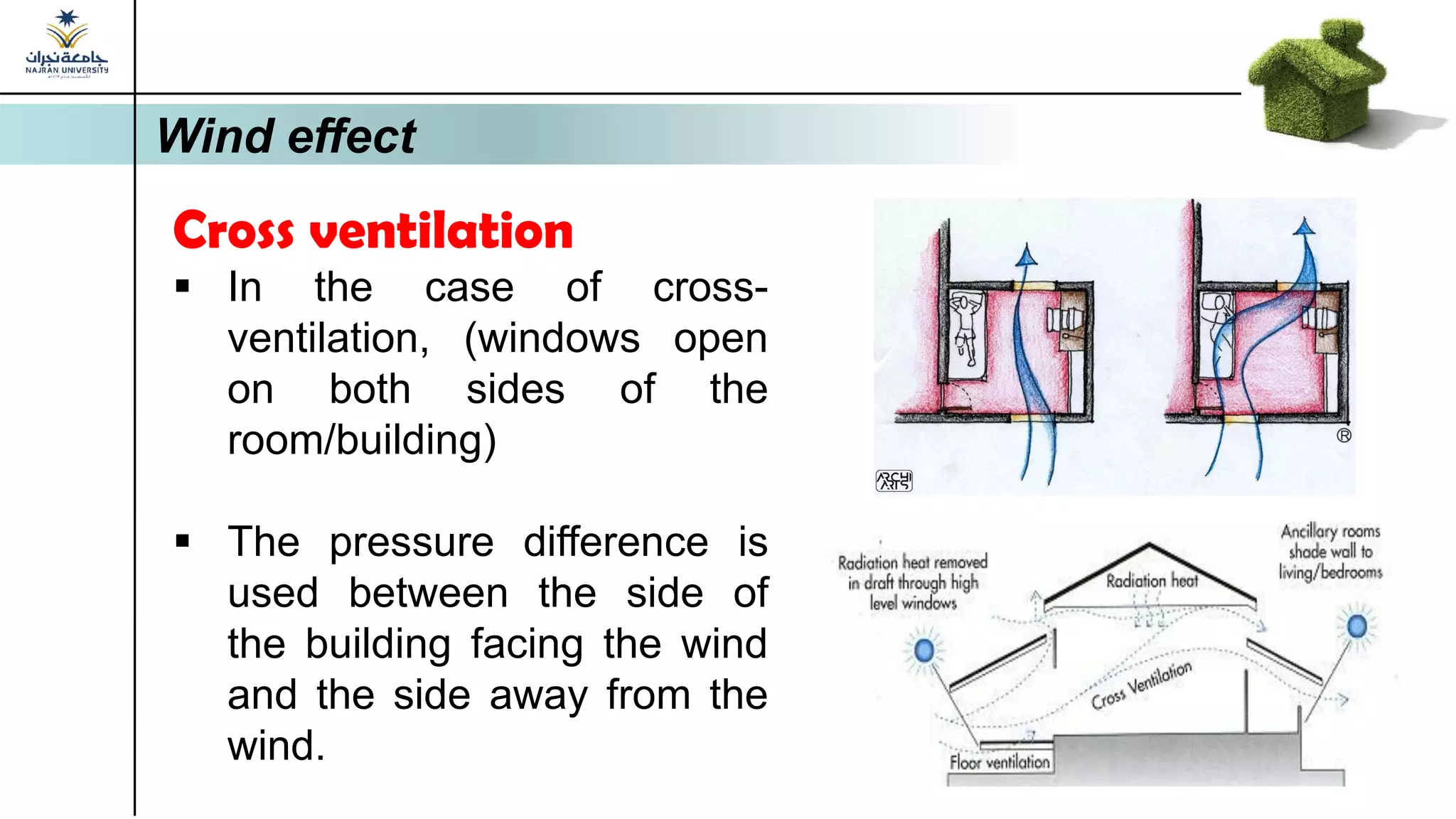
▪ In the case of cross-
ventilation, (windows open
on both sides of the
room/building)
▪ The pressure difference is
used between the side of
the building facing the wind
and the side away from the
wind.
Wind effect
Cross ventilation
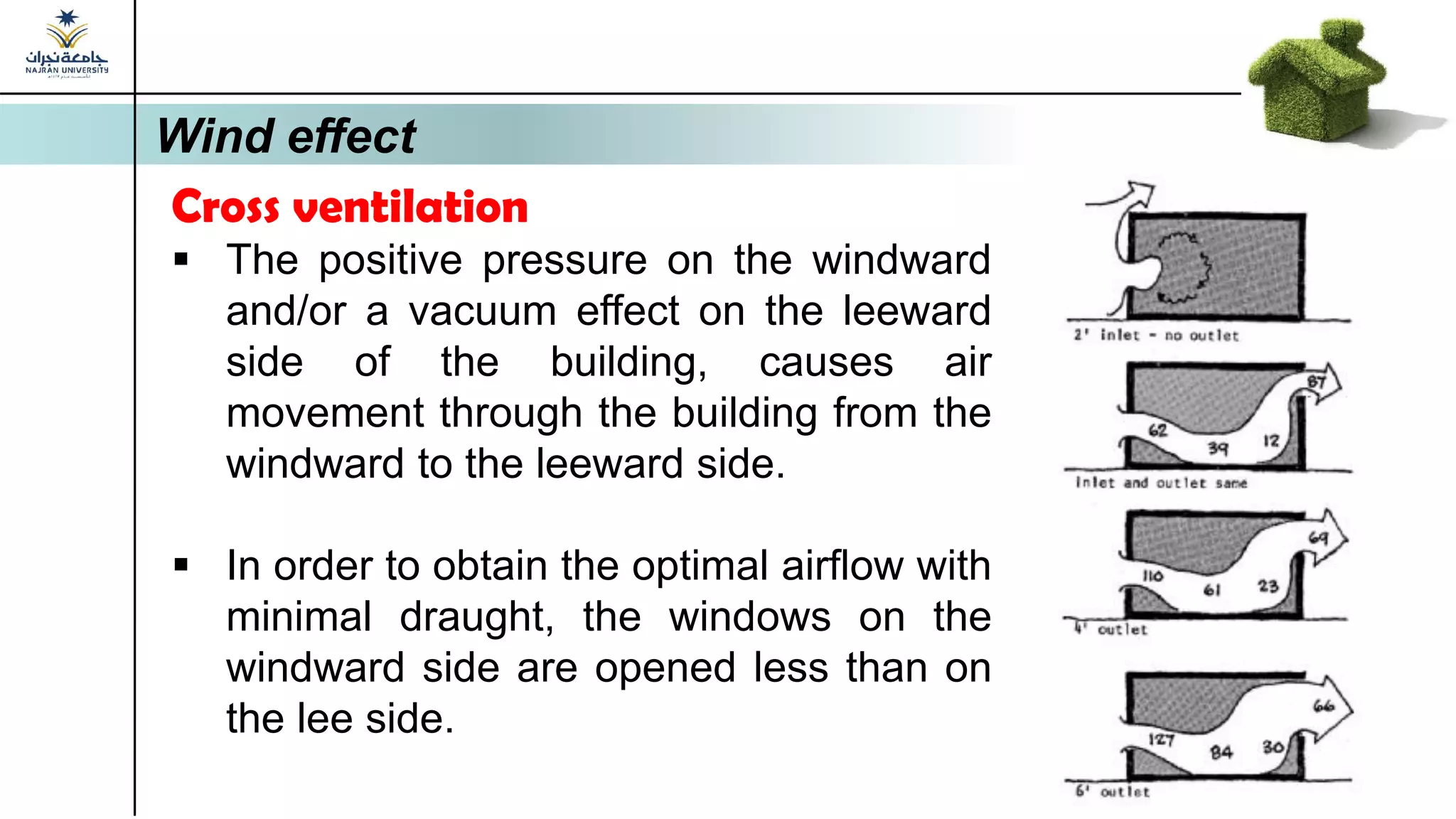
▪ The positive pressure on the windward
and/or a vacuum effect on the leeward
side of the building, causes air
movement through the building from the
windward to the leeward side.
▪ In order to obtain the optimal airflow with
minimal draught, the windows on the
windward side are opened less than on
the lee side.
Wind effect
Stack effect
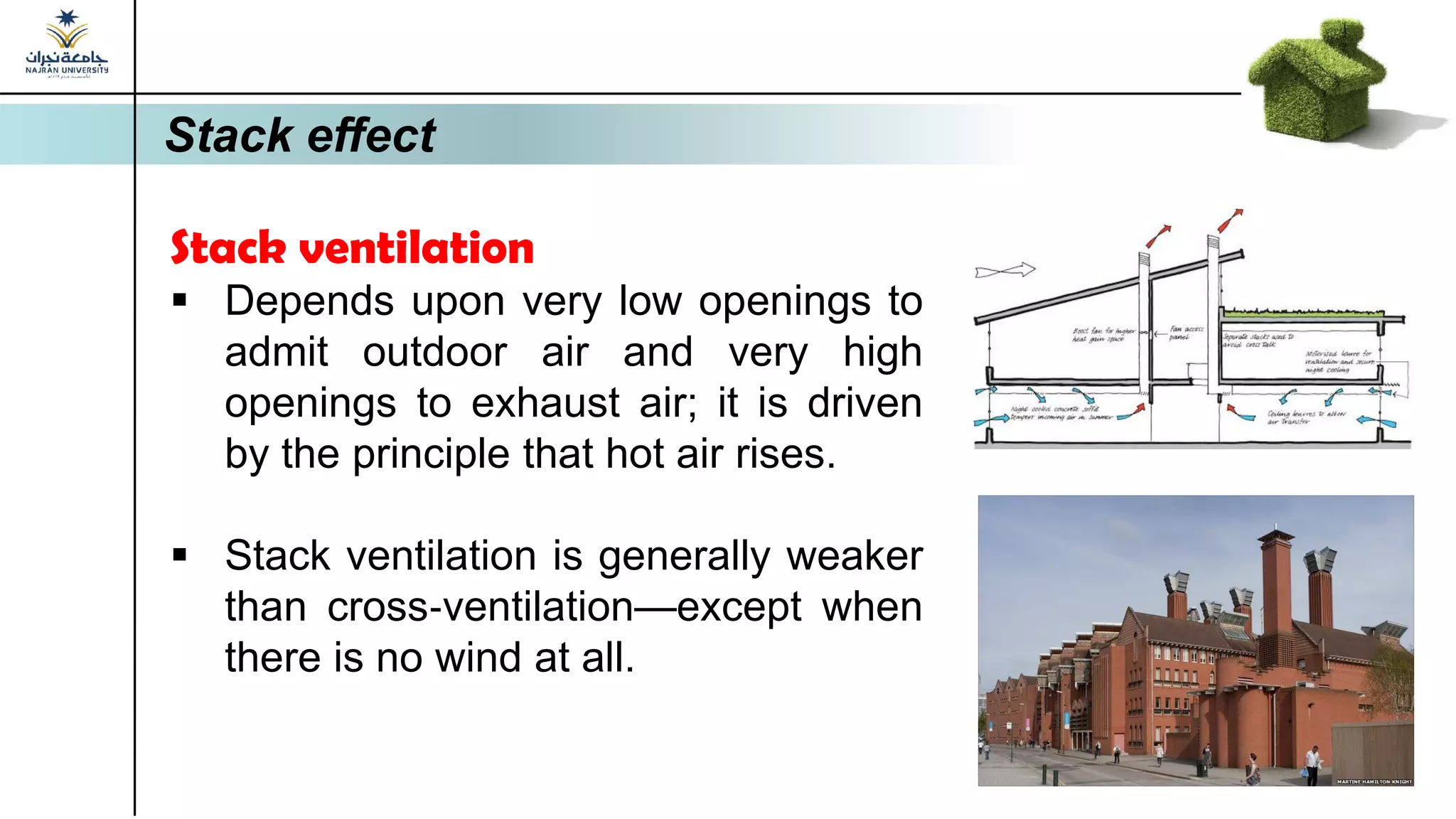
Stack ventilation
▪ Depends upon very low openings to
admit outdoor air and very high
openings to exhaust air; it is driven
by the principle that hot air rises.
▪ Stack ventilation is generally weaker
than cross‐ventilation—except when
there is no wind at all.
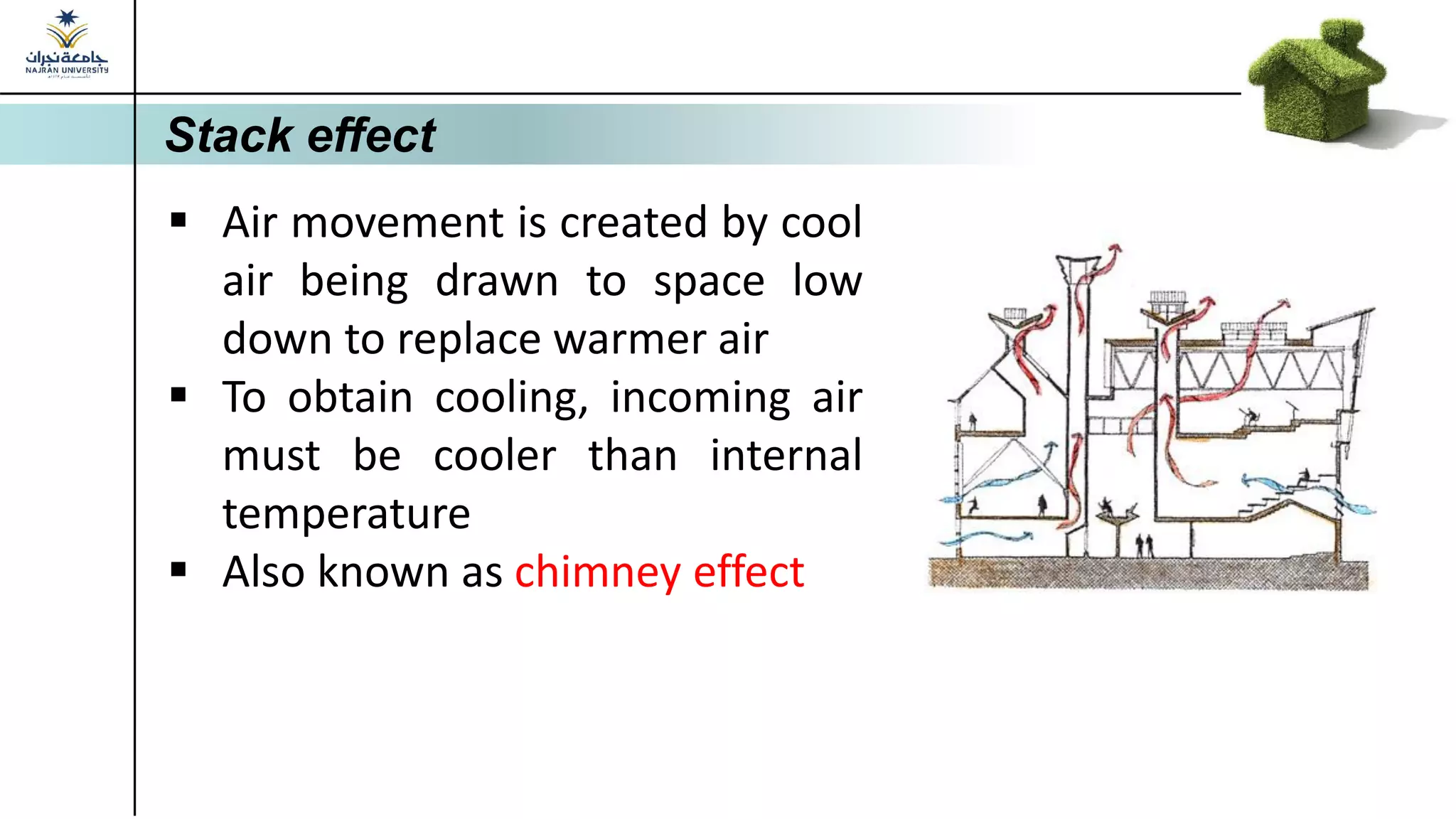
Stack effect
▪ Air movement is created by cool
air being drawn to space low
down to replace warmer air
▪ To obtain cooling, incoming air
must be cooler than internal
temperature
▪ Also known as chimney effect
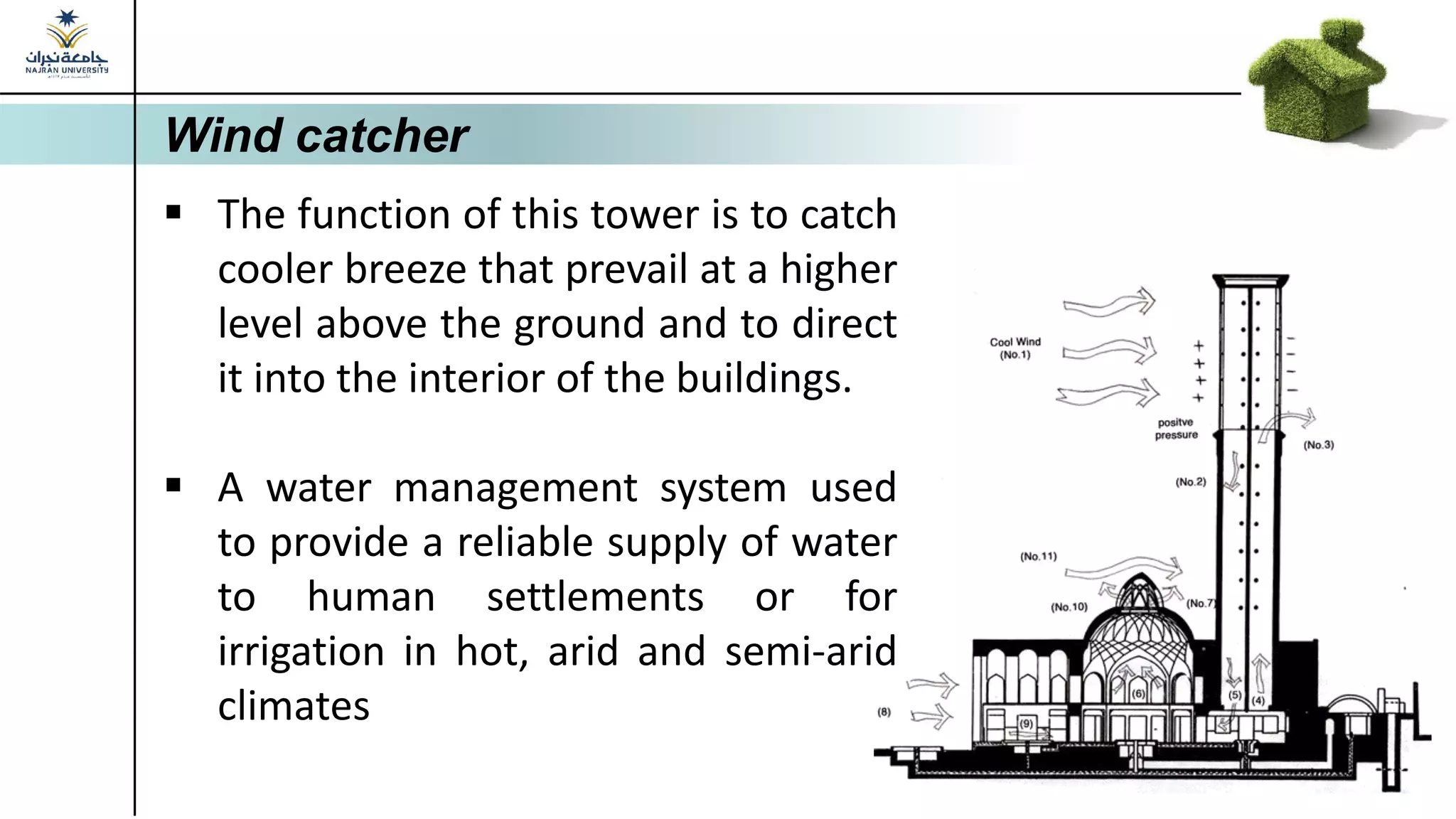
Wind catcher
▪ The function of this tower is to catch
cooler breeze that prevail at a higher
level above the ground and to direct
it into the interior of the buildings.
▪ A water management system used
to provide a reliable supply of water
to human settlements or for
irrigation in hot, arid and semi-arid
climates
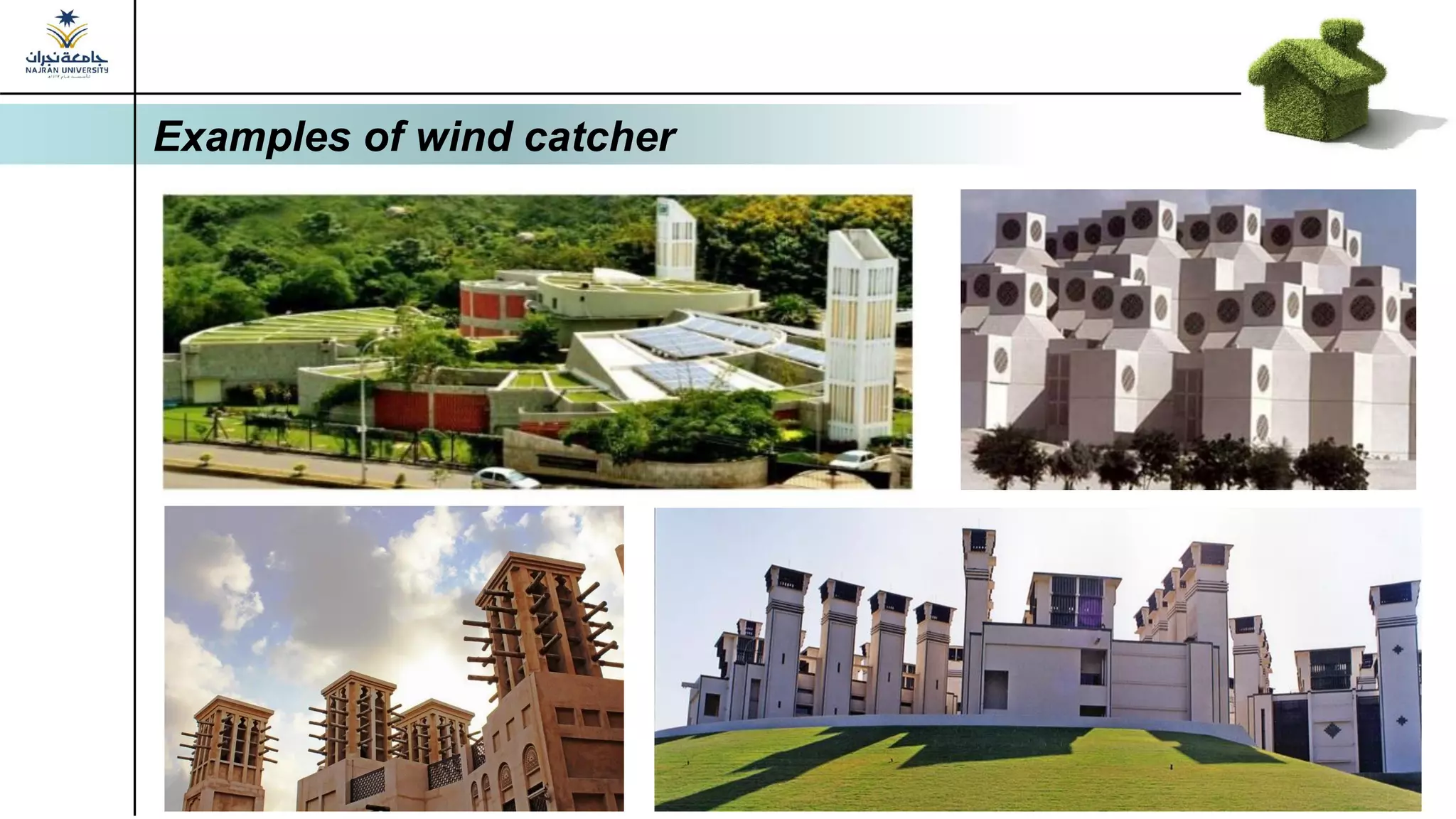
Examples of wind catcher
Functional requirements of a Ventilation system
▪ Number of air changes depend upon type of buildings and its
occupancy.
▪ Air changes per hour (ACH) is the volume of outside air
allowed in a room in one hour compared with the volume of
the room.
For example: In residential buildings
▪ Living rooms and bedrooms: 3 air changes per hour
▪ Kitchen: 6 air changes/h
▪ Bathrooms and W.C: 6 air changes/h
▪ Halls and passages: 1 air change/h
General considerations and rules for natural ventilation
▪ Inlet openings in the building should be well distributed
and should be located in the windward side at low level.
▪ The outlet openings should be located on the leeward
side near the ceiling in the side walls and in roofs.
▪ Inlet and outlet openings should preferably to be of
equal size for greatest air flow, but when outlet is in the
form of a roof opening the inlet should be larger in size.
Where the wind direction is variable, provide openings in
all walls
General considerations and rules for natural ventilation
▪ Inlet openings should not be obstructed by
obstructions in the path of flow (adjoining buildings,
trees, signboards, partitions, etc.)
▪ Increased height of the room gives better ventilation
due to stack effect
▪ The long narrow room should be ventilated by
providing suitable openings in short sides
General considerations and rules for natural ventilation
▪ Provide ventilators as close to the ceilings as
possible
▪ For cross ventilation, the position of outlets should be
just opposite to inlets
▪ If the room is to be used for burning gas or fuel,
enough quantity of air should be supplied by natural
ventilation for meeting the demands of burning as
well as ventilation of the room.
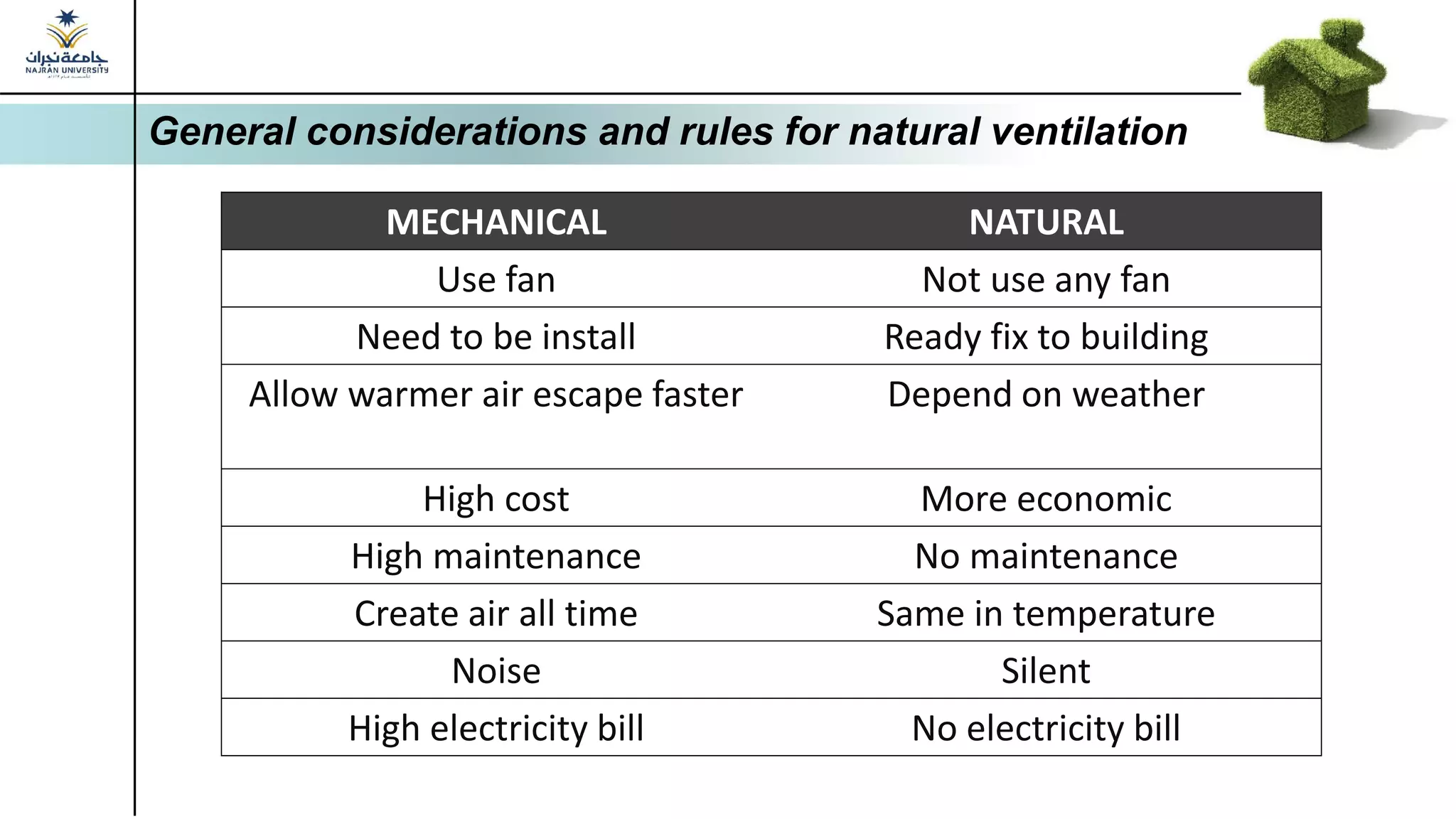
MECHANICAL NATURAL
Use fan Not use any fan
Need to be install Ready fix to building
Allow warmer air escape faster Depend on weather
High cost More economic
High maintenance No maintenance
Create air all time Same in temperature
Noise Silent
High electricity bill No electricity bill
General considerations and rules for natural ventilation
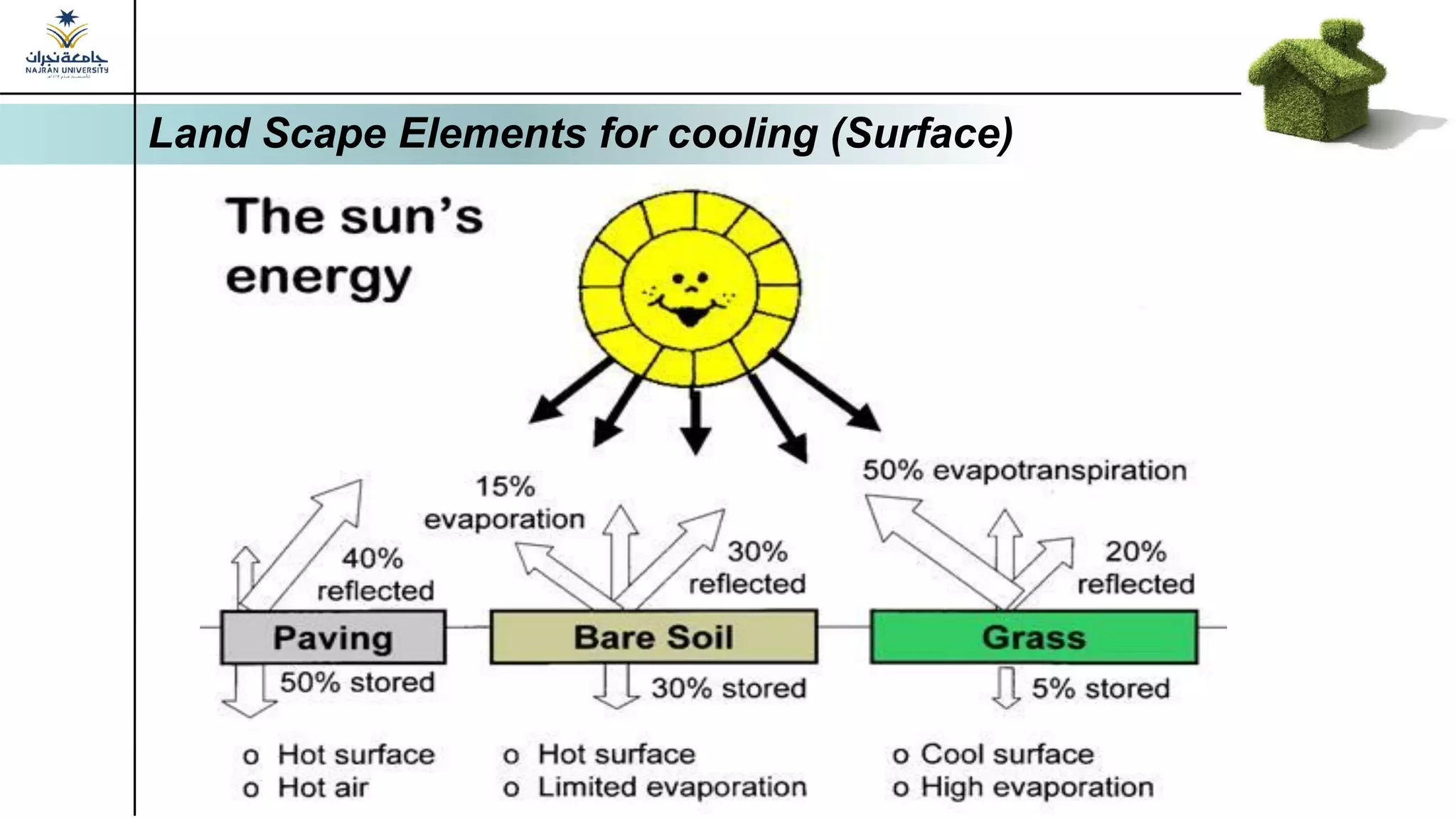
Land Scape Elements for cooling (Surface)
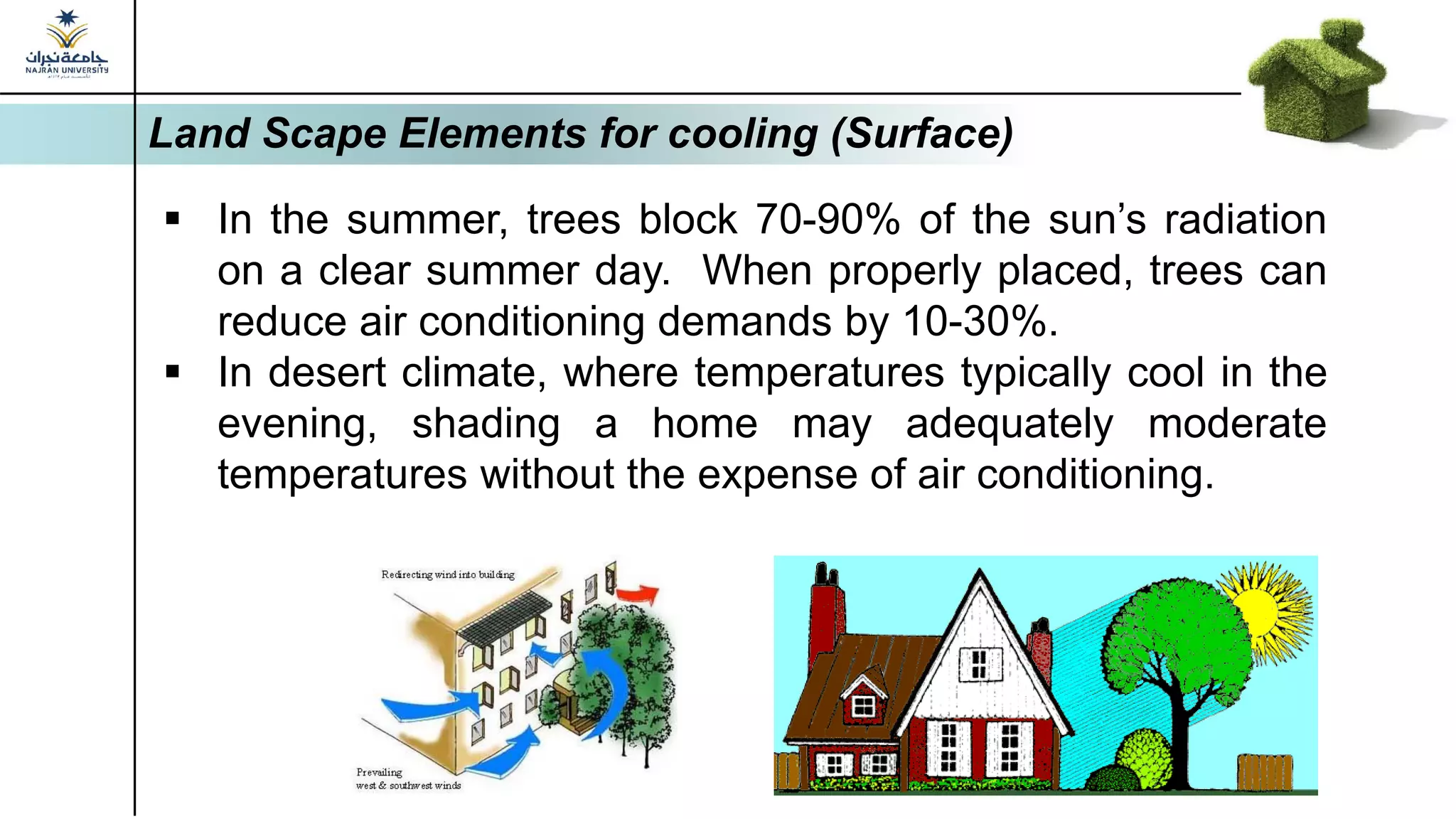
▪ In the summer, trees block 70-90% of the sun’s radiation
on a clear summer day. When properly placed, trees can
reduce air conditioning demands by 10-30%.
▪ In desert climate, where temperatures typically cool in the
evening, shading a home may adequately moderate
temperatures without the expense of air conditioning.
Land Scape Elements for cooling (Surface)
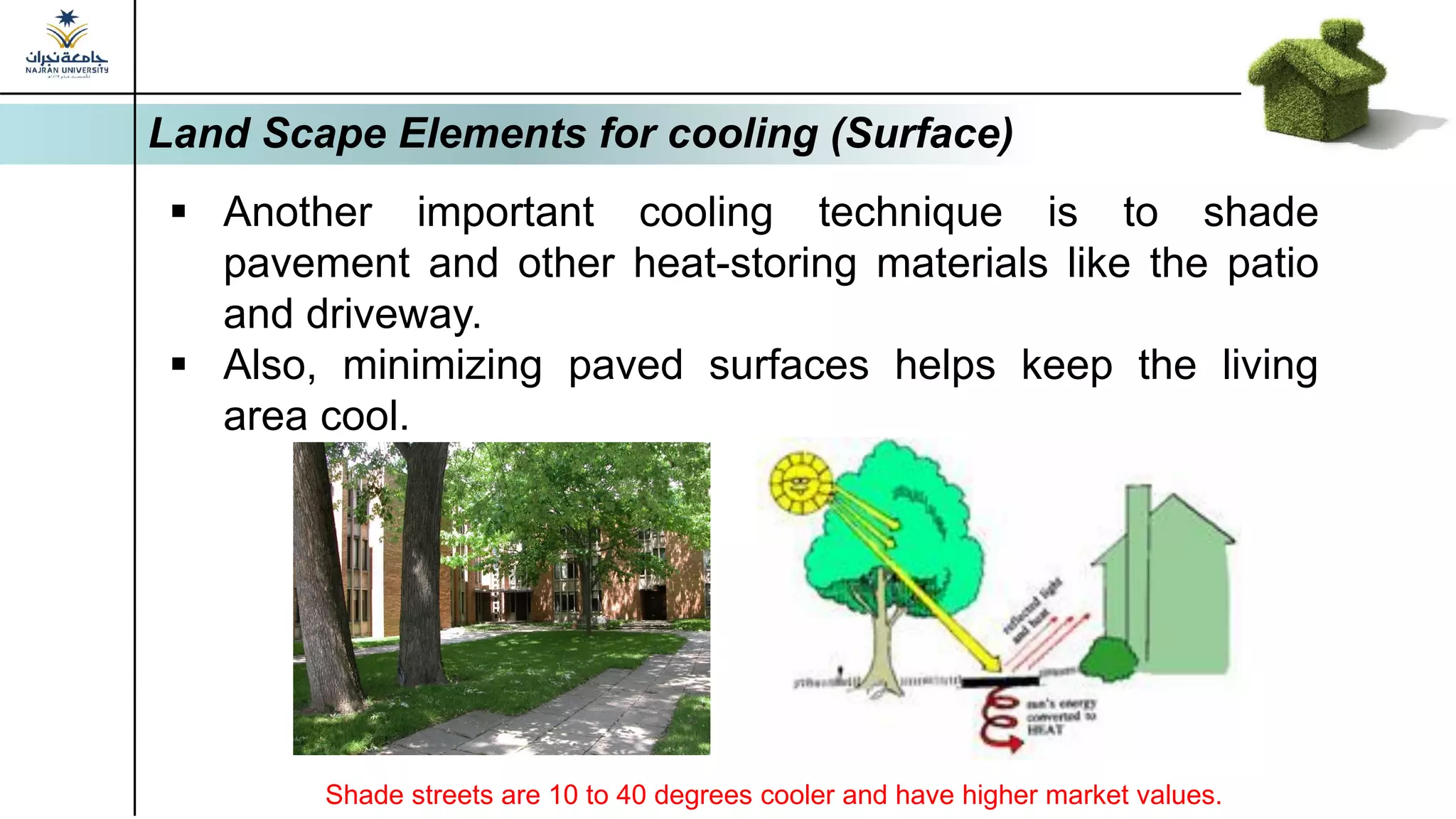
Shade streets are 10 to 40 degrees cooler and have higher market values.
▪ Another important cooling technique is to shade
pavement and other heat-storing materials like the patio
and driveway.
▪ Also, minimizing paved surfaces helps keep the living
area cool.
Land Scape Elements for cooling (Surface)
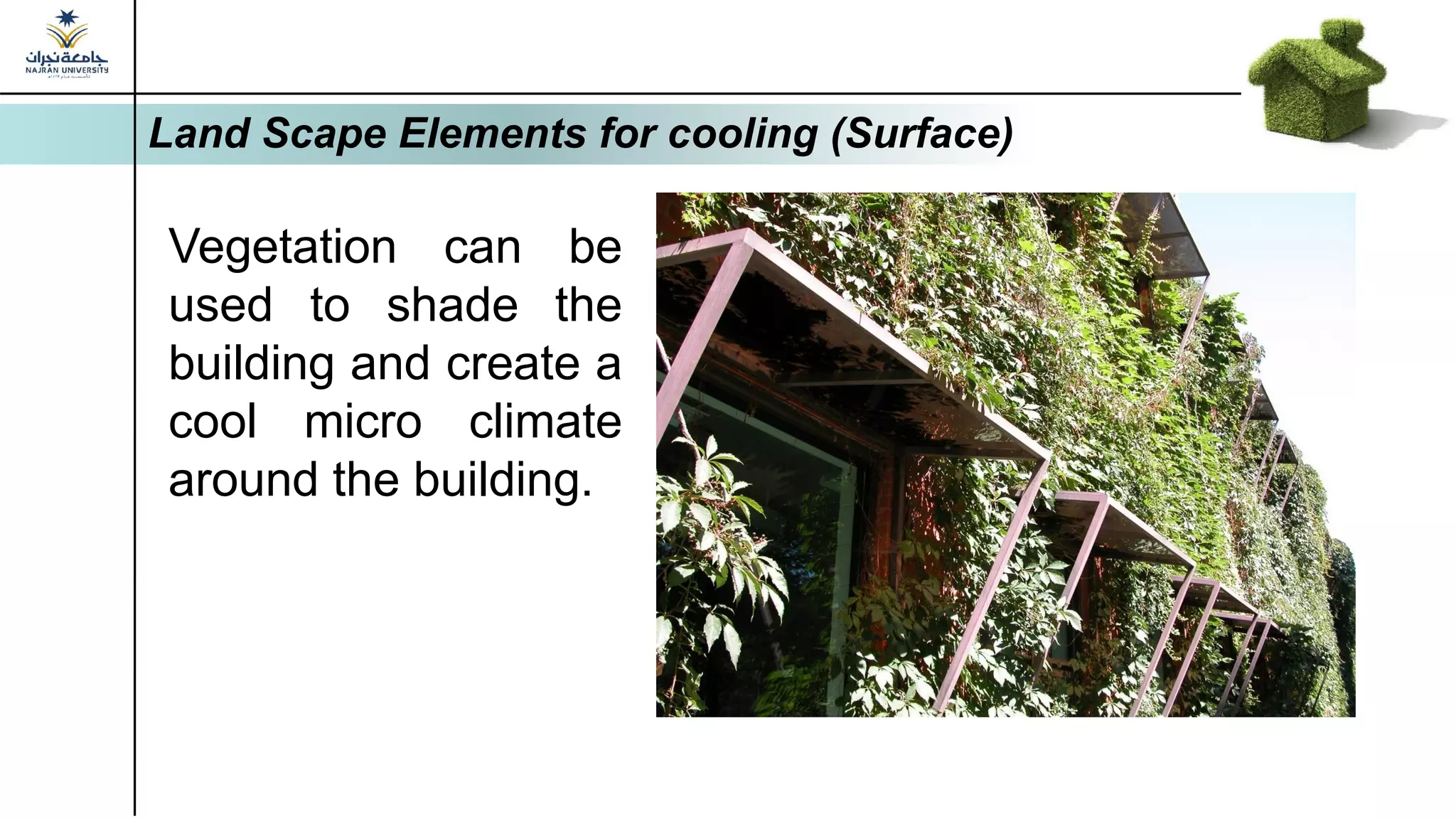
Vegetation can be
used to shade the
building and create a
cool micro climate
around the building.
Land Scape Elements for cooling (Surface)
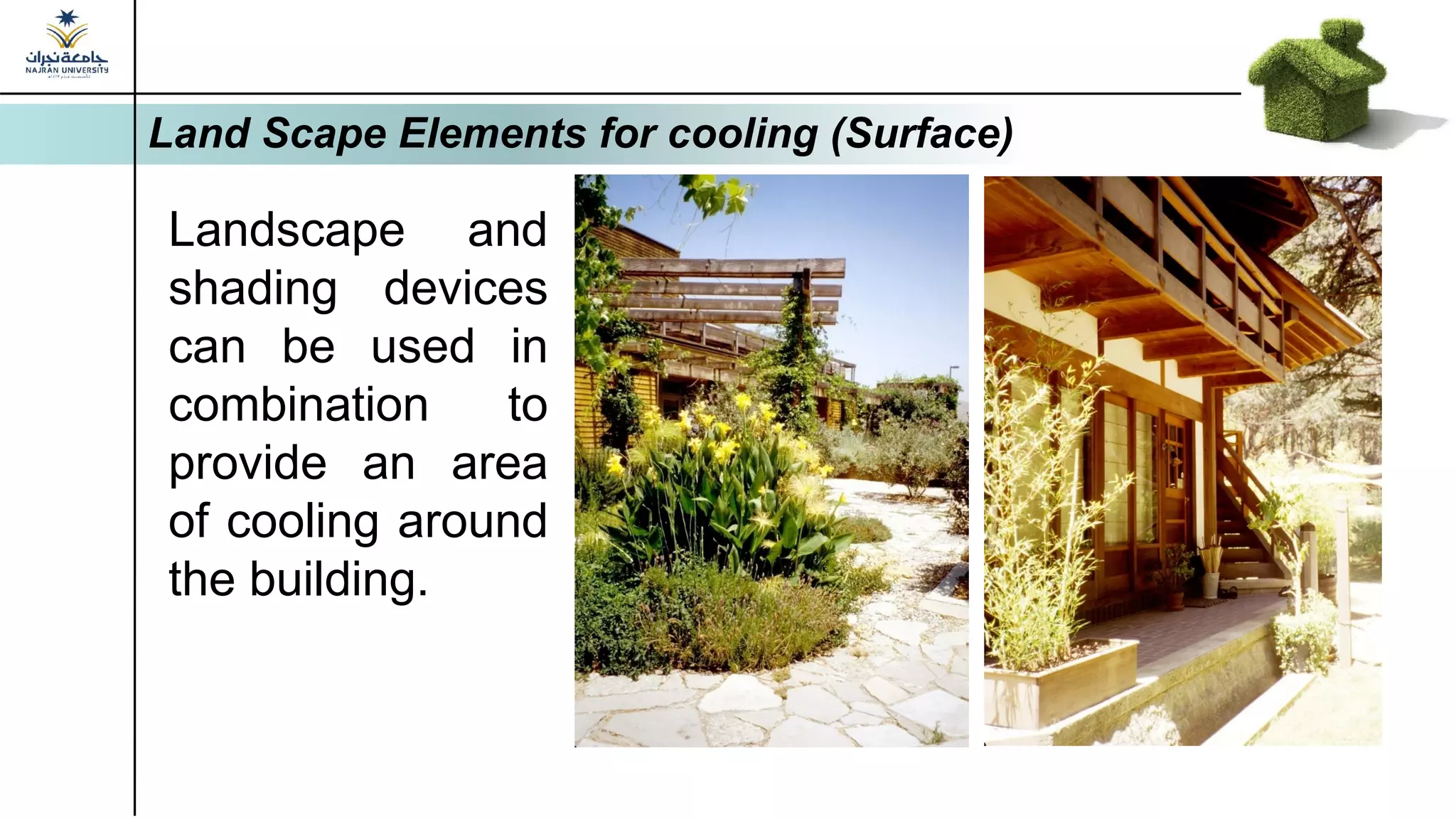
Landscape and
shading devices
can be used in
combination to
provide an area
of cooling around
the building.
Natural Lighting
Next Lecture
8
1. Principles of Natural Lighting
2. Variables Effect Illumination Level
3. Innovative Daylighting
Technologies
4. Controlling Daylight
5. Daylighting Design Guides
Climatic Design Thank You
Dr. Nedhal Al-Tamimi
AE 353-2

Lecture 7 passive ventilation system

  • 1.
    Prepared by Dr. NedhalAl-Tamimi Arch. Eng. Dept., Faculty of Engineering Najran University, KSA naaltamimi@nu.edu.sa Passive ventilation system Lecture No. 7 Climatic Design AE 353-2
  • 2.
    Scope of Presentation 1. Introduction toVentilation Systems 2. Natural Ventilation 3. The benefits of natural ventilation 4. Types of Natural Ventilation 5. Functional requirements of a Ventilation system 6. General considerations and rules 7. Land Scape Elements for cooling
  • 3.
    Bioclimatic chart EXAMPLE: Determine theviable passive strategies for Dodge City,
  • 4.
    Bioclimatic chart EXAMPLE: Determine theviable passive strategies for Najran City,
  • 5.
    EXAMPLE: Determine the viable passivestrategies for Najran City, https://drajmarsh.bitbucket.io/psychro-chart2d.html Bioclimatic chart
  • 6.
    Ventilation Systems Natural Ventilation Mechanical Ventilation VentilationSystems is: The process of removing or supplying air by natural or mechanical means to and from a space. There are two types of ventilations:
  • 7.
    Natural Ventilation ▪ NaturalVentilation is: the process of supplying and removing air through an indoor space by natural means ▪ It facilitate outside air to inside of a building through windows, doors, ventilation or other openings. ▪ Openings should not be less than 1/20th or (5%) of the floor area. ▪ It refers to the flow of external air to an indoor space as a result of pressure or temperature differences
  • 8.
  • 9.
    The benefits ofnatural ventilation The benefits of natural ventilation include:- 1. Improved Indoor air quality (IAQ) (level of Oxygen, Carbon Dioxide) 2. Energy savings by lowering the heat level 3. Reduction of greenhouse gas emissions 4. Control the moisture level 5. Remove dust and odors 6. Reduction in occupant illness 7. Increased worker productivity
  • 10.
    Types of Passiveventilation system The rate of ventilation by natural means depends on: Wind effect Stack effect
  • 11.
    Wind effect ▪ Ventilationis effected by the direction and velocity of outside wind. In addition to the size and position of the openings. ▪ Wind creates pressure differences and when it blows against a building, a positive pressure is created on the windward side and negative pressure on leeward side.
  • 12.
  • 13.
    Wind effect Single openingventilation ▪ Rooms with windows on one side only. Cold air will stream in, and warm air will stream out again through the same window. ▪ This kind of ventilation is normal and generally practised, but it is only useful up to a certain room depth.
  • 14.
    Double opening ventilation ▪An advancement of the single sided principle provides a double opening, which is considerably more efficient. Wind effect
  • 15.
    Cross ventilation ▪ Inthe case of cross- ventilation, (windows open on both sides of the room/building) ▪ The pressure difference is used between the side of the building facing the wind and the side away from the wind. Wind effect
  • 16.
    Cross ventilation ▪ Thepositive pressure on the windward and/or a vacuum effect on the leeward side of the building, causes air movement through the building from the windward to the leeward side. ▪ In order to obtain the optimal airflow with minimal draught, the windows on the windward side are opened less than on the lee side. Wind effect
  • 17.
    Stack effect Stack ventilation ▪Depends upon very low openings to admit outdoor air and very high openings to exhaust air; it is driven by the principle that hot air rises. ▪ Stack ventilation is generally weaker than cross‐ventilation—except when there is no wind at all.
  • 18.
    Stack effect ▪ Airmovement is created by cool air being drawn to space low down to replace warmer air ▪ To obtain cooling, incoming air must be cooler than internal temperature ▪ Also known as chimney effect
  • 19.
    Wind catcher ▪ Thefunction of this tower is to catch cooler breeze that prevail at a higher level above the ground and to direct it into the interior of the buildings. ▪ A water management system used to provide a reliable supply of water to human settlements or for irrigation in hot, arid and semi-arid climates
  • 20.
  • 21.
    Functional requirements ofa Ventilation system ▪ Number of air changes depend upon type of buildings and its occupancy. ▪ Air changes per hour (ACH) is the volume of outside air allowed in a room in one hour compared with the volume of the room. For example: In residential buildings ▪ Living rooms and bedrooms: 3 air changes per hour ▪ Kitchen: 6 air changes/h ▪ Bathrooms and W.C: 6 air changes/h ▪ Halls and passages: 1 air change/h
  • 22.
    General considerations andrules for natural ventilation ▪ Inlet openings in the building should be well distributed and should be located in the windward side at low level. ▪ The outlet openings should be located on the leeward side near the ceiling in the side walls and in roofs. ▪ Inlet and outlet openings should preferably to be of equal size for greatest air flow, but when outlet is in the form of a roof opening the inlet should be larger in size. Where the wind direction is variable, provide openings in all walls
  • 23.
    General considerations andrules for natural ventilation ▪ Inlet openings should not be obstructed by obstructions in the path of flow (adjoining buildings, trees, signboards, partitions, etc.) ▪ Increased height of the room gives better ventilation due to stack effect ▪ The long narrow room should be ventilated by providing suitable openings in short sides
  • 24.
    General considerations andrules for natural ventilation ▪ Provide ventilators as close to the ceilings as possible ▪ For cross ventilation, the position of outlets should be just opposite to inlets ▪ If the room is to be used for burning gas or fuel, enough quantity of air should be supplied by natural ventilation for meeting the demands of burning as well as ventilation of the room.
  • 25.
    MECHANICAL NATURAL Use fanNot use any fan Need to be install Ready fix to building Allow warmer air escape faster Depend on weather High cost More economic High maintenance No maintenance Create air all time Same in temperature Noise Silent High electricity bill No electricity bill General considerations and rules for natural ventilation
  • 26.
    Land Scape Elementsfor cooling (Surface)
  • 27.
    Land Scape Elementsfor cooling (Surface) ▪ In the summer, trees block 70-90% of the sun’s radiation on a clear summer day. When properly placed, trees can reduce air conditioning demands by 10-30%. ▪ In desert climate, where temperatures typically cool in the evening, shading a home may adequately moderate temperatures without the expense of air conditioning.
  • 28.
    Land Scape Elementsfor cooling (Surface)
  • 29.
    Shade streets are10 to 40 degrees cooler and have higher market values. ▪ Another important cooling technique is to shade pavement and other heat-storing materials like the patio and driveway. ▪ Also, minimizing paved surfaces helps keep the living area cool. Land Scape Elements for cooling (Surface)
  • 30.
    Land Scape Elementsfor cooling (Surface) Vegetation can be used to shade the building and create a cool micro climate around the building.
  • 31.
    Land Scape Elementsfor cooling (Surface) Landscape and shading devices can be used in combination to provide an area of cooling around the building.
  • 32.
    Natural Lighting Next Lecture 8 1.Principles of Natural Lighting 2. Variables Effect Illumination Level 3. Innovative Daylighting Technologies 4. Controlling Daylight 5. Daylighting Design Guides
  • 33.
    Climatic Design ThankYou Dr. Nedhal Al-Tamimi AE 353-2