On the poietic character
of technology
Federica Russo
Universiteit van Amsterdam
russofederica.wordpress.com | @federicarusso
Overview
Phil Sci and Phil Tech
Parallel tracks to investigate the same object?
The case of EXPOsOMICS
How technology leads us to reformulating questions
Revisiting the relation between science and technology
Subordination
Poiesis
©FedericaRusso 2
PHIL SCI AND PHIL TECH:
ONE OBJECT, TWO DISCIPLINES?
©FedericaRusso 3
Two disciplines?
Different professional societies
Low permeable conferences
Specialised journals and publication venues
Few joint job descriptions and study programmes
…
©FedericaRusso 4
How many ‘objects’?
Discipline-specific questions for science and technology?
Techno-science: can we still separate them?
Examples abound
Data intensive science; lab experiments; even social science
©FedericaRusso 5
Towards a multifaceted discipline?
Society for Philosophy of Science in Practice
Journal: Philosophy and Technology
Symposia on Philosophy of Interdisciplinarity in various
conferences
…
©FedericaRusso 6
EXPOsOMICS
©FedericaRusso 7
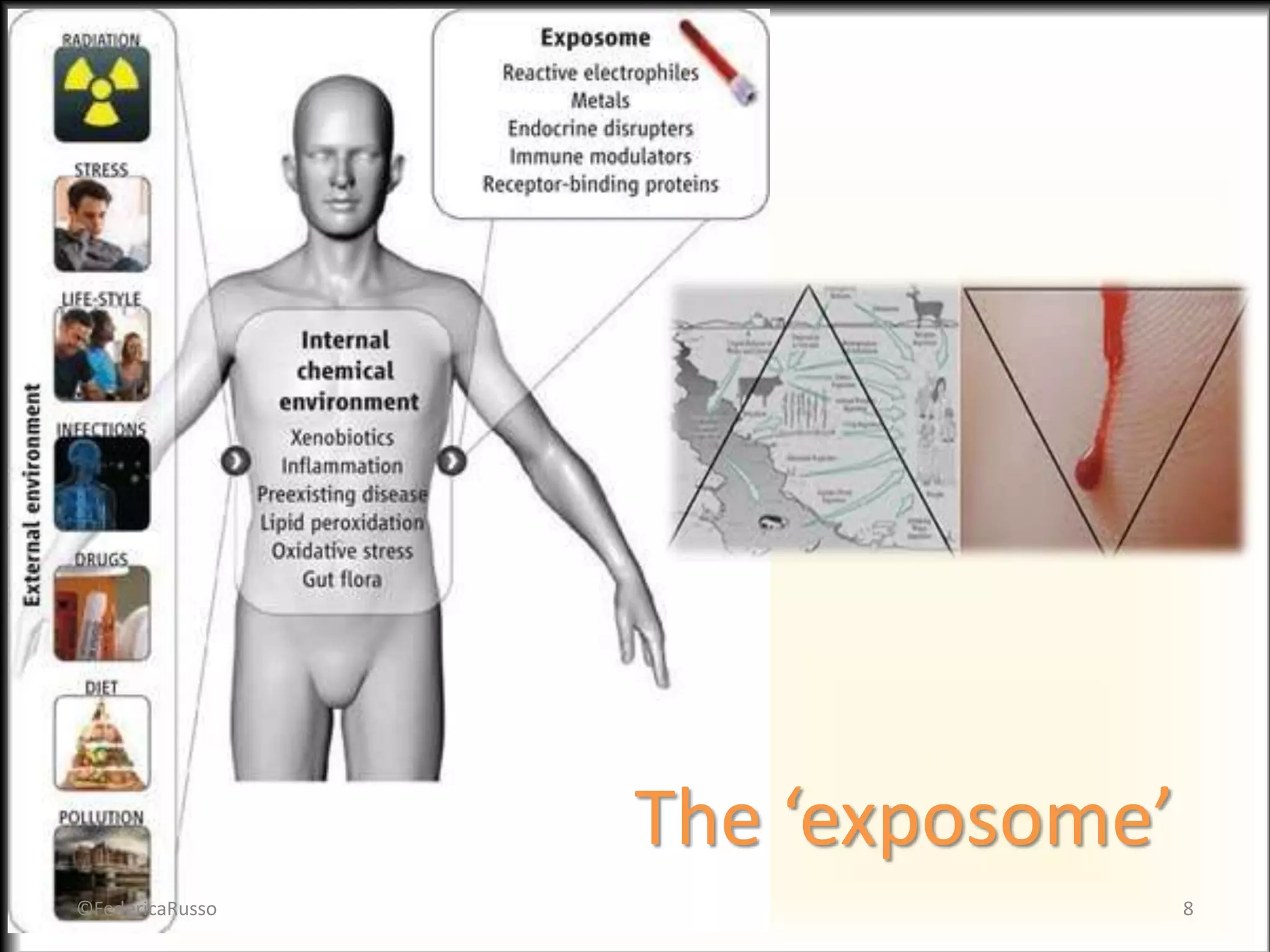
The ‘exposome’
8©FedericaRusso
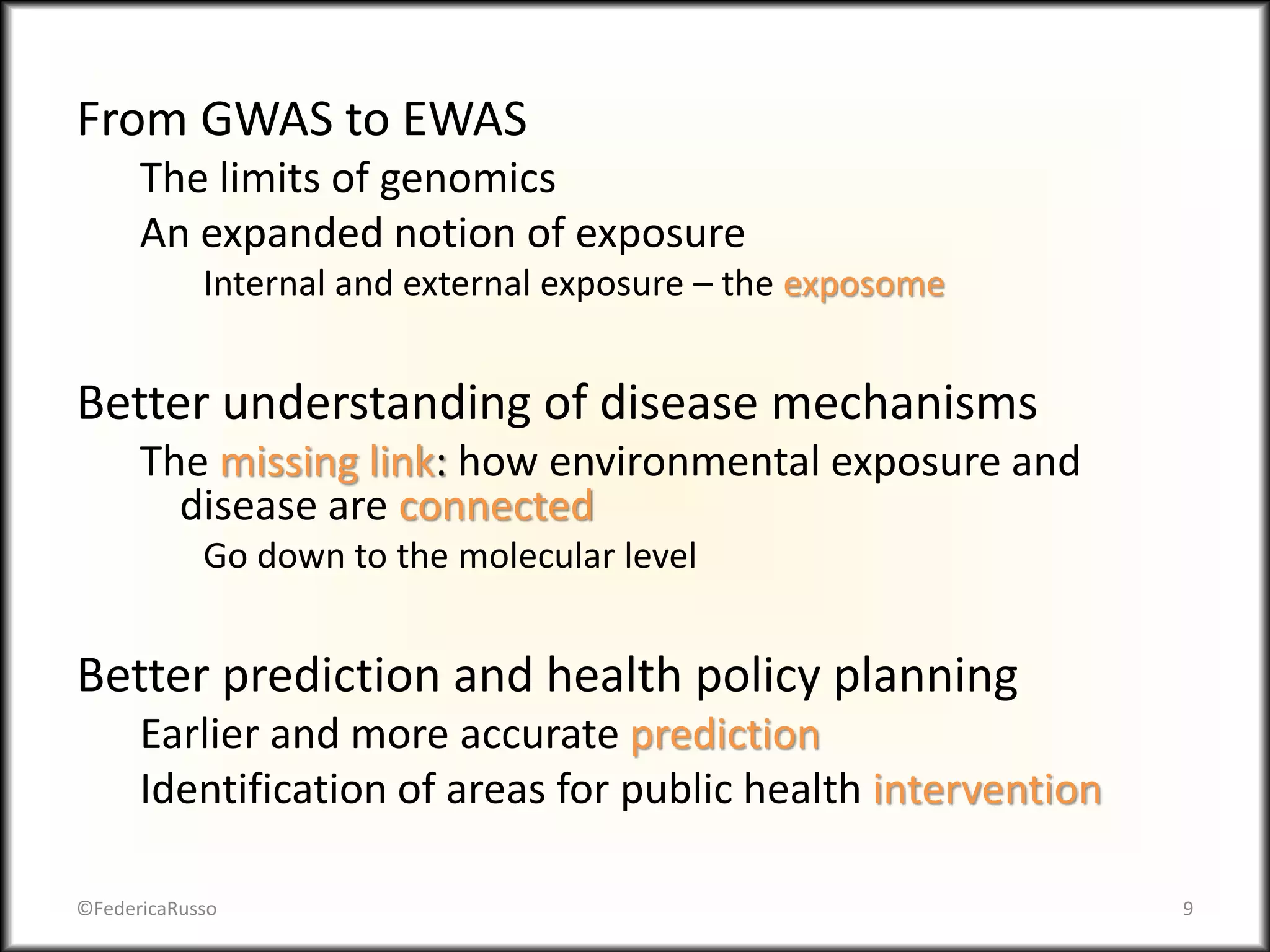
From GWAS to EWAS
The limits of genomics
An expanded notion of exposure
Internal and external exposure – the exposome
Better understanding of disease mechanisms
The missing link: how environmental exposure and
disease are connected
Go down to the molecular level
Better prediction and health policy planning
Earlier and more accurate prediction
Identification of areas for public health intervention
9©FedericaRusso
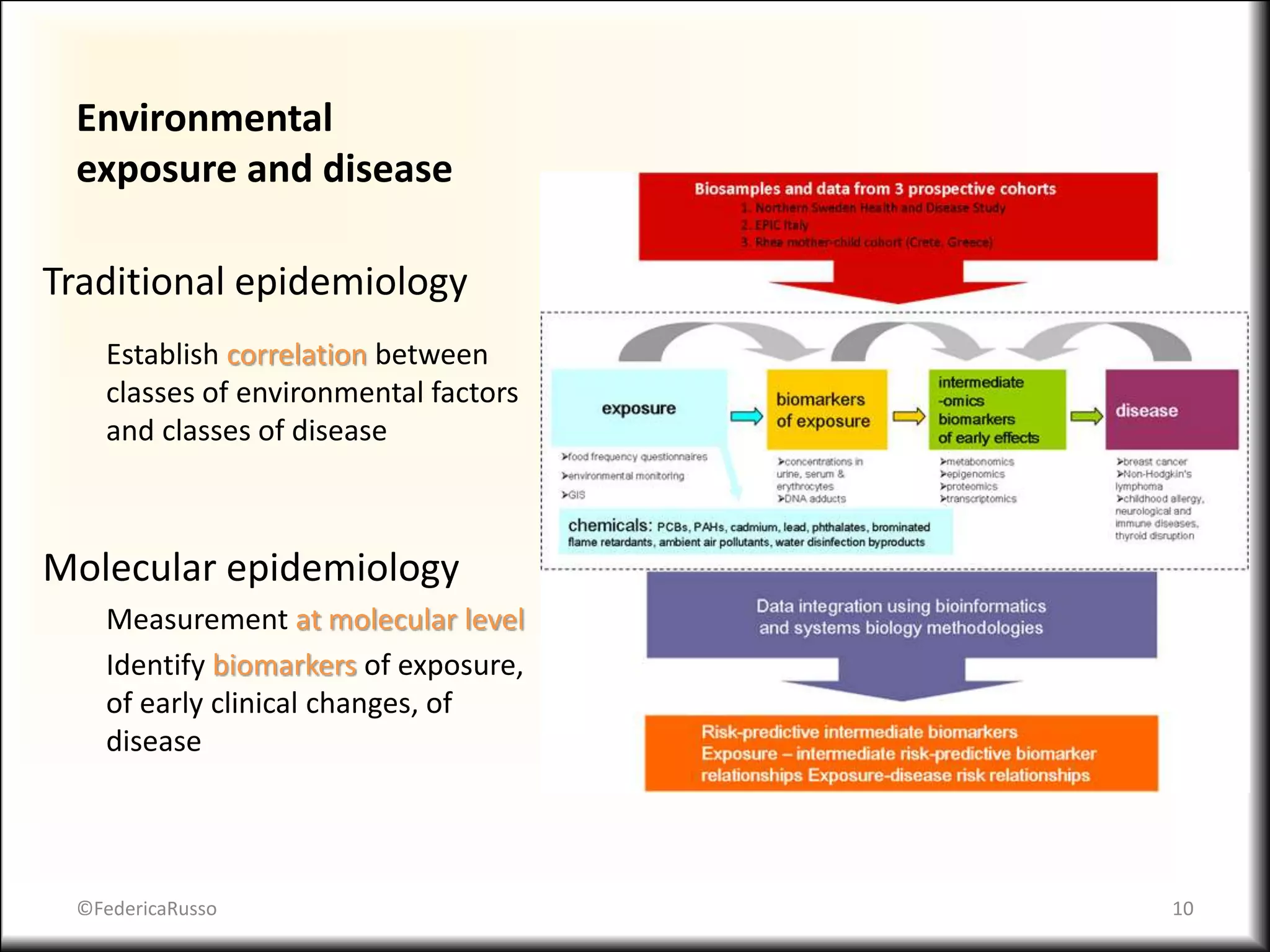
Environmental
exposure and disease
Traditional epidemiology
Establish correlation between
classes of environmental factors
and classes of disease
Molecular epidemiology
Measurement at molecular level
Identify biomarkers of exposure,
of early clinical changes, of
disease
10©FedericaRusso
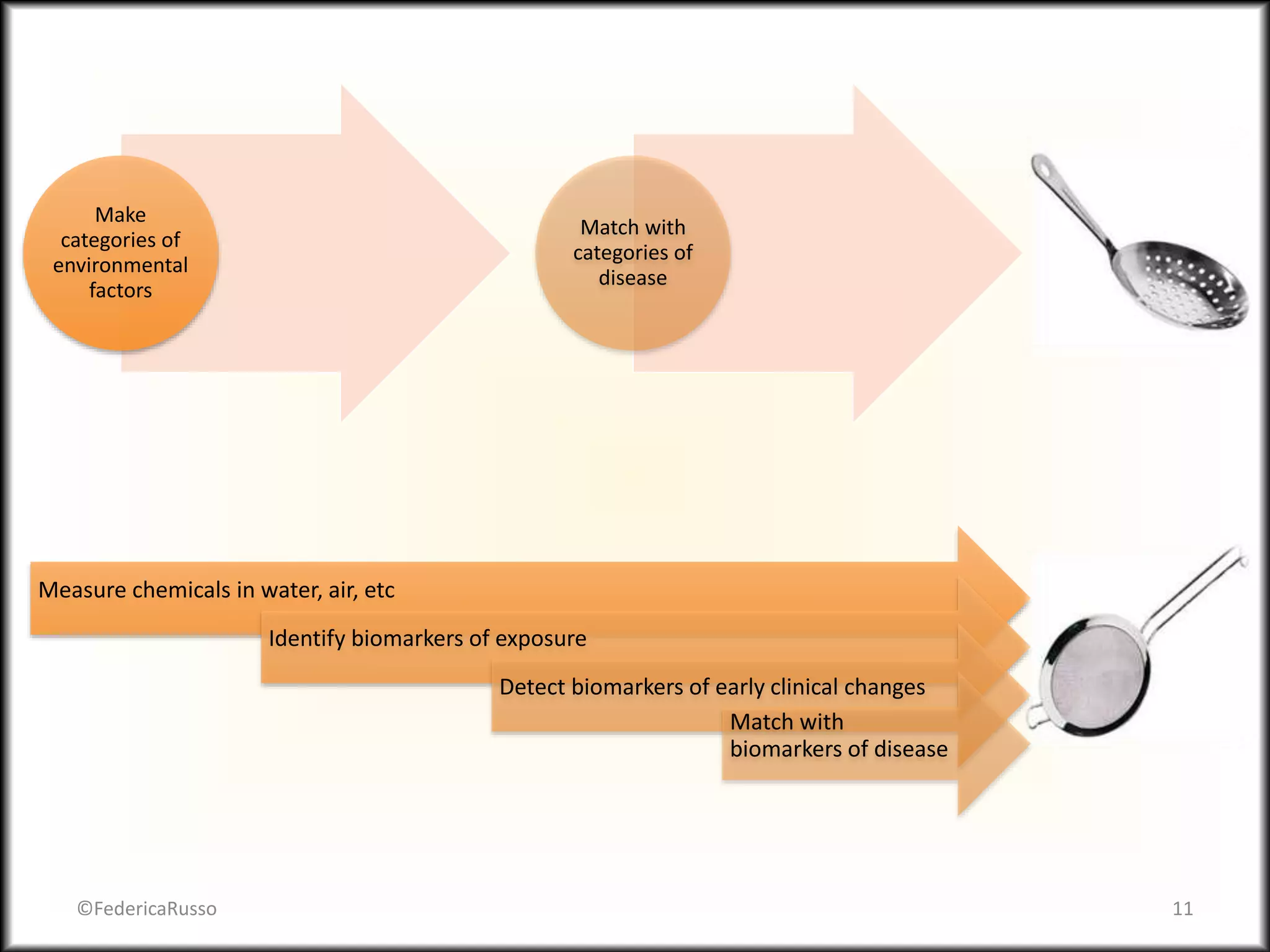
Measure chemicals in water, air, etc
Identify biomarkers of exposure
Detect biomarkers of early clinical changes
Match with
biomarkers of disease
11
Make
categories of
environmental
factors
Match with
categories of
disease
©FedericaRusso
Goals
Identify biomarkers at key stages of disease evolution
Match biomarkers to trace evolution of disease
(meeting-in-the-middle methodology)
Challenges
Understand link <environmental exposure—disease>
Handle unknowns of the system
Torture (big) data sets produced
Identify causal relations in spite of large interaction
effects
Reinterpret micro-links at macro-level
©FedericaRusso 12
Selected epistemological and
metaphysical questions
What evidence?
Mechanisms? Difference-making?
What account of causality?
Information? Capacities?
What ‘levels’?
Generic, single case? Marco, micro? Biological, social?
©FedericaRusso 13
Technology in
exposomics
Sensors, smartphones, GPS
Omic technologies
Liquid chromatography
Mass spectometry
Nuclear magnetic
resonance spectroscopy
…
Statistics softwares
©FedericaRusso 14
Technology—built in—science
Technology is present at every stage of the
scientific process
Data generation > Data collection > Data analysis
©FedericaRusso 15
Reformulating questions
How does technology change the
conceptualisation of
Data / Observation / Experience
Evidence
Causality
Knowledge
…
To answer (some of) these, we need to
revisit the relation between science
and technology
©FedericaRusso 16
SCIENCE⇋TECHNOLOGY
Subordination?
©FedericaRusso 17
Received views
Technology ancillary to science
A heir of the Greek distinction between techne and episteme
A demarcation problem
Science and technology are distinct, and
Science instrumental to creation of technology
[Arageorgis & Baltas, Agassi in the ‘80s]
Technology instrumental to science
Embodiment of science in technology
Instrumental realism
[Hacking, Ihde]
Shift object! From reality to knowledge
©FedericaRusso 18
SCIENCE⥊TECHNOLOGY
Poiesis
©FedericaRusso 19
Detecting signal
Data-driven research
First: produce massive data sets
Then: detect signals in the data
Detect signal to
Establishing meaningful correlations in the data
Tracing information (evolution of biomarkers)
Establishing causal links (between environmental factors and
diseases)
©FedericaRusso 20
Traditional epistemological categories
don’t hold out
Beyond observable / unobservable
We produce data
Beyond traditional (and single-faceted) accounts of causality
Difference-making, production, …, say what causality is, in abstraction of
how know about
Constructionist epistemology
Beyond ‘science-centric’ accounts of (causal) knowledge
Perspectivism
Distributed nature of understanding
©FedericaRusso 21
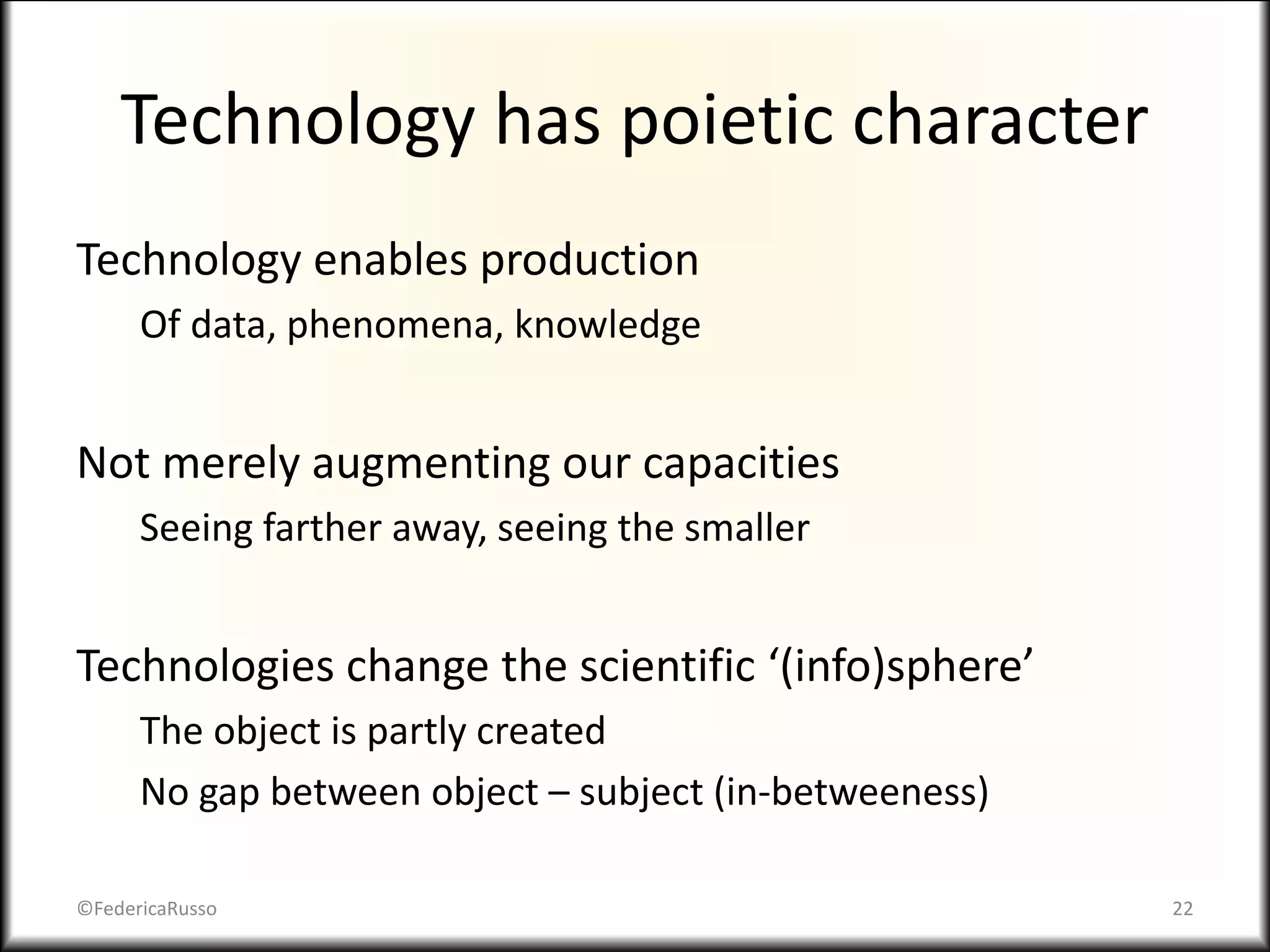
Technology has poietic character
Technology enables production
Of data, phenomena, knowledge
Not merely augmenting our capacities
Seeing farther away, seeing the smaller
Technologies change the scientific ‘(info)sphere’
The object is partly created
No gap between object – subject (in-betweeness)
©FedericaRusso 22
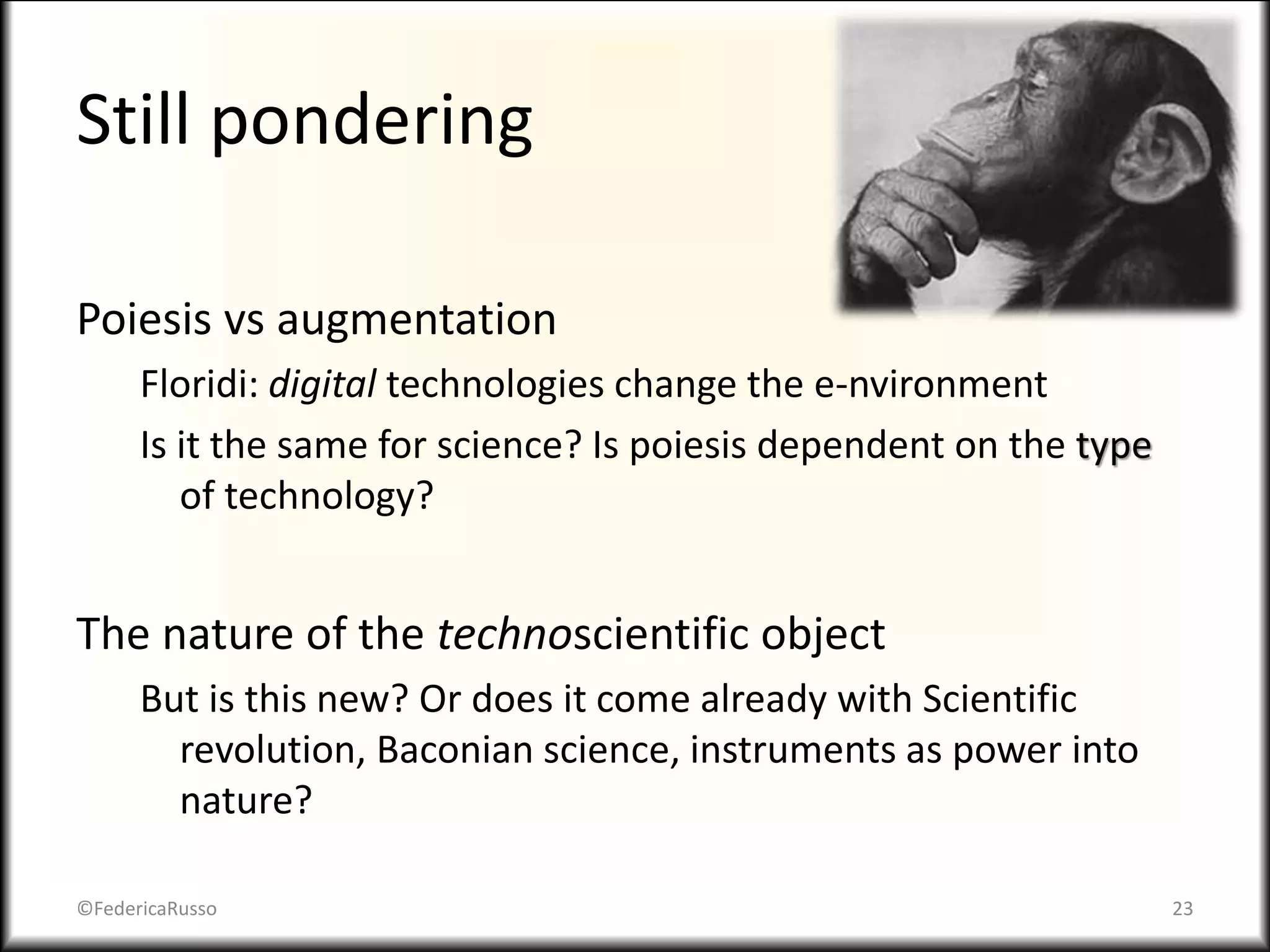
Still pondering
Poiesis vs augmentation
Floridi: digital technologies change the e-nvironment
Is it the same for science? Is poiesis dependent on the type
of technology?
The nature of the technoscientific object
But is this new? Or does it come already with Scientific
revolution, Baconian science, instruments as power into
nature?
©FedericaRusso 23
SUM UP AND CONCLUDE
©FedericaRusso 24
Phil Tech and Phil Sci run on parallel tracks of inquiry
Yet, there seems to be one technoscientific object of study
Technology urges a reformulation of traditional phil sci questions
Traditional phil sci categories don’t hold up the challenges of
technoscience
Poiesis helps understand how knowledge (specifically, causal) is
produced
Not merely scientific nor merely technical, but technoscientific
©FedericaRusso 25

Poietic character of technology

  • 1.
    On the poieticcharacter of technology Federica Russo Universiteit van Amsterdam russofederica.wordpress.com | @federicarusso
  • 2.
    Overview Phil Sci andPhil Tech Parallel tracks to investigate the same object? The case of EXPOsOMICS How technology leads us to reformulating questions Revisiting the relation between science and technology Subordination Poiesis ©FedericaRusso 2
  • 3.
    PHIL SCI ANDPHIL TECH: ONE OBJECT, TWO DISCIPLINES? ©FedericaRusso 3
  • 4.
    Two disciplines? Different professionalsocieties Low permeable conferences Specialised journals and publication venues Few joint job descriptions and study programmes … ©FedericaRusso 4
  • 5.
    How many ‘objects’? Discipline-specificquestions for science and technology? Techno-science: can we still separate them? Examples abound Data intensive science; lab experiments; even social science ©FedericaRusso 5
  • 6.
    Towards a multifaceteddiscipline? Society for Philosophy of Science in Practice Journal: Philosophy and Technology Symposia on Philosophy of Interdisciplinarity in various conferences … ©FedericaRusso 6
  • 7.
  • 8.
  • 9.
    From GWAS toEWAS The limits of genomics An expanded notion of exposure Internal and external exposure – the exposome Better understanding of disease mechanisms The missing link: how environmental exposure and disease are connected Go down to the molecular level Better prediction and health policy planning Earlier and more accurate prediction Identification of areas for public health intervention 9©FedericaRusso
  • 10.
    Environmental exposure and disease Traditionalepidemiology Establish correlation between classes of environmental factors and classes of disease Molecular epidemiology Measurement at molecular level Identify biomarkers of exposure, of early clinical changes, of disease 10©FedericaRusso
  • 11.
    Measure chemicals inwater, air, etc Identify biomarkers of exposure Detect biomarkers of early clinical changes Match with biomarkers of disease 11 Make categories of environmental factors Match with categories of disease ©FedericaRusso
  • 12.
    Goals Identify biomarkers atkey stages of disease evolution Match biomarkers to trace evolution of disease (meeting-in-the-middle methodology) Challenges Understand link <environmental exposure—disease> Handle unknowns of the system Torture (big) data sets produced Identify causal relations in spite of large interaction effects Reinterpret micro-links at macro-level ©FedericaRusso 12
  • 13.
    Selected epistemological and metaphysicalquestions What evidence? Mechanisms? Difference-making? What account of causality? Information? Capacities? What ‘levels’? Generic, single case? Marco, micro? Biological, social? ©FedericaRusso 13
  • 14.
    Technology in exposomics Sensors, smartphones,GPS Omic technologies Liquid chromatography Mass spectometry Nuclear magnetic resonance spectroscopy … Statistics softwares ©FedericaRusso 14
  • 15.
    Technology—built in—science Technology ispresent at every stage of the scientific process Data generation > Data collection > Data analysis ©FedericaRusso 15
  • 16.
    Reformulating questions How doestechnology change the conceptualisation of Data / Observation / Experience Evidence Causality Knowledge … To answer (some of) these, we need to revisit the relation between science and technology ©FedericaRusso 16
  • 17.
  • 18.
    Received views Technology ancillaryto science A heir of the Greek distinction between techne and episteme A demarcation problem Science and technology are distinct, and Science instrumental to creation of technology [Arageorgis & Baltas, Agassi in the ‘80s] Technology instrumental to science Embodiment of science in technology Instrumental realism [Hacking, Ihde] Shift object! From reality to knowledge ©FedericaRusso 18
  • 19.
  • 20.
    Detecting signal Data-driven research First:produce massive data sets Then: detect signals in the data Detect signal to Establishing meaningful correlations in the data Tracing information (evolution of biomarkers) Establishing causal links (between environmental factors and diseases) ©FedericaRusso 20
  • 21.
    Traditional epistemological categories don’thold out Beyond observable / unobservable We produce data Beyond traditional (and single-faceted) accounts of causality Difference-making, production, …, say what causality is, in abstraction of how know about Constructionist epistemology Beyond ‘science-centric’ accounts of (causal) knowledge Perspectivism Distributed nature of understanding ©FedericaRusso 21
  • 22.
    Technology has poieticcharacter Technology enables production Of data, phenomena, knowledge Not merely augmenting our capacities Seeing farther away, seeing the smaller Technologies change the scientific ‘(info)sphere’ The object is partly created No gap between object – subject (in-betweeness) ©FedericaRusso 22
  • 23.
    Still pondering Poiesis vsaugmentation Floridi: digital technologies change the e-nvironment Is it the same for science? Is poiesis dependent on the type of technology? The nature of the technoscientific object But is this new? Or does it come already with Scientific revolution, Baconian science, instruments as power into nature? ©FedericaRusso 23
  • 24.
    SUM UP ANDCONCLUDE ©FedericaRusso 24
  • 25.
    Phil Tech andPhil Sci run on parallel tracks of inquiry Yet, there seems to be one technoscientific object of study Technology urges a reformulation of traditional phil sci questions Traditional phil sci categories don’t hold up the challenges of technoscience Poiesis helps understand how knowledge (specifically, causal) is produced Not merely scientific nor merely technical, but technoscientific ©FedericaRusso 25