Medicine and
the Philosophy of Science
Federica Russo
Philosophy | Humanities | Amsterdam
russofederica.wordpress.com | @federicarusso
Staff for a
New University
@rethinkuva
Rethink UvA
2
Overview
What Medicine? What Philosophy of Science?
Causation in phil sci and in medicine
Networks of concepts, mosaics
3
MEDICINE
4
Medicine in the broadest terms
Include all clinical, scientific, and political forms
of engagement with health and disease
Not just biomedicine
Not just EBM
5
Medicine as a ‘disunion’
Include forms of practice sometimes not recognised as
’medicine’, e.g.:
Clinical practice, including primary care and hospital medicine
Preventive medicine and public health (more policy-oriented)
Epidemiology
Aim to capture major theories and approaches, including:
Evidence-based practice and associated practice like guideline
development and evidence reviews
Narrative medicine
Personalised medicine
Gender medicine
6
PHILOSOPHY OF SCIENCE
7
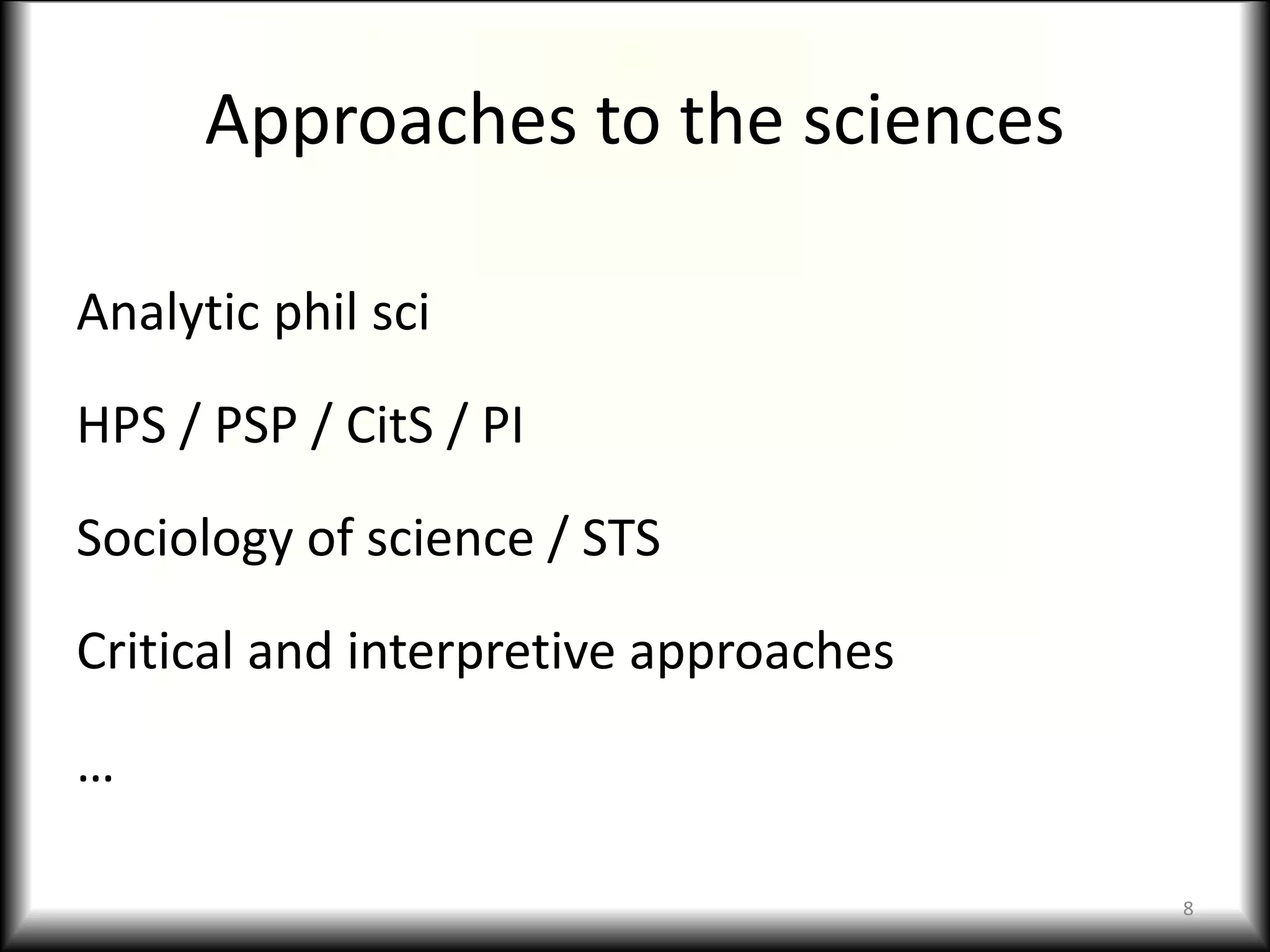
Approaches to the sciences
Analytic phil sci
HPS / PSP / CitS / PI
Sociology of science / STS
Critical and interpretive approaches
…
8
MEDICINE BELONGS TO SCIENCE
9
(Some) phil sci questions in medicine
The method
Modes of explanation
Sources of evidence
Knowledge and action
10
The end of RCT predominance?
The quantitative turn in medicine (and beyond)
Any role for qualitative observations and
studies?
Integration rather than competition?
11
What kind of phenomena are
health & disease?
The biologisation, molecularisation, and
personalisation of disease
Any role for social, psychological, behavioural
factors?
Integration rather than distinction?
12
Conceptualising and explaining
health & disease
Aetiology
Causes of disease, of recovery, of well being
(Causal) Mechanisms
Of disease development, of drug action, of the
individual’s environment
13
Where we should we get
the relevant information?
Surveys, interviews, case reports, …
Evidence of
Correlation / difference-making
Mechanisms (functioning)
14
What you do if you knew that…
‘How much’ must / should we
Establish before claiming that we understand
Health, disease, treatments
Know before we take appropriate action
Individual treatments and public health interventions
Wait before we implement changes
Adverse drug reactions, ineffective treatments, …
15
CAUSALITY
16
Phil Sci approaches to causality
A straightjacket to bridle phenomena?
Traditional accounts
In search of univocal definitions
Applicable anywhere
Or a lens through which reading scientific methods?
CitS / PSP / PI
In search for networks of concepts
Respond to scientific / philosophical / societal challenges
17
Philosophical fields expanding
Philosophy of medicine
From medical ethics and
definition of disease to
epistemology and
methodology of medicine
Philosophy of causation
From finding THE ONE
definition of causation to
understanding the role of
causal notions in several
scientific practices
Causation in medicine:
Provide an understanding of many ways in which
medicine studies and intervenes
on causes and effects of health and disease
18
CAUSATION IN MEDICINE
19
Causal mosaics
A reconstruction of how causal questions arise
in medicine
Making philosophical / methodological /
practical sense of them
20
What does it look like?
A dynamic picture that includes ‘tiles’ about:
Scientific challenges
Inference, explanation, prediction, control, reasoning
Philosophical questions
Metaphysics, epistemology, methodology, semantics, use
Specific accounts
Counterfactuals, mechanisms, processes, probabilities,
information, agency, INUS, variation, regularity, …
21
3: (SOME) CAUSAL THEORIES
© Clarke & Russo 22Causation in Medicine
Inference, Prediction, Explanation,
Control, Reasoning
Tiles
For a
Causal Mosaic
Metaphysics, Semantics,
Epistemology, Methodology, Use
Necessary
and
sufficient Levels
Evidence
Probabilistic
causality
Counter-
factuals
Manipula-
tion
Invariance
Exogeneity
Simpson’s
Paradox
ProcessMechanism
Information
Dispositions
Regularity
Variation
Action
Inference
Validity
Truth
WHO COMES FIRST?
23
None does!
We need to understand how they are connected
24
EVALUATING MECHANISMS IN
MEDICINE
AHRC project
25
Research Questions
Overarching research question [Q]:
How can evidence of mechanisms be considered
alongside evidence of correlation to evaluate
causal claims in medical research and health
policy?
The answer to this overarching question will build
on answers to following questions:
[EM: Evidence of Mechanisms]:
What is evidence of a mechanism, and how do we
get it?
[QE: Quality of Evidence]:
How can quality of evidence be characterised?
[PC: Philosophy of Causality]:
Which accounts of causality best fit the
programme for integrating evidence of
mechanisms with evidence of correlation?
26
People
Christian Wallmann, Michael Wilde, Jon Williamson
Centre for Reasoning, University of Kent
Brendan Clarke, Donald Gillies, Phyllis Illari
Department of Science and Technology Studies,
University College London (UCL)
Federica Russo
Department of Philosophy, University of
Amsterdam (UvA)
Partners
The National Institute for Health and Clinical
Excellence (NICE)
The International Agency for Research on Cancer
(IARC)
The Institute of Public Health at Cambridge
University
The Medical School at Leiden University
27
TO SUM UP AND CONCLUDE
28
Expanding domains
Philosophy of Science
Beyond – and back – to more inclusive ways of
studying science
(Philosophy of) Medicine
Beyond questions about ethics, closer to concerns
of phil sci
29
A convergence of interests
Medicine
and the
Philosophy
of Science
Methods and
concepts of
medicine
• RCTs, mechanisms,
evidence, …
Conceptualisations
of health & disease
• Bio-social
phenomena, …
Societal relevance
• The value of the
humanities, …
30

Russo unam-1

  • 1.
    Medicine and the Philosophyof Science Federica Russo Philosophy | Humanities | Amsterdam russofederica.wordpress.com | @federicarusso
  • 2.
    Staff for a NewUniversity @rethinkuva Rethink UvA 2
  • 3.
    Overview What Medicine? WhatPhilosophy of Science? Causation in phil sci and in medicine Networks of concepts, mosaics 3
  • 4.
  • 5.
    Medicine in thebroadest terms Include all clinical, scientific, and political forms of engagement with health and disease Not just biomedicine Not just EBM 5
  • 6.
    Medicine as a‘disunion’ Include forms of practice sometimes not recognised as ’medicine’, e.g.: Clinical practice, including primary care and hospital medicine Preventive medicine and public health (more policy-oriented) Epidemiology Aim to capture major theories and approaches, including: Evidence-based practice and associated practice like guideline development and evidence reviews Narrative medicine Personalised medicine Gender medicine 6
  • 7.
  • 8.
    Approaches to thesciences Analytic phil sci HPS / PSP / CitS / PI Sociology of science / STS Critical and interpretive approaches … 8
  • 9.
  • 10.
    (Some) phil sciquestions in medicine The method Modes of explanation Sources of evidence Knowledge and action 10
  • 11.
    The end ofRCT predominance? The quantitative turn in medicine (and beyond) Any role for qualitative observations and studies? Integration rather than competition? 11
  • 12.
    What kind ofphenomena are health & disease? The biologisation, molecularisation, and personalisation of disease Any role for social, psychological, behavioural factors? Integration rather than distinction? 12
  • 13.
    Conceptualising and explaining health& disease Aetiology Causes of disease, of recovery, of well being (Causal) Mechanisms Of disease development, of drug action, of the individual’s environment 13
  • 14.
    Where we shouldwe get the relevant information? Surveys, interviews, case reports, … Evidence of Correlation / difference-making Mechanisms (functioning) 14
  • 15.
    What you doif you knew that… ‘How much’ must / should we Establish before claiming that we understand Health, disease, treatments Know before we take appropriate action Individual treatments and public health interventions Wait before we implement changes Adverse drug reactions, ineffective treatments, … 15
  • 16.
  • 17.
    Phil Sci approachesto causality A straightjacket to bridle phenomena? Traditional accounts In search of univocal definitions Applicable anywhere Or a lens through which reading scientific methods? CitS / PSP / PI In search for networks of concepts Respond to scientific / philosophical / societal challenges 17
  • 18.
    Philosophical fields expanding Philosophyof medicine From medical ethics and definition of disease to epistemology and methodology of medicine Philosophy of causation From finding THE ONE definition of causation to understanding the role of causal notions in several scientific practices Causation in medicine: Provide an understanding of many ways in which medicine studies and intervenes on causes and effects of health and disease 18
  • 19.
  • 20.
    Causal mosaics A reconstructionof how causal questions arise in medicine Making philosophical / methodological / practical sense of them 20
  • 21.
    What does itlook like? A dynamic picture that includes ‘tiles’ about: Scientific challenges Inference, explanation, prediction, control, reasoning Philosophical questions Metaphysics, epistemology, methodology, semantics, use Specific accounts Counterfactuals, mechanisms, processes, probabilities, information, agency, INUS, variation, regularity, … 21
  • 22.
    3: (SOME) CAUSALTHEORIES © Clarke & Russo 22Causation in Medicine Inference, Prediction, Explanation, Control, Reasoning Tiles For a Causal Mosaic Metaphysics, Semantics, Epistemology, Methodology, Use Necessary and sufficient Levels Evidence Probabilistic causality Counter- factuals Manipula- tion Invariance Exogeneity Simpson’s Paradox ProcessMechanism Information Dispositions Regularity Variation Action Inference Validity Truth
  • 23.
  • 24.
    None does! We needto understand how they are connected 24
  • 25.
  • 26.
    Research Questions Overarching researchquestion [Q]: How can evidence of mechanisms be considered alongside evidence of correlation to evaluate causal claims in medical research and health policy? The answer to this overarching question will build on answers to following questions: [EM: Evidence of Mechanisms]: What is evidence of a mechanism, and how do we get it? [QE: Quality of Evidence]: How can quality of evidence be characterised? [PC: Philosophy of Causality]: Which accounts of causality best fit the programme for integrating evidence of mechanisms with evidence of correlation? 26
  • 27.
    People Christian Wallmann, MichaelWilde, Jon Williamson Centre for Reasoning, University of Kent Brendan Clarke, Donald Gillies, Phyllis Illari Department of Science and Technology Studies, University College London (UCL) Federica Russo Department of Philosophy, University of Amsterdam (UvA) Partners The National Institute for Health and Clinical Excellence (NICE) The International Agency for Research on Cancer (IARC) The Institute of Public Health at Cambridge University The Medical School at Leiden University 27
  • 28.
    TO SUM UPAND CONCLUDE 28
  • 29.
    Expanding domains Philosophy ofScience Beyond – and back – to more inclusive ways of studying science (Philosophy of) Medicine Beyond questions about ethics, closer to concerns of phil sci 29
  • 30.
    A convergence ofinterests Medicine and the Philosophy of Science Methods and concepts of medicine • RCTs, mechanisms, evidence, … Conceptualisations of health & disease • Bio-social phenomena, … Societal relevance • The value of the humanities, … 30

Editor's Notes

  • #2 In the last decade or so philosophers of science started paying attention to medicine, broadly construed. Before, medicine was primarily in the target of ethicists or anthropologists, but not so much philosophers of science. Conversely, philosophy of science was - before - occupied with questions arising in the natural sciences and, to a lesser extent, to the social sciences. In this talk I offer an overview of the main questions occupying the debate and I explain why this turn in philosophy of science is noteworthy. 
  • #19 Motivate need to discuss ‘causation in medicine’. Understanding it with respect to the crossing of two fields: phil med and phil cause I’d like to make a comment here about things that philmed in general could usefully acquire from causation in medicine. Definitions of disease as paradigm case (after Caplan): neither of interest to practitioners, nor philosophers more generally.