
Venepuncture


  TI CMPP:CANNU&VENE 0019/09
                 Brought to    you by Trust Interventions
Venepuncture is the procedure of inserting a needle
    into a vein, usually to obtain blood

 In order to do this safely the student must:
1.    Know the relevant anatomy and physiology
2.    Understand the criteria for selection of an appropriate vein and
      device
3.    Appreciate potential problems that may occur
4.    Have an awareness of associated Health and Safety/ risks
      involved in undertaking the procedure and correct disposal of
      equipment


                        TI CMPP:CANNU&VENE 0019/09
Indications
• To obtain blood for diagnostic purposes

• To establish/ monitor levels of blood components

• To establish/ monitor levels of drugs

• To monitor response to medical treatments (e.g. fluids)

• To provide a sample to cross match prior to transfusion

• To screen for infection


                       TI CMPP:CANNU&VENE 0019/09
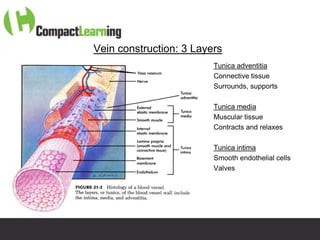
Vein construction: 3 Layers
                                 Tunica adventitia
                                 Connective tissue
                                 Surrounds, supports

                                 Tunica media
                                 Muscular tissue
                                 Contracts and relaxes

                                 Tunica intima
                                 Smooth endothelial cells
                                 Valves


    TI CMPP:CANNU&VENE 0019/09
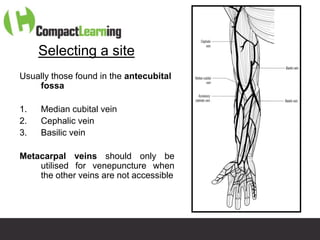
Selecting a site
Usually those found in the antecubital
    fossa

1.   Median cubital vein
2.   Cephalic vein
3.   Basilic vein

Metacarpal veins should only be
    utilised for venepuncture when
    the other veins are not accessible


                       TI CMPP:CANNU&VENE 0019/09
Choosing a vein
•   Accessible
•   Unused
•   Easily detected
•   Appears healthy and patent

    The most prominent vein is not necessarily the most
    suitable vein

              -Visual inspection
              -Palpation

                    TI CMPP:CANNU&VENE 0019/09
Visually scrutinise the veins in both arms, avoiding:
• Evidence of infection, bruising and phlebitis
• An oedematous limb where there is status of lymph
• Areas of previous venepuncture. Repeated trauma
  causes pain

Palpate veins too:
• Distinguish vein from arteries and tendons
• Identify deeper veins and presence of valves
• Use index finger, or fore finger, not thumb
• Healthy veins are soft, bouncy and refill when depressed
                   TI CMPP:CANNU&VENE 0019/09
Other factors influencing vein selection
? Injury, disease or treatment
? Position of patient
? Age of patient
? Weight of the patient
? Dehydration or Shock
? Medication/ condition that causes excessive bleeding or
  delayed clotting (anticoagulants, steroids,
  thrombocytopenia)
? Fear
                   TI CMPP:CANNU&VENE 0019/09
Hazards/ Risks
• Infection- adherence to an aseptic technique (thorough hand
  washing and use of alcohol gel) required. Performed with single use
  equipment, non- sterile gloves may be worn.
• Accidental damage- inadvertently punctured nerve, tendon or artery.
  Spend time undertaking visual inspection and palpation.
• Haematoma- Caused by poor technique, failure to remove the
  tourniquet before removing the needle and inadequate pressure on
  the site. Patient/ Client must not flex arm on completion of the
  procedure. Identify those with relevant medical history/ drug therapy.


                       TI CMPP:CANNU&VENE 0019/09
Associated hazards
• Incorrect or lack of details on request form and/or sample-
  Increases likelihood of errors occurring. Sample will be rejected by
  lab, necessitating repetition of the procedure. Always check details
  with patient, request form and sample correspond.
• Insufficient sample/ wrong specimen bottle- necessitating
  repetition.
• Needlestick injury- correct use of Vacutainer system and Sharps
  policy help reduce this.
• Infected/ ‘High risk’ samples- correctly identified as such through
  labelling so all those involved with handling are aware.


                       TI CMPP:CANNU&VENE 0019/09
Equipment list…..
Sharps bin
Procedure tray
Non-sterile gloves
Apron
Vacutainer device/ needle
Tourniquet
Alcohol hand gel
Patient identification labels
Specimen request
Specimen bottle
Gauze/ swab


  TI CMPP:CANNU&VENE 0019/09
Procedure

•   Correctly identifies patient/ gains consent
•   Hand washing/ use of alcohol gel
•   Supports chosen limb
•   Applies Tourniquet
•   Selects appropriate vein


                     TI CMPP:CANNU&VENE 0019/09
Technique

• Anchor vein
• Verbally warn patient
• Insert needle smoothly at angle of 15-30 degrees with bevel upwards
• Level off needle and advance approx 1mm
• Push specimen bottle into heamguard
• Allow vacutainer to fill specimen bottle
• Gently but firmly remove bottle
• Remove tourniquet
• Cover puncture site with gauze, remove needle, dispose of needle
  into sharps bin
• Apply pressure to straight arm, apply plaster
• Correctly label sample


                       TI CMPP:CANNU&VENE 0019/09
References and further reading
Nottingham City Hospital/ queens Medical Centre/ Rushcliffe PCT Nursing
   Practice Guidelines (2004) Venepuncture using the Vacutainer System
   (*Accessible on Hospital intranet- contains extensive further reading list)

Nottingham City Hospital/ Queens Medical Centre Nottingham ‘Working in
   New Ways’ (2004) Venepuncture and Cannulation: An educational Self-
   directed Package for Registered Nurses, Midwives and Non- registered
   staff.

Johnson and Johnson (1997) Practical Guide to Peripheral Cannulation

R.Seeley, T Stephens, P.Tate (1988) Anatomy and Physiology


                         TI CMPP:CANNU&VENE 0019/09

Venepuncture ad

  • 1.
    Venepuncture TICMPP:CANNU&VENE 0019/09 Brought to you by Trust Interventions
  • 2.
    Venepuncture is theprocedure of inserting a needle into a vein, usually to obtain blood In order to do this safely the student must: 1. Know the relevant anatomy and physiology 2. Understand the criteria for selection of an appropriate vein and device 3. Appreciate potential problems that may occur 4. Have an awareness of associated Health and Safety/ risks involved in undertaking the procedure and correct disposal of equipment TI CMPP:CANNU&VENE 0019/09
  • 3.
    Indications • To obtainblood for diagnostic purposes • To establish/ monitor levels of blood components • To establish/ monitor levels of drugs • To monitor response to medical treatments (e.g. fluids) • To provide a sample to cross match prior to transfusion • To screen for infection TI CMPP:CANNU&VENE 0019/09
  • 4.
    Vein construction: 3Layers Tunica adventitia Connective tissue Surrounds, supports Tunica media Muscular tissue Contracts and relaxes Tunica intima Smooth endothelial cells Valves TI CMPP:CANNU&VENE 0019/09
  • 5.
    Selecting a site Usuallythose found in the antecubital fossa 1. Median cubital vein 2. Cephalic vein 3. Basilic vein Metacarpal veins should only be utilised for venepuncture when the other veins are not accessible TI CMPP:CANNU&VENE 0019/09
  • 6.
    Choosing a vein • Accessible • Unused • Easily detected • Appears healthy and patent The most prominent vein is not necessarily the most suitable vein -Visual inspection -Palpation TI CMPP:CANNU&VENE 0019/09
  • 7.
    Visually scrutinise theveins in both arms, avoiding: • Evidence of infection, bruising and phlebitis • An oedematous limb where there is status of lymph • Areas of previous venepuncture. Repeated trauma causes pain Palpate veins too: • Distinguish vein from arteries and tendons • Identify deeper veins and presence of valves • Use index finger, or fore finger, not thumb • Healthy veins are soft, bouncy and refill when depressed TI CMPP:CANNU&VENE 0019/09
  • 8.
    Other factors influencingvein selection ? Injury, disease or treatment ? Position of patient ? Age of patient ? Weight of the patient ? Dehydration or Shock ? Medication/ condition that causes excessive bleeding or delayed clotting (anticoagulants, steroids, thrombocytopenia) ? Fear TI CMPP:CANNU&VENE 0019/09
  • 9.
    Hazards/ Risks • Infection-adherence to an aseptic technique (thorough hand washing and use of alcohol gel) required. Performed with single use equipment, non- sterile gloves may be worn. • Accidental damage- inadvertently punctured nerve, tendon or artery. Spend time undertaking visual inspection and palpation. • Haematoma- Caused by poor technique, failure to remove the tourniquet before removing the needle and inadequate pressure on the site. Patient/ Client must not flex arm on completion of the procedure. Identify those with relevant medical history/ drug therapy. TI CMPP:CANNU&VENE 0019/09
  • 10.
    Associated hazards • Incorrector lack of details on request form and/or sample- Increases likelihood of errors occurring. Sample will be rejected by lab, necessitating repetition of the procedure. Always check details with patient, request form and sample correspond. • Insufficient sample/ wrong specimen bottle- necessitating repetition. • Needlestick injury- correct use of Vacutainer system and Sharps policy help reduce this. • Infected/ ‘High risk’ samples- correctly identified as such through labelling so all those involved with handling are aware. TI CMPP:CANNU&VENE 0019/09
  • 11.
    Equipment list….. Sharps bin Proceduretray Non-sterile gloves Apron Vacutainer device/ needle Tourniquet Alcohol hand gel Patient identification labels Specimen request Specimen bottle Gauze/ swab TI CMPP:CANNU&VENE 0019/09
  • 12.
    Procedure • Correctly identifies patient/ gains consent • Hand washing/ use of alcohol gel • Supports chosen limb • Applies Tourniquet • Selects appropriate vein TI CMPP:CANNU&VENE 0019/09
  • 13.
    Technique • Anchor vein •Verbally warn patient • Insert needle smoothly at angle of 15-30 degrees with bevel upwards • Level off needle and advance approx 1mm • Push specimen bottle into heamguard • Allow vacutainer to fill specimen bottle • Gently but firmly remove bottle • Remove tourniquet • Cover puncture site with gauze, remove needle, dispose of needle into sharps bin • Apply pressure to straight arm, apply plaster • Correctly label sample TI CMPP:CANNU&VENE 0019/09
  • 14.
    References and furtherreading Nottingham City Hospital/ queens Medical Centre/ Rushcliffe PCT Nursing Practice Guidelines (2004) Venepuncture using the Vacutainer System (*Accessible on Hospital intranet- contains extensive further reading list) Nottingham City Hospital/ Queens Medical Centre Nottingham ‘Working in New Ways’ (2004) Venepuncture and Cannulation: An educational Self- directed Package for Registered Nurses, Midwives and Non- registered staff. Johnson and Johnson (1997) Practical Guide to Peripheral Cannulation R.Seeley, T Stephens, P.Tate (1988) Anatomy and Physiology TI CMPP:CANNU&VENE 0019/09