




Peripheral Intra venous 
cannula Insertion 
By 
MS.Rajathurai Jeya,RN
Insertion of Peripheral IV Line 
“The aim of intravenous management 
is safe, effective delivery of 
treatment without discomfort or 
tissue damage and without 
compromising venous access, 
especially if long term therapy is 
proposed”
Indications: 
•Fluid and electrolyte replacement 
•Administration of medicines 
•Administration of blood/blood 
products 
•Administration of Total Parenteral 
Nutrition 
•Hemodynamic monitoring, 
Blood sampling
Advantages 
•Immediate effect 
•Control over the rate of administration 
•Patient cannot tolerate drugs / fluids 
orally 
•Some drugs cannot be absorbed by any 
other route 
•Pain and irritation is avoided compared to 
some substances when given SC/IM
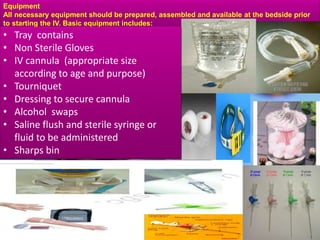
Equipment 
All necessary equipment should be prepared, assembled and available at the bedside prior 
to starting the IV. Basic equipment includes: 
• Tray contains 
• Non Sterile Gloves 
• IV cannula (appropriate size 
according to age and purpose) 
• Tourniquet 
• Dressing to secure cannula 
• Alcohol swaps 
• Saline flush and sterile syringe or 
fluid to be administered 
• Sharps bin
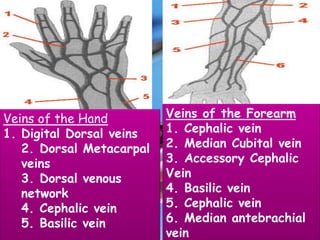
Veins of the Hand 
1. Digital Dorsal veins 
2. Dorsal Metacarpal 
veins 
3. Dorsal venous 
network 
4. Cephalic vein 
5. Basilic vein 
Veins of the Forearm 
1. Cephalic vein 
2. Median Cubital vein 
3. Accessory Cephalic 
Vein 
4. Basilic vein 
5. Cephalic vein 
6. Median antebrachial 
vein
Preparation of the patient and environment: 
• Check and verify the physician’s orders 
• Gather equipment 
• Explain the procedure to the patient 
• Provide privacy 
• Restraint the site, in case of children 
• Check the vital signs and record 
• Adjust the height of the bed for 
comfortable working of the Nurse 
• Place the patient in comfortable position 
• Select a site on a Non –Dominant arm 
• Provide a good source of light 
• Call for assistance if needed
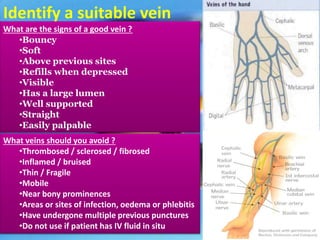
Identify a suitable vein 
What are the signs of a good vein ? 
•Bouncy 
•Soft 
•Above previous sites 
•Refills when depressed 
•Visible 
•Has a large lumen 
•Well supported 
•Straight 
•Easily palpable 
What veins should you avoid ? 
•Thrombosed / sclerosed / fibrosed 
•Inflamed / bruised 
•Thin / Fragile 
•Mobile 
•Near bony prominences 
•Areas or sites of infection, oedema or phlebitis 
•Have undergone multiple previous punctures 
•Do not use if patient has IV fluid in situ
Choose a suitable vein In adults, use long straight 
veins in an upper extremity away from the joints for 
catheter insertion – in preference to sites on the 
lower extremities. If possible avoid veins in the 
dominant hand and use distal veins first. 
Do not insert cannula on the side of MASTECTOMYor 
AV shunts/Gortex. Transfer catheter inserted in a 
lower extremity site to an upper extremity site as 
soon as the latter is available. 
In pediatric patients, it is recommended that the 
cannula be inserted into the scalp, hand, or foot site 
in preference to a leg, arm, or ante cubital fossa site 
(Category II).
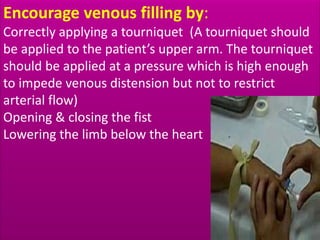
Encourage venous filling by: 
Correctly applying a tourniquet (A tourniquet should 
. 
be applied to the patient’s upper arm. The tourniquet 
should be applied at a pressure which is high enough 
to impede venous distension but not to restrict 
arterial flow) 
Opening & closing the fist 
Lowering the limb below the heart
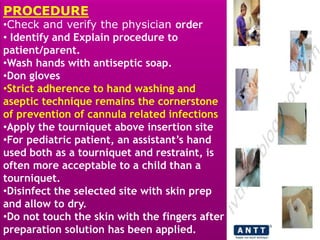
PROCEDURE 
•Check and verify the physician order 
• Identify and Explain procedure to 
. 
patient/parent. 
•Wash hands with antiseptic soap. 
•Don gloves 
•Strict adherence to hand washing and 
aseptic technique remains the cornerstone 
of prevention of cannula related infections 
•Apply the tourniquet above insertion site 
•For pediatric patient, an assistant’s hand 
used both as a tourniquet and restraint, is 
often more acceptable to a child than a 
tourniquet. 
•Disinfect the selected site with skin prep 
and allow to dry. 
•Do not touch the skin with the fingers after 
preparation solution has been applied.
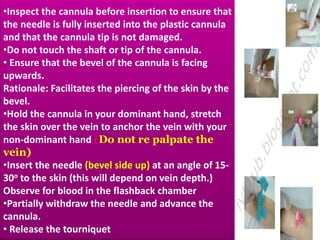
•Inspect the cannula before insertion to ensure that 
the needle is fully inserted into the plastic cannula 
and that the cannula tip is not damaged. 
. 
•Do not touch the shaft or tip of the cannula. 
• Ensure that the bevel of the cannula is facing 
upwards. 
Rationale: Facilitates the piercing of the skin by the 
bevel. 
•Hold the cannula in your dominant hand, stretch 
the skin over the vein to anchor the vein with your 
non-dominant hand (Do not re palpate the 
vein) 
•Insert the needle (bevel side up) at an angle of 15- 
30o to the skin (this will depend on vein depth.) 
Observe for blood in the flashback chamber 
•Partially withdraw the needle and advance the 
cannula. 
• Release the tourniquet
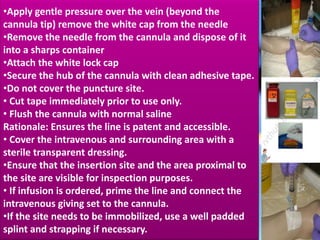
•Apply gentle pressure over the vein (beyond the 
cannula tip) remove the white cap from the needle 
•Remove the needle from the cannula and dispose of it 
. 
into a sharps container 
•Attach the white lock cap 
•Secure the hub of the cannula with clean adhesive tape. 
•Do not cover the puncture site. 
• Cut tape immediately prior to use only. 
• Flush the cannula with normal saline 
Rationale: Ensures the line is patent and accessible. 
• Cover the intravenous and surrounding area with a 
sterile transparent dressing. 
•Ensure that the insertion site and the area proximal to 
the site are visible for inspection purposes. 
• If infusion is ordered, prime the line and connect the 
intravenous giving set to the cannula. 
•If the site needs to be immobilized, use a well padded 
splint and strapping if necessary.
Document the procedure 
. 
including 
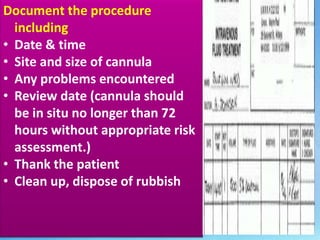
• Date & time 
• Site and size of cannula 
• Any problems encountered 
• Review date (cannula should 
be in situ no longer than 72 
hours without appropriate risk 
assessment.) 
• Thank the patient 
• Clean up, dispose of rubbish
Complications 
.•Inability to identify a vein for catheter placement. 
•Failing to get a “flash” once the catheter is inserted. 
•A flash appears, but there is no further blood flow. 
•Failing to thread the catheter into a vein after the needle is 
retracted. 
•Infiltration; remove the catheter and apply pressure. 
•Kinking of the catheter; usually the catheter must be 
removed. 
•The intravenous (IV) cannula offers direct access to a 
patient's vascular system and provides a potential route for 
entry of micro organisms into that system. These organisms 
can cause serious infection if they are allowed to enter and 
proliferate in the IV cannula, insertion site, or IV fluid.
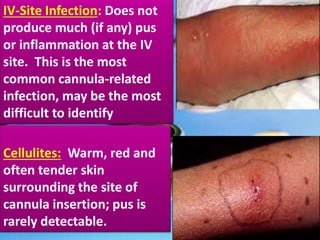
IV-Site Infection: Does not 
. 
produce much (if any) pus 
or inflammation at the IV 
site. This is the most 
common cannula-related 
infection, may be the most 
difficult to identify 
Cellulites: Warm, red and 
often tender skin 
surrounding the site of 
cannula insertion; pus is 
rarely detectable.
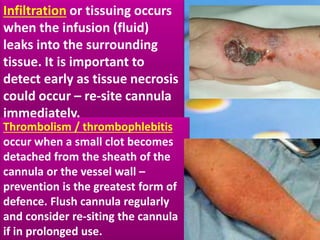
Infiltration or tissuing occurs 
. 
when the infusion (fluid) 
leaks into the surrounding 
tissue. It is important to 
detect early as tissue necrosis 
could occur – re-site cannula 
immediately. 
Thrombolism / thrombophlebitis 
occur when a small clot becomes 
detached from the sheath of the 
cannula or the vessel wall – 
prevention is the greatest form of 
defence. Flush cannula regularly 
and consider re-siting the cannula 
if in prolonged use.
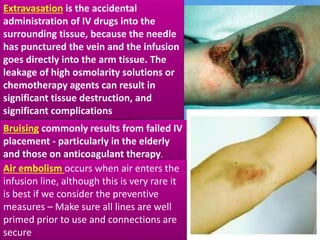
Extravasation is the accidental 
administration of IV drugs into the 
. 
surrounding tissue, because the needle 
has punctured the vein and the infusion 
goes directly into the arm tissue. The 
leakage of high osmolarity solutions or 
chemotherapy agents can result in 
significant tissue destruction, and 
significant complications 
Bruising commonly results from failed IV 
placement - particularly in the elderly 
and those on anticoagulant therapy. 
Air embolism occurs when air enters the 
infusion line, although this is very rare it 
is best if we consider the preventive 
measures – Make sure all lines are well 
primed prior to use and connections are 
secure
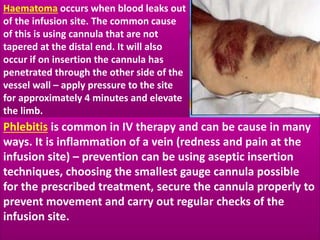
Haematoma occurs when blood leaks out 
of the infusion site. The common cause 
. 
of this is using cannula that are not 
tapered at the distal end. It will also 
occur if on insertion the cannula has 
penetrated through the other side of the 
vessel wall – apply pressure to the site 
for approximately 4 minutes and elevate 
the limb. 
Phlebitis is common in IV therapy and can be cause in many 
ways. It is inflammation of a vein (redness and pain at the 
infusion site) – prevention can be using aseptic insertion 
techniques, choosing the smallest gauge cannula possible 
for the prescribed treatment, secure the cannula properly to 
prevent movement and carry out regular checks of the 
infusion site.
IV CANNULA INSERTION

IV CANNULA INSERTION

  • 1.
    Peripheral Intra venous cannula Insertion By MS.Rajathurai Jeya,RN
  • 2.
    Insertion of PeripheralIV Line “The aim of intravenous management is safe, effective delivery of treatment without discomfort or tissue damage and without compromising venous access, especially if long term therapy is proposed”
  • 3.
    Indications: •Fluid andelectrolyte replacement •Administration of medicines •Administration of blood/blood products •Administration of Total Parenteral Nutrition •Hemodynamic monitoring, Blood sampling
  • 4.
    Advantages •Immediate effect •Control over the rate of administration •Patient cannot tolerate drugs / fluids orally •Some drugs cannot be absorbed by any other route •Pain and irritation is avoided compared to some substances when given SC/IM
  • 5.
    Equipment All necessaryequipment should be prepared, assembled and available at the bedside prior to starting the IV. Basic equipment includes: • Tray contains • Non Sterile Gloves • IV cannula (appropriate size according to age and purpose) • Tourniquet • Dressing to secure cannula • Alcohol swaps • Saline flush and sterile syringe or fluid to be administered • Sharps bin
  • 6.
    Veins of theHand 1. Digital Dorsal veins 2. Dorsal Metacarpal veins 3. Dorsal venous network 4. Cephalic vein 5. Basilic vein Veins of the Forearm 1. Cephalic vein 2. Median Cubital vein 3. Accessory Cephalic Vein 4. Basilic vein 5. Cephalic vein 6. Median antebrachial vein
  • 7.
    Preparation of thepatient and environment: • Check and verify the physician’s orders • Gather equipment • Explain the procedure to the patient • Provide privacy • Restraint the site, in case of children • Check the vital signs and record • Adjust the height of the bed for comfortable working of the Nurse • Place the patient in comfortable position • Select a site on a Non –Dominant arm • Provide a good source of light • Call for assistance if needed
  • 8.
    Identify a suitablevein What are the signs of a good vein ? •Bouncy •Soft •Above previous sites •Refills when depressed •Visible •Has a large lumen •Well supported •Straight •Easily palpable What veins should you avoid ? •Thrombosed / sclerosed / fibrosed •Inflamed / bruised •Thin / Fragile •Mobile •Near bony prominences •Areas or sites of infection, oedema or phlebitis •Have undergone multiple previous punctures •Do not use if patient has IV fluid in situ
  • 9.
    Choose a suitablevein In adults, use long straight veins in an upper extremity away from the joints for catheter insertion – in preference to sites on the lower extremities. If possible avoid veins in the dominant hand and use distal veins first. Do not insert cannula on the side of MASTECTOMYor AV shunts/Gortex. Transfer catheter inserted in a lower extremity site to an upper extremity site as soon as the latter is available. In pediatric patients, it is recommended that the cannula be inserted into the scalp, hand, or foot site in preference to a leg, arm, or ante cubital fossa site (Category II).
  • 10.
    Encourage venous fillingby: Correctly applying a tourniquet (A tourniquet should . be applied to the patient’s upper arm. The tourniquet should be applied at a pressure which is high enough to impede venous distension but not to restrict arterial flow) Opening & closing the fist Lowering the limb below the heart
  • 11.
    PROCEDURE •Check andverify the physician order • Identify and Explain procedure to . patient/parent. •Wash hands with antiseptic soap. •Don gloves •Strict adherence to hand washing and aseptic technique remains the cornerstone of prevention of cannula related infections •Apply the tourniquet above insertion site •For pediatric patient, an assistant’s hand used both as a tourniquet and restraint, is often more acceptable to a child than a tourniquet. •Disinfect the selected site with skin prep and allow to dry. •Do not touch the skin with the fingers after preparation solution has been applied.
  • 12.
    •Inspect the cannulabefore insertion to ensure that the needle is fully inserted into the plastic cannula and that the cannula tip is not damaged. . •Do not touch the shaft or tip of the cannula. • Ensure that the bevel of the cannula is facing upwards. Rationale: Facilitates the piercing of the skin by the bevel. •Hold the cannula in your dominant hand, stretch the skin over the vein to anchor the vein with your non-dominant hand (Do not re palpate the vein) •Insert the needle (bevel side up) at an angle of 15- 30o to the skin (this will depend on vein depth.) Observe for blood in the flashback chamber •Partially withdraw the needle and advance the cannula. • Release the tourniquet
  • 13.
    •Apply gentle pressureover the vein (beyond the cannula tip) remove the white cap from the needle •Remove the needle from the cannula and dispose of it . into a sharps container •Attach the white lock cap •Secure the hub of the cannula with clean adhesive tape. •Do not cover the puncture site. • Cut tape immediately prior to use only. • Flush the cannula with normal saline Rationale: Ensures the line is patent and accessible. • Cover the intravenous and surrounding area with a sterile transparent dressing. •Ensure that the insertion site and the area proximal to the site are visible for inspection purposes. • If infusion is ordered, prime the line and connect the intravenous giving set to the cannula. •If the site needs to be immobilized, use a well padded splint and strapping if necessary.
  • 14.
    Document the procedure . including • Date & time • Site and size of cannula • Any problems encountered • Review date (cannula should be in situ no longer than 72 hours without appropriate risk assessment.) • Thank the patient • Clean up, dispose of rubbish
  • 15.
    Complications .•Inability toidentify a vein for catheter placement. •Failing to get a “flash” once the catheter is inserted. •A flash appears, but there is no further blood flow. •Failing to thread the catheter into a vein after the needle is retracted. •Infiltration; remove the catheter and apply pressure. •Kinking of the catheter; usually the catheter must be removed. •The intravenous (IV) cannula offers direct access to a patient's vascular system and provides a potential route for entry of micro organisms into that system. These organisms can cause serious infection if they are allowed to enter and proliferate in the IV cannula, insertion site, or IV fluid.
  • 16.
    IV-Site Infection: Doesnot . produce much (if any) pus or inflammation at the IV site. This is the most common cannula-related infection, may be the most difficult to identify Cellulites: Warm, red and often tender skin surrounding the site of cannula insertion; pus is rarely detectable.
  • 17.
    Infiltration or tissuingoccurs . when the infusion (fluid) leaks into the surrounding tissue. It is important to detect early as tissue necrosis could occur – re-site cannula immediately. Thrombolism / thrombophlebitis occur when a small clot becomes detached from the sheath of the cannula or the vessel wall – prevention is the greatest form of defence. Flush cannula regularly and consider re-siting the cannula if in prolonged use.
  • 18.
    Extravasation is theaccidental administration of IV drugs into the . surrounding tissue, because the needle has punctured the vein and the infusion goes directly into the arm tissue. The leakage of high osmolarity solutions or chemotherapy agents can result in significant tissue destruction, and significant complications Bruising commonly results from failed IV placement - particularly in the elderly and those on anticoagulant therapy. Air embolism occurs when air enters the infusion line, although this is very rare it is best if we consider the preventive measures – Make sure all lines are well primed prior to use and connections are secure
  • 19.
    Haematoma occurs whenblood leaks out of the infusion site. The common cause . of this is using cannula that are not tapered at the distal end. It will also occur if on insertion the cannula has penetrated through the other side of the vessel wall – apply pressure to the site for approximately 4 minutes and elevate the limb. Phlebitis is common in IV therapy and can be cause in many ways. It is inflammation of a vein (redness and pain at the infusion site) – prevention can be using aseptic insertion techniques, choosing the smallest gauge cannula possible for the prescribed treatment, secure the cannula properly to prevent movement and carry out regular checks of the infusion site.