
VENDOR CERTIFICATION
Prepared by: Yachita Rajwadwala
(Q.A)
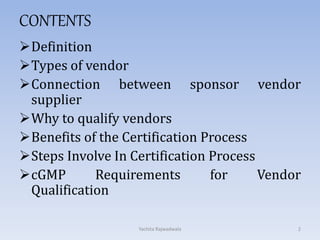
CONTENTS
Definition
Types of vendor
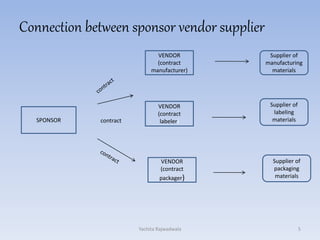
Connection between sponsor vendor
supplier
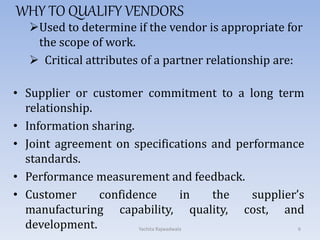
Why to qualify vendors
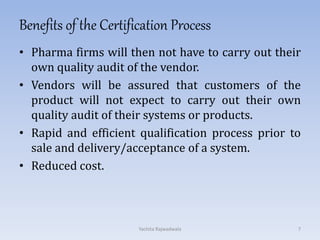
Benefits of the Certification Process
Steps Involve In Certification Process
cGMP Requirements for Vendor
Qualification
2Yachita Rajwadwala
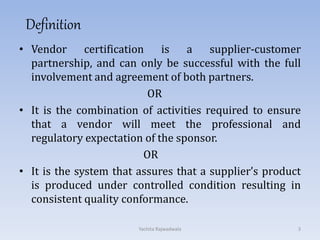
Definition
• Vendor certification is a supplier-customer
partnership, and can only be successful with the full
involvement and agreement of both partners.
OR
• It is the combination of activities required to ensure
that a vendor will meet the professional and
regulatory expectation of the sponsor.
OR
• It is the system that assures that a supplier’s product
is produced under controlled condition resulting in
consistent quality conformance.
3Yachita Rajwadwala
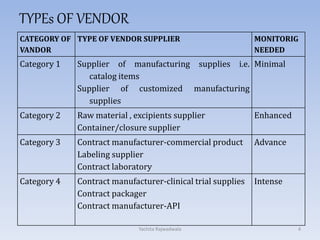
CATEGORY OF
VANDOR
TYPE OF VENDOR SUPPLIER MONITORIG
NEEDED
Category 1 Supplier of manufacturing supplies i.e.
catalog items
Supplier of customized manufacturing
supplies
Minimal
Category 2 Raw material , excipients supplier
Container/closure supplier
Enhanced
Category 3 Contract manufacturer-commercial product
Labeling supplier
Contract laboratory
Advance
Category 4 Contract manufacturer-clinical trial supplies
Contract packager
Contract manufacturer-API
Intense
TYPEs OF VENDOR
4Yachita Rajwadwala
SPONSOR
VENDOR
(contract
manufacturer)
VENDOR
(contract
labeler)
VENDOR
(contract
packager)
Supplier of
manufacturing
materials
Supplier of
labeling
materials
Supplier of
packaging
materials
contract
Connection between sponsor vendor supplier
5Yachita Rajwadwala
WHY TO QUALIFY VENDORS
Used to determine if the vendor is appropriate for
the scope of work.
 Critical attributes of a partner relationship are:
• Supplier or customer commitment to a long term
relationship.
• Information sharing.
• Joint agreement on specifications and performance
standards.
• Performance measurement and feedback.
• Customer confidence in the supplier’s
manufacturing capability, quality, cost, and
development. 6Yachita Rajwadwala
Benefits of the Certification Process
• Pharma firms will then not have to carry out their
own quality audit of the vendor.
• Vendors will be assured that customers of the
product will not expect to carry out their own
quality audit of their systems or products.
• Rapid and efficient qualification process prior to
sale and delivery/acceptance of a system.
• Reduced cost.
7Yachita Rajwadwala
Steps Involve In Certification Process
SUPPLIER SELECTIONS
– Supplier’s history in terms of quality, delivery, and
support service as well as the importance of the
specific material to the business.
– Chance of success with a supplier who already has
a high commitment to quality and customer
service.
8Yachita Rajwadwala
• STEP1: PREPARING FOR THE AUDIT
– Most critical part of the audit.
– Takes longer to complete than performing the actual audit.
– By putting more time into the preparation phase, the
performance of the audit will proceed smoothly.
• EFFECTIVE AUDIT PLAN WILL INCLUDE THE FOLLOWING
ELEMENTS
– Purpose and scope of the audit.
– Resources required of the sponsor to complete the audit.
– Number of auditors.
– Type of auditor or expertise required.
– Assignment of a lead auditor to take responsibility for the
audit.
– Reference documents to be used in planning and
performing the audit.
9Yachita Rajwadwala
STEP 2: PERFORMING THE AUDIT
– The performance of an audit begins with an
introductory meeting where in all parties are
introduced and the agenda is discussed.
– The performance of an audit is the collection of
evidence and verification of information through
the following means.
– Interviews.
– Examination of documents.
– Direct observation of activities, processes, and
conditions.
– Review of raw data related to critical documents.
10Yachita Rajwadwala
• STEP 3: REPORTING THE RESULTS
– Audit report should present a summary of the
results or findings of the audit.
– This includes both positive findings and any areas
identified for improvement.
– Written summary prior to leaving the vendor’s
facility allows the vendor to begin working on the
corrective action plans.
– Formal audit report is the product of the audit.
– Lead auditor is responsible for submitting the
formal report in a timely fashion.
– Final audit report should be prepared within 2
weeks from the date of the audit.
11Yachita Rajwadwala
• STEP 4: AUDIT CLOSURE, CORRECTIVEACTION,
AND FOLLOW UP
– After audit, vendor is responsible for developing a
corrective action plan to address any weaknesses
or deficiencies identified by the sponsor’s
auditors.
– It is the sponsor’s responsibility to ensure that the
corrective actions are effective and implemented
in a timely manner.
– The sponsor must verify all commitments through
the course of routine monitoring.
12Yachita Rajwadwala
cGMP Requirements for Vendor Qualification
• Divided into two sections: 1) Site Qualification 2) Site
follow-up
• SITE QUALIFICATION
– Vendors selected are evaluated for compliance with
the appropriate set of regulations.
– The results of the audit will be reviewed and the need
for a ‘‘site follow-up visit’’
– Site qualification visits are generally performed on a
cyclical basis; at least once every 24 months is
suggested unless the supplier becomes problematic.
– Continuous monitoring program is also an essential
component.
13Yachita Rajwadwala
• BENEFITS
– Ability to evaluate the systems that the vendor
uses to produce regulated work product.
– If a systems ‘‘gap’’ is detected in any of the
quality systems they should request corrective
action prior to initiating the work.
• RISKS
– Here the systems review is theoretical, not
practical.
– No ‘‘real’’ data can be reviewed prior to
initiating the work.
– The systems cannot be adequately tested
without ‘‘real’’ data.
14Yachita Rajwadwala
• SITE FOLLOW-UP
– Carried out during the course of the project
– Examples of issues that will usually result in
site follow-up include
• Lack of adherence to standard operating
procedures.
• Lack of appropriate documentation of training,
major renovations to the physical structure of
the facility.
• If standard operating procedure (SOP) or data
integrity questions arise during the course of
the study or project.
15Yachita Rajwadwala
• BENEFIT
– Ability to evaluate the systems that the vendor
uses to produce regulated work product in
‘‘real time’’ with data generated for a specific
project.
• RISKS
– Any corrections that may be needed will not
occur in a timely manner.
– Due to late identification of deficiencies will
delay the project.
16Yachita Rajwadwala
THANK YOU
17Yachita Rajwadwala

Vendor certification

  • 1.
    VENDOR CERTIFICATION Prepared by:Yachita Rajwadwala (Q.A)
  • 2.
    CONTENTS Definition Types of vendor Connectionbetween sponsor vendor supplier Why to qualify vendors Benefits of the Certification Process Steps Involve In Certification Process cGMP Requirements for Vendor Qualification 2Yachita Rajwadwala
  • 3.
    Definition • Vendor certificationis a supplier-customer partnership, and can only be successful with the full involvement and agreement of both partners. OR • It is the combination of activities required to ensure that a vendor will meet the professional and regulatory expectation of the sponsor. OR • It is the system that assures that a supplier’s product is produced under controlled condition resulting in consistent quality conformance. 3Yachita Rajwadwala
  • 4.
    CATEGORY OF VANDOR TYPE OFVENDOR SUPPLIER MONITORIG NEEDED Category 1 Supplier of manufacturing supplies i.e. catalog items Supplier of customized manufacturing supplies Minimal Category 2 Raw material , excipients supplier Container/closure supplier Enhanced Category 3 Contract manufacturer-commercial product Labeling supplier Contract laboratory Advance Category 4 Contract manufacturer-clinical trial supplies Contract packager Contract manufacturer-API Intense TYPEs OF VENDOR 4Yachita Rajwadwala
  • 5.
  • 6.
    WHY TO QUALIFYVENDORS Used to determine if the vendor is appropriate for the scope of work.  Critical attributes of a partner relationship are: • Supplier or customer commitment to a long term relationship. • Information sharing. • Joint agreement on specifications and performance standards. • Performance measurement and feedback. • Customer confidence in the supplier’s manufacturing capability, quality, cost, and development. 6Yachita Rajwadwala
  • 7.
    Benefits of theCertification Process • Pharma firms will then not have to carry out their own quality audit of the vendor. • Vendors will be assured that customers of the product will not expect to carry out their own quality audit of their systems or products. • Rapid and efficient qualification process prior to sale and delivery/acceptance of a system. • Reduced cost. 7Yachita Rajwadwala
  • 8.
    Steps Involve InCertification Process SUPPLIER SELECTIONS – Supplier’s history in terms of quality, delivery, and support service as well as the importance of the specific material to the business. – Chance of success with a supplier who already has a high commitment to quality and customer service. 8Yachita Rajwadwala
  • 9.
    • STEP1: PREPARINGFOR THE AUDIT – Most critical part of the audit. – Takes longer to complete than performing the actual audit. – By putting more time into the preparation phase, the performance of the audit will proceed smoothly. • EFFECTIVE AUDIT PLAN WILL INCLUDE THE FOLLOWING ELEMENTS – Purpose and scope of the audit. – Resources required of the sponsor to complete the audit. – Number of auditors. – Type of auditor or expertise required. – Assignment of a lead auditor to take responsibility for the audit. – Reference documents to be used in planning and performing the audit. 9Yachita Rajwadwala
  • 10.
    STEP 2: PERFORMINGTHE AUDIT – The performance of an audit begins with an introductory meeting where in all parties are introduced and the agenda is discussed. – The performance of an audit is the collection of evidence and verification of information through the following means. – Interviews. – Examination of documents. – Direct observation of activities, processes, and conditions. – Review of raw data related to critical documents. 10Yachita Rajwadwala
  • 11.
    • STEP 3:REPORTING THE RESULTS – Audit report should present a summary of the results or findings of the audit. – This includes both positive findings and any areas identified for improvement. – Written summary prior to leaving the vendor’s facility allows the vendor to begin working on the corrective action plans. – Formal audit report is the product of the audit. – Lead auditor is responsible for submitting the formal report in a timely fashion. – Final audit report should be prepared within 2 weeks from the date of the audit. 11Yachita Rajwadwala
  • 12.
    • STEP 4:AUDIT CLOSURE, CORRECTIVEACTION, AND FOLLOW UP – After audit, vendor is responsible for developing a corrective action plan to address any weaknesses or deficiencies identified by the sponsor’s auditors. – It is the sponsor’s responsibility to ensure that the corrective actions are effective and implemented in a timely manner. – The sponsor must verify all commitments through the course of routine monitoring. 12Yachita Rajwadwala
  • 13.
    cGMP Requirements forVendor Qualification • Divided into two sections: 1) Site Qualification 2) Site follow-up • SITE QUALIFICATION – Vendors selected are evaluated for compliance with the appropriate set of regulations. – The results of the audit will be reviewed and the need for a ‘‘site follow-up visit’’ – Site qualification visits are generally performed on a cyclical basis; at least once every 24 months is suggested unless the supplier becomes problematic. – Continuous monitoring program is also an essential component. 13Yachita Rajwadwala
  • 14.
    • BENEFITS – Abilityto evaluate the systems that the vendor uses to produce regulated work product. – If a systems ‘‘gap’’ is detected in any of the quality systems they should request corrective action prior to initiating the work. • RISKS – Here the systems review is theoretical, not practical. – No ‘‘real’’ data can be reviewed prior to initiating the work. – The systems cannot be adequately tested without ‘‘real’’ data. 14Yachita Rajwadwala
  • 15.
    • SITE FOLLOW-UP –Carried out during the course of the project – Examples of issues that will usually result in site follow-up include • Lack of adherence to standard operating procedures. • Lack of appropriate documentation of training, major renovations to the physical structure of the facility. • If standard operating procedure (SOP) or data integrity questions arise during the course of the study or project. 15Yachita Rajwadwala
  • 16.
    • BENEFIT – Abilityto evaluate the systems that the vendor uses to produce regulated work product in ‘‘real time’’ with data generated for a specific project. • RISKS – Any corrections that may be needed will not occur in a timely manner. – Due to late identification of deficiencies will delay the project. 16Yachita Rajwadwala
  • 17.