Uppers, Downers and
    Squeezers

INOTROPES AND VASOACTIVE DRUGS
Aim and Objective

 Functional overview of how inotropes and vasoactive
  drugs work.
 Explore nursing considerations.
 Discuss case examples.
 Hopefully end up feeling more confident.
It’s all about the Oxygen

 For tissues to be oxygenated, 3 factors need
 to be considered:
    1) Oxygen transfer across the alveolar-capillary
     membrane

    2) Oxygen attachment to haemaglobin

    3) Adequate cardiac output (CO) to move the
     oxyhaemaglobin compound to the tissues – this is
     what we are talking about!
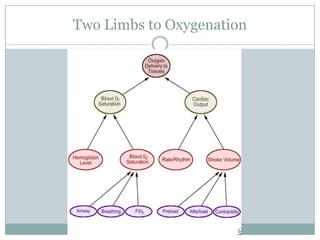
Two Limbs to Oxygenation
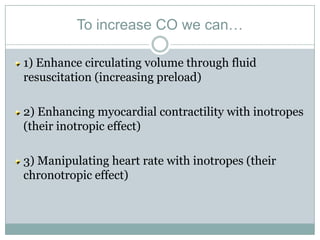
To increase CO we can…

1) Enhance circulating volume through fluid
resuscitation (increasing preload)

2) Enhancing myocardial contractility with inotropes
(their inotropic effect)

3) Manipulating heart rate with inotropes (their
chronotropic effect)
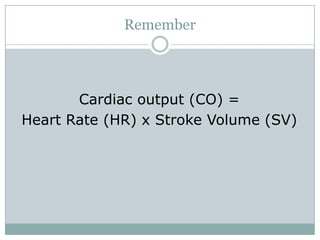
Remember


       Cardiac output (CO) =
Heart Rate (HR) x Stroke Volume (SV)
Measuring Cardiac Output

 How do we commonly evaluate?
 How complex is this?
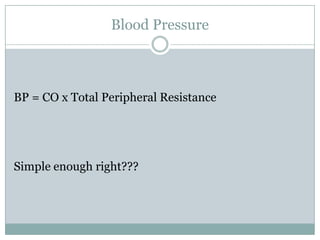
Blood Pressure


BP = CO x Total Peripheral Resistance


Simple enough right???
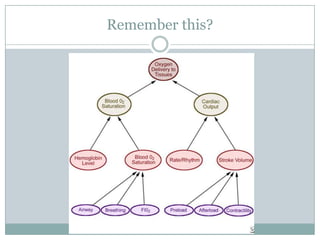
Remember this?
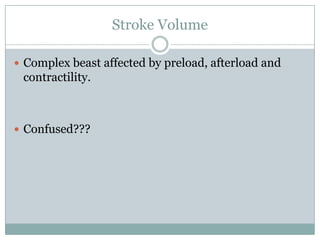
Stroke Volume

 Complex beast affected by preload, afterload and
 contractility.


 Confused???
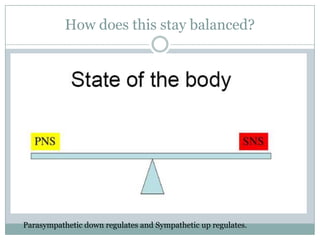
How does this stay balanced?


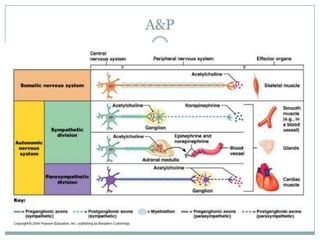
Parasympathetic down regulates and Sympathetic up regulates.
A&P
It’s all about the Receptors

Table 1. Adrenergic receptor sites (SNS)
Receptor       Actions                 Locations
α              ↑SVR                    Coronary arterioles
               ↑Blood pressure         Vascular smooth muscle
               ↓Insulin release

β1               ↑Heart rate           Sinoatrial node
                 ↑Contractility        Myocardium

β2               ↑Contractility        Coronary arterioles
                 ↓SVR                  Bronchial smooth muscle
                                       Atrioventricular node
                                       Vascular smooth muscle

DA               Vasodilation          Kidney
                                       Mesentery
                                       Heart

SVR =systemic vascular resistance.     DA = Dopaminegic
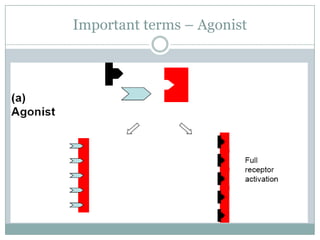
Important terms – Agonist
Important terms - Antagonist
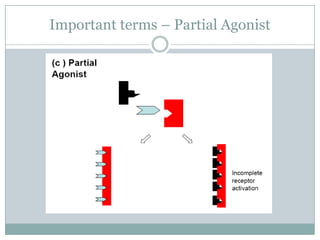
Important terms – Partial Agonist
Ok take a breather!
How do we treat this stuff?


http://www.youtube.com/watch?v=HMGIbOGu8q0
Let’s talk drugs!

In the context of the SNS, drugs:
Mimic or impair (stimulate or block)
 Directly (agonist or antagonist)
 Indirectly
 - releasing endogenous Norad (metaraminol,
  ephedrine at a1)
Let’s talk drugs!

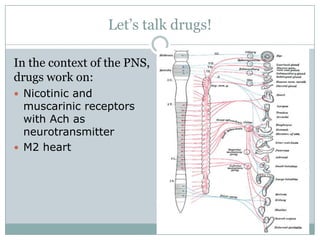
In the context of the PNS,
drugs work on:
 Nicotinic and
  muscarinic receptors
  with Ach as
  neurotransmitter
 M2 heart
Atropine - PNS

 Anticholinergic drug – works as a competitive
  antagonist in muscarinic receptors (M2 = Heart)
 Blocks slow – down signals to the heart.
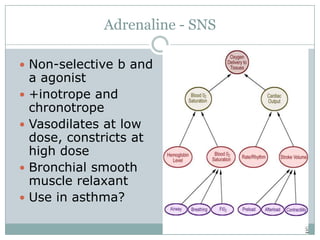
Adrenaline - SNS

 Non-selective b and
    a agonist
   +inotrope and
    chronotrope
   Vasodilates at low
    dose, constricts at
    high dose
   Bronchial smooth
    muscle relaxant
   Use in asthma?
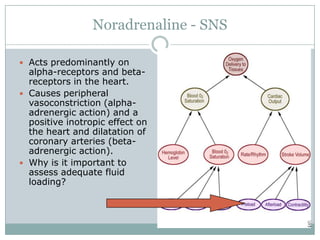
Noradrenaline - SNS

 Acts predominantly on
  alpha-receptors and beta-
  receptors in the heart.
 Causes peripheral
  vasoconstriction (alpha-
  adrenergic action) and a
  positive inotropic effect on
  the heart and dilatation of
  coronary arteries (beta-
  adrenergic action).
 Why is it important to
  assess adequate fluid
  loading?
Dobutamine - SNS

 Direct acting inotropic whose primary
  activity results from stimulation of the
  beta-receptors of the heart while
  producing comparatively mild
  chronotropic, hypertensive,
  arrhythmogenic and vasodilative effects.
 It does not cause the release of
  endogenous noradrenaline as does
  dopamine
 Used for heart failure for the above
  reasons
 250mg vials
Vasopressin (ADH)

 increase resorption of water by the renal
  tubules
 Cause contraction of smooth muscle of the
  gastrointestinal tract and of all parts of the
  vascular bed, especially the capillaries,
  small arterioles and venules, with less
  effect on the smooth musculature of the
  large veins.
 20IU/ml
Metaraminol - SNS

 Increases both systolic and diastolic blood
  pressure.
 The pressor effect begins one to two
  minutes after intravenous injection, and
  lasts about 20 minutes to one hour.
 Positive inotropic effect on the heart and
  has a peripheral vasoconstrictor action.
 Potent sympathomimetic – alpha agonist
  effects, mild beta 1 effects.
Ephedrine – SNS

Stimulates both alpha and beta-adrenergic
receptors indirectly and also releases endogenous
noradrenaline from its storage site (particularly
observed in the substantia nigra).
Often used in OT due to strong direct evidence
base lying in anaesthetic hypotension.
Phenylephrine - SNS

Used mostly in OT
Produces vasoconstriction that lasts longer than that of
adrenaline and ephedrine.
Responses are more sustained than those to adrenaline,
lasting 20 minutes after intravenous and as long as 50
minutes after subcutaneous injection.
Its action on the heart opposite to adrenaline and
ephedrine, in that it slows the heart rate and increases
the stroke output, producing no disturbance in the
rhythm
Powerful postsynaptic alpha-receptor stimulant with
little effect on the beta-receptors of the heart.
A singular advantage of this drug is the fact that repeated
injections produce comparable effects.
GTN – Direct Vasoactive

 Glyceryl trinitrate produces a dose related
  dilation of both arterial and venous beds.
 Decreases venous return to the heart,
  reducing left ventricular end diastolic
  pressure and pulmonary capillary wedge
  pressure (preload).
 Arteriolar relaxation reduces systemic
  vascular resistance and arterial pressure
  (afterload).
 Also dilates the coronary arteries, although
  this effect is short-lived.
These are also out there

 Some less frequently used drugs
Dopamine - SNS

 Stimulates alpha, beta and dopamine receptors.
 Precursor to noradrenaline chemically
 At infusion rates of 0.5 to 2 microgram/kg/minute,
    dopamine receptors are selectively activated and blood
    pressure either does not change or decreases slightly.
   Causes renal and mesenteric vasodilatation - Renal plasma
    flow, glomerular filtration rate and sodium excretion usually
    increase.
   At infusion rates of 2 to 10 microgram/kg/minute, beta1-
    receptors are activated and cardiac output and systolic
    blood pressure increase.
   The total peripheral resistance is relatively unchanged
    because of peripheral vasoconstriction (alpha effect) and
    muscle vasodilatation (beta effect).
   At infusion rates above 10 microgram/kg/minute, alpha-
    receptors are activated, causing vasoconstriction, and both
    systolic and diastolic pressures increase
   200mg Ampoules
Isoprenaline

Acts on the heart, smooth muscle of bronchi,
skeletal muscle vasculature and gastrointestinal
tract.
Increases cardiac output due to its positive
inotropic and chronotropic actions and by
increasing venous return.
Also lowers peripheral vascular resistance.
The rate of discharge of cardiac pacemakers is
increased.
Great option in complete heart block.
Milrinone


Selective phosphodiesterase inhibitor which has
positive inotropic and vasodilatory activity.
Milrinone improves hemodynamics and
biventricular function in patients with
ventricular dysfunction by increasing stroke
volume index, increasing left ventricular
contractility, producing pulmonary vasodilation.
Used in heart failure due to minimal
chronotropic effect
Sodium Nitroprusside (SNP) – Direct Vasoactive

 Potent relaxation of vascular smooth muscle and
 consequent dilatation of peripheral arteries and
 veins.
 Non-selective compared to GTN .
Levosimendan

Developed for the treatment of decompensated heart
failure and is used intravenously when patients with
heart failure require immediate initiation of drug
therapy.
It increases the sensitivity of the heart to calcium, thus
increasing cardiac contractility without a rise in
intracellular calcium.
Exerts its effect by increasing calcium sensitivity of
myocytes by binding to cardiac troponin C in a calcium-
dependent manner.
It also has a vasodilatory effect, by opening adenosine
triphosphate (ATP)-sensitive potassium channels in
vascular smooth muscle to cause smooth muscle
relaxation.
Ok…….

 Inotropic drugs are potentially dangerous so
    be very thorough checking.
   Vascular access needs to be spot on.
   On central line always endeavour to use
    distal, brown lumen (in furthest)
   Wear gloves when preparing.
   Know what the drug does and why we use
    it.
   Don’t EVER make a mistake with
    inotropes!!!

Uppers downers and squeezers

  • 1.
    Uppers, Downers and Squeezers INOTROPES AND VASOACTIVE DRUGS
  • 2.
    Aim and Objective Functional overview of how inotropes and vasoactive drugs work.  Explore nursing considerations.  Discuss case examples.  Hopefully end up feeling more confident.
  • 3.
    It’s all aboutthe Oxygen  For tissues to be oxygenated, 3 factors need to be considered:  1) Oxygen transfer across the alveolar-capillary membrane  2) Oxygen attachment to haemaglobin  3) Adequate cardiac output (CO) to move the oxyhaemaglobin compound to the tissues – this is what we are talking about!
  • 4.
    Two Limbs toOxygenation
  • 5.
    To increase COwe can… 1) Enhance circulating volume through fluid resuscitation (increasing preload) 2) Enhancing myocardial contractility with inotropes (their inotropic effect) 3) Manipulating heart rate with inotropes (their chronotropic effect)
  • 6.
    Remember Cardiac output (CO) = Heart Rate (HR) x Stroke Volume (SV)
  • 7.
    Measuring Cardiac Output How do we commonly evaluate?  How complex is this?
  • 8.
    Blood Pressure BP =CO x Total Peripheral Resistance Simple enough right???
  • 9.
  • 10.
    Stroke Volume  Complexbeast affected by preload, afterload and contractility.  Confused???
  • 11.
    How does thisstay balanced? Parasympathetic down regulates and Sympathetic up regulates.
  • 12.
  • 13.
    It’s all aboutthe Receptors Table 1. Adrenergic receptor sites (SNS) Receptor Actions Locations α ↑SVR Coronary arterioles ↑Blood pressure Vascular smooth muscle ↓Insulin release β1 ↑Heart rate Sinoatrial node ↑Contractility Myocardium β2 ↑Contractility Coronary arterioles ↓SVR Bronchial smooth muscle Atrioventricular node Vascular smooth muscle DA Vasodilation Kidney Mesentery Heart SVR =systemic vascular resistance. DA = Dopaminegic
  • 14.
  • 15.
  • 16.
    Important terms –Partial Agonist
  • 17.
    Ok take abreather!
  • 18.
    How do wetreat this stuff? http://www.youtube.com/watch?v=HMGIbOGu8q0
  • 19.
    Let’s talk drugs! Inthe context of the SNS, drugs: Mimic or impair (stimulate or block)  Directly (agonist or antagonist)  Indirectly - releasing endogenous Norad (metaraminol, ephedrine at a1)
  • 20.
    Let’s talk drugs! Inthe context of the PNS, drugs work on:  Nicotinic and muscarinic receptors with Ach as neurotransmitter  M2 heart
  • 21.
    Atropine - PNS Anticholinergic drug – works as a competitive antagonist in muscarinic receptors (M2 = Heart)  Blocks slow – down signals to the heart.
  • 22.
    Adrenaline - SNS Non-selective b and a agonist  +inotrope and chronotrope  Vasodilates at low dose, constricts at high dose  Bronchial smooth muscle relaxant  Use in asthma?
  • 23.
    Noradrenaline - SNS Acts predominantly on alpha-receptors and beta- receptors in the heart.  Causes peripheral vasoconstriction (alpha- adrenergic action) and a positive inotropic effect on the heart and dilatation of coronary arteries (beta- adrenergic action).  Why is it important to assess adequate fluid loading?
  • 24.
    Dobutamine - SNS Direct acting inotropic whose primary activity results from stimulation of the beta-receptors of the heart while producing comparatively mild chronotropic, hypertensive, arrhythmogenic and vasodilative effects.  It does not cause the release of endogenous noradrenaline as does dopamine  Used for heart failure for the above reasons  250mg vials
  • 25.
    Vasopressin (ADH)  increaseresorption of water by the renal tubules  Cause contraction of smooth muscle of the gastrointestinal tract and of all parts of the vascular bed, especially the capillaries, small arterioles and venules, with less effect on the smooth musculature of the large veins.  20IU/ml
  • 26.
    Metaraminol - SNS Increases both systolic and diastolic blood pressure.  The pressor effect begins one to two minutes after intravenous injection, and lasts about 20 minutes to one hour.  Positive inotropic effect on the heart and has a peripheral vasoconstrictor action.  Potent sympathomimetic – alpha agonist effects, mild beta 1 effects.
  • 27.
    Ephedrine – SNS Stimulatesboth alpha and beta-adrenergic receptors indirectly and also releases endogenous noradrenaline from its storage site (particularly observed in the substantia nigra). Often used in OT due to strong direct evidence base lying in anaesthetic hypotension.
  • 28.
    Phenylephrine - SNS Usedmostly in OT Produces vasoconstriction that lasts longer than that of adrenaline and ephedrine. Responses are more sustained than those to adrenaline, lasting 20 minutes after intravenous and as long as 50 minutes after subcutaneous injection. Its action on the heart opposite to adrenaline and ephedrine, in that it slows the heart rate and increases the stroke output, producing no disturbance in the rhythm Powerful postsynaptic alpha-receptor stimulant with little effect on the beta-receptors of the heart. A singular advantage of this drug is the fact that repeated injections produce comparable effects.
  • 29.
    GTN – DirectVasoactive  Glyceryl trinitrate produces a dose related dilation of both arterial and venous beds.  Decreases venous return to the heart, reducing left ventricular end diastolic pressure and pulmonary capillary wedge pressure (preload).  Arteriolar relaxation reduces systemic vascular resistance and arterial pressure (afterload).  Also dilates the coronary arteries, although this effect is short-lived.
  • 30.
    These are alsoout there  Some less frequently used drugs
  • 31.
    Dopamine - SNS Stimulates alpha, beta and dopamine receptors.  Precursor to noradrenaline chemically  At infusion rates of 0.5 to 2 microgram/kg/minute, dopamine receptors are selectively activated and blood pressure either does not change or decreases slightly.  Causes renal and mesenteric vasodilatation - Renal plasma flow, glomerular filtration rate and sodium excretion usually increase.  At infusion rates of 2 to 10 microgram/kg/minute, beta1- receptors are activated and cardiac output and systolic blood pressure increase.  The total peripheral resistance is relatively unchanged because of peripheral vasoconstriction (alpha effect) and muscle vasodilatation (beta effect).  At infusion rates above 10 microgram/kg/minute, alpha- receptors are activated, causing vasoconstriction, and both systolic and diastolic pressures increase  200mg Ampoules
  • 32.
    Isoprenaline Acts on theheart, smooth muscle of bronchi, skeletal muscle vasculature and gastrointestinal tract. Increases cardiac output due to its positive inotropic and chronotropic actions and by increasing venous return. Also lowers peripheral vascular resistance. The rate of discharge of cardiac pacemakers is increased. Great option in complete heart block.
  • 33.
    Milrinone Selective phosphodiesterase inhibitorwhich has positive inotropic and vasodilatory activity. Milrinone improves hemodynamics and biventricular function in patients with ventricular dysfunction by increasing stroke volume index, increasing left ventricular contractility, producing pulmonary vasodilation. Used in heart failure due to minimal chronotropic effect
  • 34.
    Sodium Nitroprusside (SNP)– Direct Vasoactive Potent relaxation of vascular smooth muscle and consequent dilatation of peripheral arteries and veins. Non-selective compared to GTN .
  • 35.
    Levosimendan Developed for thetreatment of decompensated heart failure and is used intravenously when patients with heart failure require immediate initiation of drug therapy. It increases the sensitivity of the heart to calcium, thus increasing cardiac contractility without a rise in intracellular calcium. Exerts its effect by increasing calcium sensitivity of myocytes by binding to cardiac troponin C in a calcium- dependent manner. It also has a vasodilatory effect, by opening adenosine triphosphate (ATP)-sensitive potassium channels in vascular smooth muscle to cause smooth muscle relaxation.
  • 36.
    Ok…….  Inotropic drugsare potentially dangerous so be very thorough checking.  Vascular access needs to be spot on.  On central line always endeavour to use distal, brown lumen (in furthest)  Wear gloves when preparing.  Know what the drug does and why we use it.  Don’t EVER make a mistake with inotropes!!!