Systemic Vasculitis:
a clinical approach
Geordie Lawry MD
Chief, Rheumatology
UC IRVINE
Medicine HS Noon Conference: October 2015
Objectives 1
• List the 4 clinical features which should
prompt you to CONSIDER A
DIAGNOSIS of systemic vasculitis
• List the “Big 5” essential questions in
patients with SUSPECTED GIANT
CELL ARTERITIS
• Describe what is meant by
PULMONARY RENAL SYNDROME
Objectives 2
• List at least 3 ORGANS / SITES commonly
involved in:
CRYOGLOBULINEMIC VASCULITIS
GRANULOMATOUS POLYANGIITIS (GPA)
MICROSCOPIC POLYANGIITIS (MPA)
CLASSIC POLYARTERITIS NODOSA
GIANT CELL ARTERITIS
Objectives 3
• List at least 2 ANCA VASCULITIS
SYNDROMES, associated ANCA
pattern / target antigens
• List at least 2 vasculitides which are
NOT ASSOCIATED WITH ANCA
• List at least 3 or more conditions
that can MIMIC THE CLINICAL
FEATURES OF VASCULITIS
VASCULITIS: Talk Outline
• Introduction and Definitions
• Approach to vasculitis
• Specific Disorders:
–Giant Cell Arteritis
–Granulomatous polyangiitis (Wegener’s)
–Microscopic Polyangiitis
–Polyarteritis Nodosa
–Cryoglobulinemia
• Take Home
VASCULITIS: principles 1
group of clinical syndromes
characterized by inflammation
of blood vessels
Normal Artery
Artery: WBC
inflammation in wall
VASCULITIS: principles 2
systemic diseases that can affect many
different organ systems
can be difficult to diagnose: challenging
clinical picture even for experienced
clinicians
can be life-threatening
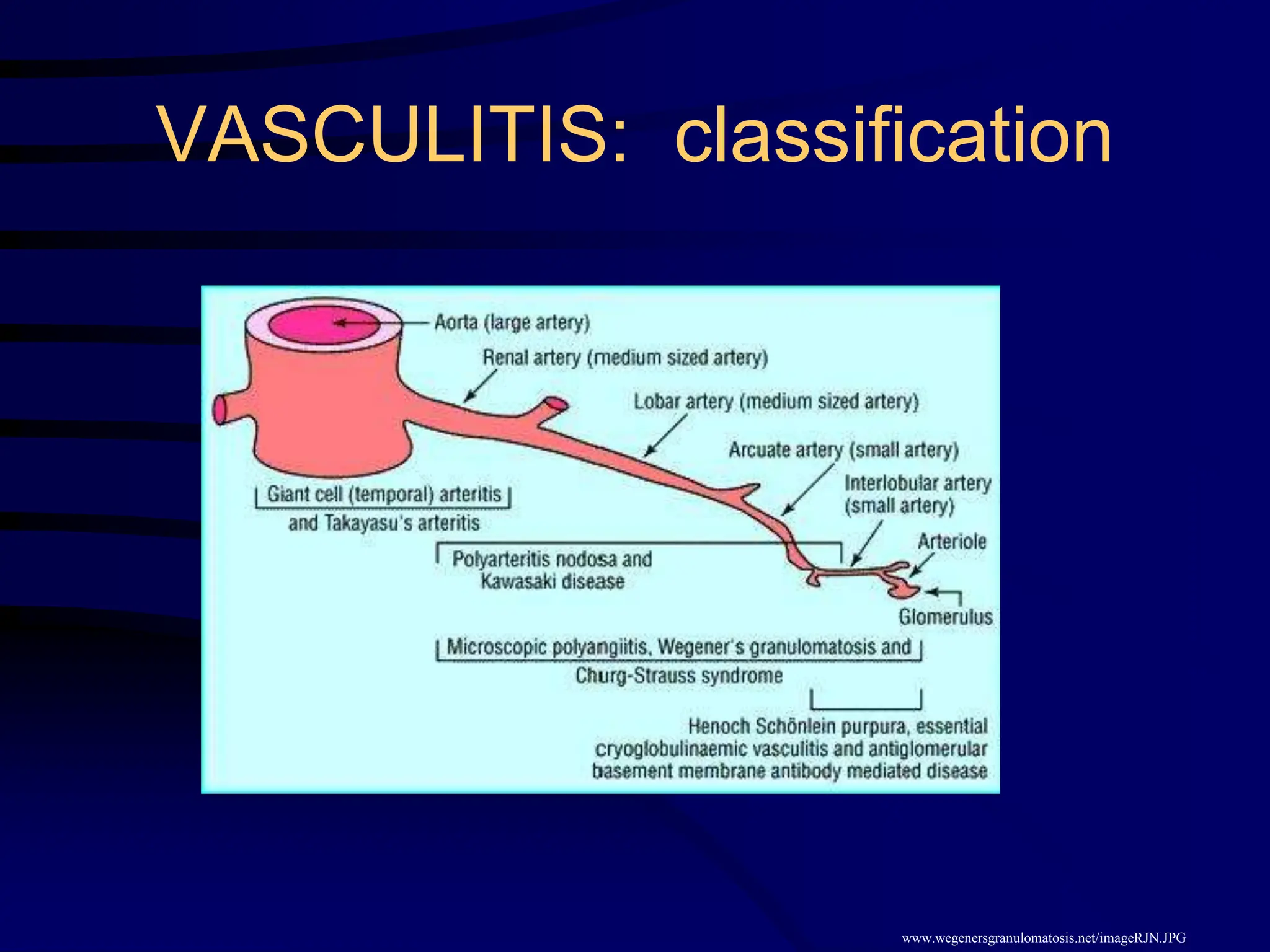
VASCULITIS: classification
www.wegenersgranulomatosis.net/imageRJN.JPG
General Approach to
Vasculitis
Throw up your hands….
General Approach to
Vasculitis
Slap at it ….
When should vasculitis be
suspected? 1
• MULTISYSTEM inflammatory disease
• Significant CONSTITUTIONAL
SYMPTOMS
• RAPIDLY PROGRESSIVE organ
dysfunction
• HIGH ESR
SEVERE anemia
PLATELETS > 500K
When should vasculitis be
suspected? 2
CLINICAL FEATURES PARTICULARLY
SUGGESTIVE of small vessel
inflammation:
• SKIN: palpable purpura *
• LUNGS: pulmonary infiltrates /
hemoptysis
• KIDNEY: active urinary sediment
• NEURO: foot drop **
What is the approach to
a patient suspected of
having vasculitis?
WHAT IS YOUR
APPROACH TO ANY
COMPLEX MEDICAL
PROBLEM?
General Approach to
Vasculitis
Gather your equipment….
Find the target….
Take aim…..
NAIL IT !
COMPLEX MEDICAL PROBLEMS 1
HISTORY: PATIENT’S STORY
get careful CHRONOLOGY
…….PROBLEMS
PHYSICAL EXAM: BODY’S STORY
thoughtful, thorough
……..MORE PROBLEMS
LABORATORY: BEHIND-THE-SCENES STORY
Basic CBC, CHEMS, LFTs, UA/micro, CXR
……..MORE PROBLEMS
COMPLEX MEDICAL PROBLEMS 2
Develop a strategy: PROBLEM LIST
CREATE PROBLEM LIST
……… LIST EVERYTHING [split don’t lump]
PRIORITIZE PROBLEM LIST
……… WHAT’S THE BIG GORILLA(S) HERE?
“WORK” the PROBLEM LIST
COMPLEX MEDICAL PROBLEMS 3
“WORK” the PROBLEM LIST
• Think of 3 explanations for each problem
Create a differential diagnosis
• What are the major organs involved?
• Do they inter-relate?
Do the patient’s, body’s and the behind-the-
scenes stories fit together in some way?
COMPLEX MEDICAL PROBLEMS 4
SYSTEMIC VASCULITIS ?
• Are there additional tests which could
help confirm this suspicion?
• Serologic tests
• Imaging studies
• Tissue biopsy
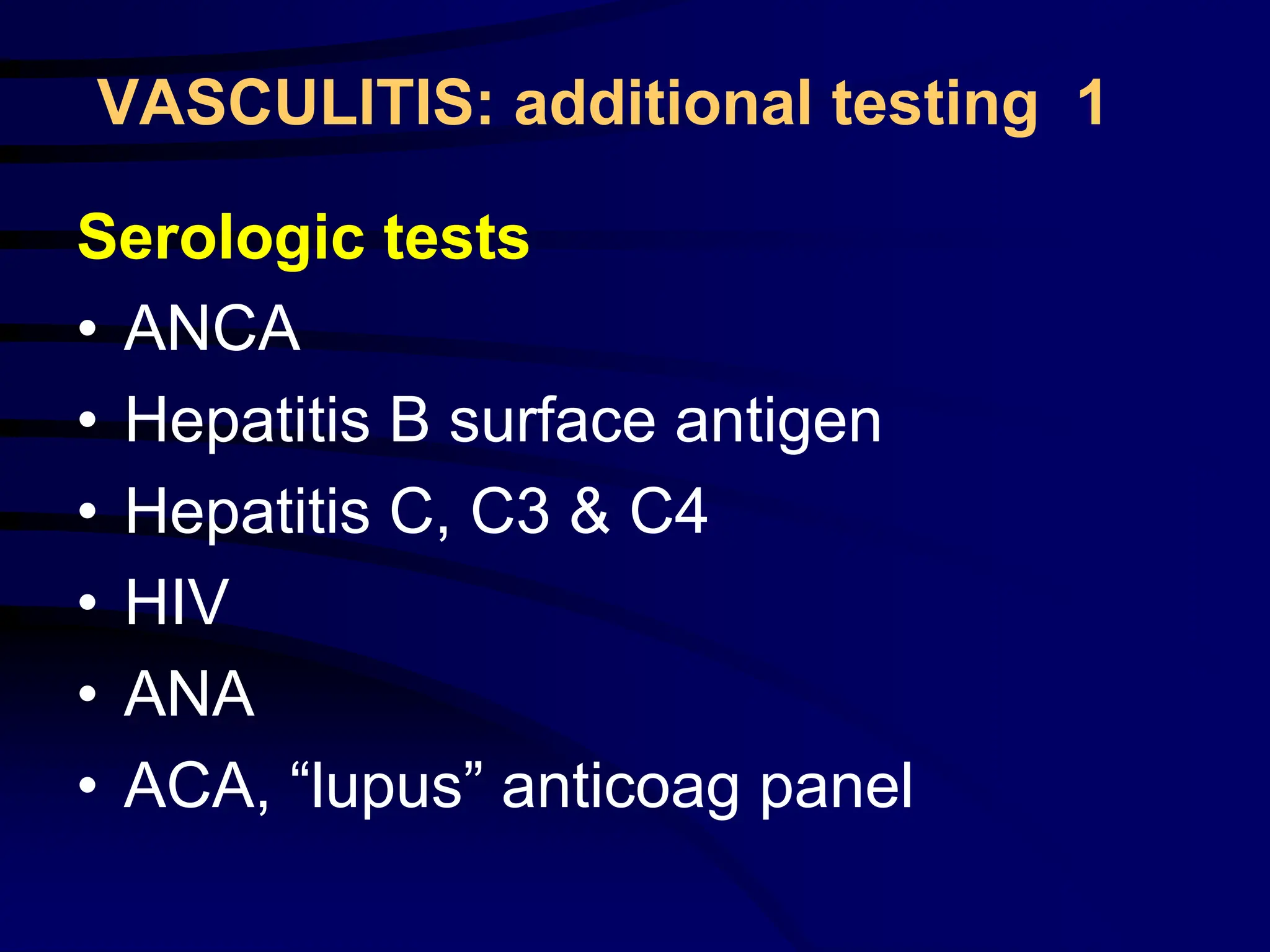
VASCULITIS: additional testing 1
Serologic tests
• ANCA
• Hepatitis B surface antigen
• Hepatitis C, C3 & C4
• HIV
• ANA
• ACA, “lupus” anticoag panel
VASCULITIS: additional testing 2
Imaging studies
• Sinus CT scan
• Chest CT scan
• Mesenteric
angiogram
VASCULITIS: additional testing 3
Tissue biopsy
• Temporal artery
• Sural nerve
• Muscle
• Lung
• Renal
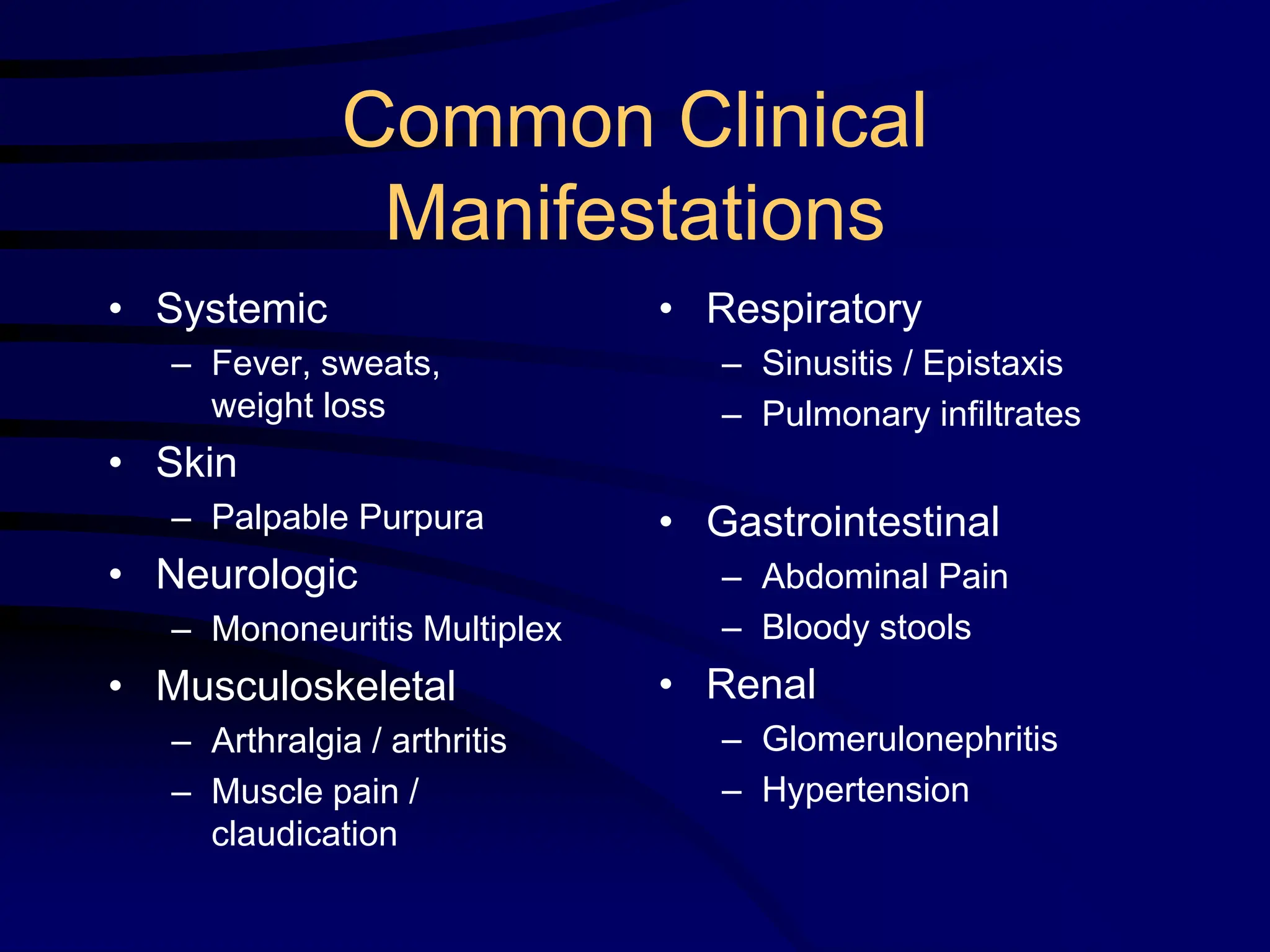
Common Clinical
Manifestations
• Systemic
– Fever, sweats,
weight loss
• Skin
– Palpable Purpura
• Neurologic
– Mononeuritis Multiplex
• Musculoskeletal
– Arthralgia / arthritis
– Muscle pain /
claudication
• Respiratory
– Sinusitis / Epistaxis
– Pulmonary infiltrates
• Gastrointestinal
– Abdominal Pain
– Bloody stools
• Renal
– Glomerulonephritis
– Hypertension
CUTANEOUS
Palpable Purpura
Livedo Reticularis
Splinter Hemorrhages
NEUROLOGIC
• Mononeuritis multiplex:
check for FOOT DROP
Sural nerve biopsy showing vasculitis
RESPIRATORY: upper
• Sinusitis
• Or……
www.conseils-orl.com/.../sommaire_epistaxis.htm
RESPIRATORY: lower
• Pulmonary infiltrates
• Nodules
• Cavities
GENITOURINARY
• Glomerulonephritis
• Hypertension
• Hematuria
• RBC casts
• Testicular pain
(especially PAN)
www.bio.davidson.edu/.../Cresgn.jpg
MUSCULOSKELETAL
• Polyarthralgias - common
• Polyarthritis - less common
• Myalgias - common
• Myositis - biopsy may demonstrate
vasculitis in muscle
GASTROINTESTINAL
• Mesenteric ischemia
– pain 30 minutes after eating
– bloody diarrhea
– bowel perforation
• hepatitis
• pancreatitis
• cholecystitis
library.med.utah.edu/WebPath/COW/COW125.html
OCULAR
http://www.uveitis.org/images/sa
rcoid6.jpg
Retinal Vasculitis
http://webmedia.unmc.edu/eye/iritis.jpg
Iritis
Scleritis
eyelearn.med.utoronto.ca/.../RedE
ye/10Sclera.htm
Common Laboratory Findings
INFLAMMATION:
Elevated ESR (can be > 100)
Elevated CRP
Leukocytosis
Thrombocytosis
Anemia
Low Albumin
VASCULITIS MIMICS
• INFECTIOUS DISEASES
– Endocarditis
– HIV
• DRUGS
– Cocaine
– Methamphetamine
• CHOLESTEROL EMBOLI
• ANTIPHOSPHOLIPID ANTIBODY
SYNDROME
Questions?
• In the ACR diagnostic criteria for Giant Cell
Arteritis (Temporal Arteritis), a patient needs
to be greater than what age?
A. > 40 years
B. > 50 years
C. > 60 years
D. > 70 years
E. > 80 years
Questions?
• In the ACR diagnostic criteria for Giant Cell
Arteritis (Temporal Arteritis), a patient needs
to be greater than what age?
A. > 40 years
B. > 50 years
C. > 60 years
D. > 70 years
E. > 80 years
-Almost all are > 60
-Average age is 70
Specific Entities
www.wegenersgranulomatosis.net/imageRJN.JPG
Arthritis Rheum. 1990;33:1122.
Giant Cell Arteritis
ACR Criteria (3 of 5)
• Age > 50
• New onset headache
• ESR (Westergren)  50
• Abnormal artery biopsy
(mononuclear cell infiltrate,
granulomatous inflammation,
usually multinucleated giant cells)
• Temporal artery
abnormality (tender or
decreased pulse)
Giant Cell Arteritis
(Other clinical manifestations)
• Visual loss, jaw/tongue claudication, scalp
tenderness
• Fever, weight loss
• PMR symptoms (proximal muscle pain)
• 10% with large vessel involvement (e.g.
subclavian artery)
• Blindness (ischemic optic neuropathy) is
major complication to avoid
GCA:Biopsy
• Temporal artery biopsy
– large specimen (4-6 cm)
– multiple sections evaluated
• Infiltration of vessel wall with
WBC
• Granulomata, Giant Cells
• Necrotic material
GCA: Therapy
• Corticosteroids mainstay of therapy
(~1 mg/kg)
– Calcium and vitamin D
– Consider bisphosphonates
• Try to prevent visual loss with therapy:
– Treat, then biopsy!
Questions?
• The confirmatory antibody for a positive C-
ANCA in a patient suspected of having
Wegener’s Granulomatosus is:
A. Topoisomerase
B. Histidine tRNA synthetase
C. Smith
D. Proteinase-3
E. Myeloperoxidase
Questions?
• The confirmatory antibody for a positive C-
ANCA in a patient suspected of having
Wegener’s Granulomatosus is:
A. Topoisomerase
B. Histidine tRNA synthetase
C. Smith (Sm)
D. Proteinase-3
E. Myeloperoxidase
C is the 3rd letter
of the alphabet:
Pr-3 C-ANCA
Granulomatous Polyangiitis
(GPA) … formerly Wegener’s
• Necrotizing vasculitis that affects the small
vessels of the respiratory tract and renal
system: PULMONARY-RENAL SYNDROME
• Age ~ 40s: M > F 2:1
Arthritis Rheum 1990;33:1101.
Granulomatous Polyangiitis (GPA)
ACR Criteria (3 of 5)
• Nasal or oral inflammation (oral ulcers or bloody nasal
drainage)
• Abnormal chest radiograph (nodules, fixed infiltrates,
cavities)
• Urinary sediment (> 5 RBC/ hpf or casts)
• Abnormal Biopsy: showing vasculitis
• Proteinase-3 antibodies
Granulomatous Polyangiitis
(GPA) : Respiratory Involvement
• Sinusitis
– Nasal septal ulceration
• Pneumonitis
– few symptoms until late
– usually no mediastinal
lymphadenopathy
– nodules that can
cavitate
Granulomatous Polyangiitis
(GPA) : Renal Involvement
• 85% of patients
• Focal/segmental
necrotizing
glomerulonephritis
• Usually progressive
www.bio.davidson.edu/.../Cresgn.jpg
Granulomatous Polyangiitis
(GPA) : ANCA
• AntiNeutrophil Cytoplasmic Antibody
– C (cytoplasmic staining) ANCA
– Proteinase 3 (C is the 3rd letter)
• Pulmonary-renal disease
– sensitivity of 95%
– specificity of 95%
• Limited disease…
– lower sensitivity and specificity
Granulomatous Polyangiitis (GPA):
Tissue Biopsy
• Yield of biopsy
– Lung
• Open – highest yield
• Bronchoscopy - lower yield
– Sinus - 40% yield
– Renal
• Vasculitis rarely seen
• Focal proliferative GN is the typical finding
Granulomatous Polyangiitis
(GPA) : Rx
• Prior to cyclophosphamide, 80-90% mortality
• With cyclophosphamide, 5-10% mortality
• Concern about long-term toxicity of PO
cyclophosphamide (bladder especially)
• IV CYTOXAN no significant bladder risk
• Rituximab: very effective for induction &
maintenance
• Azathioprine for maintenance
Microscopic Polyangiitis
(MPA)
• Systemic vasculitis with predominant
small vessel involvement
• Separate disease from PAN (Initially thought to
be a variant of PAN)
• Usually RPGN and sometimes with
pulmonary hemorrhage
• More common than PAN (both are rare)
MPA: Clinical Manifestations
• Renal manifestations 79%
• Weight loss 73%
• Skin involvement 62%
• Mononeuritis multiplex 58%
• Fever 55%
• Arthralgias/Myalgias 50%
• Pulmonary involvement 25%
MPA: ANCA
• P (perinuclear) ANCA
• Myeloperoxidase antibodies
• Sensitivity/Specificity
unclear
MPA: Epidemiology & Rx
• Ave. age 57
• Males > Females (slightly)
• Cyclophosphamide decreases mortality
• IV CYTOXAN no significant bladder risk
• Rituximab: very effective for induction &
maintenance
• Azathioprine for maintenance
Polyarteritis Nodosa
• Necrotizing vasculitis of medium & small arteries
• Age ~ 40s; M > F
• Constitutional symptoms are common
– fever 50%
– weight loss 50%
• Vasculitis can be variable in distribution making
diagnosis difficult
Arthritis Rheum. 1990;33:1088
Polyarteritis Nodosa
ACR Criteria (3 of 10)
• Wt loss > 4 kg
• Livedo reticularis
• Testicular pain
• Myalgias, weakness or
leg tenderness
• Mononeuropathy or
polyneuropathy
• Diastolic BP > 90
•  BUN or Creatinine
• Hepatitis B virus
• Arteriographic
abnormality
• Biopsy of small or
medium artery
containing PAN
Classic PAN: Manifestations
• Mononeuritis multiplex 50%
• Renal involvement: 60%
(renal arteries, interlobular arteries)
– Hypertension (more common)
– Glomerulonephritis (uncommon)
• Abdominal involvement 45%
• Arthralgias/Myalgias/Myositis 64%
• Testicular pain 25%
• Pulmonary involvement rare
Polyarteritis Nodosa
• Association with
Hepatitis B (surface
antigen)
• Classic PAN
is NOT associated with
ANCA
ANCA
Cryoglobulinemia 1
• Paradigm of small vessel vasculitis
• Association with hepatitis C infection
• Damage is immune complex-mediated
• Cryoprecipitate Hepatitis C Ag – Ab
• Complement fixing: C4 consumption
C4 levels VERY low
Cryoglobulinemia 2
Cryoglobulinemia 3
PATTERN OF ORGAN INVOLVEMENT:
• constitutional
• Cutaneous
• articular
• vascular
• neurologic
Cryoglobulinemia 4
PATTERN OF LABORATORY FINDINGS:
• rheumatoid factor
• complement C4 ↓ ↓ ↓
• cryoglobulin (cryocrit)
TREATMENT:
• Antiviral therapy …. clearance of hep C virus!
VASCULITIS: classification
www.wegenersgranulomatosis.net/imageRJN.JPG
VASCULITIS OF SMALL >> MEDIUM-SIZED
VESSELS:
• drug-induced small vessel vasculitis
(hypersensitivity vasculitis),
• Henoch-Schönlein purpura (IgA vasculitis),
• ANCA-associated vasculitis
(granulomatosis with polyangiitis [Wegener’s],
microscopic polyangiitis, eosinophilic granulomatosis
with polyangiitis [Churg Strauss syndrome]),
• infection-related vasculitis
(bacterial endocarditis, poststreptococcal vasculitis
and glomerulonephritis) plus hepatitis C-related
cryoglobulinemia)
• vasculitis associated with CTD
(SLE, RA, Sjögren's)
VASCULITIS OF MEDIUM-SIZED VESSELS:
• classic polyarteritis nodosa (PAN)
VASCULITIS OF LARGE VESSELS:
• Giant cell arteritis
• Takayasu arteritis
MIMICS OF VASCULITIS:
• infectious, thrombotic, and embolic disorders

2015 mangement of Systemic Vasculitis.ppt

  • 1.
    Systemic Vasculitis: a clinicalapproach Geordie Lawry MD Chief, Rheumatology UC IRVINE Medicine HS Noon Conference: October 2015
  • 2.
    Objectives 1 • Listthe 4 clinical features which should prompt you to CONSIDER A DIAGNOSIS of systemic vasculitis • List the “Big 5” essential questions in patients with SUSPECTED GIANT CELL ARTERITIS • Describe what is meant by PULMONARY RENAL SYNDROME
  • 3.
    Objectives 2 • Listat least 3 ORGANS / SITES commonly involved in: CRYOGLOBULINEMIC VASCULITIS GRANULOMATOUS POLYANGIITIS (GPA) MICROSCOPIC POLYANGIITIS (MPA) CLASSIC POLYARTERITIS NODOSA GIANT CELL ARTERITIS
  • 4.
    Objectives 3 • Listat least 2 ANCA VASCULITIS SYNDROMES, associated ANCA pattern / target antigens • List at least 2 vasculitides which are NOT ASSOCIATED WITH ANCA • List at least 3 or more conditions that can MIMIC THE CLINICAL FEATURES OF VASCULITIS
  • 5.
    VASCULITIS: Talk Outline •Introduction and Definitions • Approach to vasculitis • Specific Disorders: –Giant Cell Arteritis –Granulomatous polyangiitis (Wegener’s) –Microscopic Polyangiitis –Polyarteritis Nodosa –Cryoglobulinemia • Take Home
  • 6.
    VASCULITIS: principles 1 groupof clinical syndromes characterized by inflammation of blood vessels Normal Artery Artery: WBC inflammation in wall
  • 7.
    VASCULITIS: principles 2 systemicdiseases that can affect many different organ systems can be difficult to diagnose: challenging clinical picture even for experienced clinicians can be life-threatening
  • 8.
  • 9.
  • 10.
  • 11.
    When should vasculitisbe suspected? 1 • MULTISYSTEM inflammatory disease • Significant CONSTITUTIONAL SYMPTOMS • RAPIDLY PROGRESSIVE organ dysfunction • HIGH ESR SEVERE anemia PLATELETS > 500K
  • 12.
    When should vasculitisbe suspected? 2 CLINICAL FEATURES PARTICULARLY SUGGESTIVE of small vessel inflammation: • SKIN: palpable purpura * • LUNGS: pulmonary infiltrates / hemoptysis • KIDNEY: active urinary sediment • NEURO: foot drop **
  • 13.
    What is theapproach to a patient suspected of having vasculitis? WHAT IS YOUR APPROACH TO ANY COMPLEX MEDICAL PROBLEM?
  • 14.
    General Approach to Vasculitis Gatheryour equipment…. Find the target…. Take aim….. NAIL IT !
  • 15.
    COMPLEX MEDICAL PROBLEMS1 HISTORY: PATIENT’S STORY get careful CHRONOLOGY …….PROBLEMS PHYSICAL EXAM: BODY’S STORY thoughtful, thorough ……..MORE PROBLEMS LABORATORY: BEHIND-THE-SCENES STORY Basic CBC, CHEMS, LFTs, UA/micro, CXR ……..MORE PROBLEMS
  • 16.
    COMPLEX MEDICAL PROBLEMS2 Develop a strategy: PROBLEM LIST CREATE PROBLEM LIST ……… LIST EVERYTHING [split don’t lump] PRIORITIZE PROBLEM LIST ……… WHAT’S THE BIG GORILLA(S) HERE? “WORK” the PROBLEM LIST
  • 17.
    COMPLEX MEDICAL PROBLEMS3 “WORK” the PROBLEM LIST • Think of 3 explanations for each problem Create a differential diagnosis • What are the major organs involved? • Do they inter-relate? Do the patient’s, body’s and the behind-the- scenes stories fit together in some way?
  • 18.
    COMPLEX MEDICAL PROBLEMS4 SYSTEMIC VASCULITIS ? • Are there additional tests which could help confirm this suspicion? • Serologic tests • Imaging studies • Tissue biopsy
  • 19.
    VASCULITIS: additional testing1 Serologic tests • ANCA • Hepatitis B surface antigen • Hepatitis C, C3 & C4 • HIV • ANA • ACA, “lupus” anticoag panel
  • 20.
    VASCULITIS: additional testing2 Imaging studies • Sinus CT scan • Chest CT scan • Mesenteric angiogram
  • 21.
    VASCULITIS: additional testing3 Tissue biopsy • Temporal artery • Sural nerve • Muscle • Lung • Renal
  • 22.
    Common Clinical Manifestations • Systemic –Fever, sweats, weight loss • Skin – Palpable Purpura • Neurologic – Mononeuritis Multiplex • Musculoskeletal – Arthralgia / arthritis – Muscle pain / claudication • Respiratory – Sinusitis / Epistaxis – Pulmonary infiltrates • Gastrointestinal – Abdominal Pain – Bloody stools • Renal – Glomerulonephritis – Hypertension
  • 23.
  • 24.
  • 25.
  • 26.
    NEUROLOGIC • Mononeuritis multiplex: checkfor FOOT DROP Sural nerve biopsy showing vasculitis
  • 27.
    RESPIRATORY: upper • Sinusitis •Or…… www.conseils-orl.com/.../sommaire_epistaxis.htm
  • 28.
    RESPIRATORY: lower • Pulmonaryinfiltrates • Nodules • Cavities
  • 29.
    GENITOURINARY • Glomerulonephritis • Hypertension •Hematuria • RBC casts • Testicular pain (especially PAN) www.bio.davidson.edu/.../Cresgn.jpg
  • 30.
    MUSCULOSKELETAL • Polyarthralgias -common • Polyarthritis - less common • Myalgias - common • Myositis - biopsy may demonstrate vasculitis in muscle
  • 31.
    GASTROINTESTINAL • Mesenteric ischemia –pain 30 minutes after eating – bloody diarrhea – bowel perforation • hepatitis • pancreatitis • cholecystitis library.med.utah.edu/WebPath/COW/COW125.html
  • 32.
  • 33.
    Common Laboratory Findings INFLAMMATION: ElevatedESR (can be > 100) Elevated CRP Leukocytosis Thrombocytosis Anemia Low Albumin
  • 34.
    VASCULITIS MIMICS • INFECTIOUSDISEASES – Endocarditis – HIV • DRUGS – Cocaine – Methamphetamine • CHOLESTEROL EMBOLI • ANTIPHOSPHOLIPID ANTIBODY SYNDROME
  • 35.
    Questions? • In theACR diagnostic criteria for Giant Cell Arteritis (Temporal Arteritis), a patient needs to be greater than what age? A. > 40 years B. > 50 years C. > 60 years D. > 70 years E. > 80 years
  • 36.
    Questions? • In theACR diagnostic criteria for Giant Cell Arteritis (Temporal Arteritis), a patient needs to be greater than what age? A. > 40 years B. > 50 years C. > 60 years D. > 70 years E. > 80 years -Almost all are > 60 -Average age is 70
  • 37.
  • 38.
    Arthritis Rheum. 1990;33:1122. GiantCell Arteritis ACR Criteria (3 of 5) • Age > 50 • New onset headache • ESR (Westergren)  50 • Abnormal artery biopsy (mononuclear cell infiltrate, granulomatous inflammation, usually multinucleated giant cells) • Temporal artery abnormality (tender or decreased pulse)
  • 39.
    Giant Cell Arteritis (Otherclinical manifestations) • Visual loss, jaw/tongue claudication, scalp tenderness • Fever, weight loss • PMR symptoms (proximal muscle pain) • 10% with large vessel involvement (e.g. subclavian artery) • Blindness (ischemic optic neuropathy) is major complication to avoid
  • 40.
    GCA:Biopsy • Temporal arterybiopsy – large specimen (4-6 cm) – multiple sections evaluated • Infiltration of vessel wall with WBC • Granulomata, Giant Cells • Necrotic material
  • 41.
    GCA: Therapy • Corticosteroidsmainstay of therapy (~1 mg/kg) – Calcium and vitamin D – Consider bisphosphonates • Try to prevent visual loss with therapy: – Treat, then biopsy!
  • 42.
    Questions? • The confirmatoryantibody for a positive C- ANCA in a patient suspected of having Wegener’s Granulomatosus is: A. Topoisomerase B. Histidine tRNA synthetase C. Smith D. Proteinase-3 E. Myeloperoxidase
  • 43.
    Questions? • The confirmatoryantibody for a positive C- ANCA in a patient suspected of having Wegener’s Granulomatosus is: A. Topoisomerase B. Histidine tRNA synthetase C. Smith (Sm) D. Proteinase-3 E. Myeloperoxidase C is the 3rd letter of the alphabet: Pr-3 C-ANCA
  • 44.
    Granulomatous Polyangiitis (GPA) …formerly Wegener’s • Necrotizing vasculitis that affects the small vessels of the respiratory tract and renal system: PULMONARY-RENAL SYNDROME • Age ~ 40s: M > F 2:1
  • 45.
    Arthritis Rheum 1990;33:1101. GranulomatousPolyangiitis (GPA) ACR Criteria (3 of 5) • Nasal or oral inflammation (oral ulcers or bloody nasal drainage) • Abnormal chest radiograph (nodules, fixed infiltrates, cavities) • Urinary sediment (> 5 RBC/ hpf or casts) • Abnormal Biopsy: showing vasculitis • Proteinase-3 antibodies
  • 46.
    Granulomatous Polyangiitis (GPA) :Respiratory Involvement • Sinusitis – Nasal septal ulceration • Pneumonitis – few symptoms until late – usually no mediastinal lymphadenopathy – nodules that can cavitate
  • 47.
    Granulomatous Polyangiitis (GPA) :Renal Involvement • 85% of patients • Focal/segmental necrotizing glomerulonephritis • Usually progressive www.bio.davidson.edu/.../Cresgn.jpg
  • 48.
    Granulomatous Polyangiitis (GPA) :ANCA • AntiNeutrophil Cytoplasmic Antibody – C (cytoplasmic staining) ANCA – Proteinase 3 (C is the 3rd letter) • Pulmonary-renal disease – sensitivity of 95% – specificity of 95% • Limited disease… – lower sensitivity and specificity
  • 49.
    Granulomatous Polyangiitis (GPA): TissueBiopsy • Yield of biopsy – Lung • Open – highest yield • Bronchoscopy - lower yield – Sinus - 40% yield – Renal • Vasculitis rarely seen • Focal proliferative GN is the typical finding
  • 50.
    Granulomatous Polyangiitis (GPA) :Rx • Prior to cyclophosphamide, 80-90% mortality • With cyclophosphamide, 5-10% mortality • Concern about long-term toxicity of PO cyclophosphamide (bladder especially) • IV CYTOXAN no significant bladder risk • Rituximab: very effective for induction & maintenance • Azathioprine for maintenance
  • 51.
    Microscopic Polyangiitis (MPA) • Systemicvasculitis with predominant small vessel involvement • Separate disease from PAN (Initially thought to be a variant of PAN) • Usually RPGN and sometimes with pulmonary hemorrhage • More common than PAN (both are rare)
  • 52.
    MPA: Clinical Manifestations •Renal manifestations 79% • Weight loss 73% • Skin involvement 62% • Mononeuritis multiplex 58% • Fever 55% • Arthralgias/Myalgias 50% • Pulmonary involvement 25%
  • 53.
    MPA: ANCA • P(perinuclear) ANCA • Myeloperoxidase antibodies • Sensitivity/Specificity unclear
  • 54.
    MPA: Epidemiology &Rx • Ave. age 57 • Males > Females (slightly) • Cyclophosphamide decreases mortality • IV CYTOXAN no significant bladder risk • Rituximab: very effective for induction & maintenance • Azathioprine for maintenance
  • 55.
    Polyarteritis Nodosa • Necrotizingvasculitis of medium & small arteries • Age ~ 40s; M > F • Constitutional symptoms are common – fever 50% – weight loss 50% • Vasculitis can be variable in distribution making diagnosis difficult
  • 56.
    Arthritis Rheum. 1990;33:1088 PolyarteritisNodosa ACR Criteria (3 of 10) • Wt loss > 4 kg • Livedo reticularis • Testicular pain • Myalgias, weakness or leg tenderness • Mononeuropathy or polyneuropathy • Diastolic BP > 90 •  BUN or Creatinine • Hepatitis B virus • Arteriographic abnormality • Biopsy of small or medium artery containing PAN
  • 57.
    Classic PAN: Manifestations •Mononeuritis multiplex 50% • Renal involvement: 60% (renal arteries, interlobular arteries) – Hypertension (more common) – Glomerulonephritis (uncommon) • Abdominal involvement 45% • Arthralgias/Myalgias/Myositis 64% • Testicular pain 25% • Pulmonary involvement rare
  • 58.
    Polyarteritis Nodosa • Associationwith Hepatitis B (surface antigen) • Classic PAN is NOT associated with ANCA ANCA
  • 59.
    Cryoglobulinemia 1 • Paradigmof small vessel vasculitis • Association with hepatitis C infection • Damage is immune complex-mediated • Cryoprecipitate Hepatitis C Ag – Ab • Complement fixing: C4 consumption C4 levels VERY low
  • 60.
  • 61.
    Cryoglobulinemia 3 PATTERN OFORGAN INVOLVEMENT: • constitutional • Cutaneous • articular • vascular • neurologic
  • 62.
    Cryoglobulinemia 4 PATTERN OFLABORATORY FINDINGS: • rheumatoid factor • complement C4 ↓ ↓ ↓ • cryoglobulin (cryocrit) TREATMENT: • Antiviral therapy …. clearance of hep C virus!
  • 63.
  • 64.
    VASCULITIS OF SMALL>> MEDIUM-SIZED VESSELS: • drug-induced small vessel vasculitis (hypersensitivity vasculitis), • Henoch-Schönlein purpura (IgA vasculitis), • ANCA-associated vasculitis (granulomatosis with polyangiitis [Wegener’s], microscopic polyangiitis, eosinophilic granulomatosis with polyangiitis [Churg Strauss syndrome]), • infection-related vasculitis (bacterial endocarditis, poststreptococcal vasculitis and glomerulonephritis) plus hepatitis C-related cryoglobulinemia)
  • 65.
    • vasculitis associatedwith CTD (SLE, RA, Sjögren's) VASCULITIS OF MEDIUM-SIZED VESSELS: • classic polyarteritis nodosa (PAN) VASCULITIS OF LARGE VESSELS: • Giant cell arteritis • Takayasu arteritis MIMICS OF VASCULITIS: • infectious, thrombotic, and embolic disorders