Board Review
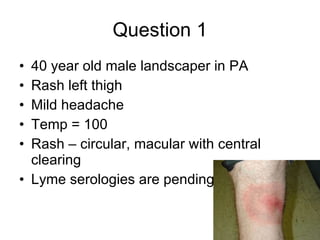
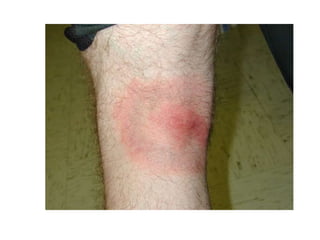
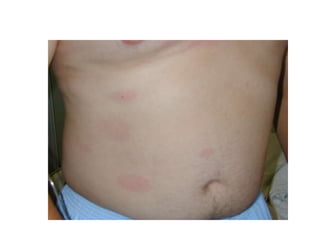
Question 1 40 year old male landscaper in PA  Rash left thigh  Mild headache  Temp = 100  Rash – circular, macular with central clearing  Lyme serologies are pending
What should you do next? A.  If IgM lyme titer is (+), begin treatment B.  Begin treatment now and discontinue if lyme titers are (-) C.  Begin treatment now regardless of results of lyme titers D.  If IgM lyme titer is (-), repeat in 2 weeks and treat if (+)
Question 1 Begin antibiotics regardless of titer results  Recognize relationship between serologic testing and empiric treatment for early Lyme disease.
Question 2 68yo with cervical cancer s/p extensive surgery  On broad spectrum antibiotics post-op  On TPN 5d post-op fever to 102.2  CXR, urine and sputum cx are neg  Vancomycin added, pt remains febrile  Blood cx and cath tip are positive for fungus
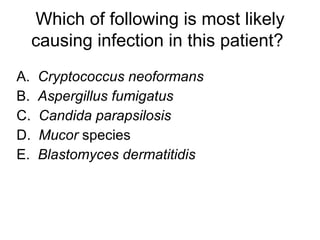
Which of following is most likely causing infection in this patient?   A.  Cryptococcus neoformans B.  Aspergillus fumigatus C.  Candida parapsilosis D.  Mucor  species E.  Blastomyces dermatitidis
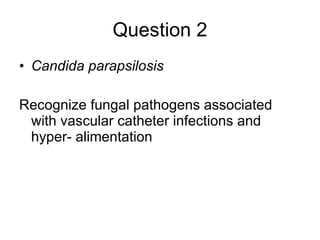
Question 2 Candida parapsilosis Recognize fungal pathogens associated with vascular catheter infections and hyper- alimentation
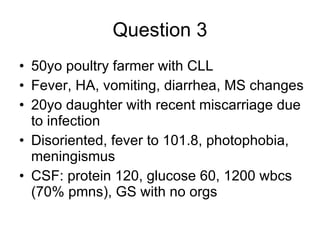
Question 3 50yo poultry farmer with CLL Fever, HA, vomiting, diarrhea, MS changes  20yo daughter with recent miscarriage due to infection  Disoriented, fever to 101.8, photophobia, meningismus CSF: protein 120, glucose 60, 1200 wbcs (70% pmns), GS with no orgs
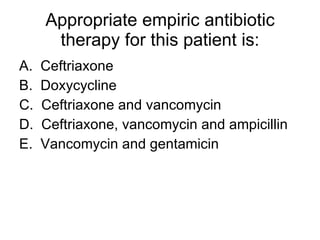
Appropriate empiric antibiotic therapy for this patient is: A.  Ceftriaxone B.  Doxycycline C.  Ceftriaxone and vancomycin D.  Ceftriaxone, vancomycin and ampicillin E.  Vancomycin and gentamicin
Question 3 Ceftriaxone, vancomycin and ampicillin Treat a patient with meningitis who is at risk for infection with  Listeria monocytogenes
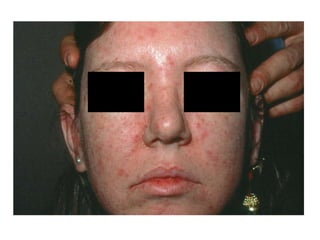
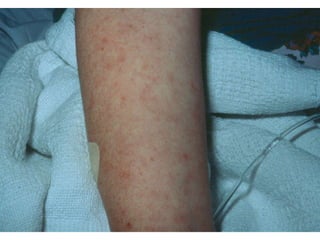
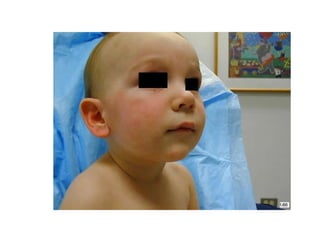
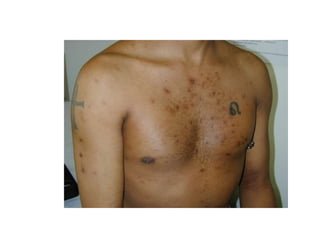
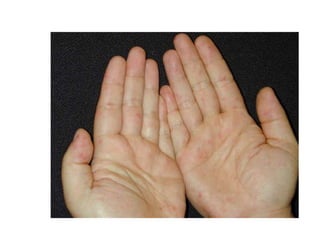
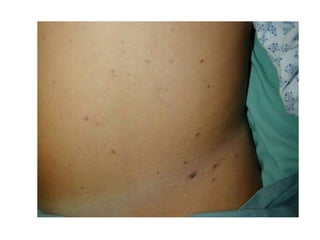
Question 4 33-year old woman presents to Emergency Department with one week history of fever, malaise, myalgias, sore throat Five days PTA noted onset of new rash, non-pruritic, on face, torso, extremities Two days PTA developed mouth sores that were so painful she was unable to eat or drink
Question 4 Past medical history: None Social history: Single, grad student, no tobacco, no IVDA Family history: DM, HTN
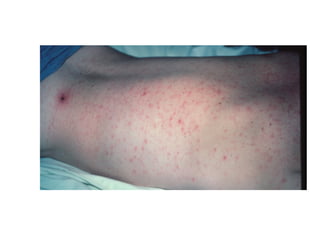
Question 4 Physical Examination in ED T 40 o C. BP 104/76 P 108   R 20 Appears unwell; clinically dehydrated HEENT:  Multiple oral ulcerations Non-exudative pharyngitis Multiple cervical nodes ( +  tender) Rash
 
 
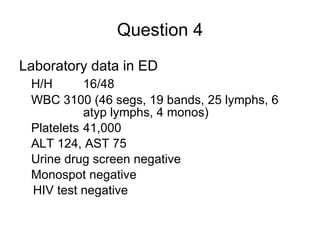
Question 4 Laboratory data in ED H/H 16/48 WBC 3100 (46 segs, 19 bands, 25 lymphs, 6  atyp lymphs, 4 monos) Platelets 41,000 ALT 124, AST 75 Urine drug screen negative Monospot negative HIV test negative
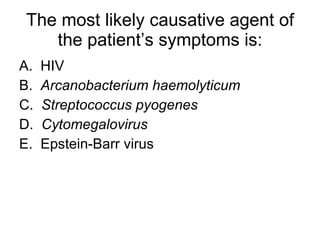
The most likely causative agent of the patient’s symptoms is: A.  HIV B.  Arcanobacterium haemolyticum C.  Streptococcus pyogenes D.  Cytomegalovirus  E.  Epstein-Barr virus
Question 4 HIV Consider differential for acute pharyngitis with rash
Question 5 34yo female from Nantucket  Inguinal LAD and constitutional sx without rash or h/o tick bite  6 weeks later - migratory polyarthralgia, sore throat, left facial palsy and HA  PE with peripheral facial cranial neuropathy  CSF: mild pleocytosis  Lyme ELISA is positive
The most appropriate therapy for this patient is: A.  Oral penicillin B.  Doxycycline C.  Intravenous ceftriaxone D.  High-dose parenteral glucocorticoids
Question 5 Intravenous ceftriaxone  Select the most appropriate treatment for later-stage (early disseminated) Lyme Disease
Question 6 50yo male with elevated LFTs and (+) hepatitis C antibody test  H/O IVDU in 1960s Normal physical exam
What further testing is indicated  to   confirm  his hepatitis C infection? A.  Third generation enzyme immunoassay B.  Recombinant immunoblot assay (RIBA) C.  Reverse transcriptase PCR D.  No further testing indicated
Question 6 No further testing indicated  Understand testing for the diagnosis of hepatitis C and interpretation of results
Question 7 24 yo G1P0, in 2 nd  month of pregnancy 5d h/o vulvar itching and vaginal d/c Exam with thin, malodorous, white d/c and mildly inflamed vulva Rare wbc’s microscopically with granulated vaginal epithelial cells
Which should be the next step in management? A.  Treat with one dose of oral fluconazole B.  Treat with a 7-day course of oral metronidazole, 500mg bid C.  Treat with one dose of oral metronidazole, 2g D.  Withold antibiotics due to fetal risk
Question 7 Treat with 7-day course of metronidazole po (500mg bid) Recognize the clinical picture of bacterial vaginosis and understand how to treat this in a pregnant patient
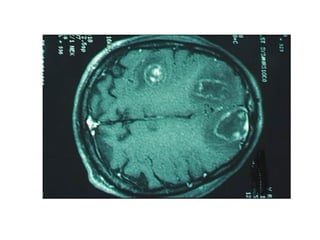
Question 8 27yo with HIV, CD4 ct 175, on daily TMP-SMX Seizure, weeks of stumbling Toxo serology (-) 2 years ago Head CT with 2 large parietal lesions with surrounding edema and midline shift
The best approach to management would be: A.  2 weeks of empiric therapy with TMP-SMX followed by repeat CT B.  2 weeks of empiric TMP-SMX + dexamethasone, followed by CT C.  CT-guided needle biopsy D.  LP to evaluate CSF for EBV PCR E.  Open brain biopsy
Question 8 (CSF for EBV PCR) CT-guided needle biopsy Select the most appropriate management for a patient with HIV and a CNS mass lesion.
Question 9 85yo nursing home resident with ruptured diverticular abscess and fever S/P open drainage On piperacillin/tazobactam Blood cultures with pan-sensitive  E. coli Pt is now afebrile and recovering Abscess culture grows  E. coli, Enterobacter, Bacteroides  and VRE
In addition to contact isolation, the appropriate treatment of this pt is to: A.  Treat VRE empirically, and test susceptibility B.  Test susceptibility and treat accordingly C.  Continue piperacillin/tazobactam D.  Discontinue all antibiotics and send the patient back to the nursing home
Question 9 Continue the piperacillin/tazobactam Distinguish between colonization and infection due to VRE and recognize significance of VRE colonization.
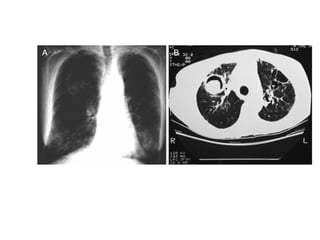
Question 10 44yo with 3 week h/o fever, purulent cough and wt loss SZ d/o s/p seizure 1 month ago CXR with 2.5cm cavity in superior segment RLL with A/F level (+) ppd
What is the most appropriate therapeutic step? A.  Culture sputum for anaerobic bacteria and begin treatment with clindamycin B.  Send sputum for AFB stain and culture and begin treatment with INH, RIF, PZA and ETB C.  Begin treatment with metronidazole and schedule bronchoscopy Send sputum for gram stain and AFB and treat empirically with piperacillin/tazobactam
Question 10 Send sputum for gram stain and AFD and treat empirically with piperacillin/tazobactam  Identify the clinical presentation of a lung abscess and select appropriate therapy.
Question 11 55yo man with fever, chills, tachypnea 2 days after squeezing a facial furuncle H/O anaphylaxis to PCN BC (+) for GPC in clusters
Which of the following would be the best treatment? A.  Aztreonam, 1g every 8 hours B.  Cefazolin, 1g every 8 hours C.  Ceftriaxone, 1g every 12 hours D.  Vancomycin, 1g every 12 hours E.  Imipenem, 500mg every 6 hours
Question 11 Vancomycin 1gm IV bid Select appropriate substitution therapy in the presence of PCN allergy.
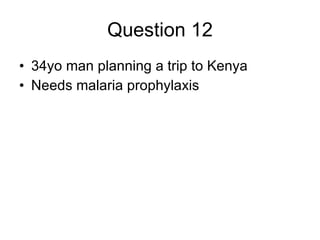
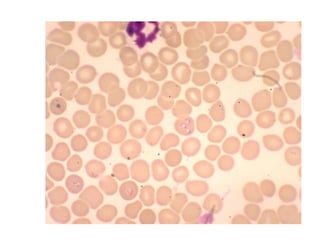
Question 12 34yo man planning a trip to Kenya Needs malaria prophylaxis
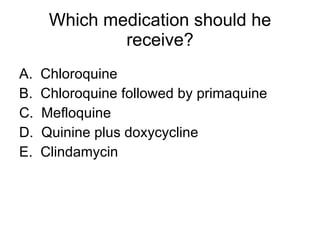
Which medication should he receive? A.  Chloroquine B.  Chloroquine followed by primaquine C.  Mefloquine D.  Quinine plus doxycycline E.  Clindamycin
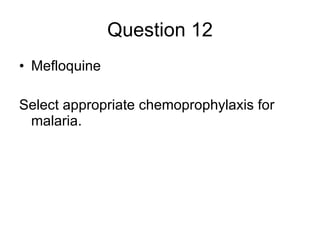
Question 12 Mefloquine Select appropriate chemoprophylaxis for malaria.
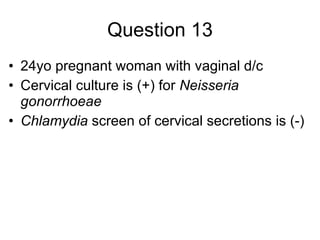
Question 13 24yo pregnant woman with vaginal d/c Cervical culture is (+) for  Neisseria gonorrhoeae Chlamydia  screen of cervical secretions   is (-)
Appropriate therapy for this patient is: A.  Ciprofloxacin 500mg po x 1 B.  Doxycycline, 100mg po bid x 7 days C.  Amoxicillin, 3g po x 1 D.  Ceftriaxone 125mg IM x 1
Question 13 Ceftriaxone IM x 1 Treat uncomplicated gonorrhea in a pregnant woman.
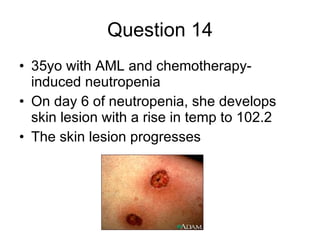
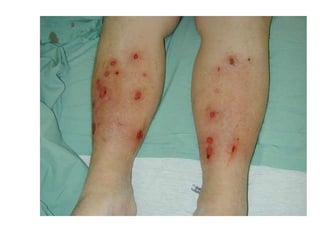
Question 14 35yo with AML and chemotherapy-induced neutropenia On day 6 of neutropenia, she develops skin lesion with a rise in temp to 102.2 The skin lesion progresses
The most likely diagnosis is: A.  Streptococcal cellulitis with bacteremia B.  Disseminated candidiasis C.  Meningococcemia D.  Pseudomonas aeruginosa  bacteremia E.  Staphylococcal endocarditis with metastatic abscesses
Question 14 Pseudomonas aeruginosa  bacteremia Diagnose  Pseudomonas  bacteremia with skin lesions in a neutropenic patient.
Question 15 19yo with urethral d/c and GS with gram-negative intracellular diplococci Given IM ceftriaxone and prescription for doxycycline 1 week later returns with persistent d/c and GS with only wbcs
The reason for symptoms is likely: A. Treatment failure B.  Non-compliance with medication C.  Re-exposure to infected partner D.  Herpes simplex infection E.  Syphilis
Question 15 Failure to take doxycycline Recognize reasons for treatment failure in urethritis.
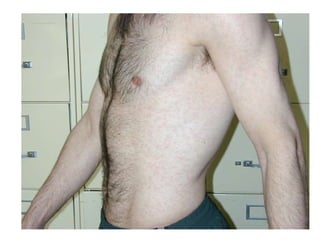
Question 16 85yo in ED b/c daughter found a bat in his bedroom Man does not recall bite or c/o pain Skin exam is unremarkable
The most appropriate course of action is: A.  Give rabies immune globulin and initiate rabies vaccine series B.  Give rabies immune globulin but not the rabies vaccine C.  Observe and initiate rabies immune globulin if the patient behaves abnormally D.  Reassure the patient and the daughter; prophylaxis is not required because a puncture wound was not evident
Question 16 Give rabies immune globulin and initiate rabies vaccine series Assess the need for rabies prophylaxis after a bat exposure.
Images


Internal Medicine Board Review

  • 1.
  • 2.
    Question 1 40year old male landscaper in PA Rash left thigh Mild headache Temp = 100 Rash – circular, macular with central clearing Lyme serologies are pending
  • 3.
    What should youdo next? A. If IgM lyme titer is (+), begin treatment B. Begin treatment now and discontinue if lyme titers are (-) C. Begin treatment now regardless of results of lyme titers D. If IgM lyme titer is (-), repeat in 2 weeks and treat if (+)
  • 4.
    Question 1 Beginantibiotics regardless of titer results Recognize relationship between serologic testing and empiric treatment for early Lyme disease.
  • 5.
    Question 2 68yowith cervical cancer s/p extensive surgery On broad spectrum antibiotics post-op On TPN 5d post-op fever to 102.2 CXR, urine and sputum cx are neg Vancomycin added, pt remains febrile Blood cx and cath tip are positive for fungus
  • 6.
    Which of followingis most likely causing infection in this patient? A. Cryptococcus neoformans B. Aspergillus fumigatus C. Candida parapsilosis D. Mucor species E. Blastomyces dermatitidis
  • 7.
    Question 2 Candidaparapsilosis Recognize fungal pathogens associated with vascular catheter infections and hyper- alimentation
  • 8.
    Question 3 50yopoultry farmer with CLL Fever, HA, vomiting, diarrhea, MS changes 20yo daughter with recent miscarriage due to infection Disoriented, fever to 101.8, photophobia, meningismus CSF: protein 120, glucose 60, 1200 wbcs (70% pmns), GS with no orgs
  • 9.
    Appropriate empiric antibiotictherapy for this patient is: A. Ceftriaxone B. Doxycycline C. Ceftriaxone and vancomycin D. Ceftriaxone, vancomycin and ampicillin E. Vancomycin and gentamicin
  • 10.
    Question 3 Ceftriaxone,vancomycin and ampicillin Treat a patient with meningitis who is at risk for infection with Listeria monocytogenes
  • 11.
    Question 4 33-yearold woman presents to Emergency Department with one week history of fever, malaise, myalgias, sore throat Five days PTA noted onset of new rash, non-pruritic, on face, torso, extremities Two days PTA developed mouth sores that were so painful she was unable to eat or drink
  • 12.
    Question 4 Pastmedical history: None Social history: Single, grad student, no tobacco, no IVDA Family history: DM, HTN
  • 13.
    Question 4 PhysicalExamination in ED T 40 o C. BP 104/76 P 108 R 20 Appears unwell; clinically dehydrated HEENT: Multiple oral ulcerations Non-exudative pharyngitis Multiple cervical nodes ( + tender) Rash
  • 14.
  • 15.
  • 16.
    Question 4 Laboratorydata in ED H/H 16/48 WBC 3100 (46 segs, 19 bands, 25 lymphs, 6 atyp lymphs, 4 monos) Platelets 41,000 ALT 124, AST 75 Urine drug screen negative Monospot negative HIV test negative
  • 17.
    The most likelycausative agent of the patient’s symptoms is: A. HIV B. Arcanobacterium haemolyticum C. Streptococcus pyogenes D. Cytomegalovirus E. Epstein-Barr virus
  • 18.
    Question 4 HIVConsider differential for acute pharyngitis with rash
  • 19.
    Question 5 34yofemale from Nantucket Inguinal LAD and constitutional sx without rash or h/o tick bite 6 weeks later - migratory polyarthralgia, sore throat, left facial palsy and HA PE with peripheral facial cranial neuropathy CSF: mild pleocytosis Lyme ELISA is positive
  • 20.
    The most appropriatetherapy for this patient is: A. Oral penicillin B. Doxycycline C. Intravenous ceftriaxone D. High-dose parenteral glucocorticoids
  • 21.
    Question 5 Intravenousceftriaxone Select the most appropriate treatment for later-stage (early disseminated) Lyme Disease
  • 22.
    Question 6 50yomale with elevated LFTs and (+) hepatitis C antibody test H/O IVDU in 1960s Normal physical exam
  • 23.
    What further testingis indicated to confirm his hepatitis C infection? A. Third generation enzyme immunoassay B. Recombinant immunoblot assay (RIBA) C. Reverse transcriptase PCR D. No further testing indicated
  • 24.
    Question 6 Nofurther testing indicated Understand testing for the diagnosis of hepatitis C and interpretation of results
  • 25.
    Question 7 24yo G1P0, in 2 nd month of pregnancy 5d h/o vulvar itching and vaginal d/c Exam with thin, malodorous, white d/c and mildly inflamed vulva Rare wbc’s microscopically with granulated vaginal epithelial cells
  • 26.
    Which should bethe next step in management? A. Treat with one dose of oral fluconazole B. Treat with a 7-day course of oral metronidazole, 500mg bid C. Treat with one dose of oral metronidazole, 2g D. Withold antibiotics due to fetal risk
  • 27.
    Question 7 Treatwith 7-day course of metronidazole po (500mg bid) Recognize the clinical picture of bacterial vaginosis and understand how to treat this in a pregnant patient
  • 28.
    Question 8 27yowith HIV, CD4 ct 175, on daily TMP-SMX Seizure, weeks of stumbling Toxo serology (-) 2 years ago Head CT with 2 large parietal lesions with surrounding edema and midline shift
  • 29.
    The best approachto management would be: A. 2 weeks of empiric therapy with TMP-SMX followed by repeat CT B. 2 weeks of empiric TMP-SMX + dexamethasone, followed by CT C. CT-guided needle biopsy D. LP to evaluate CSF for EBV PCR E. Open brain biopsy
  • 30.
    Question 8 (CSFfor EBV PCR) CT-guided needle biopsy Select the most appropriate management for a patient with HIV and a CNS mass lesion.
  • 31.
    Question 9 85yonursing home resident with ruptured diverticular abscess and fever S/P open drainage On piperacillin/tazobactam Blood cultures with pan-sensitive E. coli Pt is now afebrile and recovering Abscess culture grows E. coli, Enterobacter, Bacteroides and VRE
  • 32.
    In addition tocontact isolation, the appropriate treatment of this pt is to: A. Treat VRE empirically, and test susceptibility B. Test susceptibility and treat accordingly C. Continue piperacillin/tazobactam D. Discontinue all antibiotics and send the patient back to the nursing home
  • 33.
    Question 9 Continuethe piperacillin/tazobactam Distinguish between colonization and infection due to VRE and recognize significance of VRE colonization.
  • 34.
    Question 10 44yowith 3 week h/o fever, purulent cough and wt loss SZ d/o s/p seizure 1 month ago CXR with 2.5cm cavity in superior segment RLL with A/F level (+) ppd
  • 35.
    What is themost appropriate therapeutic step? A. Culture sputum for anaerobic bacteria and begin treatment with clindamycin B. Send sputum for AFB stain and culture and begin treatment with INH, RIF, PZA and ETB C. Begin treatment with metronidazole and schedule bronchoscopy Send sputum for gram stain and AFB and treat empirically with piperacillin/tazobactam
  • 36.
    Question 10 Sendsputum for gram stain and AFD and treat empirically with piperacillin/tazobactam Identify the clinical presentation of a lung abscess and select appropriate therapy.
  • 37.
    Question 11 55yoman with fever, chills, tachypnea 2 days after squeezing a facial furuncle H/O anaphylaxis to PCN BC (+) for GPC in clusters
  • 38.
    Which of thefollowing would be the best treatment? A. Aztreonam, 1g every 8 hours B. Cefazolin, 1g every 8 hours C. Ceftriaxone, 1g every 12 hours D. Vancomycin, 1g every 12 hours E. Imipenem, 500mg every 6 hours
  • 39.
    Question 11 Vancomycin1gm IV bid Select appropriate substitution therapy in the presence of PCN allergy.
  • 40.
    Question 12 34yoman planning a trip to Kenya Needs malaria prophylaxis
  • 41.
    Which medication shouldhe receive? A. Chloroquine B. Chloroquine followed by primaquine C. Mefloquine D. Quinine plus doxycycline E. Clindamycin
  • 42.
    Question 12 MefloquineSelect appropriate chemoprophylaxis for malaria.
  • 43.
    Question 13 24yopregnant woman with vaginal d/c Cervical culture is (+) for Neisseria gonorrhoeae Chlamydia screen of cervical secretions is (-)
  • 44.
    Appropriate therapy forthis patient is: A. Ciprofloxacin 500mg po x 1 B. Doxycycline, 100mg po bid x 7 days C. Amoxicillin, 3g po x 1 D. Ceftriaxone 125mg IM x 1
  • 45.
    Question 13 CeftriaxoneIM x 1 Treat uncomplicated gonorrhea in a pregnant woman.
  • 46.
    Question 14 35yowith AML and chemotherapy-induced neutropenia On day 6 of neutropenia, she develops skin lesion with a rise in temp to 102.2 The skin lesion progresses
  • 47.
    The most likelydiagnosis is: A. Streptococcal cellulitis with bacteremia B. Disseminated candidiasis C. Meningococcemia D. Pseudomonas aeruginosa bacteremia E. Staphylococcal endocarditis with metastatic abscesses
  • 48.
    Question 14 Pseudomonasaeruginosa bacteremia Diagnose Pseudomonas bacteremia with skin lesions in a neutropenic patient.
  • 49.
    Question 15 19yowith urethral d/c and GS with gram-negative intracellular diplococci Given IM ceftriaxone and prescription for doxycycline 1 week later returns with persistent d/c and GS with only wbcs
  • 50.
    The reason forsymptoms is likely: A. Treatment failure B. Non-compliance with medication C. Re-exposure to infected partner D. Herpes simplex infection E. Syphilis
  • 51.
    Question 15 Failureto take doxycycline Recognize reasons for treatment failure in urethritis.
  • 52.
    Question 16 85yoin ED b/c daughter found a bat in his bedroom Man does not recall bite or c/o pain Skin exam is unremarkable
  • 53.
    The most appropriatecourse of action is: A. Give rabies immune globulin and initiate rabies vaccine series B. Give rabies immune globulin but not the rabies vaccine C. Observe and initiate rabies immune globulin if the patient behaves abnormally D. Reassure the patient and the daughter; prophylaxis is not required because a puncture wound was not evident
  • 54.
    Question 16 Giverabies immune globulin and initiate rabies vaccine series Assess the need for rabies prophylaxis after a bat exposure.
  • 55.
  • 56.
  • 57.
  • 58.
  • 59.
  • 60.
  • 61.
  • 62.
  • 63.
  • 64.
  • 65.
  • 66.
  • 67.
  • 68.
  • 69.
  • 70.
  • 71.
  • 72.
  • 73.
  • 74.
  • 75.
  • 76.
  • 77.
  • 78.