Ade Wijaya
December 2017
Churg-Strauss Syndrome
Outline:
 Introduction
 Definition
 Epidemiology
 Pathogenesis
 Clinical manifestation
 Diagnosis
 Treatment
 Prognosis
 Summary
Introduction
 Churg and Strauss, 1951
 Eosinophilic Granulomatosis with polyangiitis
(EGPA)
 Uncommon
 Vasculitis disease
Churg J, Strauss L (1951) Allergic granulomatosis, allergic angiitis and periarteriitis nodosa. Am J Pathol 27:277–301
Umezawa N, Kohsaka H, Nanki T et al (2014) Successful treatment of eosinophilic granulomatosis with polyangiitis (EPGA; formerly Churg-Strauss syndrome) with
rituximab in a case refractory to glucocorticoids, cyclophosphamide, and IVIG. Mod Rheumatol 24:685–687
Definition
 A small-vessel vasculitis
 Eosinophil-rich and granulomatous inflammation
involving the respiratory tract, with necrotizing
vasculitis affecting small- to medium-sized
vessels, associated with asthma and eosinophilia
 Which combines clinical and pathologic features
of microscopic polyangiitis (MPA) and
granulomatosis with polyangiitis (GPA)
 Association with p-ANCA.
Jenette JC, Falk RJ, Andrasy K et al (1994) Nomenclature of systemic vasculitides. Proposal of an international Consensus Conference. Arthritis Rheum 37:187–192
Epidemiology
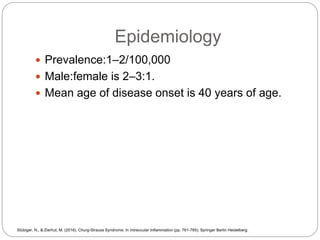
 Prevalence:1–2/100,000
 Male:female is 2–3:1.
 Mean age of disease onset is 40 years of age.
Stübiger, N., & Zierhut, M. (2016). Churg-Strauss Syndrome. In Intraocular Inflammation (pp. 761-765). Springer Berlin Heidelberg.
Pathogenesis
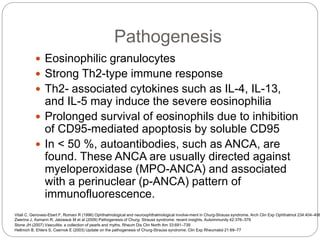
 Eosinophilic granulocytes
 Strong Th2-type immune response
 Th2- associated cytokines such as IL-4, IL-13,
and IL-5 may induce the severe eosinophilia
 Prolonged survival of eosinophils due to inhibition
of CD95-mediated apoptosis by soluble CD95
 In < 50 %, autoantibodies, such as ANCA, are
found. These ANCA are usually directed against
myeloperoxidase (MPO-ANCA) and associated
with a perinuclear (p-ANCA) pattern of
immunofluorescence.
Hellmich B, Ehlers S, Csernok E (2003) Update on the pathogenesis of Churg-Strauss syndrome. Clin Exp Rheumatol 21:69–77
Stone JH (2007) Vasculitis: a collection of pearls and myths. Rheum Dis Clin North Am 33:691–739
Vitali C, Genovesi-Ebert F, Romani R (1996) Ophthalmological and neuroophthalmological involve-ment in Churg-Strauss syndrome. Arch Clin Exp Ophthalmol 234:404–408
Zwerina J, Axmann R, Jatzwauk M et al (2009) Pathogenesis of Churg- Strauss syndrome: recent insights. Autoimmunity 42:376–379
Clinical Manifestation
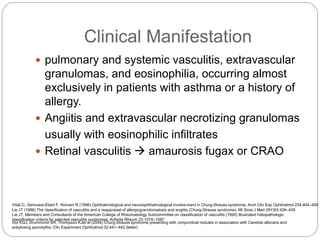
 pulmonary and systemic vasculitis, extravascular
granulomas, and eosinophilia, occurring almost
exclusively in patients with asthma or a history of
allergy.
 Angiitis and extravascular necrotizing granulomas
usually with eosinophilic infiltrates
 Retinal vasculitis  amaurosis fugax or CRAO
Lie JT (1986) The classification of vasculitis and a reappraisal of allergicgranulomatosis and angiitis (Churg-Strauss syndrome). Mt Sinai J Med (NY)53:429–439
Lie JT, Members and Consultants of the American College of Rheumatology Subcommittee on classification of vasculitis (1990) Illustrated histopathologic
classification criteria for selected vasculitis syndromes. Arthritis Rheum 33:1074–1087
Ooi KGJ, Drummond SR, Thompson KJet al (2004) Churg-Strauss syndrome presenting with conjunctival nodules in association with Candida albicans and
ankylosing spondylitis. Clin Experiment Ophthalmol 32:441–442 (letter)
Vitali C, Genovesi-Ebert F, Romani R (1996) Ophthalmological and neuroophthalmological involve-ment in Churg-Strauss syndrome. Arch Clin Exp Ophthalmol 234:404–408
Diagnosis
(American College of Rheumatology, 1990)
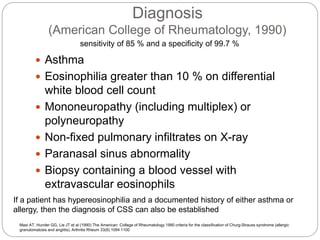
 Asthma
 Eosinophilia greater than 10 % on differential
white blood cell count
 Mononeuropathy (including multiplex) or
polyneuropathy
 Non-fixed pulmonary infiltrates on X-ray
 Paranasal sinus abnormality
 Biopsy containing a blood vessel with
extravascular eosinophils
sensitivity of 85 % and a specificity of 99.7 %
If a patient has hypereosinophilia and a documented history of either asthma or
allergy, then the diagnosis of CSS can also be established
Masi AT, Hunder GG, Lie JT et al (1990) The American College of Rheumatology 1990 criteria for the classification of Churg-Strauss syndrome (allergic
granulomatosis and angiitis). Arthritis Rheum 33(8):1094 1100
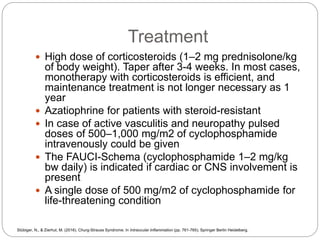
Treatment
 High dose of corticosteroids (1–2 mg prednisolone/kg
of body weight). Taper after 3-4 weeks. In most cases,
monotherapy with corticosteroids is efficient, and
maintenance treatment is not longer necessary as 1
year
 Azatiophrine for patients with steroid-resistant
 In case of active vasculitis and neuropathy pulsed
doses of 500–1,000 mg/m2 of cyclophosphamide
intravenously could be given
 The FAUCI-Schema (cyclophosphamide 1–2 mg/kg
bw daily) is indicated if cardiac or CNS involvement is
present
 A single dose of 500 mg/m2 of cyclophosphamide for
life-threatening condition
Stübiger, N., & Zierhut, M. (2016). Churg-Strauss Syndrome. In Intraocular Inflammation (pp. 761-765). Springer Berlin Heidelberg.
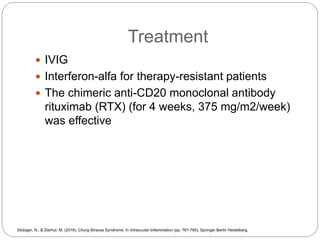
Treatment
 IVIG
 Interferon-alfa for therapy-resistant patients
 The chimeric anti-CD20 monoclonal antibody
rituximab (RTX) (for 4 weeks, 375 mg/m2/week)
was effective
Stübiger, N., & Zierhut, M. (2016). Churg-Strauss Syndrome. In Intraocular Inflammation (pp. 761-765). Springer Berlin Heidelberg.
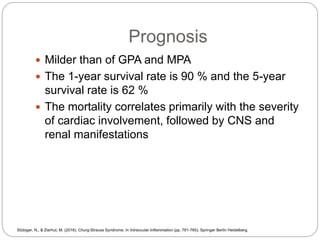
Prognosis
 Milder than of GPA and MPA
 The 1-year survival rate is 90 % and the 5-year
survival rate is 62 %
 The mortality correlates primarily with the severity
of cardiac involvement, followed by CNS and
renal manifestations
Stübiger, N., & Zierhut, M. (2016). Churg-Strauss Syndrome. In Intraocular Inflammation (pp. 761-765). Springer Berlin Heidelberg.
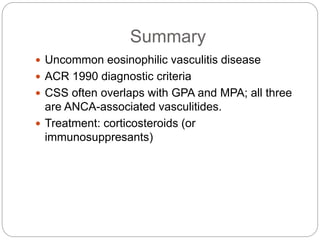
Summary
 Uncommon eosinophilic vasculitis disease
 ACR 1990 diagnostic criteria
 CSS often overlaps with GPA and MPA; all three
are ANCA-associated vasculitides.
 Treatment: corticosteroids (or
immunosuppresants)
THANK YOU

Churg-Strauss Syndrome

  • 1.
  • 2.
    Outline:  Introduction  Definition Epidemiology  Pathogenesis  Clinical manifestation  Diagnosis  Treatment  Prognosis  Summary
  • 3.
    Introduction  Churg andStrauss, 1951  Eosinophilic Granulomatosis with polyangiitis (EGPA)  Uncommon  Vasculitis disease Churg J, Strauss L (1951) Allergic granulomatosis, allergic angiitis and periarteriitis nodosa. Am J Pathol 27:277–301 Umezawa N, Kohsaka H, Nanki T et al (2014) Successful treatment of eosinophilic granulomatosis with polyangiitis (EPGA; formerly Churg-Strauss syndrome) with rituximab in a case refractory to glucocorticoids, cyclophosphamide, and IVIG. Mod Rheumatol 24:685–687
  • 4.
    Definition  A small-vesselvasculitis  Eosinophil-rich and granulomatous inflammation involving the respiratory tract, with necrotizing vasculitis affecting small- to medium-sized vessels, associated with asthma and eosinophilia  Which combines clinical and pathologic features of microscopic polyangiitis (MPA) and granulomatosis with polyangiitis (GPA)  Association with p-ANCA. Jenette JC, Falk RJ, Andrasy K et al (1994) Nomenclature of systemic vasculitides. Proposal of an international Consensus Conference. Arthritis Rheum 37:187–192
  • 5.
    Epidemiology  Prevalence:1–2/100,000  Male:femaleis 2–3:1.  Mean age of disease onset is 40 years of age. Stübiger, N., & Zierhut, M. (2016). Churg-Strauss Syndrome. In Intraocular Inflammation (pp. 761-765). Springer Berlin Heidelberg.
  • 6.
    Pathogenesis  Eosinophilic granulocytes Strong Th2-type immune response  Th2- associated cytokines such as IL-4, IL-13, and IL-5 may induce the severe eosinophilia  Prolonged survival of eosinophils due to inhibition of CD95-mediated apoptosis by soluble CD95  In < 50 %, autoantibodies, such as ANCA, are found. These ANCA are usually directed against myeloperoxidase (MPO-ANCA) and associated with a perinuclear (p-ANCA) pattern of immunofluorescence. Hellmich B, Ehlers S, Csernok E (2003) Update on the pathogenesis of Churg-Strauss syndrome. Clin Exp Rheumatol 21:69–77 Stone JH (2007) Vasculitis: a collection of pearls and myths. Rheum Dis Clin North Am 33:691–739 Vitali C, Genovesi-Ebert F, Romani R (1996) Ophthalmological and neuroophthalmological involve-ment in Churg-Strauss syndrome. Arch Clin Exp Ophthalmol 234:404–408 Zwerina J, Axmann R, Jatzwauk M et al (2009) Pathogenesis of Churg- Strauss syndrome: recent insights. Autoimmunity 42:376–379
  • 7.
    Clinical Manifestation  pulmonaryand systemic vasculitis, extravascular granulomas, and eosinophilia, occurring almost exclusively in patients with asthma or a history of allergy.  Angiitis and extravascular necrotizing granulomas usually with eosinophilic infiltrates  Retinal vasculitis  amaurosis fugax or CRAO Lie JT (1986) The classification of vasculitis and a reappraisal of allergicgranulomatosis and angiitis (Churg-Strauss syndrome). Mt Sinai J Med (NY)53:429–439 Lie JT, Members and Consultants of the American College of Rheumatology Subcommittee on classification of vasculitis (1990) Illustrated histopathologic classification criteria for selected vasculitis syndromes. Arthritis Rheum 33:1074–1087 Ooi KGJ, Drummond SR, Thompson KJet al (2004) Churg-Strauss syndrome presenting with conjunctival nodules in association with Candida albicans and ankylosing spondylitis. Clin Experiment Ophthalmol 32:441–442 (letter) Vitali C, Genovesi-Ebert F, Romani R (1996) Ophthalmological and neuroophthalmological involve-ment in Churg-Strauss syndrome. Arch Clin Exp Ophthalmol 234:404–408
  • 8.
    Diagnosis (American College ofRheumatology, 1990)  Asthma  Eosinophilia greater than 10 % on differential white blood cell count  Mononeuropathy (including multiplex) or polyneuropathy  Non-fixed pulmonary infiltrates on X-ray  Paranasal sinus abnormality  Biopsy containing a blood vessel with extravascular eosinophils sensitivity of 85 % and a specificity of 99.7 % If a patient has hypereosinophilia and a documented history of either asthma or allergy, then the diagnosis of CSS can also be established Masi AT, Hunder GG, Lie JT et al (1990) The American College of Rheumatology 1990 criteria for the classification of Churg-Strauss syndrome (allergic granulomatosis and angiitis). Arthritis Rheum 33(8):1094 1100
  • 9.
    Treatment  High doseof corticosteroids (1–2 mg prednisolone/kg of body weight). Taper after 3-4 weeks. In most cases, monotherapy with corticosteroids is efficient, and maintenance treatment is not longer necessary as 1 year  Azatiophrine for patients with steroid-resistant  In case of active vasculitis and neuropathy pulsed doses of 500–1,000 mg/m2 of cyclophosphamide intravenously could be given  The FAUCI-Schema (cyclophosphamide 1–2 mg/kg bw daily) is indicated if cardiac or CNS involvement is present  A single dose of 500 mg/m2 of cyclophosphamide for life-threatening condition Stübiger, N., & Zierhut, M. (2016). Churg-Strauss Syndrome. In Intraocular Inflammation (pp. 761-765). Springer Berlin Heidelberg.
  • 10.
    Treatment  IVIG  Interferon-alfafor therapy-resistant patients  The chimeric anti-CD20 monoclonal antibody rituximab (RTX) (for 4 weeks, 375 mg/m2/week) was effective Stübiger, N., & Zierhut, M. (2016). Churg-Strauss Syndrome. In Intraocular Inflammation (pp. 761-765). Springer Berlin Heidelberg.
  • 11.
    Prognosis  Milder thanof GPA and MPA  The 1-year survival rate is 90 % and the 5-year survival rate is 62 %  The mortality correlates primarily with the severity of cardiac involvement, followed by CNS and renal manifestations Stübiger, N., & Zierhut, M. (2016). Churg-Strauss Syndrome. In Intraocular Inflammation (pp. 761-765). Springer Berlin Heidelberg.
  • 12.
    Summary  Uncommon eosinophilicvasculitis disease  ACR 1990 diagnostic criteria  CSS often overlaps with GPA and MPA; all three are ANCA-associated vasculitides.  Treatment: corticosteroids (or immunosuppresants)
  • 13.