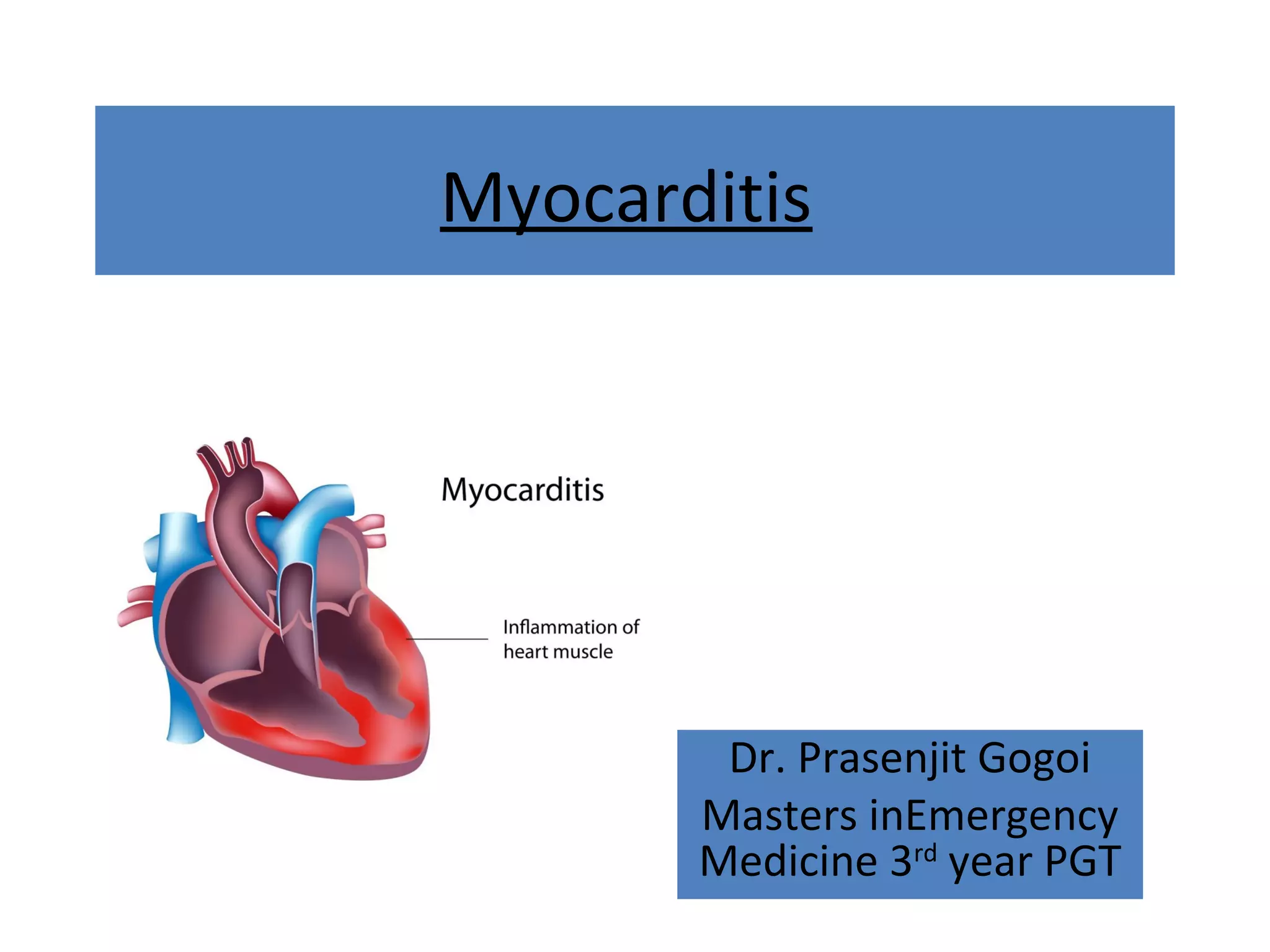

Myocarditis
Dr. Prasenjit Gogoi
Masters inEmergency
Medicine 3rd
year PGT
Myocarditis (WHO /ISFC)
Defination
• Inflammatory disease of the myocardium diagnosed by established
histological*, immunological and immunohistochemical criteria**.
• *N.B. established histological Dallas criteria defined as follows:
‘histological evidence of inflammatory infiltrates within the myocar-dium
associated with myocyte degeneration and necrosis of non-ischaemic origin
• **N.B. unspecified immunohistochemical criteria
we propose an abnormal inflammatory infiltrate to be defined as follows:
≥ 14 leucocytes/mm including up to 4 monocytes/mm with the presence of CD 3
positive T-lymphocytes ≥ 7 cells/mm
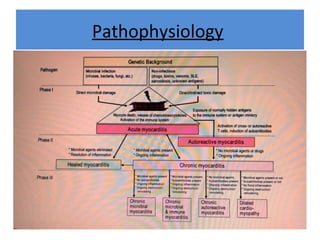
Pathophysiology
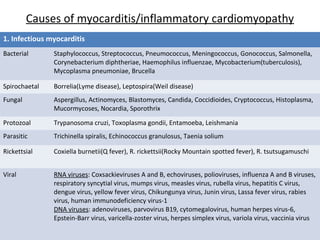
Causes of myocarditis/inflammatory cardiomyopathy
1. Infectious myocarditis
Bacterial Staphylococcus, Streptococcus, Pneumococcus, Meningococcus, Gonococcus, Salmonella,
Corynebacterium diphtheriae, Haemophilus influenzae, Mycobacterium(tuberculosis),
Mycoplasma pneumoniae, Brucella
Spirochaetal Borrelia(Lyme disease), Leptospira(Weil disease)
Fungal Aspergillus, Actinomyces, Blastomyces, Candida, Coccidioides, Cryptococcus, Histoplasma,
Mucormycoses, Nocardia, Sporothrix
Protozoal Trypanosoma cruzi, Toxoplasma gondii, Entamoeba, Leishmania
Parasitic Trichinella spiralis, Echinococcus granulosus, Taenia solium
Rickettsial Coxiella burnetii(Q fever), R. rickettsii(Rocky Mountain spotted fever), R. tsutsugamuschi
Viral RNA viruses: Coxsackieviruses A and B, echoviruses, polioviruses, influenza A and B viruses,
respiratory syncytial virus, mumps virus, measles virus, rubella virus, hepatitis C virus,
dengue virus, yellow fever virus, Chikungunya virus, Junin virus, Lassa fever virus, rabies
virus, human immunodeficiency virus-1
DNA viruses: adenoviruses, parvovirus B19, cytomegalovirus, human herpes virus-6,
Epstein-Barr virus, varicella-zoster virus, herpes simplex virus, variola virus, vaccinia virus
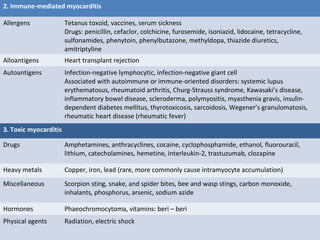
2. Immune-mediated myocarditis
Allergens Tetanus toxoid, vaccines, serum sickness
Drugs: penicillin, cefaclor, colchicine, furosemide, isoniazid, lidocaine, tetracycline,
sulfonamides, phenytoin, phenylbutazone, methyldopa, thiazide diuretics,
amitriptyline
Alloantigens Heart transplant rejection
Autoantigens Infection-negative lymphocytic, infection-negative giant cell
Associated with autoimmune or immune-oriented disorders: systemic lupus
erythematosus, rheumatoid arthritis, Churg-Strauss syndrome, Kawasaki’s disease,
inflammatory bowel disease, scleroderma, polymyositis, myasthenia gravis, insulin-
dependent diabetes mellitus, thyrotoxicosis, sarcoidosis, Wegener’s granulomatosis,
rheumatic heart disease (rheumatic fever)
3. Toxic myocarditis
Drugs Amphetamines, anthracyclines, cocaine, cyclophosphamide, ethanol, fluorouracil,
lithium, catecholamines, hemetine, interleukin-2, trastuzumab, clozapine
Heavy metals Copper, iron, lead (rare, more commonly cause intramyocyte accumulation)
Miscellaneous Scorpion sting, snake, and spider bites, bee and wasp stings, carbon monoxide,
inhalants, phosphorus, arsenic, sodium azide
Hormones Phaeochromocytoma, vitamins: beri – beri
Physical agents Radiation, electric shock
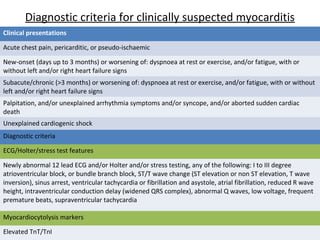
Diagnostic criteria for clinically suspected myocarditis
Clinical presentations
Acute chest pain, pericarditic, or pseudo-ischaemic
New-onset (days up to 3 months) or worsening of: dyspnoea at rest or exercise, and/or fatigue, with or
without left and/or right heart failure signs
Subacute/chronic (>3 months) or worsening of: dyspnoea at rest or exercise, and/or fatigue, with or without
left and/or right heart failure signs
Palpitation, and/or unexplained arrhythmia symptoms and/or syncope, and/or aborted sudden cardiac
death
Unexplained cardiogenic shock
Diagnostic criteria
ECG/Holter/stress test features
Newly abnormal 12 lead ECG and/or Holter and/or stress testing, any of the following: I to III degree
atrioventricular block, or bundle branch block, ST/T wave change (ST elevation or non ST elevation, T wave
inversion), sinus arrest, ventricular tachycardia or fibrillation and asystole, atrial fibrillation, reduced R wave
height, intraventricular conduction delay (widened QRS complex), abnormal Q waves, low voltage, frequent
premature beats, supraventricular tachycardia
Myocardiocytolysis markers
Elevated TnT/TnI
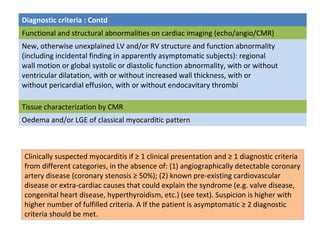
Diagnostic criteria : Contd
Functional and structural abnormalities on cardiac imaging (echo/angio/CMR)
New, otherwise unexplained LV and/or RV structure and function abnormality
(including incidental finding in apparently asymptomatic subjects): regional
wall motion or global systolic or diastolic function abnormality, with or without
ventricular dilatation, with or without increased wall thickness, with or
without pericardial effusion, with or without endocavitary thrombi
Tissue characterization by CMR
Oedema and/or LGE of classical myocarditic pattern
Clinically suspected myocarditis if ≥ 1 clinical presentation and ≥ 1 diagnostic criteria
from different categories, in the absence of: (1) angiographically detectable coronary
artery disease (coronary stenosis ≥ 50%); (2) known pre-existing cardiovascular
disease or extra-cardiac causes that could explain the syndrome (e.g. valve disease,
congenital heart disease, hyperthyroidism, etc.) (see text). Suspicion is higher with
higher number of fulfilled criteria. A If the patient is asymptomatic ≥ 2 diagnostic
criteria should be met.
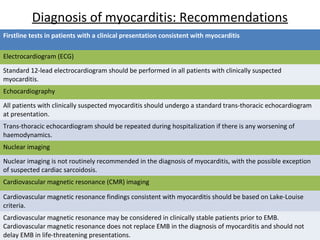
Diagnosis of myocarditis: Recommendations
Firstline tests in patients with a clinical presentation consistent with myocarditis
Electrocardiogram (ECG)
Standard 12-lead electrocardiogram should be performed in all patients with clinically suspected
myocarditis.
Echocardiography
All patients with clinically suspected myocarditis should undergo a standard trans-thoracic echocardiogram
at presentation.
Trans-thoracic echocardiogram should be repeated during hospitalization if there is any worsening of
haemodynamics.
Nuclear imaging
Nuclear imaging is not routinely recommended in the diagnosis of myocarditis, with the possible exception
of suspected cardiac sarcoidosis.
Cardiovascular magnetic resonance (CMR) imaging
Cardiovascular magnetic resonance findings consistent with myocarditis should be based on Lake-Louise
criteria.
Cardiovascular magnetic resonance may be considered in clinically stable patients prior to EMB.
Cardiovascular magnetic resonance does not replace EMB in the diagnosis of myocarditis and should not
delay EMB in life-threatening presentations.
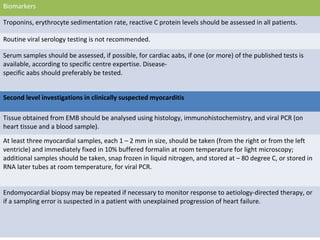
Biomarkers
Troponins, erythrocyte sedimentation rate, reactive C protein levels should be assessed in all patients.
Routine viral serology testing is not recommended.
Serum samples should be assessed, if possible, for cardiac aabs, if one (or more) of the published tests is
available, according to specific centre expertise. Disease-
specific aabs should preferably be tested.
Second level investigations in clinically suspected myocarditis
Tissue obtained from EMB should be analysed using histology, immunohistochemistry, and viral PCR (on
heart tissue and a blood sample).
At least three myocardial samples, each 1 – 2 mm in size, should be taken (from the right or from the left
ventricle) and immediately fixed in 10% buffered formalin at room temperature for light microscopy;
additional samples should be taken, snap frozen in liquid nitrogen, and stored at – 80 degree C, or stored in
RNA later tubes at room temperature, for viral PCR.
Endomyocardial biopsy may be repeated if necessary to monitor response to aetiology-directed therapy, or
if a sampling error is suspected in a patient with unexplained progression of heart failure.
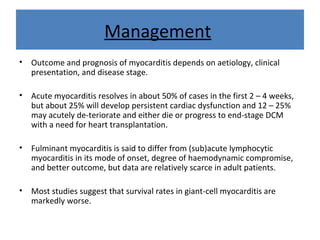
Management
• Outcome and prognosis of myocarditis depends on aetiology, clinical
presentation, and disease stage.
• Acute myocarditis resolves in about 50% of cases in the first 2 – 4 weeks,
but about 25% will develop persistent cardiac dysfunction and 12 – 25%
may acutely de-teriorate and either die or progress to end-stage DCM
with a need for heart transplantation.
• Fulminant myocarditis is said to differ from (sub)acute lymphocytic
myocarditis in its mode of onset, degree of haemodynamic compromise,
and better outcome, but data are relatively scarce in adult patients.
• Most studies suggest that survival rates in giant-cell myocarditis are
markedly worse.
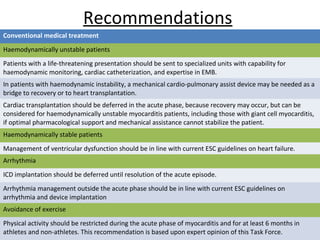
Recommendations
Conventional medical treatment
Haemodynamically unstable patients
Patients with a life-threatening presentation should be sent to specialized units with capability for
haemodynamic monitoring, cardiac catheterization, and expertise in EMB.
In patients with haemodynamic instability, a mechanical cardio-pulmonary assist device may be needed as a
bridge to recovery or to heart transplantation.
Cardiac transplantation should be deferred in the acute phase, because recovery may occur, but can be
considered for haemodynamically unstable myocarditis patients, including those with giant cell myocarditis,
if optimal pharmacological support and mechanical assistance cannot stabilize the patient.
Haemodynamically stable patients
Management of ventricular dysfunction should be in line with current ESC guidelines on heart failure.
Arrhythmia
ICD implantation should be deferred until resolution of the acute episode.
Arrhythmia management outside the acute phase should be in line with current ESC guidelines on
arrhythmia and device implantation
Avoidance of exercise
Physical activity should be restricted during the acute phase of myocarditis and for at least 6 months in
athletes and non-athletes. This recommendation is based upon expert opinion of this Task Force.
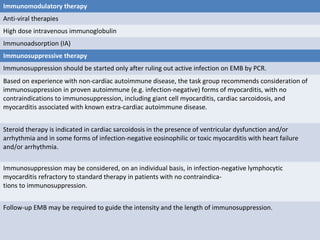
Immunomodulatory therapy
Anti-viral therapies
High dose intravenous immunoglobulin
Immunoadsorption (IA)
Immunosuppressive therapy
Immunosuppression should be started only after ruling out active infection on EMB by PCR.
Based on experience with non-cardiac autoimmune disease, the task group recommends consideration of
immunosuppression in proven autoimmune (e.g. infection-negative) forms of myocarditis, with no
contraindications to immunosuppression, including giant cell myocarditis, cardiac sarcoidosis, and
myocarditis associated with known extra-cardiac autoimmune disease.
Steroid therapy is indicated in cardiac sarcoidosis in the presence of ventricular dysfunction and/or
arrhythmia and in some forms of infection-negative eosinophilic or toxic myocarditis with heart failure
and/or arrhythmia.
Immunosuppression may be considered, on an individual basis, in infection-negative lymphocytic
myocarditis refractory to standard therapy in patients with no contraindica-
tions to immunosuppression.
Follow-up EMB may be required to guide the intensity and the length of immunosuppression.
Follow-up
Recommendations
All patients with myocarditis should be followed, with clinical assessment, ECG, and
echocardiography.
Long-term follow-up for patients that have experienced myocarditis is recommended
Thank you..!!

Myocarditis

  • 1.
    Myocarditis Dr. Prasenjit Gogoi MastersinEmergency Medicine 3rd year PGT
  • 2.
    Myocarditis (WHO /ISFC) Defination •Inflammatory disease of the myocardium diagnosed by established histological*, immunological and immunohistochemical criteria**. • *N.B. established histological Dallas criteria defined as follows: ‘histological evidence of inflammatory infiltrates within the myocar-dium associated with myocyte degeneration and necrosis of non-ischaemic origin • **N.B. unspecified immunohistochemical criteria we propose an abnormal inflammatory infiltrate to be defined as follows: ≥ 14 leucocytes/mm including up to 4 monocytes/mm with the presence of CD 3 positive T-lymphocytes ≥ 7 cells/mm
  • 3.
  • 4.
    Causes of myocarditis/inflammatorycardiomyopathy 1. Infectious myocarditis Bacterial Staphylococcus, Streptococcus, Pneumococcus, Meningococcus, Gonococcus, Salmonella, Corynebacterium diphtheriae, Haemophilus influenzae, Mycobacterium(tuberculosis), Mycoplasma pneumoniae, Brucella Spirochaetal Borrelia(Lyme disease), Leptospira(Weil disease) Fungal Aspergillus, Actinomyces, Blastomyces, Candida, Coccidioides, Cryptococcus, Histoplasma, Mucormycoses, Nocardia, Sporothrix Protozoal Trypanosoma cruzi, Toxoplasma gondii, Entamoeba, Leishmania Parasitic Trichinella spiralis, Echinococcus granulosus, Taenia solium Rickettsial Coxiella burnetii(Q fever), R. rickettsii(Rocky Mountain spotted fever), R. tsutsugamuschi Viral RNA viruses: Coxsackieviruses A and B, echoviruses, polioviruses, influenza A and B viruses, respiratory syncytial virus, mumps virus, measles virus, rubella virus, hepatitis C virus, dengue virus, yellow fever virus, Chikungunya virus, Junin virus, Lassa fever virus, rabies virus, human immunodeficiency virus-1 DNA viruses: adenoviruses, parvovirus B19, cytomegalovirus, human herpes virus-6, Epstein-Barr virus, varicella-zoster virus, herpes simplex virus, variola virus, vaccinia virus
  • 5.
    2. Immune-mediated myocarditis AllergensTetanus toxoid, vaccines, serum sickness Drugs: penicillin, cefaclor, colchicine, furosemide, isoniazid, lidocaine, tetracycline, sulfonamides, phenytoin, phenylbutazone, methyldopa, thiazide diuretics, amitriptyline Alloantigens Heart transplant rejection Autoantigens Infection-negative lymphocytic, infection-negative giant cell Associated with autoimmune or immune-oriented disorders: systemic lupus erythematosus, rheumatoid arthritis, Churg-Strauss syndrome, Kawasaki’s disease, inflammatory bowel disease, scleroderma, polymyositis, myasthenia gravis, insulin- dependent diabetes mellitus, thyrotoxicosis, sarcoidosis, Wegener’s granulomatosis, rheumatic heart disease (rheumatic fever) 3. Toxic myocarditis Drugs Amphetamines, anthracyclines, cocaine, cyclophosphamide, ethanol, fluorouracil, lithium, catecholamines, hemetine, interleukin-2, trastuzumab, clozapine Heavy metals Copper, iron, lead (rare, more commonly cause intramyocyte accumulation) Miscellaneous Scorpion sting, snake, and spider bites, bee and wasp stings, carbon monoxide, inhalants, phosphorus, arsenic, sodium azide Hormones Phaeochromocytoma, vitamins: beri – beri Physical agents Radiation, electric shock
  • 6.
    Diagnostic criteria forclinically suspected myocarditis Clinical presentations Acute chest pain, pericarditic, or pseudo-ischaemic New-onset (days up to 3 months) or worsening of: dyspnoea at rest or exercise, and/or fatigue, with or without left and/or right heart failure signs Subacute/chronic (>3 months) or worsening of: dyspnoea at rest or exercise, and/or fatigue, with or without left and/or right heart failure signs Palpitation, and/or unexplained arrhythmia symptoms and/or syncope, and/or aborted sudden cardiac death Unexplained cardiogenic shock Diagnostic criteria ECG/Holter/stress test features Newly abnormal 12 lead ECG and/or Holter and/or stress testing, any of the following: I to III degree atrioventricular block, or bundle branch block, ST/T wave change (ST elevation or non ST elevation, T wave inversion), sinus arrest, ventricular tachycardia or fibrillation and asystole, atrial fibrillation, reduced R wave height, intraventricular conduction delay (widened QRS complex), abnormal Q waves, low voltage, frequent premature beats, supraventricular tachycardia Myocardiocytolysis markers Elevated TnT/TnI
  • 7.
    Diagnostic criteria :Contd Functional and structural abnormalities on cardiac imaging (echo/angio/CMR) New, otherwise unexplained LV and/or RV structure and function abnormality (including incidental finding in apparently asymptomatic subjects): regional wall motion or global systolic or diastolic function abnormality, with or without ventricular dilatation, with or without increased wall thickness, with or without pericardial effusion, with or without endocavitary thrombi Tissue characterization by CMR Oedema and/or LGE of classical myocarditic pattern Clinically suspected myocarditis if ≥ 1 clinical presentation and ≥ 1 diagnostic criteria from different categories, in the absence of: (1) angiographically detectable coronary artery disease (coronary stenosis ≥ 50%); (2) known pre-existing cardiovascular disease or extra-cardiac causes that could explain the syndrome (e.g. valve disease, congenital heart disease, hyperthyroidism, etc.) (see text). Suspicion is higher with higher number of fulfilled criteria. A If the patient is asymptomatic ≥ 2 diagnostic criteria should be met.
  • 8.
    Diagnosis of myocarditis:Recommendations Firstline tests in patients with a clinical presentation consistent with myocarditis Electrocardiogram (ECG) Standard 12-lead electrocardiogram should be performed in all patients with clinically suspected myocarditis. Echocardiography All patients with clinically suspected myocarditis should undergo a standard trans-thoracic echocardiogram at presentation. Trans-thoracic echocardiogram should be repeated during hospitalization if there is any worsening of haemodynamics. Nuclear imaging Nuclear imaging is not routinely recommended in the diagnosis of myocarditis, with the possible exception of suspected cardiac sarcoidosis. Cardiovascular magnetic resonance (CMR) imaging Cardiovascular magnetic resonance findings consistent with myocarditis should be based on Lake-Louise criteria. Cardiovascular magnetic resonance may be considered in clinically stable patients prior to EMB. Cardiovascular magnetic resonance does not replace EMB in the diagnosis of myocarditis and should not delay EMB in life-threatening presentations.
  • 9.
    Biomarkers Troponins, erythrocyte sedimentationrate, reactive C protein levels should be assessed in all patients. Routine viral serology testing is not recommended. Serum samples should be assessed, if possible, for cardiac aabs, if one (or more) of the published tests is available, according to specific centre expertise. Disease- specific aabs should preferably be tested. Second level investigations in clinically suspected myocarditis Tissue obtained from EMB should be analysed using histology, immunohistochemistry, and viral PCR (on heart tissue and a blood sample). At least three myocardial samples, each 1 – 2 mm in size, should be taken (from the right or from the left ventricle) and immediately fixed in 10% buffered formalin at room temperature for light microscopy; additional samples should be taken, snap frozen in liquid nitrogen, and stored at – 80 degree C, or stored in RNA later tubes at room temperature, for viral PCR. Endomyocardial biopsy may be repeated if necessary to monitor response to aetiology-directed therapy, or if a sampling error is suspected in a patient with unexplained progression of heart failure.
  • 10.
    Management • Outcome andprognosis of myocarditis depends on aetiology, clinical presentation, and disease stage. • Acute myocarditis resolves in about 50% of cases in the first 2 – 4 weeks, but about 25% will develop persistent cardiac dysfunction and 12 – 25% may acutely de-teriorate and either die or progress to end-stage DCM with a need for heart transplantation. • Fulminant myocarditis is said to differ from (sub)acute lymphocytic myocarditis in its mode of onset, degree of haemodynamic compromise, and better outcome, but data are relatively scarce in adult patients. • Most studies suggest that survival rates in giant-cell myocarditis are markedly worse.
  • 11.
    Recommendations Conventional medical treatment Haemodynamicallyunstable patients Patients with a life-threatening presentation should be sent to specialized units with capability for haemodynamic monitoring, cardiac catheterization, and expertise in EMB. In patients with haemodynamic instability, a mechanical cardio-pulmonary assist device may be needed as a bridge to recovery or to heart transplantation. Cardiac transplantation should be deferred in the acute phase, because recovery may occur, but can be considered for haemodynamically unstable myocarditis patients, including those with giant cell myocarditis, if optimal pharmacological support and mechanical assistance cannot stabilize the patient. Haemodynamically stable patients Management of ventricular dysfunction should be in line with current ESC guidelines on heart failure. Arrhythmia ICD implantation should be deferred until resolution of the acute episode. Arrhythmia management outside the acute phase should be in line with current ESC guidelines on arrhythmia and device implantation Avoidance of exercise Physical activity should be restricted during the acute phase of myocarditis and for at least 6 months in athletes and non-athletes. This recommendation is based upon expert opinion of this Task Force.
  • 12.
    Immunomodulatory therapy Anti-viral therapies Highdose intravenous immunoglobulin Immunoadsorption (IA) Immunosuppressive therapy Immunosuppression should be started only after ruling out active infection on EMB by PCR. Based on experience with non-cardiac autoimmune disease, the task group recommends consideration of immunosuppression in proven autoimmune (e.g. infection-negative) forms of myocarditis, with no contraindications to immunosuppression, including giant cell myocarditis, cardiac sarcoidosis, and myocarditis associated with known extra-cardiac autoimmune disease. Steroid therapy is indicated in cardiac sarcoidosis in the presence of ventricular dysfunction and/or arrhythmia and in some forms of infection-negative eosinophilic or toxic myocarditis with heart failure and/or arrhythmia. Immunosuppression may be considered, on an individual basis, in infection-negative lymphocytic myocarditis refractory to standard therapy in patients with no contraindica- tions to immunosuppression. Follow-up EMB may be required to guide the intensity and the length of immunosuppression.
  • 13.
    Follow-up Recommendations All patients withmyocarditis should be followed, with clinical assessment, ECG, and echocardiography. Long-term follow-up for patients that have experienced myocarditis is recommended
  • 14.