Variational Formulation
(Rayleigh-Ritz Method)


     Akshay Wadalkar (06)
     Tushar A Aneyrao (16)
Variational Formulations
• The variational approach of establishing the
  governing equilibrium equations of systems
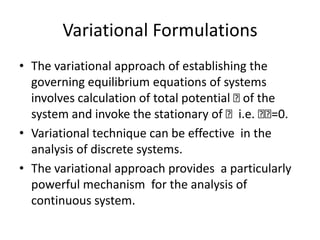
  involves calculation of total potential ᴨ the
                                           of
  system and invoke the stationary of ᴨi.e. ᴨ=0.
                                              ᴨ
• Variational technique can be effective in the
  analysis of discrete systems.
• The variational approach provides a particularly
  powerful mechanism for the analysis of
  continuous system.
Variational System
• The variational method may provide a
  relatively easy way to construct the system
  governing equations. This ease of use of a
  variational principle depends largely o the fact
  in the variational formulation scalar quantities
  are considered rather than vector quantities.
• A variational approach may lead to more
  directly to the system-governing equations
  and boundary condition.
Variational System
• The variational approach provides some
  additional insight into a problem and gives an
  independent check on the formulation of the
  problem.
• For approximate solution a larger class of trial
  functions can be employed in many cases if
  the analyst operates on the variational
  formulation rather than on the differential
  formulation of the problem.
Rayleigh-Ritz Method
• In this method form of the unknown solution is
  assumed in terms of known functions (trial
  functions) with unknow adjustable parameters.
• From the family of trial functions the function
  that renders the functional stationary are
  selected and substituted into the functional
  which is function of the function.
• Thus, The functional is expressed in terms of the
  adjustable parameters.
Rayleigh-Ritz Method
• The resulting functional is differentiated with
  respect to each parameter and resulting
  equation is set equal to zero.
• If there are n unknown parameters in the
  functional, there will be n simultaneous
  equations to be solved for the parameters and
  best solution is obtained.
Rayleigh-Ritz Method
• The main aim of Rayleigh-Ritz method is to
  replace the problem of finding the minima
  and maxima of integrals by finding the minima
  of functions of several variables.
Contd….
• For example
  – Consider search of a function L(x) that will extremize
    certain given functional I(L). As metioned, L(x) can be
    approximated by liniar combination of suitable
    chosen coordinate function c1(x), c2(x),…………. cn(x)

  – Then L(x) can be written as

       L(x)= g1 c1(x) + g2 c2(x) + ………………….. + gn cn(x)

  where gi are unknown constants to be found.
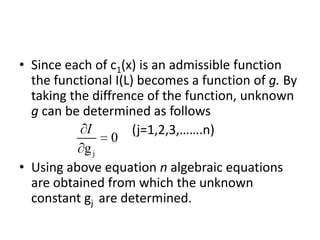
• Since each of c1(x) is an admissible function
  the functional I(L) becomes a function of g. By
  taking the diffrence of the function, unknown
  g can be determined as follows
            I        (j=1,2,3,…….n)
                 0
           gj
• Using above equation n algebraic equations
  are obtained from which the unknown
  constant gj are determined.
REFERENCES
• Y.M.DESAI,T.I.ELDHO,A.H.SHAH ; Finite elemnt
  method with application in engg.
• Klaus-Jürgen Bathe; Finite element Procedures
• Daryl L. Logan; Finite element Method.

Varaiational formulation fem

  • 1.
    Variational Formulation (Rayleigh-Ritz Method) Akshay Wadalkar (06) Tushar A Aneyrao (16)
  • 2.
    Variational Formulations • Thevariational approach of establishing the governing equilibrium equations of systems involves calculation of total potential ᴨ the of system and invoke the stationary of ᴨi.e. ᴨ=0. ᴨ • Variational technique can be effective in the analysis of discrete systems. • The variational approach provides a particularly powerful mechanism for the analysis of continuous system.
  • 3.
    Variational System • Thevariational method may provide a relatively easy way to construct the system governing equations. This ease of use of a variational principle depends largely o the fact in the variational formulation scalar quantities are considered rather than vector quantities. • A variational approach may lead to more directly to the system-governing equations and boundary condition.
  • 4.
    Variational System • Thevariational approach provides some additional insight into a problem and gives an independent check on the formulation of the problem. • For approximate solution a larger class of trial functions can be employed in many cases if the analyst operates on the variational formulation rather than on the differential formulation of the problem.
  • 5.
    Rayleigh-Ritz Method • Inthis method form of the unknown solution is assumed in terms of known functions (trial functions) with unknow adjustable parameters. • From the family of trial functions the function that renders the functional stationary are selected and substituted into the functional which is function of the function. • Thus, The functional is expressed in terms of the adjustable parameters.
  • 6.
    Rayleigh-Ritz Method • Theresulting functional is differentiated with respect to each parameter and resulting equation is set equal to zero. • If there are n unknown parameters in the functional, there will be n simultaneous equations to be solved for the parameters and best solution is obtained.
  • 7.
    Rayleigh-Ritz Method • Themain aim of Rayleigh-Ritz method is to replace the problem of finding the minima and maxima of integrals by finding the minima of functions of several variables.
  • 8.
    Contd…. • For example – Consider search of a function L(x) that will extremize certain given functional I(L). As metioned, L(x) can be approximated by liniar combination of suitable chosen coordinate function c1(x), c2(x),…………. cn(x) – Then L(x) can be written as L(x)= g1 c1(x) + g2 c2(x) + ………………….. + gn cn(x) where gi are unknown constants to be found.
  • 9.
    • Since eachof c1(x) is an admissible function the functional I(L) becomes a function of g. By taking the diffrence of the function, unknown g can be determined as follows I (j=1,2,3,…….n) 0 gj • Using above equation n algebraic equations are obtained from which the unknown constant gj are determined.
  • 10.
    REFERENCES • Y.M.DESAI,T.I.ELDHO,A.H.SHAH ;Finite elemnt method with application in engg. • Klaus-Jürgen Bathe; Finite element Procedures • Daryl L. Logan; Finite element Method.