VAP Valori
sVAPVAC
Prepared By:- Deepak Kumar Sen
Clinical Educator , Patient Safety Officer
MHCRC Jabalpur M.P.
 Pneumonia that develops in someone who has been
intubated .
- Typically in studies , patients are only included if intubated
greater than 48 hours.
-Early onset -less than 4 days.
-Late onset – greater than 4days.
Endo-tracheal intubation increases risk of developing
pneumonia (90% of infections in mechanically ventilated patients )
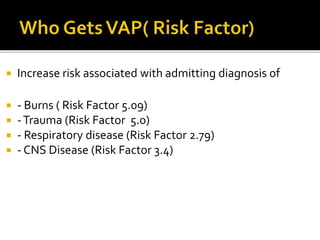
 Increase risk associated with admitting diagnosis of
 - Burns ( Risk Factor 5.09)
 -Trauma (Risk Factor 5.0)
 - Respiratory disease (Risk Factor 2.79)
 - CNS Disease (Risk Factor 3.4)
 1. Host factor:-
 a. Elderly
 b. Severe illness
 c. Underlying lung disease
 d. Immune compromising condition of treatment.
 e.Viral respiratory tract infection
 2. Colonization:-
 a. Intensive care settings
 b. Contaminated hands
 c. Contaminated equipments
Respiratory
status
component
No CXR
needed
Patient on mechanical ventilation > 2
days
Baseline period of stability or
improvement, followed by sustained
period of worsening oxygenation
Ventilator‐AssociatedCondition (VAC)
General evidence of
infection/inflammation
Infection‐Related
Ventilator‐AssociatedComplication
(IVAC)
Infection /
inflammation
component
Positive results of microbiological
testing
Possible or ProbableVAP
Additional
evidence
“A technique used in respiratory therapy in which airway pressure greater
than atmospheric pressure is achieved at the end of exhalation by the
introduction of a mechanical impedance to exhalation.”
In patients on conventional mechanical ventilation, PEEP is one of the
parameters that can be adjusted depending on the patient’s oxygenation
needs.
A sustained increase in the daily minimum PEEP of ≥ 3 cmH2O following a
period of stability or improvement on the ventilator is one of two criteria
that can be used in meeting theVAC definition.
Daily minimum PEEP must be maintained for at least 1 hour
* The fraction of oxygen in inspired gas.
- For example, the FiO2 of ambient air is 0.21; the oxygen
concentration of ambient air is 21%.
* In patients on mechanical ventilation, the FiO2 is one of
the key parameters that can be adjusted depending on
the patient’s oxygenation needs
* A sustained increase in the daily minimum FiO2 of ≥ 0.20
(20%) following a period of stability or improvement on
the ventilator is the second of the two criteria that can be
used in meeting theVAC definition.
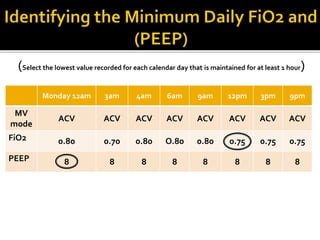
(Select the lowest value recorded for each calendar day that is maintained for at least 1 hour)
Monday 12am 3am 4am 6am 9am 12pm 3pm 9pm
MV
mode
ACV ACV ACV ACV ACV ACV ACV ACV
FiO2 0.80 0.70 0.80 O.80 0.80 0.75 0.75 0.75
PEEP 8 8 8 8 8 8 8 8
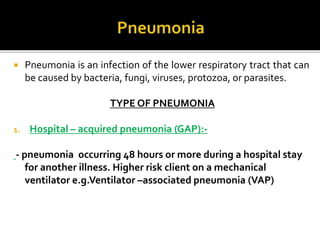
 Pneumonia is an infection of the lower respiratory tract that can
be caused by bacteria, fungi, viruses, protozoa, or parasites.
TYPE OF PNEUMONIA
1. Hospital – acquired pneumonia (GAP):-
- pneumonia occurring 48 hours or more during a hospital stay
for another illness. Higher risk client on a mechanical
ventilator e.g.Ventilator –associated pneumonia (VAP)
 1. MinimizeVentilator exposure.
A. First.
B. Second.
 2. Provide excellent oral hygiene care.
 3. Coordinate care of subglottic suctioning.
 4. Maintain optimal positioning and encourage mobility.
 5. Peptic Ulcer Disease Prophylaxix
6.SedationVacations
7. Adequate hand hygiene/Washing
8. Ensure adequate staffing
 A. First:- First, encourage and advocate for the use of non-
invasive ventilation approaches, such as bi-level positive airway
pressure or continuous positive airway pressure.
 B. Second:- Second, when mechanical ventilation can’t be
avoided, work to minimize its duration. Ventilator-weaning
protocols or evidence-based care bundles (for example, the
Awakening, Breathing Coordination, Delirium, and Early mobility
[ABCDE] bundle) can be effective in shortening mechanical
ventilation duration.
 Oral health quickly deteriorates in mechanically ventilated
patients. Some patients sustain injuries to the oral mucosa
during the intubation procedure, and after intubation, patients
are prone to dry mouth.
 Brush teeth, gums, and tongue at least twice a day using a soft, compact
head (pediatric or adult) toothbrush.
 Provide oral moisturizing to oral mucosa and lips every 2 to 4 hours.
 Use an oral chlorhexidine gluconate (0.12%) rinse twice a day in intubated
patients to reduce risk ofVAP.
 There is no recommendation for routine use of oral chlorhexidine
gluconate (0.12%) in nonintubated patients at this time.
 Aspiration of secretions that accumulate around a
mechanically ventilated patient’s endotrachial tube can lead
toVAP.
 Subglottic secretion suctioning can be performed by both
the Nurse , respiratory therapist to help prevent aspiration
and subsequentVAP.
 Subglottic suctioning reduced the risk forVAP by 45% .
 Proper positioning (keeping the head of the bed between 30–45
degrees) and encouraging early mobility of mechanically
ventilated patients aid in the prevention ofVAP.
 Gastric reflux and aspiration can also lead to VAP in mechanically
ventilated patients.
 Keeping the head of the bed elevated between 30–45 degrees
(semi-recumbent position) is recommended to reduce reflux and
subsequent risk forVAP.
 Gastric ulcer prophylaxis
-Why?
▪ Reduces acid production in stomach.
▪ Reduces potential for severe lung injury related to
aspiration.
- Identified issues and concerns
▪ None-well accepted therapy
- Anecdotal experience
▪ None significant
 SedationVacation
-Why?
▪ Has been demonstrated to reduce overall patient sedation
▪ Promotes early weaning
▪ Potential to increase time to extubation
- Identified issues and concerns
▪ Increases potential for self extubation
▪ Increases potential for patient pain and anxiety
▪ Increases episodes of de-saturation
- Anecdotal Experience
▪ Promotes early extubation
▪ No significant increase in pt. self extubation
 Adequate nurse staffing in the ICU, especially for mechanically
ventilated patients, can help minimizeVAP risk.
 Healthy work environments and inter-professional collaboration
also have been associated with lowering the risk forVAP.
 Two studies found that better nurse work environments, in
conjunction with physician staffing, have implications for VAP risk.
For example, in open ICUs where patients are managed by general
physicians instead of specially trained critical care physicians,
having better nurse work environments can reduce VAP rates for
mechanically ventilated patients.
 The key elements of theVentilator Bundle are:
 Elevation of the Head of the Bed
 Daily “SedationVacations” and Assessment of Readiness
to Extubate
 Peptic Ulcer Disease Prophylaxix
 DeepVenousThrombosis Prophylaxix
 Other potential additions
▪ Oral Care Protocol
▪ Mobility Protocol

VAP

  • 1.
    VAP Valori sVAPVAC Prepared By:-Deepak Kumar Sen Clinical Educator , Patient Safety Officer MHCRC Jabalpur M.P.
  • 2.
     Pneumonia thatdevelops in someone who has been intubated . - Typically in studies , patients are only included if intubated greater than 48 hours. -Early onset -less than 4 days. -Late onset – greater than 4days. Endo-tracheal intubation increases risk of developing pneumonia (90% of infections in mechanically ventilated patients )
  • 3.
     Increase riskassociated with admitting diagnosis of  - Burns ( Risk Factor 5.09)  -Trauma (Risk Factor 5.0)  - Respiratory disease (Risk Factor 2.79)  - CNS Disease (Risk Factor 3.4)
  • 4.
     1. Hostfactor:-  a. Elderly  b. Severe illness  c. Underlying lung disease  d. Immune compromising condition of treatment.  e.Viral respiratory tract infection  2. Colonization:-  a. Intensive care settings  b. Contaminated hands  c. Contaminated equipments
  • 5.
    Respiratory status component No CXR needed Patient onmechanical ventilation > 2 days Baseline period of stability or improvement, followed by sustained period of worsening oxygenation Ventilator‐AssociatedCondition (VAC) General evidence of infection/inflammation Infection‐Related Ventilator‐AssociatedComplication (IVAC) Infection / inflammation component Positive results of microbiological testing Possible or ProbableVAP Additional evidence
  • 6.
    “A technique usedin respiratory therapy in which airway pressure greater than atmospheric pressure is achieved at the end of exhalation by the introduction of a mechanical impedance to exhalation.” In patients on conventional mechanical ventilation, PEEP is one of the parameters that can be adjusted depending on the patient’s oxygenation needs. A sustained increase in the daily minimum PEEP of ≥ 3 cmH2O following a period of stability or improvement on the ventilator is one of two criteria that can be used in meeting theVAC definition. Daily minimum PEEP must be maintained for at least 1 hour
  • 7.
    * The fractionof oxygen in inspired gas. - For example, the FiO2 of ambient air is 0.21; the oxygen concentration of ambient air is 21%. * In patients on mechanical ventilation, the FiO2 is one of the key parameters that can be adjusted depending on the patient’s oxygenation needs * A sustained increase in the daily minimum FiO2 of ≥ 0.20 (20%) following a period of stability or improvement on the ventilator is the second of the two criteria that can be used in meeting theVAC definition.
  • 8.
    (Select the lowestvalue recorded for each calendar day that is maintained for at least 1 hour) Monday 12am 3am 4am 6am 9am 12pm 3pm 9pm MV mode ACV ACV ACV ACV ACV ACV ACV ACV FiO2 0.80 0.70 0.80 O.80 0.80 0.75 0.75 0.75 PEEP 8 8 8 8 8 8 8 8
  • 9.
     Pneumonia isan infection of the lower respiratory tract that can be caused by bacteria, fungi, viruses, protozoa, or parasites. TYPE OF PNEUMONIA 1. Hospital – acquired pneumonia (GAP):- - pneumonia occurring 48 hours or more during a hospital stay for another illness. Higher risk client on a mechanical ventilator e.g.Ventilator –associated pneumonia (VAP)
  • 12.
     1. MinimizeVentilatorexposure. A. First. B. Second.  2. Provide excellent oral hygiene care.  3. Coordinate care of subglottic suctioning.  4. Maintain optimal positioning and encourage mobility.  5. Peptic Ulcer Disease Prophylaxix
  • 13.
    6.SedationVacations 7. Adequate handhygiene/Washing 8. Ensure adequate staffing
  • 14.
     A. First:-First, encourage and advocate for the use of non- invasive ventilation approaches, such as bi-level positive airway pressure or continuous positive airway pressure.  B. Second:- Second, when mechanical ventilation can’t be avoided, work to minimize its duration. Ventilator-weaning protocols or evidence-based care bundles (for example, the Awakening, Breathing Coordination, Delirium, and Early mobility [ABCDE] bundle) can be effective in shortening mechanical ventilation duration.
  • 15.
     Oral healthquickly deteriorates in mechanically ventilated patients. Some patients sustain injuries to the oral mucosa during the intubation procedure, and after intubation, patients are prone to dry mouth.  Brush teeth, gums, and tongue at least twice a day using a soft, compact head (pediatric or adult) toothbrush.  Provide oral moisturizing to oral mucosa and lips every 2 to 4 hours.  Use an oral chlorhexidine gluconate (0.12%) rinse twice a day in intubated patients to reduce risk ofVAP.  There is no recommendation for routine use of oral chlorhexidine gluconate (0.12%) in nonintubated patients at this time.
  • 16.
     Aspiration ofsecretions that accumulate around a mechanically ventilated patient’s endotrachial tube can lead toVAP.  Subglottic secretion suctioning can be performed by both the Nurse , respiratory therapist to help prevent aspiration and subsequentVAP.  Subglottic suctioning reduced the risk forVAP by 45% .
  • 17.
     Proper positioning(keeping the head of the bed between 30–45 degrees) and encouraging early mobility of mechanically ventilated patients aid in the prevention ofVAP.  Gastric reflux and aspiration can also lead to VAP in mechanically ventilated patients.  Keeping the head of the bed elevated between 30–45 degrees (semi-recumbent position) is recommended to reduce reflux and subsequent risk forVAP.
  • 19.
     Gastric ulcerprophylaxis -Why? ▪ Reduces acid production in stomach. ▪ Reduces potential for severe lung injury related to aspiration. - Identified issues and concerns ▪ None-well accepted therapy - Anecdotal experience ▪ None significant
  • 20.
     SedationVacation -Why? ▪ Hasbeen demonstrated to reduce overall patient sedation ▪ Promotes early weaning ▪ Potential to increase time to extubation - Identified issues and concerns ▪ Increases potential for self extubation ▪ Increases potential for patient pain and anxiety ▪ Increases episodes of de-saturation - Anecdotal Experience ▪ Promotes early extubation ▪ No significant increase in pt. self extubation
  • 23.
     Adequate nursestaffing in the ICU, especially for mechanically ventilated patients, can help minimizeVAP risk.  Healthy work environments and inter-professional collaboration also have been associated with lowering the risk forVAP.  Two studies found that better nurse work environments, in conjunction with physician staffing, have implications for VAP risk. For example, in open ICUs where patients are managed by general physicians instead of specially trained critical care physicians, having better nurse work environments can reduce VAP rates for mechanically ventilated patients.
  • 24.
     The keyelements of theVentilator Bundle are:  Elevation of the Head of the Bed  Daily “SedationVacations” and Assessment of Readiness to Extubate  Peptic Ulcer Disease Prophylaxix  DeepVenousThrombosis Prophylaxix  Other potential additions ▪ Oral Care Protocol ▪ Mobility Protocol