■ State the definition for ventilator
associated pneumonia (VAP)
■ Define who is at greatest risk for the
development of VAP
■ Describe effective strategies for reducing
the incidence of VAP
■ A nosocomial pneumonia associated with
mechanical ventilation that develops within 48 hours
or more of hospital admission and which was not
developing at the time of admission
■ Early onset:
■ Hemophilus influenza
■ Streptococcus pneumoniae
■ Staphylococcus aureus (methicillin sensitive)
■ Escherichia coli
■ Klebsiella
■ Late onset:
■ Pseudomonas aeruginosa
■ Acinetobacter
■ Staphylococcus aureus (methicillin resistant)
■ Most strains responsible for early onset VAP are
antibiotic sensitive. Those responsible for late onset VAP
are usually multi antibiotic resistant
■ Bacteria enter the lower respiratory tract by this
pathways:
■ Aspiration of organisms from the oropharynx
and GI tract (most common cause)
■ Inhalation of bacteria
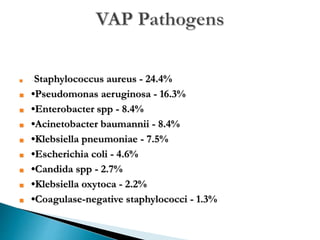
■ •Staphylococcus aureus - 24.4%
■ •Pseudomonas aeruginosa - 16.3%
■ •Enterobacter spp - 8.4%
■ •Acinetobacter baumannii - 8.4%
■ •Klebsiella pneumoniae - 7.5%
■ •Escherichia coli - 4.6%
■ •Candida spp - 2.7%
■ •Klebsiella oxytoca - 2.2%
■ •Coagulase-negative staphylococci - 1.3%
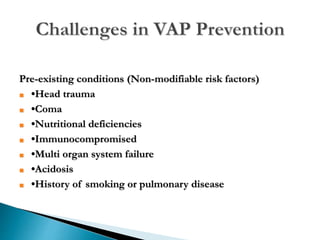
Pre-existing conditions (Non-modifiable risk factors)
■ •Head trauma
■ •Coma
■ •Nutritional deficiencies
■ •Immunocompromised
■ •Multi organ system failure
■ •Acidosis
■ •History of smoking or pulmonary disease
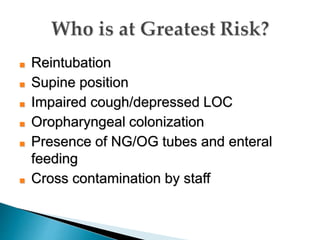
■ Reintubation
■ Supine position
■ Impaired cough/depressed LOC
■ Oropharyngeal colonization
■ Presence of NG/OG tubes and enteral
feeding
■ Cross contamination by staff
■ Hospital acquired pneumonia (HAP) is the
second most common hospital infection
■ VAP is the most common intensive care
unit (ICU) infection
■ VAP occurs in 10 - 65% of all ventilated patients
■ The incidence of VAP is highest in the following
groups:
■ Trauma
■ Burns
■ Neurosurgical population
■ Surgery
■ Mortality rate is 24 – 50%
■ Mortality rate in VAP caused by Pseudomonas or
Acinetobacter is as high as 76%
■ VAP increases:
■ Medical costs
■ Ventilator days
■ ICU and hospital LOS
■ Estimated direct cost of excess hospital stay due
to VAP is $40,000 per patient
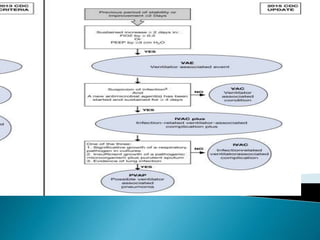
■ What are our rates?
■ How do we collect data?
■ What criteria do we use?
■ Radiographic evidence x 2 consecutive days
■ New, progressive or persistent infiltrate
■ Consolidation, opacity, or cavitation
■ At least 1 of the following:
■ Fever (> 38 degrees C) with no other recognized cause
■ Leukopenia (< 4,000 WBC/mm3) or leukocytosis (> 12,000
WBC/mm3)
■ At least 2 of the following:
■ New onset of purulent sputum or change in character of
secretions
■ New onset or worsening cough, dyspnea, or tachypnea
■ Rales or bronchial breath sounds
■ Worsening gas exchange (↓ sats, P:F ratio < 240, ↑ O2 req.)
■ Specific practices have been shown to decrease
VAP
■ Strong evidence that a collaborative,
multidisciplinary approach incorporating many
interventions is paramount
■ Intensive education directed at nurses and
respiratory care practitioners resulted in a 57%
decrease in VAP
■ Hand washing
■ Oral care
■ HOB ↑ 30 degrees (in the absence of medical
contraindications)
■ Patient turning and rotational therapy
■ DVT prophylaxis
■ Daily interruption of sedative infusions
■ Airway/ventilator management
■ Hand washing is the single most important (and
easiest!!!) method for reducing the transmission of
pathogens.
■ Remember to wash your hands
■ Before and after patient contact
■ Beginning and end of work day
■ Before and after using gloves
■ After touching contaminated surfaces
Health care worker button
Room poster
■ Dental plaque contains multiple pathogens (may include s.
aureus and p. aeruginosa)
■ After 48 hours, normal oral flora of critically ill pts changes
to more virulent gram (-) organisms
■ Aspiration of oral secretions around the cuff and ETT
occurs in all ventilated patients
■ VAP rates are reduced when oral care measures are
included in a comprehensive prevention program
■ Oral decontamination – application of an antibiotic
solution
■ Chlorhexidine oral rinse
■ Antiseptic agent active against both gram (-) and (+)
organisms
■ Allergies are rare
■ May discolor teeth
■ When used prior to intubation has been shown to ↓
respiratory tract infections
■ Best Practice??
■ Daily assessment to determine oral health
■ Brush q 12 hours to prevent plaque
■ Oral cleansing q 2-4 hours to promote healing and
maintain integrity of oral tissues
■ Use of an alcohol-free, antiseptic oral rinse to prevent or
reduce bacterial load of oropharynx
■ Routine suctioning of mouth to manage oral secretions
and minimize risk of aspiration
■ Use of a moisturizer
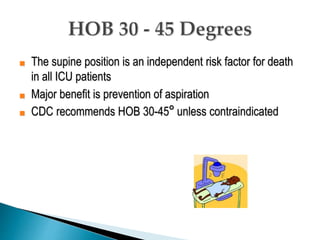
■ The supine position is an independent risk factor for death
in all ICU patients
■ Major benefit is prevention of aspiration
■ CDC recommends HOB 30-45° unless contraindicated
■ Kinetic therapy (KT) – continuous turning through bedframe
rotation at least 62° on each side
■ Continuous lateral rotation therapy (CLRT) - similar to KT,
but degree of turn < 40°
■ Advantages include more even distribution of
transpulmonary pressures and tidal volume and increased
mobilization of secretions.
■ Rotational therapy is beneficial for patients at high
risk for pneumonia, including patients who are:
■ sedated and ventilated > 3 – 4 days
■ difficult to turn
■ have head injury
■ in traction
■ When rotational beds are not used, turn at least q 2
hours
■ Review of 11 randomized, controlled studies (1073
patients)
■ All rotational therapies included
■ 48% reduction in risk of developing pneumonia
■ Shorter ICU stay (decrease of 2.1 days)
■ No difference in mortality
■ Kinetic therapy more effective than CLRT
■ Predisposes patients to:
■ Thromboemboli
■ Pressure ulcers
■ Gastric aspiration
■ VAP
■ Sepsis
■ Consequences include:
■ Difficulty in monitoring neuro status
■ Increased use of diagnostic procedures
■ Increase ventilator days
■ Prolonged ICU and hospital stay
■ All infusions should be at the lowest rate to achieve effect
■ IV bolus therapy should be used to supplement infusion
when necessary
■ Every patient must be awakened daily unless
contraindicated!
■ Contributes to the development of VAP:
■ Causes mucosal injury, producing decreased mucociliary
clearance
■ Decreases effectiveness of cough
■ Increases binding sites for bacteria
■ Increases mucus secretion
■ Provides a reservoir for bacteria
■ Reintubation is a significant risk factor for VAP
■ Mechanical ventilation
■ Orotracheal intubation
■ Nasotracheal intubation may slightly increase the risk for VAP
■ Ventilator circuitry changes
■ Change only when soiled or malfunctioning
■ Cuff management
■ Maintain at 25-30 cm H2O
■ Suctioning
■ In-line suctioning using closed technique
■ Normal saline
■ Should not be routinely used to suction pts
■ Causes desaturation
■ Can potentially dislodge bacteria
■ Should be used to rinse the suction catheter after
suctioning
■ Should be done using a 14 Fr sterile suction catheter:
■ Prior to lying patient supine
■ Prior to extubation
■ Continuous subglottic suctioning
■ ETT with dedicated lumen to continuously or
intermittently suction above the cuff may reduce the risk
of VAP
■ Heat and Humidity Exchangers (HMEs) should not be
routinely changed unless:
■ Visibly soiled
■ Use Heated Humidification (HH) if:
■ Ventilated longer than 96 hours
■ Thick/bloody secretions
■ Resp. Acidosis
■ Air leak from chest tube or around airway
■ H2 blockers and antacids ↓ incidence of stress ulcers
■ Colonization of the GI tract occurs as the pH rises
■ These organisms ascend the GI tract and gain access to
the trachea
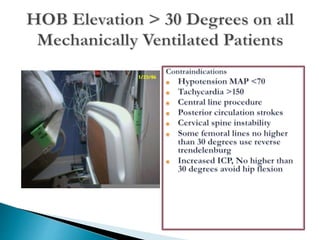
■ Elevate HOB 30 - 45 degrees
■ Routinely verify tube placement
■ Develop processes that enhance efficiency and
communication to help move evidence into practice
■ Implement interventional hygiene
■ Measure the results using standard definitions to capture
and compile data
■ Compare against the benchmarks
■ Celebrate and reward your successes and growth as a
team
■ Check on a quarterly basis continued compliance with the
new program
prevention o VAP2.pptx

prevention o VAP2.pptx

  • 2.
    ■ State thedefinition for ventilator associated pneumonia (VAP) ■ Define who is at greatest risk for the development of VAP ■ Describe effective strategies for reducing the incidence of VAP
  • 3.
    ■ A nosocomialpneumonia associated with mechanical ventilation that develops within 48 hours or more of hospital admission and which was not developing at the time of admission
  • 4.
    ■ Early onset: ■Hemophilus influenza ■ Streptococcus pneumoniae ■ Staphylococcus aureus (methicillin sensitive) ■ Escherichia coli ■ Klebsiella ■ Late onset: ■ Pseudomonas aeruginosa ■ Acinetobacter ■ Staphylococcus aureus (methicillin resistant) ■ Most strains responsible for early onset VAP are antibiotic sensitive. Those responsible for late onset VAP are usually multi antibiotic resistant
  • 5.
    ■ Bacteria enterthe lower respiratory tract by this pathways: ■ Aspiration of organisms from the oropharynx and GI tract (most common cause) ■ Inhalation of bacteria
  • 6.
    ■ •Staphylococcus aureus- 24.4% ■ •Pseudomonas aeruginosa - 16.3% ■ •Enterobacter spp - 8.4% ■ •Acinetobacter baumannii - 8.4% ■ •Klebsiella pneumoniae - 7.5% ■ •Escherichia coli - 4.6% ■ •Candida spp - 2.7% ■ •Klebsiella oxytoca - 2.2% ■ •Coagulase-negative staphylococci - 1.3%
  • 7.
    Pre-existing conditions (Non-modifiablerisk factors) ■ •Head trauma ■ •Coma ■ •Nutritional deficiencies ■ •Immunocompromised ■ •Multi organ system failure ■ •Acidosis ■ •History of smoking or pulmonary disease
  • 8.
    ■ Reintubation ■ Supineposition ■ Impaired cough/depressed LOC ■ Oropharyngeal colonization ■ Presence of NG/OG tubes and enteral feeding ■ Cross contamination by staff
  • 9.
    ■ Hospital acquiredpneumonia (HAP) is the second most common hospital infection ■ VAP is the most common intensive care unit (ICU) infection
  • 10.
    ■ VAP occursin 10 - 65% of all ventilated patients ■ The incidence of VAP is highest in the following groups: ■ Trauma ■ Burns ■ Neurosurgical population ■ Surgery ■ Mortality rate is 24 – 50% ■ Mortality rate in VAP caused by Pseudomonas or Acinetobacter is as high as 76%
  • 11.
    ■ VAP increases: ■Medical costs ■ Ventilator days ■ ICU and hospital LOS ■ Estimated direct cost of excess hospital stay due to VAP is $40,000 per patient
  • 12.
    ■ What areour rates? ■ How do we collect data? ■ What criteria do we use?
  • 13.
    ■ Radiographic evidencex 2 consecutive days ■ New, progressive or persistent infiltrate ■ Consolidation, opacity, or cavitation ■ At least 1 of the following: ■ Fever (> 38 degrees C) with no other recognized cause ■ Leukopenia (< 4,000 WBC/mm3) or leukocytosis (> 12,000 WBC/mm3) ■ At least 2 of the following: ■ New onset of purulent sputum or change in character of secretions ■ New onset or worsening cough, dyspnea, or tachypnea ■ Rales or bronchial breath sounds ■ Worsening gas exchange (↓ sats, P:F ratio < 240, ↑ O2 req.)
  • 14.
    ■ Specific practiceshave been shown to decrease VAP ■ Strong evidence that a collaborative, multidisciplinary approach incorporating many interventions is paramount ■ Intensive education directed at nurses and respiratory care practitioners resulted in a 57% decrease in VAP
  • 15.
    ■ Hand washing ■Oral care ■ HOB ↑ 30 degrees (in the absence of medical contraindications) ■ Patient turning and rotational therapy ■ DVT prophylaxis ■ Daily interruption of sedative infusions ■ Airway/ventilator management
  • 16.
    ■ Hand washingis the single most important (and easiest!!!) method for reducing the transmission of pathogens.
  • 17.
    ■ Remember towash your hands ■ Before and after patient contact ■ Beginning and end of work day ■ Before and after using gloves ■ After touching contaminated surfaces
  • 18.
    Health care workerbutton Room poster
  • 19.
    ■ Dental plaquecontains multiple pathogens (may include s. aureus and p. aeruginosa) ■ After 48 hours, normal oral flora of critically ill pts changes to more virulent gram (-) organisms ■ Aspiration of oral secretions around the cuff and ETT occurs in all ventilated patients ■ VAP rates are reduced when oral care measures are included in a comprehensive prevention program
  • 20.
    ■ Oral decontamination– application of an antibiotic solution
  • 21.
    ■ Chlorhexidine oralrinse ■ Antiseptic agent active against both gram (-) and (+) organisms ■ Allergies are rare ■ May discolor teeth ■ When used prior to intubation has been shown to ↓ respiratory tract infections
  • 22.
    ■ Best Practice?? ■Daily assessment to determine oral health ■ Brush q 12 hours to prevent plaque ■ Oral cleansing q 2-4 hours to promote healing and maintain integrity of oral tissues ■ Use of an alcohol-free, antiseptic oral rinse to prevent or reduce bacterial load of oropharynx ■ Routine suctioning of mouth to manage oral secretions and minimize risk of aspiration ■ Use of a moisturizer
  • 23.
    ■ The supineposition is an independent risk factor for death in all ICU patients ■ Major benefit is prevention of aspiration ■ CDC recommends HOB 30-45° unless contraindicated
  • 25.
    ■ Kinetic therapy(KT) – continuous turning through bedframe rotation at least 62° on each side ■ Continuous lateral rotation therapy (CLRT) - similar to KT, but degree of turn < 40° ■ Advantages include more even distribution of transpulmonary pressures and tidal volume and increased mobilization of secretions.
  • 26.
    ■ Rotational therapyis beneficial for patients at high risk for pneumonia, including patients who are: ■ sedated and ventilated > 3 – 4 days ■ difficult to turn ■ have head injury ■ in traction ■ When rotational beds are not used, turn at least q 2 hours
  • 27.
    ■ Review of11 randomized, controlled studies (1073 patients) ■ All rotational therapies included ■ 48% reduction in risk of developing pneumonia ■ Shorter ICU stay (decrease of 2.1 days) ■ No difference in mortality ■ Kinetic therapy more effective than CLRT
  • 28.
    ■ Predisposes patientsto: ■ Thromboemboli ■ Pressure ulcers ■ Gastric aspiration ■ VAP ■ Sepsis ■ Consequences include: ■ Difficulty in monitoring neuro status ■ Increased use of diagnostic procedures ■ Increase ventilator days ■ Prolonged ICU and hospital stay
  • 29.
    ■ All infusionsshould be at the lowest rate to achieve effect ■ IV bolus therapy should be used to supplement infusion when necessary ■ Every patient must be awakened daily unless contraindicated!
  • 30.
    ■ Contributes tothe development of VAP: ■ Causes mucosal injury, producing decreased mucociliary clearance ■ Decreases effectiveness of cough ■ Increases binding sites for bacteria ■ Increases mucus secretion ■ Provides a reservoir for bacteria ■ Reintubation is a significant risk factor for VAP
  • 31.
    ■ Mechanical ventilation ■Orotracheal intubation ■ Nasotracheal intubation may slightly increase the risk for VAP ■ Ventilator circuitry changes ■ Change only when soiled or malfunctioning ■ Cuff management ■ Maintain at 25-30 cm H2O
  • 32.
    ■ Suctioning ■ In-linesuctioning using closed technique ■ Normal saline ■ Should not be routinely used to suction pts ■ Causes desaturation ■ Can potentially dislodge bacteria ■ Should be used to rinse the suction catheter after suctioning
  • 33.
    ■ Should bedone using a 14 Fr sterile suction catheter: ■ Prior to lying patient supine ■ Prior to extubation ■ Continuous subglottic suctioning ■ ETT with dedicated lumen to continuously or intermittently suction above the cuff may reduce the risk of VAP
  • 34.
    ■ Heat andHumidity Exchangers (HMEs) should not be routinely changed unless: ■ Visibly soiled ■ Use Heated Humidification (HH) if: ■ Ventilated longer than 96 hours ■ Thick/bloody secretions ■ Resp. Acidosis ■ Air leak from chest tube or around airway
  • 35.
    ■ H2 blockersand antacids ↓ incidence of stress ulcers ■ Colonization of the GI tract occurs as the pH rises ■ These organisms ascend the GI tract and gain access to the trachea
  • 36.
    ■ Elevate HOB30 - 45 degrees ■ Routinely verify tube placement
  • 37.
    ■ Develop processesthat enhance efficiency and communication to help move evidence into practice ■ Implement interventional hygiene ■ Measure the results using standard definitions to capture and compile data ■ Compare against the benchmarks ■ Celebrate and reward your successes and growth as a team ■ Check on a quarterly basis continued compliance with the new program