The Role of the Respiratory Therapist in the Diagnosis and Prevention of Ventilator-Associated Pneumonia
Healthcare-associated infections (HAI) Healthcare-associated pneumonia (HCAP) Pneumonia acquired during or immediately after admission to a healthcare facility (Such as a long-term care or outpatient facility) Hospital-acquired pneumonia (HAP) Pneumonia acquired during or immediately after admission to an acute care facility, even as an outpatient Ventilator-associated pneumonia (VAP) During or after intubation and initiation of mechanical ventilation
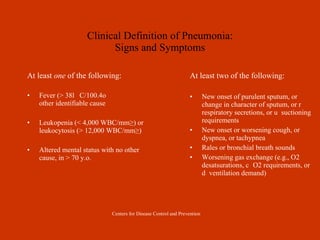
Clinical Definition of Pneumonia: Signs and Symptoms At least  one  of the following: Fever (> 38 C/100.4 F) with no other identifiable cause Leukopenia (< 4,000 WBC/mm³) or leukocytosis (> 12,000 WBC/mm³) Altered mental status with no other cause, in > 70 y.o. At least two of the following: New onset of purulent sputum, or change in character of sputum, or  respiratory secretions, or  suctioning requirements New onset or worsening cough, or dyspnea, or tachypnea Rales or bronchial breath sounds Worsening gas exchange (e.g., O2 desatsurations,  O2 requirements, or  ventilation demand)
Early onset VAP Develops    48 hours    72 hours post ventilator Usually caused by: Streptococcus pneumoniae Haemophilus influenzae Moraxella catarrhalis (Grossman, et al. Evidence-Based Assessmant of Diagnostic Tests for Ventilator-Associated Pneumonia. Chest 2000)
Late onset VAP Develops    72 hours post ventilator Usually caused by: Pseudomonas aeruginosa methicillin-resistant Staphylococcus aureus (MRSA) Acinetobacter baumannii Enterobacteriaceae (Grossman, et al. Evidence-Based Assessmant of Diagnostic Tests for Ventilator-Associated Pneumonia. Chest 2000) (Uy, Ake, Regan, Niven. Impact of mini-BAL in High Risk Patients with Suspected Ventilator Associated Pneumonia (VAP). Chest 2007)
Medicare no longer covers the costs of preventable infections and mistakes. This includes all forms of HAIs 10% to 20% of patients intubated for 48 hours or longer will develop VAP. The mortality rate for VAP ranges from 24% to 50% and can reach 76%.
How do I diagnose VAP? Chest X-ray Sputum / Endotracheal aspirates (ETA) Clinical Pulmonary Infection Score (CPIS) Bronchoscopic bronchoalveolar lavage (BAL) Nonbronchoscopic bronchoalveolar lavage (mini-BAL)
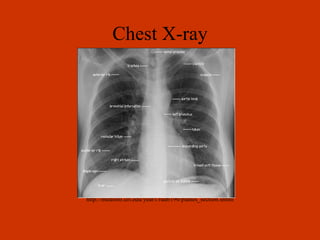
Chest X-ray http://medinfo.ufl.edu/year1/rad6190/planes_section.shtml
CXR Not a reliable tool for diagnosing pneumonia as the reproducibility of the findings may vary significantly. Pulmonary infiltrates may be due to pulmonary hemorrhage, chemical aspiration, pleural effusion, congestive heart failure, atelectasis, pulmonary embolism, or tumor as well as in VAP
ETA Easily obtainable at the bedside by any clinical personnel Inexpensive compared to other procedures Often contaminated by oral secretions Often leads to over diagnosis of VAP
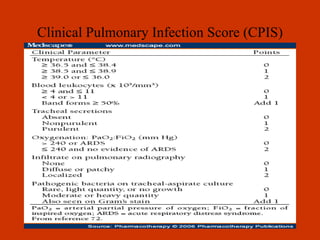
Clinical Pulmonary Infection Score (CPIS)
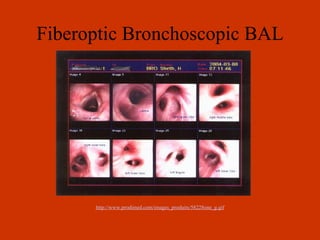
Fiberoptic Bronchoscopic BAL http://www. prodimed .com/images_ produits /58228one_g. gif
Fiberoptic Bronchoscopic BAL Pros Most accurate diagnostic test available Direct visualization and sampling of specific lung area Allows identification of accompanying disease, disorder, or lesion Cons Highly invasive: greater potential for adverse effects Limited by endotracheal tube (ETT) size; not available in pediatrics Costly Probable delays in use, not available 24 hours / day May actually spread infection if improperly cleaned
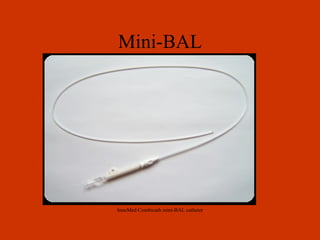
Mini-BAL InnoMed Combicath mini-BAL catheter
Mini-BAL Pros Sample may  may be collected quickly by RN or RCP Much less expensive than bronchoscopic BAL Limited and temporary adverse effects Sterile equipment - no risk of cross-contamination Protected specimen means higher specificity and sensitivity than ETA Narrow catheter usable in most patient populations Cons Blind procedure means unknown sample site More expensive than ETA Requires trained personnel
How do I treat VAP? Antibiotic Therapy Empiric Treatment Quantitative / Qualitative based Treatment Oral Care Organism inhibition Suction Ventilator bundle
Empiric Antibiotic Therapy Pros - Based on most likely Gram negative organisms Allows for rapid initial treatment of suspected pneumonia Cons - Often a hit-or-miss option May lead to resistant organisms
Quantitative & Qualitative Antibiotic Therapy Pros - Identifies specific organisms and the measure of each one Allows for focused treatment by the best choice of antibiotic Cons - Slow, requires waiting on the results of cultures Dependent on invasive tests that may or may not be available
Oral Care Chlorhexidine mouthwash - Inhibits Staphylococcus aureus bacterial growth (Tad-y) Reduces intubation time (Scannapieco) Reduces VAP risk (Scannapieco) (Tad-y et al. Efficacy of Chlorhexidine Oral Decontamination in the Prevention of Ventilator-Associated Pneumonia. Chest 2007) (Scannapieco et al. A randomized Trial of Chlorhexidine Gluconate on Oral Bacterial Pathogens in Mechanically Ventilated Patients. Critical Care. 2009)
Endotracheal Tubes Traditional Endotracheal Tube
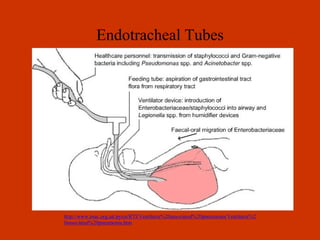
Endotracheal Tubes As a safety mechanism, the ETT cuff does not completely seal the airway - movement of the tube, checking cuff pressure, and patient movement will allow secretions to flow past the cuff into the lower airway and lung fields. Medication to treat stress ulcers reduces the gastric pH often leading to colonization of gastrointestinal organisms which then migrate up the esophagus because the gastric sphincter is held open by the nasogastric tube.
Endotracheal Tubes
Subglottic ETT Subglottic Suction Devices (SSD) - Uses a dedicated irrigation channel to remove pooled secretions above the ETT cuff. Suction port becomes clogged with purulent secretions or by subglottic tissue Much more expensive than traditional tubes May cause policy conflicts if patients are intubated with traditional tubes prior to arrival
Subglottic Suction ETT Subglottic Suction
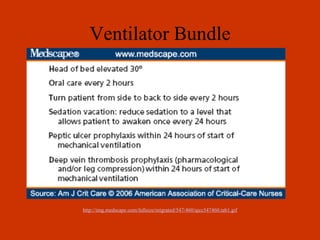
Ventilator Bundle http:// img . medscape .com/ fullsize /migrated/547/460/ajcc547460.tab1. gif
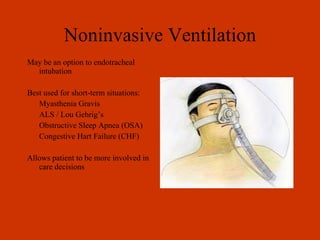
Noninvasive Ventilation May be an option to endotracheal intubation Best used for short-term situations: Myasthenia Gravis ALS / Lou Gehrig’s Obstructive Sleep Apnea (OSA) Congestive Hart Failure (CHF) Allows patient to be more involved in care decisions
Handwashing According to the CDC - Clean hands are the single most important factor in preventing the spread of pathogens and antibiotic resistance in healthcare settings. Hand hygiene reduces the incidence of healthcare associated infections. CDC estimates that each year nearly 2 million patients in the United States get an infection in hospitals, and about 90,000 of these patients die as a result of their infection.
Conclusions Through aggressive adherence to established protocols, effective utilization of proven policies, and critical decision making, respiratory therapists can reduce costs and improve patient outcomes.

Ventilator Associated Pneumonia

  • 1.
    The Role ofthe Respiratory Therapist in the Diagnosis and Prevention of Ventilator-Associated Pneumonia
  • 2.
    Healthcare-associated infections (HAI)Healthcare-associated pneumonia (HCAP) Pneumonia acquired during or immediately after admission to a healthcare facility (Such as a long-term care or outpatient facility) Hospital-acquired pneumonia (HAP) Pneumonia acquired during or immediately after admission to an acute care facility, even as an outpatient Ventilator-associated pneumonia (VAP) During or after intubation and initiation of mechanical ventilation
  • 3.
    Clinical Definition ofPneumonia: Signs and Symptoms At least one of the following: Fever (> 38 C/100.4 F) with no other identifiable cause Leukopenia (< 4,000 WBC/mm³) or leukocytosis (> 12,000 WBC/mm³) Altered mental status with no other cause, in > 70 y.o. At least two of the following: New onset of purulent sputum, or change in character of sputum, or  respiratory secretions, or  suctioning requirements New onset or worsening cough, or dyspnea, or tachypnea Rales or bronchial breath sounds Worsening gas exchange (e.g., O2 desatsurations,  O2 requirements, or  ventilation demand)
  • 4.
    Early onset VAPDevelops  48 hours  72 hours post ventilator Usually caused by: Streptococcus pneumoniae Haemophilus influenzae Moraxella catarrhalis (Grossman, et al. Evidence-Based Assessmant of Diagnostic Tests for Ventilator-Associated Pneumonia. Chest 2000)
  • 5.
    Late onset VAPDevelops  72 hours post ventilator Usually caused by: Pseudomonas aeruginosa methicillin-resistant Staphylococcus aureus (MRSA) Acinetobacter baumannii Enterobacteriaceae (Grossman, et al. Evidence-Based Assessmant of Diagnostic Tests for Ventilator-Associated Pneumonia. Chest 2000) (Uy, Ake, Regan, Niven. Impact of mini-BAL in High Risk Patients with Suspected Ventilator Associated Pneumonia (VAP). Chest 2007)
  • 6.
    Medicare no longercovers the costs of preventable infections and mistakes. This includes all forms of HAIs 10% to 20% of patients intubated for 48 hours or longer will develop VAP. The mortality rate for VAP ranges from 24% to 50% and can reach 76%.
  • 7.
    How do Idiagnose VAP? Chest X-ray Sputum / Endotracheal aspirates (ETA) Clinical Pulmonary Infection Score (CPIS) Bronchoscopic bronchoalveolar lavage (BAL) Nonbronchoscopic bronchoalveolar lavage (mini-BAL)
  • 8.
  • 9.
    CXR Not areliable tool for diagnosing pneumonia as the reproducibility of the findings may vary significantly. Pulmonary infiltrates may be due to pulmonary hemorrhage, chemical aspiration, pleural effusion, congestive heart failure, atelectasis, pulmonary embolism, or tumor as well as in VAP
  • 10.
    ETA Easily obtainableat the bedside by any clinical personnel Inexpensive compared to other procedures Often contaminated by oral secretions Often leads to over diagnosis of VAP
  • 11.
  • 12.
    Fiberoptic Bronchoscopic BALhttp://www. prodimed .com/images_ produits /58228one_g. gif
  • 13.
    Fiberoptic Bronchoscopic BALPros Most accurate diagnostic test available Direct visualization and sampling of specific lung area Allows identification of accompanying disease, disorder, or lesion Cons Highly invasive: greater potential for adverse effects Limited by endotracheal tube (ETT) size; not available in pediatrics Costly Probable delays in use, not available 24 hours / day May actually spread infection if improperly cleaned
  • 14.
    Mini-BAL InnoMed Combicathmini-BAL catheter
  • 15.
    Mini-BAL Pros Samplemay may be collected quickly by RN or RCP Much less expensive than bronchoscopic BAL Limited and temporary adverse effects Sterile equipment - no risk of cross-contamination Protected specimen means higher specificity and sensitivity than ETA Narrow catheter usable in most patient populations Cons Blind procedure means unknown sample site More expensive than ETA Requires trained personnel
  • 16.
    How do Itreat VAP? Antibiotic Therapy Empiric Treatment Quantitative / Qualitative based Treatment Oral Care Organism inhibition Suction Ventilator bundle
  • 17.
    Empiric Antibiotic TherapyPros - Based on most likely Gram negative organisms Allows for rapid initial treatment of suspected pneumonia Cons - Often a hit-or-miss option May lead to resistant organisms
  • 18.
    Quantitative & QualitativeAntibiotic Therapy Pros - Identifies specific organisms and the measure of each one Allows for focused treatment by the best choice of antibiotic Cons - Slow, requires waiting on the results of cultures Dependent on invasive tests that may or may not be available
  • 19.
    Oral Care Chlorhexidinemouthwash - Inhibits Staphylococcus aureus bacterial growth (Tad-y) Reduces intubation time (Scannapieco) Reduces VAP risk (Scannapieco) (Tad-y et al. Efficacy of Chlorhexidine Oral Decontamination in the Prevention of Ventilator-Associated Pneumonia. Chest 2007) (Scannapieco et al. A randomized Trial of Chlorhexidine Gluconate on Oral Bacterial Pathogens in Mechanically Ventilated Patients. Critical Care. 2009)
  • 20.
  • 21.
    Endotracheal Tubes Asa safety mechanism, the ETT cuff does not completely seal the airway - movement of the tube, checking cuff pressure, and patient movement will allow secretions to flow past the cuff into the lower airway and lung fields. Medication to treat stress ulcers reduces the gastric pH often leading to colonization of gastrointestinal organisms which then migrate up the esophagus because the gastric sphincter is held open by the nasogastric tube.
  • 22.
  • 23.
    Subglottic ETT SubglotticSuction Devices (SSD) - Uses a dedicated irrigation channel to remove pooled secretions above the ETT cuff. Suction port becomes clogged with purulent secretions or by subglottic tissue Much more expensive than traditional tubes May cause policy conflicts if patients are intubated with traditional tubes prior to arrival
  • 24.
    Subglottic Suction ETTSubglottic Suction
  • 25.
    Ventilator Bundle http://img . medscape .com/ fullsize /migrated/547/460/ajcc547460.tab1. gif
  • 26.
    Noninvasive Ventilation Maybe an option to endotracheal intubation Best used for short-term situations: Myasthenia Gravis ALS / Lou Gehrig’s Obstructive Sleep Apnea (OSA) Congestive Hart Failure (CHF) Allows patient to be more involved in care decisions
  • 27.
    Handwashing According tothe CDC - Clean hands are the single most important factor in preventing the spread of pathogens and antibiotic resistance in healthcare settings. Hand hygiene reduces the incidence of healthcare associated infections. CDC estimates that each year nearly 2 million patients in the United States get an infection in hospitals, and about 90,000 of these patients die as a result of their infection.
  • 28.
    Conclusions Through aggressiveadherence to established protocols, effective utilization of proven policies, and critical decision making, respiratory therapists can reduce costs and improve patient outcomes.