The presentation is solely meant for Academic
purpose


            Department of Critical Care Medicine, Apollo Hospitals 
PREVENTING VENTILATOR
ASSOCIATED PNEUMONIA
    (VAP BUNDLE)


  Department of Critical Care Medicine, Apollo Hospitals 
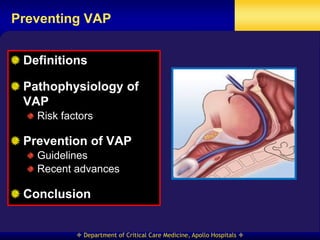
Preventing VAP


 Definitions

 Pathophysiology of
 VAP
   Risk factors

 Prevention of VAP
   Guidelines
   Recent advances

 Conclusion


            Department of Critical Care Medicine, Apollo Hospitals 
Definitions

 Hospital acquired pneumonia (HAP)                               ATS/IDSA 2005 guidelines

   48 hours or more after admission

 Ventilator associated pneumonia (VAP)
   Type of HAP developing > 48 hours after intubation
      Early vs Late

 Healthcare associated pneumonia (HCAP)
      Hospitalization in an acute care hospital for two or more
      days within the prior 90 days
   Other health care contact


             Department of Critical Care Medicine, Apollo Hospitals 
Risk Factors

             It is NOT the Ventilator


          Department of Critical Care Medicine, Apollo Hospitals 
Risk Factors
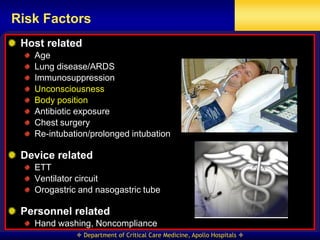
 Host related
   Age
   Lung disease/ARDS
   Immunosuppression
   Unconsciousness
   Body position
   Antibiotic exposure
   Chest surgery
   Re-intubation/prolonged intubation

 Device related
   ETT
   Ventilator circuit
   Orogastric and nasogastric tube

 Personnel related
   Hand washing, Noncompliance
              Department of Critical Care Medicine, Apollo Hospitals 
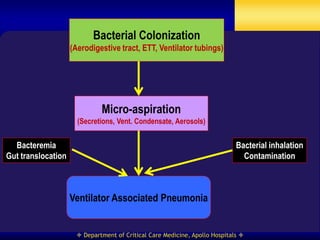
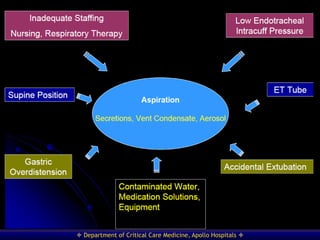
Bacterial Colonization
                    (Aerodigestive tract, ETT, Ventilator tubings)


                             Micro-aspiration
                      (Secretions, Vent. Condensate, Aerosols)


  Bacteremia                                                                Bacterial inhalation
Gut translocation                                                             Contamination


                    Ventilator Associated Pneumonia


                      Department of Critical Care Medicine, Apollo Hospitals 
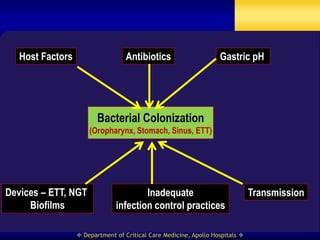
Host Factors                    Antibiotics                     Gastric pH


                         Bacterial Colonization
                      (Oropharynx, Stomach, Sinus, ETT)


Devices – ETT, NGT                     Inadequate                              Transmission
     Biofilms                  infection control practices

                   Department of Critical Care Medicine, Apollo Hospitals 
 Department of Critical Care Medicine, Apollo Hospitals 
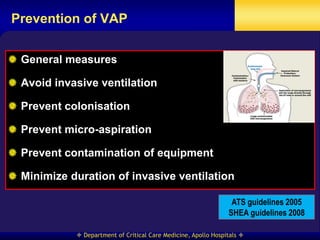
Prevention of VAP


 General measures

 Avoid invasive ventilation

 Prevent colonisation

 Prevent micro-aspiration

 Prevent contamination of equipment

 Minimize duration of invasive ventilation

                                                                ATS guidelines 2005
                                                               SHEA guidelines 2008

            Department of Critical Care Medicine, Apollo Hospitals 
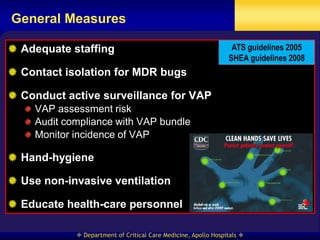
General Measures

 Adequate staffing                                              ATS guidelines 2005
                                                               SHEA guidelines 2008
 Contact isolation for MDR bugs

 Conduct active surveillance for VAP
   VAP assessment risk
   Audit compliance with VAP bundle
   Monitor incidence of VAP

 Hand-hygiene

 Use non-invasive ventilation

 Educate health-care personnel

            Department of Critical Care Medicine, Apollo Hospitals 
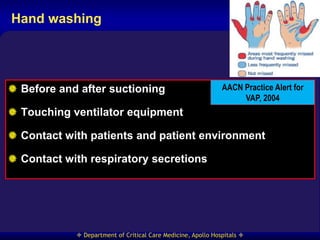
Hand washing


 Before and after suctioning                                 AACN Practice Alert for
                                                                  VAP, 2004
 Touching ventilator equipment

 Contact with patients and patient environment

 Contact with respiratory secretions


            Department of Critical Care Medicine, Apollo Hospitals 
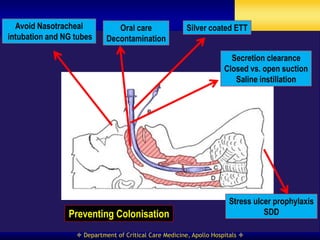
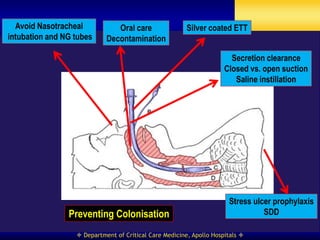
Avoid Nasotracheal           Oral care                Silver coated ETT
intubation and NG tubes     Decontamination

                                                                       Secretion clearance
                                                                     Closed vs. open suction
                                                                        Saline instillation


                                                                      Stress ulcer prophylaxis
                Preventing Colonisation                                         SDD

                   Department of Critical Care Medicine, Apollo Hospitals 
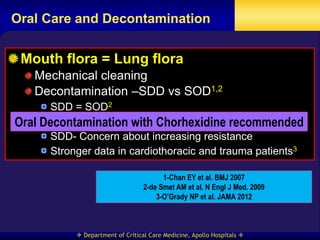
Oral Care and Decontamination


 Mouth flora = Lung flora
    Mechanical cleaning
    Decontamination –SDD vs SOD1,2
      SDD = SOD2
Oral Decontamination only in post-hoc analysis2
      Mortality benefit with Chorhexidine recommended
      SDD- Concern about increasing resistance
      Stronger data in cardiothoracic and trauma patients3

                                         1-Chan EY et al. BMJ 2007
                                   2-de Smet AM et al. N Engl J Med. 2009
                                       3-O’Grady NP et al. JAMA 2012


             Department of Critical Care Medicine, Apollo Hospitals 
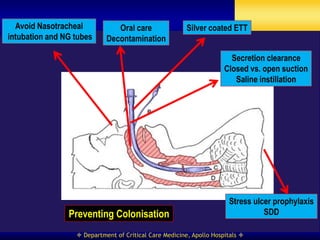
Avoid Nasotracheal           Oral care                Silver coated ETT
intubation and NG tubes     Decontamination

                                                                       Secretion clearance
                                                                     Closed vs. open suction
                                                                        Saline instillation


                                                                      Stress ulcer prophylaxis
                Preventing Colonisation                                         SDD

                   Department of Critical Care Medicine, Apollo Hospitals 
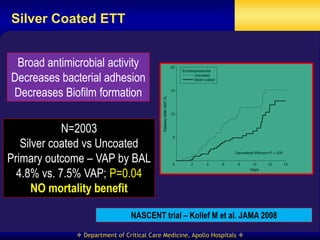
Silver Coated ETT


 Broad antimicrobial activity
Decreases bacterial adhesion
Decreases Biofilm formation

            N=2003
   Silver coated vs Uncoated
Primary outcome – VAP by BAL
  4.8% vs. 7.5% VAP; P=0.04
      NO mortality benefit

                                NASCENT trial – Kollef M et al. JAMA 2008

               Department of Critical Care Medicine, Apollo Hospitals 
Avoid Nasotracheal           Oral care                Silver coated ETT
intubation and NG tubes     Decontamination

                                                                       Secretion clearance
                                                                     Closed vs. open suction
                                                                        Saline instillation


                                                                      Stress ulcer prophylaxis
                Preventing Colonisation                                         SDD

                   Department of Critical Care Medicine, Apollo Hospitals 
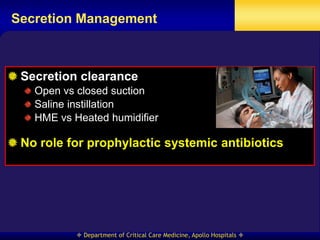
Secretion Management


 Secretion clearance
   Open vs closed suction
   Saline instillation
   HME vs Heated humidifier

 No role for prophylactic systemic antibiotics


            Department of Critical Care Medicine, Apollo Hospitals 
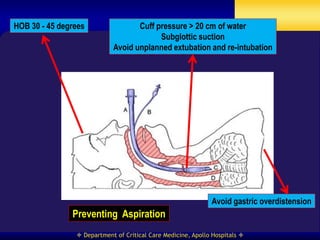
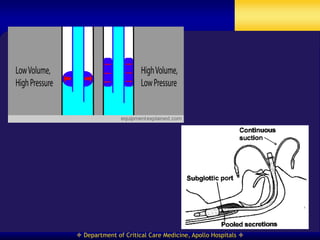
HOB 30 - 45 degrees                Cuff pressure > 20 cm of water
                                         Subglottic suction
                            Avoid unplanned extubation and re-intubation


                                                              Avoid gastric overdistension
               Preventing Aspiration
                 Department of Critical Care Medicine, Apollo Hospitals 
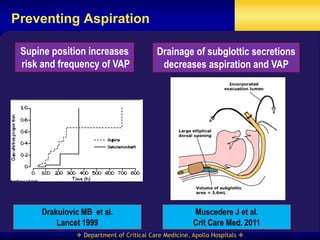
Preventing Aspiration

 Supine position increases               Drainage of subglottic secretions
 risk and frequency of VAP                decreases aspiration and VAP


     Drakulovic MB et al.                             Muscedere J et al.
         Lancet 1999                                  Crit Care Med. 2011
               Department of Critical Care Medicine, Apollo Hospitals 
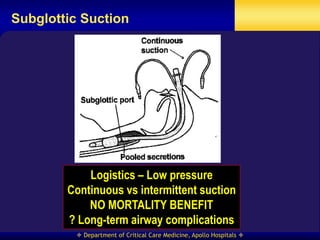
Subglottic Suction


            Logistics – Low pressure
        Continuous vs intermittent suction
            NO MORTALITY BENEFIT
        ? Long-term airway complications
          Department of Critical Care Medicine, Apollo Hospitals 
ETT modifications


 High volume low-pressure cuffs of ultrathin membrane
   Minimize folds

 Continuous monitoring of ETT Cuff pressure

 Low volume low pressure cuffs

 ETT with mucus shaver
   Disrupts Biofilm


             Department of Critical Care Medicine, Apollo Hospitals 
Prevent Contamination of Equipments


 Use sterile water to rinse reusable respiratory
 equipment

 Remove condensate from ventilatory circuits

 Keep the ventilatory circuit closed during condensate
 removal

 Change the ventilatory circuit only when visibly soiled
 or malfunctioning

 Store and disinfect respiratory therapy equipment
 properly                                SHEA guidelines 2008


             Department of Critical Care Medicine, Apollo Hospitals 
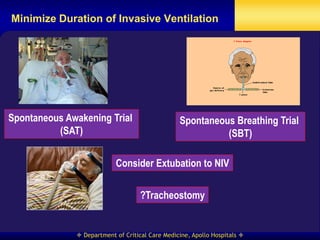
Minimize Duration of Invasive Ventilation


Spontaneous Awakening Trial                      Spontaneous Breathing Trial
          (SAT)                                            (SBT)

                           Consider Extubation to NIV


                                    ?Tracheostomy


               Department of Critical Care Medicine, Apollo Hospitals 
Interventions with unclear Value                                     Take Home

 Stress ulcer prophylaxis
   Need and type

 Monitoring gastric residual volume

 Silver coated ETT
   Promising but need more data

 Saline instillation during suction

 Newer ETTs – Rationale robust
   Data limited


             Department of Critical Care Medicine, Apollo Hospitals 
Prevention of VAP - Bottomline                                        Take Home
 Adhere to good infection control practices

 Avoid invasive ventilation when possible
   Minimize duration

 Prevent colonisation
   Avoid nasal intubation/NGT
   Oral care and decontamination – Chlorhexidine

 Prevent micro-aspiration
   HOB elevation 30-45 degrees
   Maintain ETT cuff pressure > 20 cm of water
   Subglottic suction

 Prevent contamination of equipments
   Minimize disconnections
   Routine change of tubings NOT recommended
              Department of Critical Care Medicine, Apollo Hospitals 
 Department of Critical Care Medicine, Apollo Hospitals 

VAP Bundle

  • 1.
    The presentation issolely meant for Academic purpose  Department of Critical Care Medicine, Apollo Hospitals 
  • 2.
    PREVENTING VENTILATOR ASSOCIATED PNEUMONIA (VAP BUNDLE)  Department of Critical Care Medicine, Apollo Hospitals 
  • 3.
    Preventing VAP Definitions Pathophysiology of VAP Risk factors Prevention of VAP Guidelines Recent advances Conclusion  Department of Critical Care Medicine, Apollo Hospitals 
  • 4.
    Definitions Hospital acquiredpneumonia (HAP) ATS/IDSA 2005 guidelines 48 hours or more after admission Ventilator associated pneumonia (VAP) Type of HAP developing > 48 hours after intubation Early vs Late Healthcare associated pneumonia (HCAP) Hospitalization in an acute care hospital for two or more days within the prior 90 days Other health care contact  Department of Critical Care Medicine, Apollo Hospitals 
  • 5.
    Risk Factors It is NOT the Ventilator  Department of Critical Care Medicine, Apollo Hospitals 
  • 6.
    Risk Factors Hostrelated Age Lung disease/ARDS Immunosuppression Unconsciousness Body position Antibiotic exposure Chest surgery Re-intubation/prolonged intubation Device related ETT Ventilator circuit Orogastric and nasogastric tube Personnel related Hand washing, Noncompliance  Department of Critical Care Medicine, Apollo Hospitals 
  • 7.
    Bacterial Colonization (Aerodigestive tract, ETT, Ventilator tubings) Micro-aspiration (Secretions, Vent. Condensate, Aerosols) Bacteremia Bacterial inhalation Gut translocation Contamination Ventilator Associated Pneumonia  Department of Critical Care Medicine, Apollo Hospitals 
  • 8.
    Host Factors Antibiotics Gastric pH Bacterial Colonization (Oropharynx, Stomach, Sinus, ETT) Devices – ETT, NGT Inadequate Transmission Biofilms infection control practices  Department of Critical Care Medicine, Apollo Hospitals 
  • 9.
     Department ofCritical Care Medicine, Apollo Hospitals 
  • 10.
    Prevention of VAP General measures Avoid invasive ventilation Prevent colonisation Prevent micro-aspiration Prevent contamination of equipment Minimize duration of invasive ventilation ATS guidelines 2005 SHEA guidelines 2008  Department of Critical Care Medicine, Apollo Hospitals 
  • 11.
    General Measures Adequatestaffing ATS guidelines 2005 SHEA guidelines 2008 Contact isolation for MDR bugs Conduct active surveillance for VAP VAP assessment risk Audit compliance with VAP bundle Monitor incidence of VAP Hand-hygiene Use non-invasive ventilation Educate health-care personnel  Department of Critical Care Medicine, Apollo Hospitals 
  • 12.
    Hand washing Beforeand after suctioning AACN Practice Alert for VAP, 2004 Touching ventilator equipment Contact with patients and patient environment Contact with respiratory secretions  Department of Critical Care Medicine, Apollo Hospitals 
  • 13.
    Avoid Nasotracheal Oral care Silver coated ETT intubation and NG tubes Decontamination Secretion clearance Closed vs. open suction Saline instillation Stress ulcer prophylaxis Preventing Colonisation SDD  Department of Critical Care Medicine, Apollo Hospitals 
  • 14.
    Oral Care andDecontamination Mouth flora = Lung flora Mechanical cleaning Decontamination –SDD vs SOD1,2 SDD = SOD2 Oral Decontamination only in post-hoc analysis2 Mortality benefit with Chorhexidine recommended SDD- Concern about increasing resistance Stronger data in cardiothoracic and trauma patients3 1-Chan EY et al. BMJ 2007 2-de Smet AM et al. N Engl J Med. 2009 3-O’Grady NP et al. JAMA 2012  Department of Critical Care Medicine, Apollo Hospitals 
  • 15.
    Avoid Nasotracheal Oral care Silver coated ETT intubation and NG tubes Decontamination Secretion clearance Closed vs. open suction Saline instillation Stress ulcer prophylaxis Preventing Colonisation SDD  Department of Critical Care Medicine, Apollo Hospitals 
  • 16.
    Silver Coated ETT Broad antimicrobial activity Decreases bacterial adhesion Decreases Biofilm formation N=2003 Silver coated vs Uncoated Primary outcome – VAP by BAL 4.8% vs. 7.5% VAP; P=0.04 NO mortality benefit NASCENT trial – Kollef M et al. JAMA 2008  Department of Critical Care Medicine, Apollo Hospitals 
  • 17.
    Avoid Nasotracheal Oral care Silver coated ETT intubation and NG tubes Decontamination Secretion clearance Closed vs. open suction Saline instillation Stress ulcer prophylaxis Preventing Colonisation SDD  Department of Critical Care Medicine, Apollo Hospitals 
  • 18.
    Secretion Management Secretionclearance Open vs closed suction Saline instillation HME vs Heated humidifier No role for prophylactic systemic antibiotics  Department of Critical Care Medicine, Apollo Hospitals 
  • 19.
    HOB 30 -45 degrees Cuff pressure > 20 cm of water Subglottic suction Avoid unplanned extubation and re-intubation Avoid gastric overdistension Preventing Aspiration  Department of Critical Care Medicine, Apollo Hospitals 
  • 20.
    Preventing Aspiration Supineposition increases Drainage of subglottic secretions risk and frequency of VAP decreases aspiration and VAP Drakulovic MB et al. Muscedere J et al. Lancet 1999 Crit Care Med. 2011  Department of Critical Care Medicine, Apollo Hospitals 
  • 21.
    Subglottic Suction Logistics – Low pressure Continuous vs intermittent suction NO MORTALITY BENEFIT ? Long-term airway complications  Department of Critical Care Medicine, Apollo Hospitals 
  • 22.
    ETT modifications Highvolume low-pressure cuffs of ultrathin membrane Minimize folds Continuous monitoring of ETT Cuff pressure Low volume low pressure cuffs ETT with mucus shaver Disrupts Biofilm  Department of Critical Care Medicine, Apollo Hospitals 
  • 23.
    Prevent Contamination ofEquipments Use sterile water to rinse reusable respiratory equipment Remove condensate from ventilatory circuits Keep the ventilatory circuit closed during condensate removal Change the ventilatory circuit only when visibly soiled or malfunctioning Store and disinfect respiratory therapy equipment properly SHEA guidelines 2008  Department of Critical Care Medicine, Apollo Hospitals 
  • 24.
    Minimize Duration ofInvasive Ventilation Spontaneous Awakening Trial Spontaneous Breathing Trial (SAT) (SBT) Consider Extubation to NIV ?Tracheostomy  Department of Critical Care Medicine, Apollo Hospitals 
  • 25.
    Interventions with unclearValue Take Home Stress ulcer prophylaxis Need and type Monitoring gastric residual volume Silver coated ETT Promising but need more data Saline instillation during suction Newer ETTs – Rationale robust Data limited  Department of Critical Care Medicine, Apollo Hospitals 
  • 26.
    Prevention of VAP- Bottomline Take Home Adhere to good infection control practices Avoid invasive ventilation when possible Minimize duration Prevent colonisation Avoid nasal intubation/NGT Oral care and decontamination – Chlorhexidine Prevent micro-aspiration HOB elevation 30-45 degrees Maintain ETT cuff pressure > 20 cm of water Subglottic suction Prevent contamination of equipments Minimize disconnections Routine change of tubings NOT recommended  Department of Critical Care Medicine, Apollo Hospitals 
  • 27.
     Department ofCritical Care Medicine, Apollo Hospitals 
  • 28.
     Department ofCritical Care Medicine, Apollo Hospitals 