VENTILATOR ASSOCIATED
PNEUMONIA
DR. C S ARAVIND (IST YEAR PG RESIDENT)
UNIT CHIEF – DR. ANBARASU M.D
SYNOPSIS
 INTRODUCTION- WAT IS VAP?
 FACTS AND FIGURES
 WHAT ARE THE TYPES OF VAP ?
 WHO ARE AT RISK ?
 HOW DO THE ORGANISMS CAUSE VAP ?
 IS IT BACTERIA / VIRUS / FUNGUS- IF SO , WHAT ARE THE POSSIBLE
ORGANISM ?
 HOW TO DIAGNOSE VAP ?
 HOW TO TREAT ?
 IS THERE ANY PREVENTIVE STRATEGY ?
 CONCLUSION
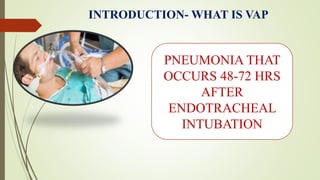
INTRODUCTION- WHAT IS VAP
PNEUMONIA THAT
OCCURS 48-72 HRS
AFTER
ENDOTRACHEAL
INTUBATION
FACTS AND FIGURES
½ OF HAP
2ND MC CAUSE OF NOSOCOMIAL
INFECTION IN ICU
MC CAUSE OF NOSOCOMIAL INFECTION
IN VENTILATOR BOUND PATIENTS
MORALITY RATE IS HIGHER IN PATIENT
OF TRAUMA, BURNS, POST OP
60- 70 % MORTALITY IN PATIENTS OF
PSEUDOMONAS AND ACINOBACTOR
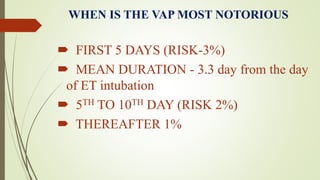
WHEN IS THE VAP MOST NOTORIOUS
 FIRST 5 DAYS (RISK-3%)
 MEAN DURATION - 3.3 day from the day
of ET intubation
 5TH TO 10TH DAY (RISK 2%)
 THEREAFTER 1%
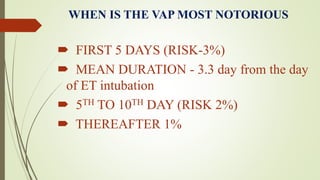
WHEN IS THE VAP MOST NOTORIOUS
 FIRST 5 DAYS (RISK-3%)
 MEAN DURATION - 3.3 day from the day
of ET intubation
 5TH TO 10TH DAY (RISK 2%)
 THEREAFTER 1%
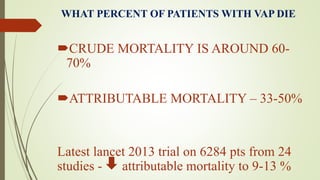
WHAT PERCENT OF PATIENTS WITH VAP DIE
CRUDE MORTALITY IS AROUND 60-
70%
ATTRIBUTABLE MORTALITY – 33-50%
Latest lancet 2013 trial on 6284 pts from 24
studies - attributable mortality to 9-13 %
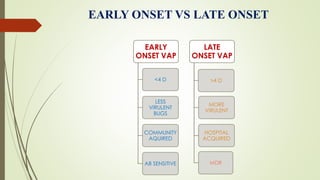
EARLY ONSET VS LATE ONSET
EARLY
ONSET VAP
<4 D
LESS
VIRULENT
BUGS
COMMUNITY
AQUIRED
AB SENSITIVE
LATE
ONSET VAP
>4 D
MORE
VIRULENT
HOSPITAL
ACQUIRED
MDR
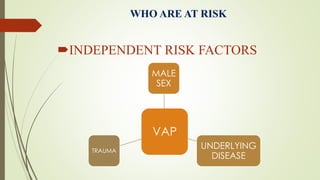
WHO ARE AT RISK
INDEPENDENT RISK FACTORS
VAP
MALE
SEX
UNDERLYING
DISEASE
TRAUMA
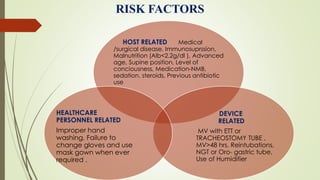
RISK FACTORS
HOST RELATED Medical
/surgical disease, Immunosuprssion,
Malnutrition (Alb<2.2g/dl ), Advanced
age, Supine position, Level of
conciousness, Medication-NMB,
sedation, steroids, Previous antibiotic
use
DEVICE
RELATED
MV with ETT or
TRACHEOSTOMY TUBE ,
MV>48 hrs, Reintubations,
NGT or Oro- gastric tube,
Use of Humidifier
HEALTHCARE
PERSONNEL RELATED
Improper hand
washing, Failure to
change gloves and use
mask gown when ever
required .
RISK FACTORS (CONT.)
HOST RELATED:
-UNDERLYING MEDICAL CONDITIONS-
COPD, OBESITY, ARDS, GERD, BURN,
TRAUMA, MODS ETC--
-IMMUNOSUPPRESSION,
MALNUTRITION(S.ALBUMIN<2.2G/DL)
-ADVANCED AGE
-PATIENTS’ BODY POSITION
-LEVEL OF CONSCIOUSNESS- IMPAIRED
LOC, DELIRIUM, COMA.
-NUMBER OF INTUBATIONS-
REINTUBATIONS
-MEDICATIONS (ANTIBIOTICS, SEDATION,
NM BLOCKERS)
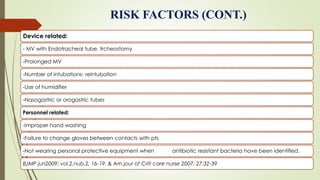
RISK FACTORS (CONT.)
Device related:
- MV with Endotracheal tube, trcheostomy
-Prolonged MV
-Number of intubations- reintubation
-Use of humidifier
-Nasogastric or orogastric tubes
Personnel related:
-Improper hand washing
-Failure to change gloves between contacts with pts
-Not wearing personal protective equipment when antibiotic resistant bacteria have been identified.
BJMP jun2009: vol.2,nub.2, 16-19. & Am.jour of Criti care nurse 2007; 27:32-39
HOW DO THE ORGANISM GET IN?
HOW DO THE ORGANISM GET IN (CONT)
MICROASPIRATION
BIOFILM
TRICKLING AROUND THE CUFF
IMPAIRED MUCOCILIARY CLEARANCE
POSITIVE PRESSURE FROM VENTILATOR
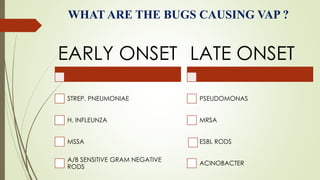
WHAT ARE THE BUGS CAUSING VAP ?
EARLY ONSET
STREP. PNEUMONIAE
H. INFLEUNZA
MSSA
A/B SENSITIVE GRAM NEGATIVE
RODS
LATE ONSET
PSEUDOMONAS
MRSA
ESBL RODS
ACINOBACTER
HOW TO DIAGNOSE VAP ?
NO UNVERSALLY
ACCEPTED GOLD
STANDARD
DIAGNOSTIC
CRITERIA!!!!!
DIAGNOSIS
CLINICAL
MICROBIOLOGICAL
RADIOLOGICAL
WHAT IS CPIS SCORE
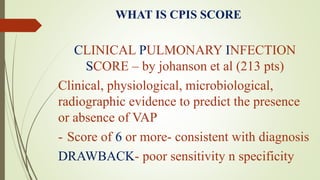
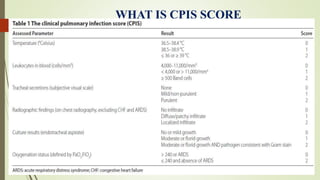
CLINICAL PULMONARY INFECTION
SCORE – by johanson et al (213 pts)
Clinical, physiological, microbiological,
radiographic evidence to predict the presence
or absence of VAP
- Score of 6 or more- consistent with diagnosis
DRAWBACK- poor sensitivity n specificity
WHAT IS CPIS SCORE
WHAT IS CPIS SCORE
MICROBIOLOGICAL DIAGNOSIS
ATS/IDSA
QUALITATIVE
CLINICAL
CRITERIA
QUANTITATIVE
ENDOTRACHEAL
ASPIRATE
-BAL
-MINI BAL
- PROTEECTED
SPECIMEN BRUSH
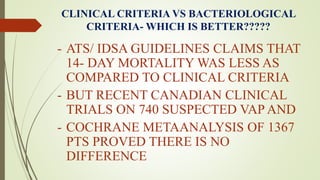
CLINICAL CRITERIA VS BACTERIOLOGICAL
CRITERIA- WHICH IS BETTER?????
- ATS/ IDSA GUIDELINES CLAIMS THAT
14- DAY MORTALITY WAS LESS AS
COMPARED TO CLINICAL CRITERIA
- BUT RECENT CANADIAN CLINICAL
TRIALS ON 740 SUSPECTED VAP AND
- COCHRANE METAANALYSIS OF 1367
PTS PROVED THERE IS NO
DIFFERENCE
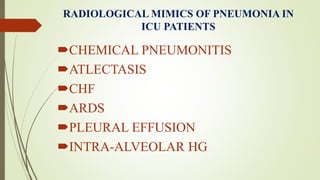
RADIOLOGICAL MIMICS OF PNEUMONIA IN
ICU PATIENTS
CHEMICAL PNEUMONITIS
ATLECTASIS
CHF
ARDS
PLEURAL EFFUSION
INTRA-ALVEOLAR HG
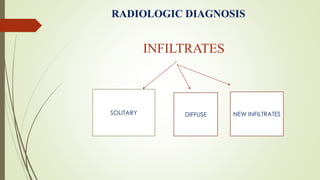
RADIOLOGIC DIAGNOSIS
INFILTRATES
SOLITARY DIFFUSE NEW INFILTRATES
RADIOLOGICAL EVIDENCE OF PNEUMONIA
THINK BEFORE
LABELLING IT
AS VAP!!
RADIOLIGICAL EVIDENCE
IF X RAYS ARE NOT A GOOD PREDICTOR
OF VAP ,,,
THEN WAT IS IT USED FOR
‘’’
RADIOLIGICAL EVIDENCE
ANS. It is used to rule out vap. (what else do u
want ?)
Meta-analysis by KLOMPAS ET AL
VERY STRONG NEGATIVE
PREDICTIVE VALUE
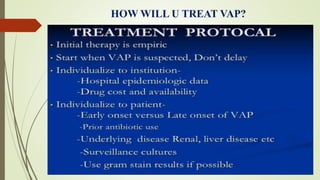
HOW WILL U TREAT VAP?
BEFORE CHOOSING ANTIBIOTIC, keep in
mind on the following issues
RISK FACTORS OF THE PATIENT
WAS IT EARLY OR LATE ONSET
VIRULENCE OF ORGANISM
ANTIBIOTIC RESISTANCE
COST
HOW WILL U TREAT VAP?
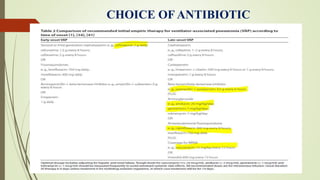
CHOICE OF ANTIBIOTIC
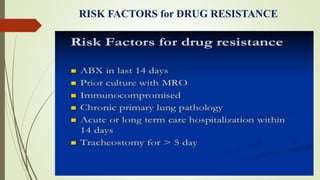
RISK FACTORS for DRUG RESISTANCE
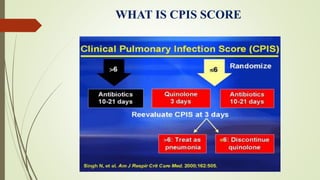
WHAT IF CPIS SCORE DOESN’T IMPROVE
CPIS SCORE <6 FOR MORE THAN 3 DAYS
CONSIDER ALTERNATE DIAGNOSIS
OR CONSIDER FUNGAL OR VIRAL
INFECTIONS
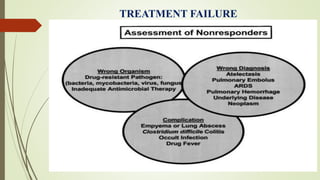
TREATMENT FAILURE
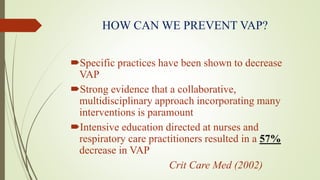
HOW CAN WE PREVENT VAP?
Specific practices have been shown to decrease
VAP
Strong evidence that a collaborative,
multidisciplinary approach incorporating many
interventions is paramount
Intensive education directed at nurses and
respiratory care practitioners resulted in a 57%
decrease in VAP
Crit Care Med (2002)
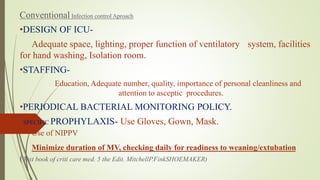
Conventional Infection control Aproach
•DESIGN OF ICU-
Adequate space, lighting, proper function of ventilatory system, facilities
for hand washing, Isolation room.
•STAFFING-
Education, Adequate number, quality, importance of personal cleanliness and

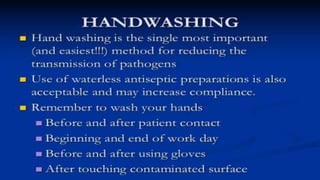
attention to asceptic procedures.
•PERIODICAL BACTERIAL MONITORING POLICY.
• SPECIFIC PROPHYLAXIS- Use Gloves, Gown, Mask.
Use of NIPPV
Minimize duration of MV, checking daily for readiness to weaning/extubation
(Text book of criti care med. 5 the Edit. MitchellP.FinkSHOEMAKER)
Daily Sedative Interruption and Daily
Assessment of Readiness to Extubate
OVERSEDATION
Predisposes patients to:
 Thromboemboli
 Pressure ulcers
 Gastric regurgitation and aspiration
 VAP
 Sepsis
Consequences include:
 Difficulty in monitoring neuro status
 Increased use of diagnostic procedures
 Increase ventilator days
 Prolonged ICU and hospital stay
STRESS ULCER PROPHYLAXIS
Increases gastric ph and minimize bacterial colonization that reduces
the risk of VAP and GI bleeding
SUCRALFATE- Decreases the VAP rate but increases the risk of GI
bleeding by 4%.
H2 receptor blockers/PP inhibitors- Increase rate of VAP by
increasing gastric Ph leading to colonization of bacteria and decreases
the risk of GI bleeding.
H2 receptor blocker, PP inhibitor preferred over
sucralfate
Am J Respir Crit Care Med. 2005;171(4):388-
416.
Airway Management
 Mechanical ventilation
 Avoidance of Endotracheal intubation
 Mask ventilation trials , NIPPV
 Minimize duration on MV
 Orotracheal intubation
 Nasotracheal intubation slightly increase the risk for VAP
 Avoid Reintubations- increases risk of VAP 6 fold
(Am resp.criti car med.1995;152(1):137-141)
 Maintain at 25-30 cm H2O
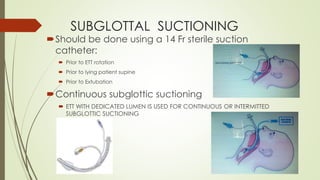
SUBGLOTTAL SUCTIONING
Should be done using a 14 Fr sterile suction
catheter:
 Prior to ETT rotation
 Prior to lying patient supine
 Prior to Extubation
Continuous subglottic suctioning
 ETT WITH DEDICATED LUMEN IS USED FOR CONTINUOUS OR INTERMITTED
SUBGLOTTIC SUCTIONING
Enteral Feedings
Early enternal feeding decrease bacterial
colonization and rate of VAP
Bolus feeding should be avoided to minimize
the risk of aspiration
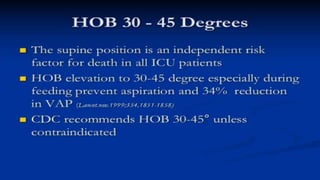
Elevate HOB 30 - 45 degrees
Routinely verify tube placement
PATIENT TURNING-
Routine turning of patient for every 2 hrs increase pulmonary
drainage and decrease the risk of VAP.
Use of beds with continues lateral rotation can decrease the
incidence of pneumonia but do not decreases mortality or duration
of MV (critical care 2002;30(9):1983-1986)
NEW DEVELOPMENT• National healthcare safety(NHSN) and CDC proposed-
VAP terminology changed to VAC (ventilated associated
conditions and complications) not necessarily limited VAP.
• VAP Surveillance definination algorithm.
Chest x ray is not included ,
And diagnosis is mainly depend on worsening of gas
exchange, clinical features, isolation of microorganism in
resp.secreation.
• ETT-- with continuous subglottic suction, ployurethrene
cuff,Sponge cuff , Silver nitrate and antibiotic coated ETTs.
• VAP industrial complex- kinetic beds, inlines suction
catheters
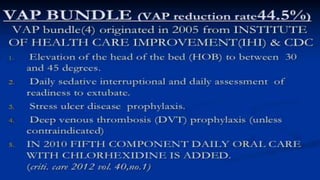
• VAP bunddle with 7 components – 5+ Replacing NGT to
Orogastric tube and Hand washing by health care personnel.
IMPLEMENTATION and ENFORCEMENT of VAP bundle
VAP TO VAC
 NOVEL SURVEILLANCE CRITERIA BY CDC
- to include other complication in ventilated patients
 WHAT IS VENTILATOR ASSOCIATED CONDITION
- defined by 2 days of stable or decreasing ventilators
setting
- followed by consistently higher ventilator settings
VAP TO VAC
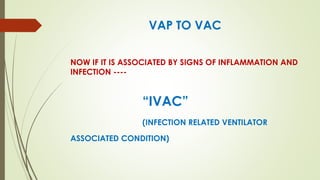
NOW IF IT IS ASSOCIATED BY SIGNS OF INFLAMMATION AND
INFECTION ----
“IVAC”
(INFECTION RELATED VENTILATOR
ASSOCIATED CONDITION)
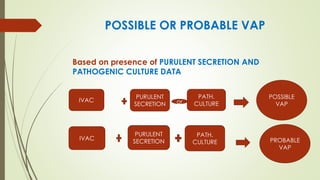
POSSIBLE OR PROBABLE VAP
Based on presence of PURULENT SECRETION AND
PATHOGENIC CULTURE DATA
IVAC
PURULENT
SECRETION
PATH.
CULTURE
POSSIBLE
VAP
IVAC
PURULENT
SECRETION
PATH.
CULTURE PROBABLE
VAP
or
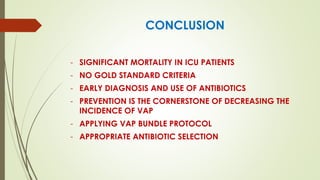
CONCLUSION
- SIGNIFICANT MORTALITY IN ICU PATIENTS
- NO GOLD STANDARD CRITERIA
- EARLY DIAGNOSIS AND USE OF ANTIBIOTICS
- PREVENTION IS THE CORNERSTONE OF DECREASING THE
INCIDENCE OF VAP
- APPLYING VAP BUNDLE PROTOCOL
- APPROPRIATE ANTIBIOTIC SELECTION
TAKE HOME MESSAGE
- DIAGNOSE VAP WHEN THERE IS SUSPICION
- CLASSIFY AND START EMPIRICAL ANTIBIOTIC AT THE EARLIEST
- DON’T FORGET TO SEND CULTURE SAMPLES
- PREVENTION IS THE KEY
- APPLY VAP BUNDLE PROTOCOL
- XRAYS ARE NOT DIAGNOSTIC ACCORDING TO NEW
PROTOCOL
- WEAN THE PATIENT EARLY
- STOP ANTIBIOTIC RESISTANCE
- FINALLY PLS DO WASH UR HANDS ***- SIMPLE BUT EFFECTIVE
 “THANK YOU”

Ventilator associated pneumonia

  • 1.
    VENTILATOR ASSOCIATED PNEUMONIA DR. CS ARAVIND (IST YEAR PG RESIDENT) UNIT CHIEF – DR. ANBARASU M.D
  • 2.
    SYNOPSIS  INTRODUCTION- WATIS VAP?  FACTS AND FIGURES  WHAT ARE THE TYPES OF VAP ?  WHO ARE AT RISK ?  HOW DO THE ORGANISMS CAUSE VAP ?  IS IT BACTERIA / VIRUS / FUNGUS- IF SO , WHAT ARE THE POSSIBLE ORGANISM ?  HOW TO DIAGNOSE VAP ?  HOW TO TREAT ?  IS THERE ANY PREVENTIVE STRATEGY ?  CONCLUSION
  • 3.
    INTRODUCTION- WHAT ISVAP PNEUMONIA THAT OCCURS 48-72 HRS AFTER ENDOTRACHEAL INTUBATION
  • 4.
    FACTS AND FIGURES ½OF HAP 2ND MC CAUSE OF NOSOCOMIAL INFECTION IN ICU MC CAUSE OF NOSOCOMIAL INFECTION IN VENTILATOR BOUND PATIENTS MORALITY RATE IS HIGHER IN PATIENT OF TRAUMA, BURNS, POST OP 60- 70 % MORTALITY IN PATIENTS OF PSEUDOMONAS AND ACINOBACTOR
  • 5.
    WHEN IS THEVAP MOST NOTORIOUS  FIRST 5 DAYS (RISK-3%)  MEAN DURATION - 3.3 day from the day of ET intubation  5TH TO 10TH DAY (RISK 2%)  THEREAFTER 1%
  • 6.
    WHEN IS THEVAP MOST NOTORIOUS  FIRST 5 DAYS (RISK-3%)  MEAN DURATION - 3.3 day from the day of ET intubation  5TH TO 10TH DAY (RISK 2%)  THEREAFTER 1%
  • 7.
    WHAT PERCENT OFPATIENTS WITH VAP DIE CRUDE MORTALITY IS AROUND 60- 70% ATTRIBUTABLE MORTALITY – 33-50% Latest lancet 2013 trial on 6284 pts from 24 studies - attributable mortality to 9-13 %
  • 8.
    EARLY ONSET VSLATE ONSET EARLY ONSET VAP <4 D LESS VIRULENT BUGS COMMUNITY AQUIRED AB SENSITIVE LATE ONSET VAP >4 D MORE VIRULENT HOSPITAL ACQUIRED MDR
  • 9.
    WHO ARE ATRISK INDEPENDENT RISK FACTORS VAP MALE SEX UNDERLYING DISEASE TRAUMA
  • 10.
    RISK FACTORS HOST RELATEDMedical /surgical disease, Immunosuprssion, Malnutrition (Alb<2.2g/dl ), Advanced age, Supine position, Level of conciousness, Medication-NMB, sedation, steroids, Previous antibiotic use DEVICE RELATED MV with ETT or TRACHEOSTOMY TUBE , MV>48 hrs, Reintubations, NGT or Oro- gastric tube, Use of Humidifier HEALTHCARE PERSONNEL RELATED Improper hand washing, Failure to change gloves and use mask gown when ever required .
  • 11.
    RISK FACTORS (CONT.) HOSTRELATED: -UNDERLYING MEDICAL CONDITIONS- COPD, OBESITY, ARDS, GERD, BURN, TRAUMA, MODS ETC-- -IMMUNOSUPPRESSION, MALNUTRITION(S.ALBUMIN<2.2G/DL) -ADVANCED AGE -PATIENTS’ BODY POSITION -LEVEL OF CONSCIOUSNESS- IMPAIRED LOC, DELIRIUM, COMA. -NUMBER OF INTUBATIONS- REINTUBATIONS -MEDICATIONS (ANTIBIOTICS, SEDATION, NM BLOCKERS)
  • 12.
    RISK FACTORS (CONT.) Devicerelated: - MV with Endotracheal tube, trcheostomy -Prolonged MV -Number of intubations- reintubation -Use of humidifier -Nasogastric or orogastric tubes Personnel related: -Improper hand washing -Failure to change gloves between contacts with pts -Not wearing personal protective equipment when antibiotic resistant bacteria have been identified. BJMP jun2009: vol.2,nub.2, 16-19. & Am.jour of Criti care nurse 2007; 27:32-39
  • 13.
    HOW DO THEORGANISM GET IN?
  • 14.
    HOW DO THEORGANISM GET IN (CONT) MICROASPIRATION BIOFILM TRICKLING AROUND THE CUFF IMPAIRED MUCOCILIARY CLEARANCE POSITIVE PRESSURE FROM VENTILATOR
  • 15.
    WHAT ARE THEBUGS CAUSING VAP ? EARLY ONSET STREP. PNEUMONIAE H. INFLEUNZA MSSA A/B SENSITIVE GRAM NEGATIVE RODS LATE ONSET PSEUDOMONAS MRSA ESBL RODS ACINOBACTER
  • 16.
    HOW TO DIAGNOSEVAP ? NO UNVERSALLY ACCEPTED GOLD STANDARD DIAGNOSTIC CRITERIA!!!!!
  • 17.
  • 18.
    WHAT IS CPISSCORE CLINICAL PULMONARY INFECTION SCORE – by johanson et al (213 pts) Clinical, physiological, microbiological, radiographic evidence to predict the presence or absence of VAP - Score of 6 or more- consistent with diagnosis DRAWBACK- poor sensitivity n specificity
  • 19.
  • 20.
  • 21.
  • 22.
    CLINICAL CRITERIA VSBACTERIOLOGICAL CRITERIA- WHICH IS BETTER????? - ATS/ IDSA GUIDELINES CLAIMS THAT 14- DAY MORTALITY WAS LESS AS COMPARED TO CLINICAL CRITERIA - BUT RECENT CANADIAN CLINICAL TRIALS ON 740 SUSPECTED VAP AND - COCHRANE METAANALYSIS OF 1367 PTS PROVED THERE IS NO DIFFERENCE
  • 23.
    RADIOLOGICAL MIMICS OFPNEUMONIA IN ICU PATIENTS CHEMICAL PNEUMONITIS ATLECTASIS CHF ARDS PLEURAL EFFUSION INTRA-ALVEOLAR HG
  • 24.
  • 25.
    RADIOLOGICAL EVIDENCE OFPNEUMONIA THINK BEFORE LABELLING IT AS VAP!!
  • 26.
    RADIOLIGICAL EVIDENCE IF XRAYS ARE NOT A GOOD PREDICTOR OF VAP ,,, THEN WAT IS IT USED FOR ‘’’
  • 27.
    RADIOLIGICAL EVIDENCE ANS. Itis used to rule out vap. (what else do u want ?) Meta-analysis by KLOMPAS ET AL VERY STRONG NEGATIVE PREDICTIVE VALUE
  • 28.
    HOW WILL UTREAT VAP? BEFORE CHOOSING ANTIBIOTIC, keep in mind on the following issues RISK FACTORS OF THE PATIENT WAS IT EARLY OR LATE ONSET VIRULENCE OF ORGANISM ANTIBIOTIC RESISTANCE COST
  • 29.
    HOW WILL UTREAT VAP?
  • 30.
  • 31.
    RISK FACTORS forDRUG RESISTANCE
  • 32.
    WHAT IF CPISSCORE DOESN’T IMPROVE CPIS SCORE <6 FOR MORE THAN 3 DAYS CONSIDER ALTERNATE DIAGNOSIS OR CONSIDER FUNGAL OR VIRAL INFECTIONS
  • 33.
  • 34.
    HOW CAN WEPREVENT VAP? Specific practices have been shown to decrease VAP Strong evidence that a collaborative, multidisciplinary approach incorporating many interventions is paramount Intensive education directed at nurses and respiratory care practitioners resulted in a 57% decrease in VAP Crit Care Med (2002)
  • 35.
    Conventional Infection controlAproach •DESIGN OF ICU- Adequate space, lighting, proper function of ventilatory system, facilities for hand washing, Isolation room. •STAFFING- Education, Adequate number, quality, importance of personal cleanliness and attention to asceptic procedures. •PERIODICAL BACTERIAL MONITORING POLICY. • SPECIFIC PROPHYLAXIS- Use Gloves, Gown, Mask. Use of NIPPV Minimize duration of MV, checking daily for readiness to weaning/extubation (Text book of criti care med. 5 the Edit. MitchellP.FinkSHOEMAKER)
  • 41.
    Daily Sedative Interruptionand Daily Assessment of Readiness to Extubate OVERSEDATION Predisposes patients to:  Thromboemboli  Pressure ulcers  Gastric regurgitation and aspiration  VAP  Sepsis Consequences include:  Difficulty in monitoring neuro status  Increased use of diagnostic procedures  Increase ventilator days  Prolonged ICU and hospital stay
  • 42.
    STRESS ULCER PROPHYLAXIS Increasesgastric ph and minimize bacterial colonization that reduces the risk of VAP and GI bleeding SUCRALFATE- Decreases the VAP rate but increases the risk of GI bleeding by 4%. H2 receptor blockers/PP inhibitors- Increase rate of VAP by increasing gastric Ph leading to colonization of bacteria and decreases the risk of GI bleeding. H2 receptor blocker, PP inhibitor preferred over sucralfate Am J Respir Crit Care Med. 2005;171(4):388- 416.
  • 43.
    Airway Management  Mechanicalventilation  Avoidance of Endotracheal intubation  Mask ventilation trials , NIPPV  Minimize duration on MV  Orotracheal intubation  Nasotracheal intubation slightly increase the risk for VAP  Avoid Reintubations- increases risk of VAP 6 fold (Am resp.criti car med.1995;152(1):137-141)  Maintain at 25-30 cm H2O
  • 44.
    SUBGLOTTAL SUCTIONING Should bedone using a 14 Fr sterile suction catheter:  Prior to ETT rotation  Prior to lying patient supine  Prior to Extubation Continuous subglottic suctioning  ETT WITH DEDICATED LUMEN IS USED FOR CONTINUOUS OR INTERMITTED SUBGLOTTIC SUCTIONING
  • 45.
    Enteral Feedings Early enternalfeeding decrease bacterial colonization and rate of VAP Bolus feeding should be avoided to minimize the risk of aspiration Elevate HOB 30 - 45 degrees Routinely verify tube placement
  • 46.
    PATIENT TURNING- Routine turningof patient for every 2 hrs increase pulmonary drainage and decrease the risk of VAP. Use of beds with continues lateral rotation can decrease the incidence of pneumonia but do not decreases mortality or duration of MV (critical care 2002;30(9):1983-1986)
  • 48.
    NEW DEVELOPMENT• Nationalhealthcare safety(NHSN) and CDC proposed- VAP terminology changed to VAC (ventilated associated conditions and complications) not necessarily limited VAP. • VAP Surveillance definination algorithm. Chest x ray is not included , And diagnosis is mainly depend on worsening of gas exchange, clinical features, isolation of microorganism in resp.secreation. • ETT-- with continuous subglottic suction, ployurethrene cuff,Sponge cuff , Silver nitrate and antibiotic coated ETTs. • VAP industrial complex- kinetic beds, inlines suction catheters • VAP bunddle with 7 components – 5+ Replacing NGT to Orogastric tube and Hand washing by health care personnel. IMPLEMENTATION and ENFORCEMENT of VAP bundle
  • 49.
    VAP TO VAC NOVEL SURVEILLANCE CRITERIA BY CDC - to include other complication in ventilated patients  WHAT IS VENTILATOR ASSOCIATED CONDITION - defined by 2 days of stable or decreasing ventilators setting - followed by consistently higher ventilator settings
  • 50.
    VAP TO VAC NOWIF IT IS ASSOCIATED BY SIGNS OF INFLAMMATION AND INFECTION ---- “IVAC” (INFECTION RELATED VENTILATOR ASSOCIATED CONDITION)
  • 51.
    POSSIBLE OR PROBABLEVAP Based on presence of PURULENT SECRETION AND PATHOGENIC CULTURE DATA IVAC PURULENT SECRETION PATH. CULTURE POSSIBLE VAP IVAC PURULENT SECRETION PATH. CULTURE PROBABLE VAP or
  • 52.
    CONCLUSION - SIGNIFICANT MORTALITYIN ICU PATIENTS - NO GOLD STANDARD CRITERIA - EARLY DIAGNOSIS AND USE OF ANTIBIOTICS - PREVENTION IS THE CORNERSTONE OF DECREASING THE INCIDENCE OF VAP - APPLYING VAP BUNDLE PROTOCOL - APPROPRIATE ANTIBIOTIC SELECTION
  • 53.
    TAKE HOME MESSAGE -DIAGNOSE VAP WHEN THERE IS SUSPICION - CLASSIFY AND START EMPIRICAL ANTIBIOTIC AT THE EARLIEST - DON’T FORGET TO SEND CULTURE SAMPLES - PREVENTION IS THE KEY - APPLY VAP BUNDLE PROTOCOL - XRAYS ARE NOT DIAGNOSTIC ACCORDING TO NEW PROTOCOL - WEAN THE PATIENT EARLY - STOP ANTIBIOTIC RESISTANCE - FINALLY PLS DO WASH UR HANDS ***- SIMPLE BUT EFFECTIVE
  • 54.