Transportation Techniques
By Group 1
Shreeya
Sonia
Shweta
Shobha
Introduction
• A transportation problem basically deals with
the problem, which aims to find the best way
to fulfill the demand of n demand points using
the capacities of m supply points
A Transportation Model Requires
• The origin points, and the capacity or supply
per period at each
• The destination points and the demand per
period at each
• The cost of shipping one unit from each origin
to each destination
Terminology
• Balanced Transportation Problem
• Unbalanced Transportation Problem
• Transportation Table
• Dummy source or destination
• Initial feasible solution
• Optimum solution
• Objective function
• Constraint.
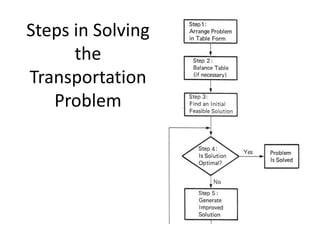
Transportation Problem Solutions steps
• Define problem
• Set up transportation table (matrix)
– Summarizes all data
– Keeps track of computations
• Develop initial solution
• Find optimal solution
• Assumption
Steps in Solving
the
Transportation
Problem
Warehouse
Source W1 W2 W3 W4 Supply
Capacity
F1 30 25 40 20 100
F2 29 26 35 40 250
F3 31 33 37 30 150
Demand 90 160 200 50 N = Total
supply/
Demand
Transportation Table
Special Issues in the Transportation
Model
• Demand not equal to supply
– Called ‘unbalanced’ problem
– Add dummy source if demand > supply
– Add dummy destination if supply > demand
There are three basic methods:
1. Minimum Cost Method
2. Northwest Corner Method
3. Vogel’s Method
Minimum Cost Method
Here, we use the following steps:
Step 1 Find the cell that has the least cost
Step 2: Assign as much as allocation to this cell
Step 3: Block those cells that cannot be allocated
Step 4: Repeat above steps until all allocation have been
assigned.
An example for Minimum Cost Method
Step 1: Select the cell with minimum cost.
2 3 5 6
2 1 3 5
3 8 4 6
5
10
15
12 8 4 6
Step 2: Cross-out column 2
2 3 5 6
2 1 3 5
8
3 8 4 6
12 X 4 6
5
2
15
Step 3: Find the new cell with minimum shipping cost
and cross-out row 2
2 3 5 6
2 1 3 5
2 8
3 8 4 6
5
X
15
10 X 4 6
Step 4: Find the new cell with minimum shipping cost
and cross-out row 1
2 3 5 6
5
2 1 3 5
2 8
3 8 4 6
X
X
15
5 X 4 6
Step 5: Find the new cell with minimum shipping cost
and cross-out column 1
2 3 5 6
5
2 1 3 5
2 8
3 8 4 6
5
X
X
10
X X 4 6
Step 6: Find the new cell with minimum shipping cost
and cross-out column 3
2 3 5 6
5
2 1 3 5
2 8
3 8 4 6
5 4
X
X
6
X X X 6
Step 7: Finally assign 6 to last cell. The bfs is found as:
X11=5, X21=2, X22=8, X31=5, X33=4 and X34=6
2 3 5 6
5
2 1 3 5
2 8
3 8 4 6
5 4 6
X
X
X
X X X X
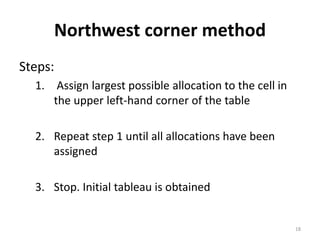
Northwest corner method
Steps:
1. Assign largest possible allocation to the cell in
the upper left-hand corner of the table
2. Repeat step 1 until all allocations have been
assigned
3. Stop. Initial tableau is obtained
18
Vogel’s Approximation Method
• 1. Determine the penalty cost for each row and
column.
• 2. Select the row or column with the highest
penalty cost.
• 3. Allocate as much as possible to the feasible
cell with the lowest transportation cost in the row
or column with the highest penalty cost.
• 4. Repeat steps 1, 2, and 3 until all requirements
have been met.
An example for Vogel’s Method
Step 1: Compute the penalties.
Supply Row Penalty
6 7 8
15 80 78
Demand
Column Penalty 15-6=9 80-7=73 78-8=70
7-6=1
78-15=63
15 5 5
10
15
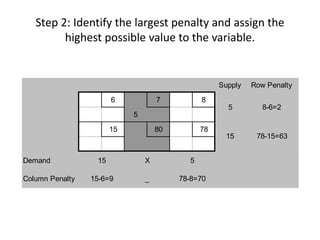
Step 2: Identify the largest penalty and assign the
highest possible value to the variable.
Supply Row Penalty
6 7 8
5
15 80 78
Demand
Column Penalty 15-6=9 _ 78-8=70
8-6=2
78-15=63
15 X 5
5
15
Step 3: Identify the largest penalty and assign the
highest possible value to the variable.
Supply Row Penalty
6 7 8
5 5
15 80 78
Demand
Column Penalty 15-6=9 _ _
_
_
15 X X
0
15
Step 5: Finally the bfs is found as X11=0, X12=5, X13=5,
and X21=15
Supply Row Penalty
6 7 8
0 5 5
15 80 78
15
Demand
Column Penalty _ _ _
_
_
X X X
X
X
Applications of
Transportation Model
• Scheduling airlines, including both planes and crew
• Deciding the appropriate place to site new facilities
such as a warehouse, factory or fire station
• Managing the flow of water from reservoirs
• Identifying possible future development paths for
parts of the telecommunications industry
• Establishing the information needs and appropriate
systems to supply them within the health service
2 February 2015
W1 W2 W3 W4 SUPPLY
S1 10 20 5 7 10
S2 13 9 12 8 20
S3 4 15 7 9 30
S4 14 7 1 0 40
S5 3 12 5 19 50
DEMAND 60 60 20 10
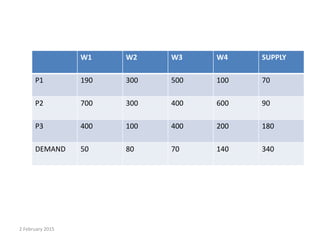
W1 W2 W3 W4 SUPPLY
P1 190 300 500 100 70
P2 700 300 400 600 90
P3 400 100 400 200 180
DEMAND 50 80 70 140 340
2 February 2015

Transportation technique

  • 1.
    Transportation Techniques By Group1 Shreeya Sonia Shweta Shobha
  • 2.
    Introduction • A transportationproblem basically deals with the problem, which aims to find the best way to fulfill the demand of n demand points using the capacities of m supply points
  • 3.
    A Transportation ModelRequires • The origin points, and the capacity or supply per period at each • The destination points and the demand per period at each • The cost of shipping one unit from each origin to each destination
  • 4.
    Terminology • Balanced TransportationProblem • Unbalanced Transportation Problem • Transportation Table • Dummy source or destination • Initial feasible solution • Optimum solution • Objective function • Constraint.
  • 5.
    Transportation Problem Solutionssteps • Define problem • Set up transportation table (matrix) – Summarizes all data – Keeps track of computations • Develop initial solution • Find optimal solution • Assumption
  • 6.
  • 7.
    Warehouse Source W1 W2W3 W4 Supply Capacity F1 30 25 40 20 100 F2 29 26 35 40 250 F3 31 33 37 30 150 Demand 90 160 200 50 N = Total supply/ Demand Transportation Table
  • 8.
    Special Issues inthe Transportation Model • Demand not equal to supply – Called ‘unbalanced’ problem – Add dummy source if demand > supply – Add dummy destination if supply > demand
  • 9.
    There are threebasic methods: 1. Minimum Cost Method 2. Northwest Corner Method 3. Vogel’s Method
  • 10.
    Minimum Cost Method Here,we use the following steps: Step 1 Find the cell that has the least cost Step 2: Assign as much as allocation to this cell Step 3: Block those cells that cannot be allocated Step 4: Repeat above steps until all allocation have been assigned.
  • 11.
    An example forMinimum Cost Method Step 1: Select the cell with minimum cost. 2 3 5 6 2 1 3 5 3 8 4 6 5 10 15 12 8 4 6
  • 12.
    Step 2: Cross-outcolumn 2 2 3 5 6 2 1 3 5 8 3 8 4 6 12 X 4 6 5 2 15
  • 13.
    Step 3: Findthe new cell with minimum shipping cost and cross-out row 2 2 3 5 6 2 1 3 5 2 8 3 8 4 6 5 X 15 10 X 4 6
  • 14.
    Step 4: Findthe new cell with minimum shipping cost and cross-out row 1 2 3 5 6 5 2 1 3 5 2 8 3 8 4 6 X X 15 5 X 4 6
  • 15.
    Step 5: Findthe new cell with minimum shipping cost and cross-out column 1 2 3 5 6 5 2 1 3 5 2 8 3 8 4 6 5 X X 10 X X 4 6
  • 16.
    Step 6: Findthe new cell with minimum shipping cost and cross-out column 3 2 3 5 6 5 2 1 3 5 2 8 3 8 4 6 5 4 X X 6 X X X 6
  • 17.
    Step 7: Finallyassign 6 to last cell. The bfs is found as: X11=5, X21=2, X22=8, X31=5, X33=4 and X34=6 2 3 5 6 5 2 1 3 5 2 8 3 8 4 6 5 4 6 X X X X X X X
  • 18.
    Northwest corner method Steps: 1.Assign largest possible allocation to the cell in the upper left-hand corner of the table 2. Repeat step 1 until all allocations have been assigned 3. Stop. Initial tableau is obtained 18
  • 19.
    Vogel’s Approximation Method •1. Determine the penalty cost for each row and column. • 2. Select the row or column with the highest penalty cost. • 3. Allocate as much as possible to the feasible cell with the lowest transportation cost in the row or column with the highest penalty cost. • 4. Repeat steps 1, 2, and 3 until all requirements have been met.
  • 20.
    An example forVogel’s Method Step 1: Compute the penalties. Supply Row Penalty 6 7 8 15 80 78 Demand Column Penalty 15-6=9 80-7=73 78-8=70 7-6=1 78-15=63 15 5 5 10 15
  • 21.
    Step 2: Identifythe largest penalty and assign the highest possible value to the variable. Supply Row Penalty 6 7 8 5 15 80 78 Demand Column Penalty 15-6=9 _ 78-8=70 8-6=2 78-15=63 15 X 5 5 15
  • 22.
    Step 3: Identifythe largest penalty and assign the highest possible value to the variable. Supply Row Penalty 6 7 8 5 5 15 80 78 Demand Column Penalty 15-6=9 _ _ _ _ 15 X X 0 15
  • 23.
    Step 5: Finallythe bfs is found as X11=0, X12=5, X13=5, and X21=15 Supply Row Penalty 6 7 8 0 5 5 15 80 78 15 Demand Column Penalty _ _ _ _ _ X X X X X
  • 24.
    Applications of Transportation Model •Scheduling airlines, including both planes and crew • Deciding the appropriate place to site new facilities such as a warehouse, factory or fire station • Managing the flow of water from reservoirs • Identifying possible future development paths for parts of the telecommunications industry • Establishing the information needs and appropriate systems to supply them within the health service
  • 26.
    2 February 2015 W1W2 W3 W4 SUPPLY S1 10 20 5 7 10 S2 13 9 12 8 20 S3 4 15 7 9 30 S4 14 7 1 0 40 S5 3 12 5 19 50 DEMAND 60 60 20 10
  • 27.
    W1 W2 W3W4 SUPPLY P1 190 300 500 100 70 P2 700 300 400 600 90 P3 400 100 400 200 180 DEMAND 50 80 70 140 340 2 February 2015