Values, Attitudes, and Job Satisfaction Chapter 3 MA. STELLA M.FRIAS MME Prof Jo B. Bitonio ME 217 HBO
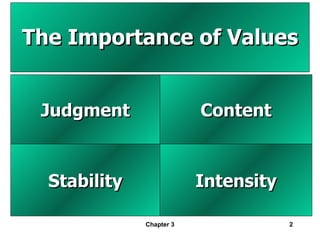
The Importance of Values Chapter 3 Judgment Content Intensity Stability
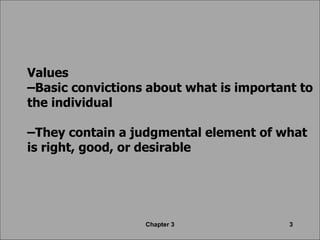
Values –Basic convictions about what is important to the individual –They contain a judgmental element of what is right, good, or desirable Chapter 3
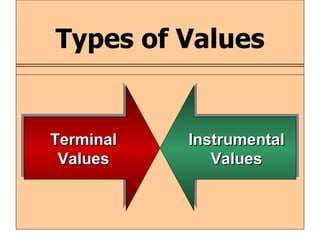
Chapter 3 Types of Values Terminal Values Instrumental Values
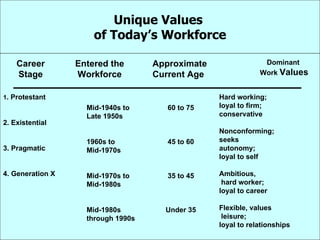
Unique Values  of Today’s Workforce Chapter 3 Career Stage Entered the Workforce Approximate Current Age Dominant  Work  Values 1 . Protestant  2. Existential 3. Pragmatic 4. Generation X Mid-1940s to Late 1950s 1960s to  Mid-1970s Mid-1970s to Mid-1980s Mid-1980s through 1990s 60 to 75 45 to 60 35 to 45 Under 35 Hard working;  loyal to firm;  conservative  Nonconforming;  seeks autonomy;  loyal to self Ambitious, hard worker; loyal to career Flexible, values leisure; loyal to relationships
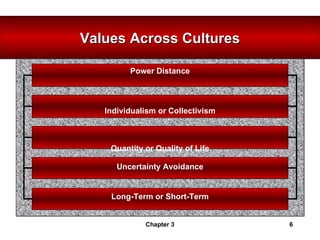
Power Distance Individualism or Collectivism Quantity or Quality of Life Uncertainty Avoidance Long-Term or Short-Term Chapter 3 Values Across Cultures
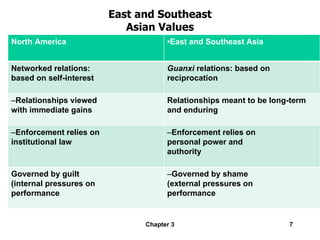
East and Southeast Asian Values Chapter 3 North America • East and Southeast Asia Networked relations: based on self-interest Guanxi  relations: based on reciprocation – Relationships viewed with immediate gains Relationships meant to be long-term and enduring – Enforcement relies on institutional law – Enforcement relies on personal power and authority Governed by guilt (internal pressures on performance – Governed by shame (external pressures on performance
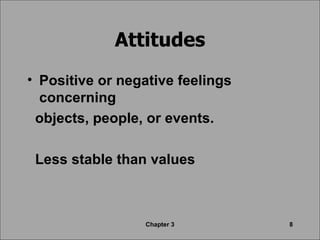
Attitudes Positive or negative feelings concerning objects, people, or events. Less stable than values Chapter 3
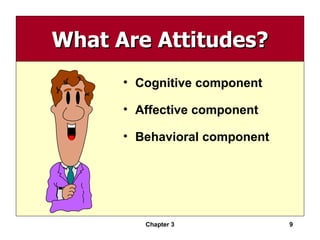
What Are Attitudes? Cognitive component Affective component Behavioral component Chapter 3
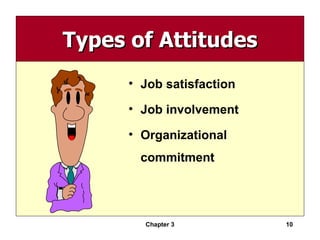
Types of Attitudes Job satisfaction Job involvement Organizational commitment Chapter 3
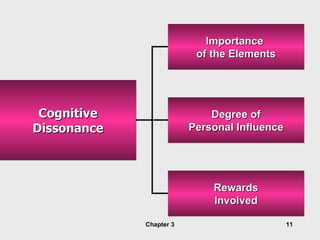
Chapter 3 Importance  of the Elements Cognitive Dissonance Degree of Personal Influence Rewards Involved
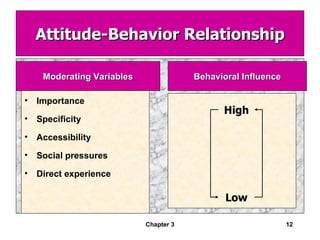
Attitude-Behavior Relationship Importance Specificity Accessibility Social pressures Direct experience Chapter 3 Moderating Variables Behavioral Influence High Low
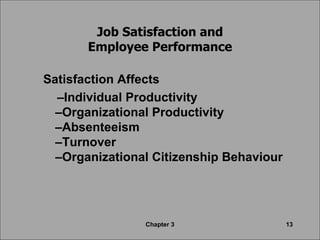
Job Satisfaction and Employee Performance Satisfaction Affects – Individual Productivity –Organizational Productivity –Absenteeism –Turnover –Organizational Citizenship Behaviour Chapter 3
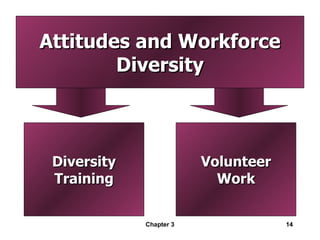
Attitudes and Workforce Diversity Chapter 3 Diversity Training Volunteer Work
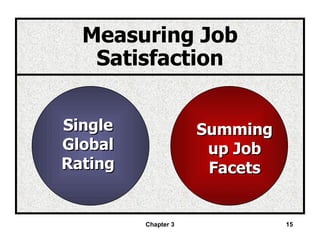
Chapter 3 Measuring Job Satisfaction Single Global Rating Summing up Job Facets
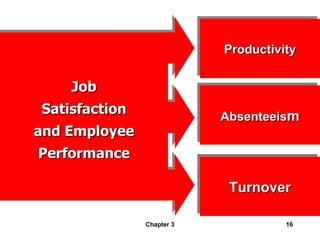
Chapter 3 Job Satisfaction and Employee Performance Productivity Absenteeis m Turnover
Job Satisfaction and Employee Performance Satisfaction Affects – Individual Productivity –Organizational  Productivity –Absenteeism –Turnover –Organizational Citizenship Behaviour Chapter 3
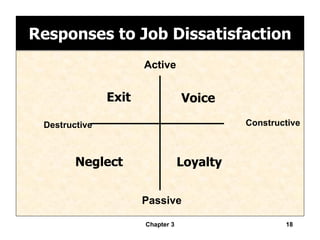
Responses to Job Dissatisfaction Chapter 3 Destructive Active Passive Constructive Exit Voice Neglect Loyalty
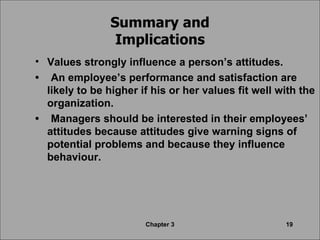
Summary and Implications Values strongly influence a person’s attitudes. •  An employee’s performance and satisfaction are likely to be higher if his or her values fit well with the organization. •  Managers should be interested in their employees’ attitudes because attitudes give warning signs of potential problems and because they influence behaviour. Chapter 3
Thank you Chapter 3

Values, Attitudes and Job Satisfaction

  • 1.
    Values, Attitudes, andJob Satisfaction Chapter 3 MA. STELLA M.FRIAS MME Prof Jo B. Bitonio ME 217 HBO
  • 2.
    The Importance ofValues Chapter 3 Judgment Content Intensity Stability
  • 3.
    Values –Basic convictionsabout what is important to the individual –They contain a judgmental element of what is right, good, or desirable Chapter 3
  • 4.
    Chapter 3 Typesof Values Terminal Values Instrumental Values
  • 5.
    Unique Values of Today’s Workforce Chapter 3 Career Stage Entered the Workforce Approximate Current Age Dominant Work Values 1 . Protestant 2. Existential 3. Pragmatic 4. Generation X Mid-1940s to Late 1950s 1960s to Mid-1970s Mid-1970s to Mid-1980s Mid-1980s through 1990s 60 to 75 45 to 60 35 to 45 Under 35 Hard working; loyal to firm; conservative Nonconforming; seeks autonomy; loyal to self Ambitious, hard worker; loyal to career Flexible, values leisure; loyal to relationships
  • 6.
    Power Distance Individualismor Collectivism Quantity or Quality of Life Uncertainty Avoidance Long-Term or Short-Term Chapter 3 Values Across Cultures
  • 7.
    East and SoutheastAsian Values Chapter 3 North America • East and Southeast Asia Networked relations: based on self-interest Guanxi  relations: based on reciprocation – Relationships viewed with immediate gains Relationships meant to be long-term and enduring – Enforcement relies on institutional law – Enforcement relies on personal power and authority Governed by guilt (internal pressures on performance – Governed by shame (external pressures on performance
  • 8.
    Attitudes Positive ornegative feelings concerning objects, people, or events. Less stable than values Chapter 3
  • 9.
    What Are Attitudes?Cognitive component Affective component Behavioral component Chapter 3
  • 10.
    Types of AttitudesJob satisfaction Job involvement Organizational commitment Chapter 3
  • 11.
    Chapter 3 Importance of the Elements Cognitive Dissonance Degree of Personal Influence Rewards Involved
  • 12.
    Attitude-Behavior Relationship ImportanceSpecificity Accessibility Social pressures Direct experience Chapter 3 Moderating Variables Behavioral Influence High Low
  • 13.
    Job Satisfaction andEmployee Performance Satisfaction Affects – Individual Productivity –Organizational Productivity –Absenteeism –Turnover –Organizational Citizenship Behaviour Chapter 3
  • 14.
    Attitudes and WorkforceDiversity Chapter 3 Diversity Training Volunteer Work
  • 15.
    Chapter 3 MeasuringJob Satisfaction Single Global Rating Summing up Job Facets
  • 16.
    Chapter 3 JobSatisfaction and Employee Performance Productivity Absenteeis m Turnover
  • 17.
    Job Satisfaction andEmployee Performance Satisfaction Affects – Individual Productivity –Organizational Productivity –Absenteeism –Turnover –Organizational Citizenship Behaviour Chapter 3
  • 18.
    Responses to JobDissatisfaction Chapter 3 Destructive Active Passive Constructive Exit Voice Neglect Loyalty
  • 19.
    Summary and ImplicationsValues strongly influence a person’s attitudes. • An employee’s performance and satisfaction are likely to be higher if his or her values fit well with the organization. • Managers should be interested in their employees’ attitudes because attitudes give warning signs of potential problems and because they influence behaviour. Chapter 3
  • 20.