1
Chapter Six
Leading/Directing
Meaning and nature of direction
• Planning, organizing and staffing are concerned only
with the preparation for work performance.
• Different authors define leading in different ways, but
the general ideas of each definition give the same
messages. Therefore, directing is simply defined as:
• The process of influencing people so that they will
contribute to the organization & group goals; but it
does not to mean coercing/ forcing, imposing
sanctions or pushing people at the behind.
2
• Leading is instructing, guiding and inspiring human
factor in the organization to achieve objectives.
• Directing is the process of integrating the people with
the organization, to obtain their willingness and
enthusiastic co-operation for the achievement of its
goals.
• It is the heart of managerial functions because it is
involves with initiating actions.
3
Elements of directing
• Managers to direct individuals require three basic
elements. They are:
1. Leadership
2. Motivation
3. Communication
4
Leadership
• Some define leadership as an integral part of the
group process.
• Others define it primarily as an influence
process.
• Still others see leadership as the initiation of
structure and the instrument of goal
achievement.
• Several even consider leaders to be servants of
their followers.
• Despite the differences, the various definitions
of leadership share three common elements:
5
1. First, leadership is a group phenomenon; there no
leaders without followers.
2. Second, leadership is goal directed.
3. Third, the presence of leaders assumes some form
of hierarchy within a group –formal and informal
• Leadership is a process whereby an individual
influences a group of individuals to achieve a
common goal.
6
Leadership at-Individual level involves mentoring,
coaching, inspiring and motivating.
At group level, leaders build team, create
cohesion/unity and resolve conflict.
At organizational level, leaders build culture, and
create change.
• According to Hersey and Blanchard, leadership is a
function of the leader, followers and situation which
can be depicted as:
L= f (L, F, S)
• Where L denotes leadership f- the function of, L-
leader, F-followers and S -the situation
7
Leadership Styles
• is the typical pattern of behavior a leader uses to
influence employees to achieve organizational goals.
• implies the ways in which the leaders exercise
leadership and the functions of leadership are carried
out.
Basic leadership styles
• Leadership styles are also broadly classified based on
three points of view: Motivation, Authority and
supervision.
• On the basis of motivation leadership style can be
positive or negative style.
• In positive style a leader motivates his followers to
work hard by offering them rewards.
8
• In negative styles, a leader forces his followers to work hard
and punishes them for lower productivity.
On the basis of Authority, leadership styles are:
1. Autocratic leadership style
2. Democratic leadership style
3. Laissez-faire leadership style
4. Bureaucratic leadership style
5. Situational leadership style
(The above listed 1, 2, 3, 4, 5 leadership styles are your individual assignment )
9
Leadership Theories
There are many theories on leadership as
philosophers, researchers and professors that have
studied and ultimately published their leadership
theory.
Every leader is different, and no single theory works
for all leaders.
The most widespread theories are:
1. Great man theory
2. Trait theory
3. Behavioral theories
4. Contingency theories
10
1. Great man theory (Thomas Carlyle, 1847)
The Great Man theory assumes that the traits of
leadership are intrinsic, great leaders are born with
innate qualities –not made, leaders are exceptional
people lead.
Gender issues were not on the table when the 'Great
Man' theory was proposed.
Most leaders were male and the thought of a Great
Woman was generally in areas other than leadership.
Most researchers were also male, and this led to the
next school of Trait Theory.
11
2. Trait theory :Late 1800s to mid-1940s
• This theory is similar to the Great Man theory. In
the 1920's and 1930's, leadership research focused
on trying to identify the traits that
differentiated leaders from non-leaders.
• The trait approach to understanding leadership
assumes that certain physical, social, personal and
task –oriented characteristics are inherent in
leaders.
• Physical traits include being young to middle-aged,
energetic, tall, and handsome.
• Social background traits include being educated at
the "right" schools and being socially prominent or
upwardly mobile.
12
• Social characteristics include being charismatic,
charming/polite, tactful, popular, cooperative, and
diplomatic.
• Personality traits include being self-confident,
adaptable, assertive, and emotionally stable.
• Task-related characteristics include being driven to
excel, accepting of responsibility, having initiative,
and being results-oriented.
• Stogdill (1974) identified the following traits and
skills as critical to leaders.
13
Trait skill
Adaptable to situations
Alert to social environment
Achievement orientated
Assertive
Cooperative
Decisive
Dependable /loyal/responsive
Dominant (desire to influence
others)
Energetic (high activity level)
Persistent
Self-confident
Clever (intelligent)
Conceptually skilled
Creative
Diplomatic and tactful
Fluent in speaking
Knowledgeable about
group task
Organized (administrative
ability)
Persuasive
Socially skilled
14
• McCall and Lombardo (1983) researched both
success and failure identified four primary traits:
Emotional stability and composure: Calm,
confident and predictable, particularly when under
stress.
Admitting error: Owning up to mistakes, rather than
putting energy into covering up.
Good interpersonal skills: Able to communicate
and persuade others without resort to negative or
coercive tactics.
Intellectual breadth: Able to understand a wide
range of areas, rather than having a narrow (and
narrow-minded) area of expertise.
15
Limitations / Short coming of Trait theory
• All the leaders may not possess all the traits & many
of non-leaders may possess most or all of them.
• The trait approach gives no guidance as to how much
of trait a person should have.
• It ignores situational factors.
3. Behavioral leadership theory: Mid 1940s to 1970s
• McGregor was a teacher, researcher, & consultant
and he influenced all the behavioral theories, which
emphasize focusing on human relationships, along
with output and performance.
16
• Behavioral leadership theory is a big leap/jump from
trait theory.
• It assumes that leadership capability can be learned,
rather than being inherent.
• Training people to perform effective leadership
behaviors, not focus on personality traits.
4. Contingency (situational) theory: 1960s to present
• They also propose that leaders choose the best course
of action based upon situational variable.
• Leaders are products of a given situation; what is
effective in one situation may not be effective in
other situation.
17
• Effective leadership is really a function of the
interaction of several variables, including:
Superior - subordinate relationships
The power distribution between superior and
subordinate
The degree to which the job is structured
Subordinates and superiors characteristics
Organizational culture and policies
Situational theory attempts to discover that no
one unique set of leadership traits were largely
successful
18
A. Fiedler's Contingency Model
Theory postulates that there is no single best way
for managers to lead.
Situations will create different leadership style.
For example, in a highly routine (mechanistic)
environment relatively directive leadership style
may result best performance, however, in a
dynamic environment a more flexible, participative
style may be required.
• He identified 3 situational that influence the leader’s
effectiveness.
1. Leader - member relations: refers to the degree of
confidence, trust & respect the followers have in
their leader.
19
2. Task structure: If tasks are clear/ structure the quality
of performance easily controllable & employees are
responsible for their performance.
3. Position power: the degree of leaders power to living,
promoting, sacking, salary increase etc.
It refers to the power inherent in the leadership position
to reward or punish.
• These 3 factors together determine how favorable the
situation is for the leader.
• Good member - leader relations, high task structure &
strong position power indicates the most favorable
situation.
20
B. Path-goal theory
Effective leaders increase motivation and satisfaction
and help subordinates to see the goal.
Role of the leader is:
 To clarify the path to help followers get to their goals
 To make the journey easily by reducing roadblocks
and pitfalls.
Leader’s behavior is acceptable to subordinates, they
view the leader as an immediate source for future
satisfaction.
21
Leader’s behavior is motivational if it:
Makes the subordinate’s satisfaction contingent on
performance.
Provides the coaching guidance, support, and rewards
necessary for effective performance.
• In contrast to Fielder’s contingency model, path-goal theory
assumes that managers can alter their leadership style as needed.
Qualities of leadership
The important qualities of leadership are:
Physical appearance and strength: A leader has to put hard
work physically. He should have a capacity to work for long
hours than others.
Mental vigor: a leader has to be strong mentally.
Emotional stability: a leader should not be moved by emotion
or sentiment.
22
Sense of judgment: a leader should know human psychology.
Goodwill: she/he must win the goodwill of his followers.
Motivation: a leader should know the motivation techniques and
how to use them.
Communication skill: a leader should communicate information
to the workers, and also be effective speaker & writer.
Guiding ability: a leader should act as a teacher
Sociability: The leader should meet workers frequently.
Technical knowledge: a leader should posses a thorough
knowledge of theory and practice of his job.
Be honest, sincere and fair: a leader should also be honest,
sincere and fair to be accepted by all.
23
The difference between leaders and managers
• Leaders essence is change
• Leaders are lead people
• leaders have followers
• Leader seeks vision
• Leader facilitate for decisions
• Leader is reactive
• Leader take risk
• Leader uses conflict
• Leader shows new road
• Leader gives credit
• Leader doing right thing
 Managers essence is stability
 Managers are managing work
 Managers have subordinate
 Manager seeks objectives
 Manager make decisions
 Managers are proactive
 Manager minimize risk
 Manager avoids conflict
 Manager shows existing road
 Manager takes credit
 Manager doing things right
 Managers strive to copy/imitate
24
Motivation
• The term motivation is derived from the Latin word
“Mover”, meaning “to move.”
Definitions of Motivation
The following are some of the important definitions
of motivation given by Eminent/well-known
management thinkers:
• Motivation is defined as “inner burning passion
caused by need, wants and desire.
• Performance can be expressed as under;
Performance= Ability × Motivation
• Scot defined motivation as “a process of stimulating
people to action or accomplish desired goals”.
25
• Something that moves the person to action and continues
him in the course of action already initiated– Robert
Dubin.
• Motivation is the process of attempting to influence
others to do your will through the possibility of gain or
reward. – Edwin B. Flippo.
• The Encyclopedia of Management: Motivation refers to
degree of readiness.
• Memoria: “A willingness to expand energy to achieve a
goal or reward.
26
Characteristics of motivation
 Motivation is a psychological phenomenon. It is the
internal desire of an individual to accomplish something
more.
 Motivation is a continuous process. Since need is a
continuous phenomenon if one need is satisfied the other
need emerges.
 There are unsatisfied needs. A person remains
disturbed till they are satisfied. This disturbance or
tension causes disequilibria in human behavior. The
more the motivation level, the higher effort will give
27
Importance of motivation
1. High level of performance
2. Low employee turnover and absenteeism
3. Acceptance of organization change
4. Organizational image
Types of motivation
On the basis of approach motivation can
Positive Motivation
• Positive motivation is creation of an environment &
necessary facilities for workers to satisfy their needs and
aspirations.
• rewards and incentives are offered to inspire employees.
• Positive motivation removes the psychological barrier
and develops a sense of affiliation.
28
Negative Motivation
• Negative motivation involves creating a sense of fear
or unhelpful environment.
• Workers who do not perform well are penalized like
Demotion, layoffs etc.
• Negative motivation creates detachment between
the individuals and the organization
• Negative motivation is based on pessimistic view
which holds that only fear of punishment will force
employees to improve their performance.
On the basis of the type of incentives
Financial Motivation
• Financial motivation implies use of monetary
benefits to inspire employees. wages and salaries,
bonus, fringe benefits, retirement benefits, etc.,
29
Non-financial Motivation
• Non-financial motivators are not associated with monetary rewards. These
include recognition of work done, greater involvement in decision-making,
responsibility, challenging job, Praise etc.
On the basis of the nature of reward
 Extrinsic Motivation
• Extrinsic motivators do not occur on the job but around the job.
• Extrinsic reward may be direct which are linked with performance and
indirect compensation like free housing, conveyance /transport, medical
facilities, etc. generally direct compensation is more effective motivator.
 Intrinsic Motivation
• Intrinsic motivation occurs on the job and provides satisfaction while the job
is being performed.
• Intrinsic or internal motivators include status, authority, participation,
challenging task etc.
30
Theories of motivation
Many experts have developed different theories on the concept
of motivation. Popular ones are given below:
1. Maslow’s theory of need hierarchy
2. ERG theory
3. Two factor theory
4. Theory ''X'' and theory ''Y''
Maslow’s theory of need hierarchy
 Maslow suggested that every individual has complex set of
needs at any particular moment and his behavior is
determined by the existence of strongest need.
 Needs are hierarchical in nature and only one need
dominates at any one point of time.
 Once the strongest need is satisfied then the second need
emerges.
31
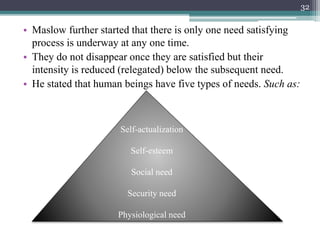
• Maslow further started that there is only one need satisfying
process is underway at any one time.
• They do not disappear once they are satisfied but their
intensity is reduced (relegated) below the subsequent need.
• He stated that human beings have five types of needs. Such as:
Self-actualization
Self-esteem
Social need
Security need
Physiological need
32
1. Physiological Needs
 It is strongest need as compared to the other needs; like hunger;
thirst, shelter, clothing and sex.
 These needs keep dominating unless they are reasonably
satisfied. Human being is therefore motivated to work in that
direction.
2. Safety Needs or Security Needs - Once the physiological need
of an individual is satisfied, the safety need /security need arises
and is dominant at that point of time. This need is related to:
 Workers want to be free from physical danger and job must
secured.
 There should be certainty in the job and non existence of arbitrary
action.
 Administration policy must cover various safeties like pay,
pension, insurance, and gratuity/extra pay.
 Given adequate security against being fired, laid off or demotion.
33
3. Social Needs
Once the safety need is satisfied, third need i.e. social
need arises.
People want to belong to some social group where their
emotional need of love, affection, warmth and friendship
are satisfied.
Being member of sports club, social organizations or
being the company of friends and relatives, needs can
satisfy social.
4. Esteem Need or Ego Need
 Individual wants self-recognition, appreciation for the
work done.
 It is related to self-respect, self-confidence, praise, power
and control. These needs are satisfied it gives an
individual a sense self-worth and ego satisfaction.
34
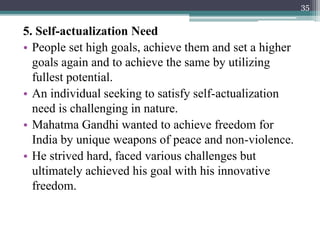
5. Self-actualization Need
• People set high goals, achieve them and set a higher
goals again and to achieve the same by utilizing
fullest potential.
• An individual seeking to satisfy self-actualization
need is challenging in nature.
• Mahatma Gandhi wanted to achieve freedom for
India by unique weapons of peace and non-violence.
• He strived hard, faced various challenges but
ultimately achieved his goal with his innovative
freedom.
35
• In essence Maslow’s Motivational Theory covers:
There are five levels of human needs.
These needs are hierarchical in nature.
A satisfied need is no longer a need. Once that need is
satisfied, the next level need becomes stronger.
Needs do not diminish. It is the gravity that changes.
Critics of Maslow’s Hierarchy of Needs Theory
• Maslow has laid down that individual has a particular pattern
and hierarchy of needs which may not be true.
• There are craftsmen, poets, sculptures, painters who have
devoted their entire life towards fulfillment of self-
actualization need without having satisfied other needs.
• To some people esteem need may be more important than
social need.
36
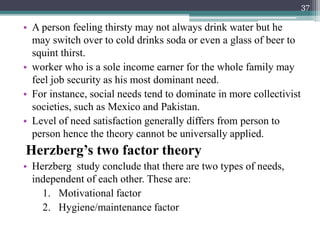
• A person feeling thirsty may not always drink water but he
may switch over to cold drinks soda or even a glass of beer to
squint thirst.
• worker who is a sole income earner for the whole family may
feel job security as his most dominant need.
• For instance, social needs tend to dominate in more collectivist
societies, such as Mexico and Pakistan.
• Level of need satisfaction generally differs from person to
person hence the theory cannot be universally applied.
Herzberg’s two factor theory
• Herzberg study conclude that there are two types of needs,
independent of each other. These are:
1. Motivational factor
2. Hygiene/maintenance factor
37
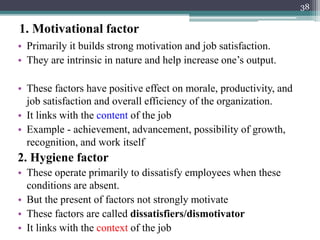
1. Motivational factor
• Primarily it builds strong motivation and job satisfaction.
• They are intrinsic in nature and help increase one’s output.
• These factors have positive effect on morale, productivity, and
job satisfaction and overall efficiency of the organization.
• It links with the content of the job
• Example - achievement, advancement, possibility of growth,
recognition, and work itself
2. Hygiene factor
• These operate primarily to dissatisfy employees when these
conditions are absent.
• But the present of factors not strongly motivate
• These factors are called dissatisfiers/dismotivator
• It links with the context of the job
38
These factors are:
• Company Policy and administration.
• Technical supervision.
• Interpersonal relationship with superiors, subordinate and peers
• Salary, job security, working condition and status.
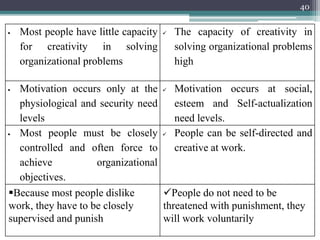
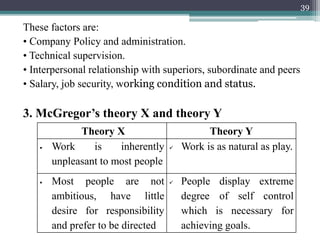
3. McGregor’s theory X and theory Y
Theory X Theory Y
 Work is inherently
unpleasant to most people
 Work is as natural as play.
 Most people are not
ambitious, have little
desire for responsibility
and prefer to be directed
 People display extreme
degree of self control
which is necessary for
achieving goals.
39
 Most people have little capacity
for creativity in solving
organizational problems
 The capacity of creativity in
solving organizational problems
high
 Motivation occurs only at the
physiological and security need
levels
 Motivation occurs at social,
esteem and Self-actualization
need levels.
 Most people must be closely
controlled and often force to
achieve organizational
objectives.
 People can be self-directed and
creative at work.
Because most people dislike
work, they have to be closely
supervised and punish
People do not need to be
threatened with punishment, they
will work voluntarily
40
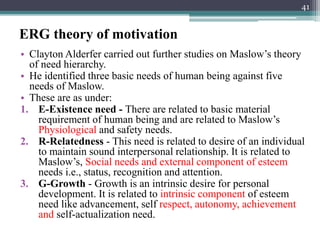
ERG theory of motivation
• Clayton Alderfer carried out further studies on Maslow’s theory
of need hierarchy.
• He identified three basic needs of human being against five
needs of Maslow.
• These are as under:
1. E-Existence need - There are related to basic material
requirement of human being and are related to Maslow’s
Physiological and safety needs.
2. R-Relatedness - This need is related to desire of an individual
to maintain sound interpersonal relationship. It is related to
Maslow’s, Social needs and external component of esteem
needs i.e., status, recognition and attention.
3. G-Growth - Growth is an intrinsic desire for personal
development. It is related to intrinsic component of esteem
need like advancement, self respect, autonomy, achievement
and self-actualization need.
41
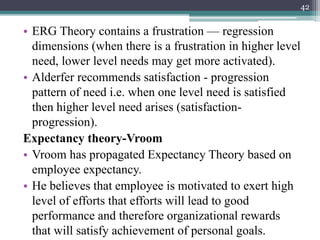
• ERG Theory contains a frustration — regression
dimensions (when there is a frustration in higher level
need, lower level needs may get more activated).
• Alderfer recommends satisfaction - progression
pattern of need i.e. when one level need is satisfied
then higher level need arises (satisfaction-
progression).
Expectancy theory-Vroom
• Vroom has propagated Expectancy Theory based on
employee expectancy.
• He believes that employee is motivated to exert high
level of efforts that efforts will lead to good
performance and therefore organizational rewards
that will satisfy achievement of personal goals.
42
• The focus of the theory has three elements.
▫ Efforts - Performance relationship. It is related to
the probability perceived by individual that
exerting a given amount of efforts will lead to
performance (Expectancy).
▫ Performance - Reward Relationship. The degree
to which the individual believes that performing a
particular level will lead to attainment of desired
outcome (Instrumentality).
▫ Reward-personal goal relationship. The degree to
which an organizational reward will satisfy
individual needs and its attractiveness for the
individual (Valence).
43
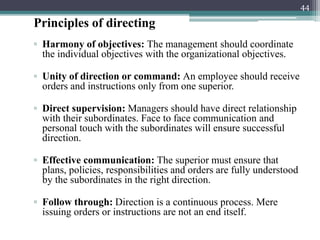
Principles of directing
▫ Harmony of objectives: The management should coordinate
the individual objectives with the organizational objectives.
▫ Unity of direction or command: An employee should receive
orders and instructions only from one superior.
▫ Direct supervision: Managers should have direct relationship
with their subordinates. Face to face communication and
personal touch with the subordinates will ensure successful
direction.
▫ Effective communication: The superior must ensure that
plans, policies, responsibilities and orders are fully understood
by the subordinates in the right direction.
▫ Follow through: Direction is a continuous process. Mere
issuing orders or instructions are not an end itself.
44
45

CH - 6 Leading.pptx

  • 1.
  • 2.
    Meaning and natureof direction • Planning, organizing and staffing are concerned only with the preparation for work performance. • Different authors define leading in different ways, but the general ideas of each definition give the same messages. Therefore, directing is simply defined as: • The process of influencing people so that they will contribute to the organization & group goals; but it does not to mean coercing/ forcing, imposing sanctions or pushing people at the behind. 2
  • 3.
    • Leading isinstructing, guiding and inspiring human factor in the organization to achieve objectives. • Directing is the process of integrating the people with the organization, to obtain their willingness and enthusiastic co-operation for the achievement of its goals. • It is the heart of managerial functions because it is involves with initiating actions. 3
  • 4.
    Elements of directing •Managers to direct individuals require three basic elements. They are: 1. Leadership 2. Motivation 3. Communication 4
  • 5.
    Leadership • Some defineleadership as an integral part of the group process. • Others define it primarily as an influence process. • Still others see leadership as the initiation of structure and the instrument of goal achievement. • Several even consider leaders to be servants of their followers. • Despite the differences, the various definitions of leadership share three common elements: 5
  • 6.
    1. First, leadershipis a group phenomenon; there no leaders without followers. 2. Second, leadership is goal directed. 3. Third, the presence of leaders assumes some form of hierarchy within a group –formal and informal • Leadership is a process whereby an individual influences a group of individuals to achieve a common goal. 6
  • 7.
    Leadership at-Individual levelinvolves mentoring, coaching, inspiring and motivating. At group level, leaders build team, create cohesion/unity and resolve conflict. At organizational level, leaders build culture, and create change. • According to Hersey and Blanchard, leadership is a function of the leader, followers and situation which can be depicted as: L= f (L, F, S) • Where L denotes leadership f- the function of, L- leader, F-followers and S -the situation 7
  • 8.
    Leadership Styles • isthe typical pattern of behavior a leader uses to influence employees to achieve organizational goals. • implies the ways in which the leaders exercise leadership and the functions of leadership are carried out. Basic leadership styles • Leadership styles are also broadly classified based on three points of view: Motivation, Authority and supervision. • On the basis of motivation leadership style can be positive or negative style. • In positive style a leader motivates his followers to work hard by offering them rewards. 8
  • 9.
    • In negativestyles, a leader forces his followers to work hard and punishes them for lower productivity. On the basis of Authority, leadership styles are: 1. Autocratic leadership style 2. Democratic leadership style 3. Laissez-faire leadership style 4. Bureaucratic leadership style 5. Situational leadership style (The above listed 1, 2, 3, 4, 5 leadership styles are your individual assignment ) 9
  • 10.
    Leadership Theories There aremany theories on leadership as philosophers, researchers and professors that have studied and ultimately published their leadership theory. Every leader is different, and no single theory works for all leaders. The most widespread theories are: 1. Great man theory 2. Trait theory 3. Behavioral theories 4. Contingency theories 10
  • 11.
    1. Great mantheory (Thomas Carlyle, 1847) The Great Man theory assumes that the traits of leadership are intrinsic, great leaders are born with innate qualities –not made, leaders are exceptional people lead. Gender issues were not on the table when the 'Great Man' theory was proposed. Most leaders were male and the thought of a Great Woman was generally in areas other than leadership. Most researchers were also male, and this led to the next school of Trait Theory. 11
  • 12.
    2. Trait theory:Late 1800s to mid-1940s • This theory is similar to the Great Man theory. In the 1920's and 1930's, leadership research focused on trying to identify the traits that differentiated leaders from non-leaders. • The trait approach to understanding leadership assumes that certain physical, social, personal and task –oriented characteristics are inherent in leaders. • Physical traits include being young to middle-aged, energetic, tall, and handsome. • Social background traits include being educated at the "right" schools and being socially prominent or upwardly mobile. 12
  • 13.
    • Social characteristicsinclude being charismatic, charming/polite, tactful, popular, cooperative, and diplomatic. • Personality traits include being self-confident, adaptable, assertive, and emotionally stable. • Task-related characteristics include being driven to excel, accepting of responsibility, having initiative, and being results-oriented. • Stogdill (1974) identified the following traits and skills as critical to leaders. 13
  • 14.
    Trait skill Adaptable tosituations Alert to social environment Achievement orientated Assertive Cooperative Decisive Dependable /loyal/responsive Dominant (desire to influence others) Energetic (high activity level) Persistent Self-confident Clever (intelligent) Conceptually skilled Creative Diplomatic and tactful Fluent in speaking Knowledgeable about group task Organized (administrative ability) Persuasive Socially skilled 14
  • 15.
    • McCall andLombardo (1983) researched both success and failure identified four primary traits: Emotional stability and composure: Calm, confident and predictable, particularly when under stress. Admitting error: Owning up to mistakes, rather than putting energy into covering up. Good interpersonal skills: Able to communicate and persuade others without resort to negative or coercive tactics. Intellectual breadth: Able to understand a wide range of areas, rather than having a narrow (and narrow-minded) area of expertise. 15
  • 16.
    Limitations / Shortcoming of Trait theory • All the leaders may not possess all the traits & many of non-leaders may possess most or all of them. • The trait approach gives no guidance as to how much of trait a person should have. • It ignores situational factors. 3. Behavioral leadership theory: Mid 1940s to 1970s • McGregor was a teacher, researcher, & consultant and he influenced all the behavioral theories, which emphasize focusing on human relationships, along with output and performance. 16
  • 17.
    • Behavioral leadershiptheory is a big leap/jump from trait theory. • It assumes that leadership capability can be learned, rather than being inherent. • Training people to perform effective leadership behaviors, not focus on personality traits. 4. Contingency (situational) theory: 1960s to present • They also propose that leaders choose the best course of action based upon situational variable. • Leaders are products of a given situation; what is effective in one situation may not be effective in other situation. 17
  • 18.
    • Effective leadershipis really a function of the interaction of several variables, including: Superior - subordinate relationships The power distribution between superior and subordinate The degree to which the job is structured Subordinates and superiors characteristics Organizational culture and policies Situational theory attempts to discover that no one unique set of leadership traits were largely successful 18
  • 19.
    A. Fiedler's ContingencyModel Theory postulates that there is no single best way for managers to lead. Situations will create different leadership style. For example, in a highly routine (mechanistic) environment relatively directive leadership style may result best performance, however, in a dynamic environment a more flexible, participative style may be required. • He identified 3 situational that influence the leader’s effectiveness. 1. Leader - member relations: refers to the degree of confidence, trust & respect the followers have in their leader. 19
  • 20.
    2. Task structure:If tasks are clear/ structure the quality of performance easily controllable & employees are responsible for their performance. 3. Position power: the degree of leaders power to living, promoting, sacking, salary increase etc. It refers to the power inherent in the leadership position to reward or punish. • These 3 factors together determine how favorable the situation is for the leader. • Good member - leader relations, high task structure & strong position power indicates the most favorable situation. 20
  • 21.
    B. Path-goal theory Effectiveleaders increase motivation and satisfaction and help subordinates to see the goal. Role of the leader is:  To clarify the path to help followers get to their goals  To make the journey easily by reducing roadblocks and pitfalls. Leader’s behavior is acceptable to subordinates, they view the leader as an immediate source for future satisfaction. 21
  • 22.
    Leader’s behavior ismotivational if it: Makes the subordinate’s satisfaction contingent on performance. Provides the coaching guidance, support, and rewards necessary for effective performance. • In contrast to Fielder’s contingency model, path-goal theory assumes that managers can alter their leadership style as needed. Qualities of leadership The important qualities of leadership are: Physical appearance and strength: A leader has to put hard work physically. He should have a capacity to work for long hours than others. Mental vigor: a leader has to be strong mentally. Emotional stability: a leader should not be moved by emotion or sentiment. 22
  • 23.
    Sense of judgment:a leader should know human psychology. Goodwill: she/he must win the goodwill of his followers. Motivation: a leader should know the motivation techniques and how to use them. Communication skill: a leader should communicate information to the workers, and also be effective speaker & writer. Guiding ability: a leader should act as a teacher Sociability: The leader should meet workers frequently. Technical knowledge: a leader should posses a thorough knowledge of theory and practice of his job. Be honest, sincere and fair: a leader should also be honest, sincere and fair to be accepted by all. 23
  • 24.
    The difference betweenleaders and managers • Leaders essence is change • Leaders are lead people • leaders have followers • Leader seeks vision • Leader facilitate for decisions • Leader is reactive • Leader take risk • Leader uses conflict • Leader shows new road • Leader gives credit • Leader doing right thing  Managers essence is stability  Managers are managing work  Managers have subordinate  Manager seeks objectives  Manager make decisions  Managers are proactive  Manager minimize risk  Manager avoids conflict  Manager shows existing road  Manager takes credit  Manager doing things right  Managers strive to copy/imitate 24
  • 25.
    Motivation • The termmotivation is derived from the Latin word “Mover”, meaning “to move.” Definitions of Motivation The following are some of the important definitions of motivation given by Eminent/well-known management thinkers: • Motivation is defined as “inner burning passion caused by need, wants and desire. • Performance can be expressed as under; Performance= Ability × Motivation • Scot defined motivation as “a process of stimulating people to action or accomplish desired goals”. 25
  • 26.
    • Something thatmoves the person to action and continues him in the course of action already initiated– Robert Dubin. • Motivation is the process of attempting to influence others to do your will through the possibility of gain or reward. – Edwin B. Flippo. • The Encyclopedia of Management: Motivation refers to degree of readiness. • Memoria: “A willingness to expand energy to achieve a goal or reward. 26
  • 27.
    Characteristics of motivation Motivation is a psychological phenomenon. It is the internal desire of an individual to accomplish something more.  Motivation is a continuous process. Since need is a continuous phenomenon if one need is satisfied the other need emerges.  There are unsatisfied needs. A person remains disturbed till they are satisfied. This disturbance or tension causes disequilibria in human behavior. The more the motivation level, the higher effort will give 27
  • 28.
    Importance of motivation 1.High level of performance 2. Low employee turnover and absenteeism 3. Acceptance of organization change 4. Organizational image Types of motivation On the basis of approach motivation can Positive Motivation • Positive motivation is creation of an environment & necessary facilities for workers to satisfy their needs and aspirations. • rewards and incentives are offered to inspire employees. • Positive motivation removes the psychological barrier and develops a sense of affiliation. 28
  • 29.
    Negative Motivation • Negativemotivation involves creating a sense of fear or unhelpful environment. • Workers who do not perform well are penalized like Demotion, layoffs etc. • Negative motivation creates detachment between the individuals and the organization • Negative motivation is based on pessimistic view which holds that only fear of punishment will force employees to improve their performance. On the basis of the type of incentives Financial Motivation • Financial motivation implies use of monetary benefits to inspire employees. wages and salaries, bonus, fringe benefits, retirement benefits, etc., 29
  • 30.
    Non-financial Motivation • Non-financialmotivators are not associated with monetary rewards. These include recognition of work done, greater involvement in decision-making, responsibility, challenging job, Praise etc. On the basis of the nature of reward  Extrinsic Motivation • Extrinsic motivators do not occur on the job but around the job. • Extrinsic reward may be direct which are linked with performance and indirect compensation like free housing, conveyance /transport, medical facilities, etc. generally direct compensation is more effective motivator.  Intrinsic Motivation • Intrinsic motivation occurs on the job and provides satisfaction while the job is being performed. • Intrinsic or internal motivators include status, authority, participation, challenging task etc. 30
  • 31.
    Theories of motivation Manyexperts have developed different theories on the concept of motivation. Popular ones are given below: 1. Maslow’s theory of need hierarchy 2. ERG theory 3. Two factor theory 4. Theory ''X'' and theory ''Y'' Maslow’s theory of need hierarchy  Maslow suggested that every individual has complex set of needs at any particular moment and his behavior is determined by the existence of strongest need.  Needs are hierarchical in nature and only one need dominates at any one point of time.  Once the strongest need is satisfied then the second need emerges. 31
  • 32.
    • Maslow furtherstarted that there is only one need satisfying process is underway at any one time. • They do not disappear once they are satisfied but their intensity is reduced (relegated) below the subsequent need. • He stated that human beings have five types of needs. Such as: Self-actualization Self-esteem Social need Security need Physiological need 32
  • 33.
    1. Physiological Needs It is strongest need as compared to the other needs; like hunger; thirst, shelter, clothing and sex.  These needs keep dominating unless they are reasonably satisfied. Human being is therefore motivated to work in that direction. 2. Safety Needs or Security Needs - Once the physiological need of an individual is satisfied, the safety need /security need arises and is dominant at that point of time. This need is related to:  Workers want to be free from physical danger and job must secured.  There should be certainty in the job and non existence of arbitrary action.  Administration policy must cover various safeties like pay, pension, insurance, and gratuity/extra pay.  Given adequate security against being fired, laid off or demotion. 33
  • 34.
    3. Social Needs Oncethe safety need is satisfied, third need i.e. social need arises. People want to belong to some social group where their emotional need of love, affection, warmth and friendship are satisfied. Being member of sports club, social organizations or being the company of friends and relatives, needs can satisfy social. 4. Esteem Need or Ego Need  Individual wants self-recognition, appreciation for the work done.  It is related to self-respect, self-confidence, praise, power and control. These needs are satisfied it gives an individual a sense self-worth and ego satisfaction. 34
  • 35.
    5. Self-actualization Need •People set high goals, achieve them and set a higher goals again and to achieve the same by utilizing fullest potential. • An individual seeking to satisfy self-actualization need is challenging in nature. • Mahatma Gandhi wanted to achieve freedom for India by unique weapons of peace and non-violence. • He strived hard, faced various challenges but ultimately achieved his goal with his innovative freedom. 35
  • 36.
    • In essenceMaslow’s Motivational Theory covers: There are five levels of human needs. These needs are hierarchical in nature. A satisfied need is no longer a need. Once that need is satisfied, the next level need becomes stronger. Needs do not diminish. It is the gravity that changes. Critics of Maslow’s Hierarchy of Needs Theory • Maslow has laid down that individual has a particular pattern and hierarchy of needs which may not be true. • There are craftsmen, poets, sculptures, painters who have devoted their entire life towards fulfillment of self- actualization need without having satisfied other needs. • To some people esteem need may be more important than social need. 36
  • 37.
    • A personfeeling thirsty may not always drink water but he may switch over to cold drinks soda or even a glass of beer to squint thirst. • worker who is a sole income earner for the whole family may feel job security as his most dominant need. • For instance, social needs tend to dominate in more collectivist societies, such as Mexico and Pakistan. • Level of need satisfaction generally differs from person to person hence the theory cannot be universally applied. Herzberg’s two factor theory • Herzberg study conclude that there are two types of needs, independent of each other. These are: 1. Motivational factor 2. Hygiene/maintenance factor 37
  • 38.
    1. Motivational factor •Primarily it builds strong motivation and job satisfaction. • They are intrinsic in nature and help increase one’s output. • These factors have positive effect on morale, productivity, and job satisfaction and overall efficiency of the organization. • It links with the content of the job • Example - achievement, advancement, possibility of growth, recognition, and work itself 2. Hygiene factor • These operate primarily to dissatisfy employees when these conditions are absent. • But the present of factors not strongly motivate • These factors are called dissatisfiers/dismotivator • It links with the context of the job 38
  • 39.
    These factors are: •Company Policy and administration. • Technical supervision. • Interpersonal relationship with superiors, subordinate and peers • Salary, job security, working condition and status. 3. McGregor’s theory X and theory Y Theory X Theory Y  Work is inherently unpleasant to most people  Work is as natural as play.  Most people are not ambitious, have little desire for responsibility and prefer to be directed  People display extreme degree of self control which is necessary for achieving goals. 39
  • 40.
     Most peoplehave little capacity for creativity in solving organizational problems  The capacity of creativity in solving organizational problems high  Motivation occurs only at the physiological and security need levels  Motivation occurs at social, esteem and Self-actualization need levels.  Most people must be closely controlled and often force to achieve organizational objectives.  People can be self-directed and creative at work. Because most people dislike work, they have to be closely supervised and punish People do not need to be threatened with punishment, they will work voluntarily 40
  • 41.
    ERG theory ofmotivation • Clayton Alderfer carried out further studies on Maslow’s theory of need hierarchy. • He identified three basic needs of human being against five needs of Maslow. • These are as under: 1. E-Existence need - There are related to basic material requirement of human being and are related to Maslow’s Physiological and safety needs. 2. R-Relatedness - This need is related to desire of an individual to maintain sound interpersonal relationship. It is related to Maslow’s, Social needs and external component of esteem needs i.e., status, recognition and attention. 3. G-Growth - Growth is an intrinsic desire for personal development. It is related to intrinsic component of esteem need like advancement, self respect, autonomy, achievement and self-actualization need. 41
  • 42.
    • ERG Theorycontains a frustration — regression dimensions (when there is a frustration in higher level need, lower level needs may get more activated). • Alderfer recommends satisfaction - progression pattern of need i.e. when one level need is satisfied then higher level need arises (satisfaction- progression). Expectancy theory-Vroom • Vroom has propagated Expectancy Theory based on employee expectancy. • He believes that employee is motivated to exert high level of efforts that efforts will lead to good performance and therefore organizational rewards that will satisfy achievement of personal goals. 42
  • 43.
    • The focusof the theory has three elements. ▫ Efforts - Performance relationship. It is related to the probability perceived by individual that exerting a given amount of efforts will lead to performance (Expectancy). ▫ Performance - Reward Relationship. The degree to which the individual believes that performing a particular level will lead to attainment of desired outcome (Instrumentality). ▫ Reward-personal goal relationship. The degree to which an organizational reward will satisfy individual needs and its attractiveness for the individual (Valence). 43
  • 44.
    Principles of directing ▫Harmony of objectives: The management should coordinate the individual objectives with the organizational objectives. ▫ Unity of direction or command: An employee should receive orders and instructions only from one superior. ▫ Direct supervision: Managers should have direct relationship with their subordinates. Face to face communication and personal touch with the subordinates will ensure successful direction. ▫ Effective communication: The superior must ensure that plans, policies, responsibilities and orders are fully understood by the subordinates in the right direction. ▫ Follow through: Direction is a continuous process. Mere issuing orders or instructions are not an end itself. 44
  • 45.