VALUATION
CONCEPTS
HARLENE B.
TAMONDONG
JONNALYN G.
DE JESUS
BRENDA D.
TOMAS
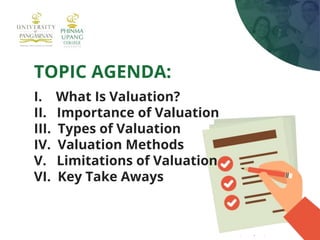
I. What Is Valuation?
II. Importance of Valuation
III. Types of Valuation
IV. Valuation Methods
V. Limitations of Valuation
VI. Key Take Aways
TOPIC AGENDA:
WE LOOK FORWARD TO
YOUR UTMOST
PARTICIPATION!
What Is Valuation?
● Value is the monetary, material, or assessed worth of
an asset, good, or service.
● The analytical process of determining the current (or
projected) worth of an asset or a company is called
valuation.
● Determine the fair value of a security, which is
determined by what a buyer is willing to pay a seller
Importance of Valuation
- Better Knowledge of Company Assets
Specific numbers need to be gained from
valuation processes so that business owners can
obtain proper insurance coverage, know how
much to reinvest into the company, and how
much to sell your company for so that you still
make a profit.
Importance of Valuation
- Comprehending Company’s Resale Value
If the management is contemplating to sell the
company, knowing its true value is necessary. This
process should be started far before the business
goes up for sale on the open market because it
will have an opportunity to take more time to
increase the company's value to achieve
a higher selling price.
Importance of Valuation
- Obtain a True Company Value
Knowing the true value of the company is often a
deciding factor if selling the business becomes a
possibility. It also helps to show company income
and valuation growth over the course of the previous
years. Potential buyers like to see that a company
has seen regular, consistent growth as it ages.
Importance of Valuation
- Mergers and Acquisitions
When a company goes for merger or acquisition,
the valuation of business gains substantial
significance. As it assist in determining the value
of assets, current scenario of the company’s
growth going for merger /acquisition and whether
post acquisition / merger it possess growth
potential.
Importance of Valuation
- Access to More Investors
While seeking additional investors to fund company’s
growth or save it from financial catastrophe, the
investor will demand for a complete company
valuation report. One should also provide potential
investors with a valuation projection based upon
their provided funding.
Types of Valuation
Liquidation Value
- The amount of money realized by selling a firm’s
assets and paying off creditors
Going concern Value
- The value of a firm as an operating business
Book Value
- The accounting value of a firm or an asset
Types of Valuation
Market Value
- The transaction price of the asset in the
marketplace
Intrinsic Value
- The true value of an asset
Valuation Methods
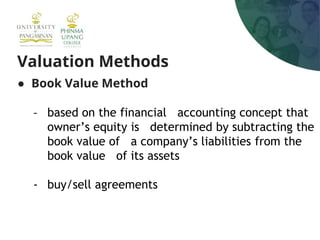
● Book Value Method
- based on the financial accounting concept that
owner’s equity is determined by subtracting the
book value of a company’s liabilities from the
book value of its assets
- buy/sell agreements
Valuation Methods
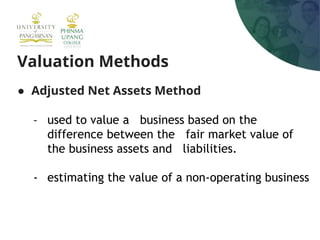
● Adjusted Net Assets Method
- used to value a business based on the
difference between the fair market value of
the business assets and liabilities.
- estimating the value of a non-operating business
Valuation Methods
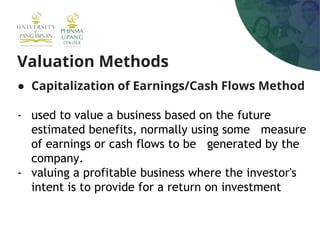
● Capitalization of Earnings/Cash Flows Method
- used to value a business based on the future
estimated benefits, normally using some measure
of earnings or cash flows to be generated by the
company.
- valuing a profitable business where the investor's
intent is to provide for a return on investment
Valuation Methods
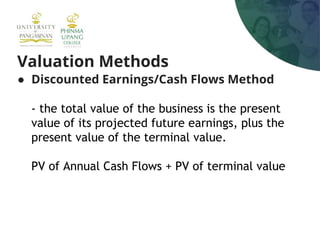
● Discounted Earnings/Cash Flows Method
- the total value of the business is the present
value of its projected future earnings, plus the
present value of the terminal value.
PV of Annual Cash Flows + PV of terminal value
Valuation Methods
● Dividend Paying Capacity Method
- this method of valuation is based on the future
estimated dividends to be paid out or the
capacity to pay out.
- estimating the value of businesses that are
relatively large and businesses that have had a
history of paying dividends to shareholders
Limitations of Valuation
● When deciding which valuation method to use to value a stock
for the first time, it's easy to become overwhelmed by the
number of valuation techniques available to investors. There are
valuation methods that are fairly straightforward while others
are more involved and complicated.
● Unfortunately, there's no one method that's best suited for
every situation. Each stock is different, and each industry or
sector has unique characteristics that may require multiple
valuation methods. At the same time, different valuation
methods will produce different values for the same underlying
asset or company which may lead analysts to employ the
technique that provides the most favorable output.
Key Take Aways
● Valuation is a quantitative process of determining the
fair value of an asset or a firm.
● In general, a company can be valued on its own on an
absolute basis, or else on a relative basis compared to
other similar companies or assets.
● There are several methods and techniques for arriving
at a valuation—each of which may produce a different
value.
● Valuations can be quickly impacted by corporate
earnings or economic events that force analysts to
retool their valuation models.
-THE END-
Source:
https://www.investopedia.com/terms/v/valuation.asp
http://edu.nacva.com/preread/2012BVTC/2012v1_FTT_Chapter_Six.pdf
https://www.icsi.edu/media/webmodules/PRACTICE%20QUESTIONS%20VALUA
TIONS%20&%20BUSINESS%20MODELLING.pdf
https://www.investopedia.com/terms/b/business-valuation.asp
https://www.investopedia.com/terms/v/value.asp

VALUATION CONCEPTSFIN 069.pptx

  • 1.
  • 2.
  • 3.
    I. What IsValuation? II. Importance of Valuation III. Types of Valuation IV. Valuation Methods V. Limitations of Valuation VI. Key Take Aways TOPIC AGENDA:
  • 5.
    WE LOOK FORWARDTO YOUR UTMOST PARTICIPATION!
  • 6.
    What Is Valuation? ●Value is the monetary, material, or assessed worth of an asset, good, or service. ● The analytical process of determining the current (or projected) worth of an asset or a company is called valuation. ● Determine the fair value of a security, which is determined by what a buyer is willing to pay a seller
  • 7.
    Importance of Valuation -Better Knowledge of Company Assets Specific numbers need to be gained from valuation processes so that business owners can obtain proper insurance coverage, know how much to reinvest into the company, and how much to sell your company for so that you still make a profit.
  • 8.
    Importance of Valuation -Comprehending Company’s Resale Value If the management is contemplating to sell the company, knowing its true value is necessary. This process should be started far before the business goes up for sale on the open market because it will have an opportunity to take more time to increase the company's value to achieve a higher selling price.
  • 9.
    Importance of Valuation -Obtain a True Company Value Knowing the true value of the company is often a deciding factor if selling the business becomes a possibility. It also helps to show company income and valuation growth over the course of the previous years. Potential buyers like to see that a company has seen regular, consistent growth as it ages.
  • 10.
    Importance of Valuation -Mergers and Acquisitions When a company goes for merger or acquisition, the valuation of business gains substantial significance. As it assist in determining the value of assets, current scenario of the company’s growth going for merger /acquisition and whether post acquisition / merger it possess growth potential.
  • 11.
    Importance of Valuation -Access to More Investors While seeking additional investors to fund company’s growth or save it from financial catastrophe, the investor will demand for a complete company valuation report. One should also provide potential investors with a valuation projection based upon their provided funding.
  • 12.
    Types of Valuation LiquidationValue - The amount of money realized by selling a firm’s assets and paying off creditors Going concern Value - The value of a firm as an operating business Book Value - The accounting value of a firm or an asset
  • 13.
    Types of Valuation MarketValue - The transaction price of the asset in the marketplace Intrinsic Value - The true value of an asset
  • 14.
    Valuation Methods ● BookValue Method - based on the financial accounting concept that owner’s equity is determined by subtracting the book value of a company’s liabilities from the book value of its assets - buy/sell agreements
  • 15.
    Valuation Methods ● AdjustedNet Assets Method - used to value a business based on the difference between the fair market value of the business assets and liabilities. - estimating the value of a non-operating business
  • 16.
    Valuation Methods ● Capitalizationof Earnings/Cash Flows Method - used to value a business based on the future estimated benefits, normally using some measure of earnings or cash flows to be generated by the company. - valuing a profitable business where the investor's intent is to provide for a return on investment
  • 17.
    Valuation Methods ● DiscountedEarnings/Cash Flows Method - the total value of the business is the present value of its projected future earnings, plus the present value of the terminal value. PV of Annual Cash Flows + PV of terminal value
  • 18.
    Valuation Methods ● DividendPaying Capacity Method - this method of valuation is based on the future estimated dividends to be paid out or the capacity to pay out. - estimating the value of businesses that are relatively large and businesses that have had a history of paying dividends to shareholders
  • 19.
    Limitations of Valuation ●When deciding which valuation method to use to value a stock for the first time, it's easy to become overwhelmed by the number of valuation techniques available to investors. There are valuation methods that are fairly straightforward while others are more involved and complicated. ● Unfortunately, there's no one method that's best suited for every situation. Each stock is different, and each industry or sector has unique characteristics that may require multiple valuation methods. At the same time, different valuation methods will produce different values for the same underlying asset or company which may lead analysts to employ the technique that provides the most favorable output.
  • 20.
    Key Take Aways ●Valuation is a quantitative process of determining the fair value of an asset or a firm. ● In general, a company can be valued on its own on an absolute basis, or else on a relative basis compared to other similar companies or assets. ● There are several methods and techniques for arriving at a valuation—each of which may produce a different value. ● Valuations can be quickly impacted by corporate earnings or economic events that force analysts to retool their valuation models.
  • 21.
  • 22.