POWERPOINT
PRESENTATION
MBA- Finance 069
F i n a n c e 0 6 9
Business Risk
and
Financial Risk
POWERPOINT
PRESENTATION
MBA- Finance 069
PRESENTERS
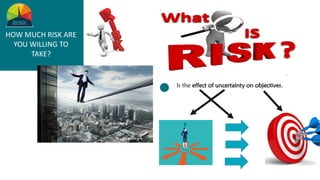
HOW MUCH RISK ARE
YOU WILLING TO
TAKE?
Is the effect of uncertainty on objectives.
BUSINESS RISKS
refers to a threat to the company’s ability to achieve
its financial goals.
The risk associated with a company’s operating
performance
implies uncertainty in profits or danger of loss and
the events that could pose a risk due to some
unforeseen events in future, which causes business to
fail.
Lorem ipsum dolor sit amet,
consectetuer adipiscing elit.
Maecenas porttitor congue massa.
Lorem ipsum
TYPES
OF
BUSINESS RISKS
Business risk is a broad category. It applies to any event or circumstance that has the potential to
prevent you from achieving your business goals or objectives.
Business risk can be internal (such as your strategy) or external (such as the global economy).
STRATEGIC
RISK
TYPES
OF
BUSINESS RISKS
Refers to the internal and external events that may
make it difficult, or even impossible, for an
organization to achieve their objectives and strategic
goals.
Relate to strategic decisions or objectives set by the
board
Are long-term, affecting an organization's future
the potential impact of strategic decisions, or of a
defective or inappropriate strategy
OPERATIONAL
RISK
TYPES
OF
BUSINESS RISKS
Refers to the risk of direct and indirect loss resulting
from inadequate or failed internal processes,
people and systems or from external events. It
includes Legal Risk but excludes reputational and
strategic risks.
the risk of loss resulting from inadequate or failed
internal processes, people and systems, or from
external events.
LEGAL
RISK
TYPES
OF
BUSINESS RISKS
refers to damage or any loss incurred to a business due
to negligence in compliance with laws related to the
business.
Legal risk is the likelihood of financial or reputational
loss resulting from a lack of knowledge (or
misunderstanding) of how the law applies to your
business, or operating with a reckless indifference to
the law and how it applies.
Legal risk management starts with identifying possible threats, which
could cause loss or disruption to your business, enabling you to
implement processes to minimize or negate them
risk arising from failure to comply with statutory or
regulatory obligations.
REPUTATIONAL
RISK
TYPES
OF
BUSINESS RISKS
The loss to the good name or standing of an
organization arising due to any malpractices or any
criminal event
Reputational risk arises due to the involvement of
employees or other peripheral parties.
Reputational risk is the damage that can occur to a
business when it fails to meet the expectations of its
stakeholders and is thus negatively perceived. It can
affect any business, regardless of size or industry.
Chance of losses due to declining reputation as a result
of practices or incidents that are perceived as dishonest
, disrespectful or incompetent.
COMPLIANCE
RISK
TYPES
OF
BUSINESS RISKS
Compliance risk is an organization's potential
exposure to legal penalties, financial forfeiture and
material loss, resulting from its failure to act in
accordance with industry laws and regulations,
internal policies or prescribed best practices.
Also known as Integrity Risk
is the potential for losses and legal penalties due to
failure to comply with laws or regulations.
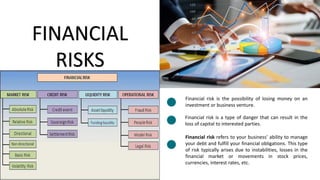
FINANCIAL
RISKS
Financial risk is the possibility of losing money on an
investment or business venture.
Financial risk is a type of danger that can result in the
loss of capital to interested parties.
Financial risk refers to your business' ability to manage
your debt and fulfill your financial obligations. This type
of risk typically arises due to instabilities, losses in the
financial market or movements in stock prices,
currencies, interest rates, etc.
Lorem ipsum dolor sit amet,
consectetuer adipiscing elit.
Maecenas porttitor congue massa.
Lorem ipsum
CREDIT
RISK
TYPES
OF
FINANCIAL RISKS
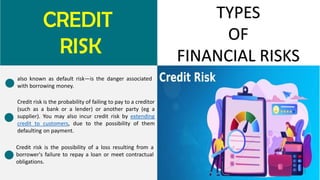
also known as default risk—is the danger associated
with borrowing money.
Credit risk is the probability of failing to pay to a creditor
(such as a bank or a lender) or another party (eg a
supplier). You may also incur credit risk by extending
credit to customers, due to the possibility of them
defaulting on payment.
Credit risk is the possibility of a loss resulting from a
borrower's failure to repay a loan or meet contractual
obligations.
MARKET
RISK
TYPES
OF
FINANCIAL RISKS
Market risk relates to the probability of incurring a loss
due to things like market volatility, hikes in interest
rates or raw material costs, fluctuation in foreign
currency values, etc.
Market risk is the risk that arises from movements in
stock prices, interest rates, exchange rates, and
commodity prices.
Market risk is distinguished from credit risk, which is the
risk of loss from the failure of a counterparty to make a
promised payment, and also from a number of other
risks that organizations face, such as breakdowns in
their operational procedures.
LIQUIDITY
RISK
TYPES
OF
FINANCIAL RISKS
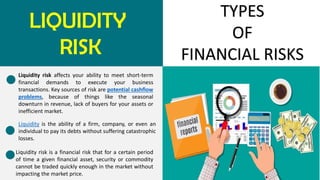
Liquidity risk affects your ability to meet short-term
financial demands to execute your business
transactions. Key sources of risk are potential cashflow
problems, because of things like the seasonal
downturn in revenue, lack of buyers for your assets or
inefficient market.
Liquidity is the ability of a firm, company, or even an
individual to pay its debts without suffering catastrophic
losses.
Liquidity risk is a financial risk that for a certain period
of time a given financial asset, security or commodity
cannot be traded quickly enough in the market without
impacting the market price.
VALUATION
RISK
TYPES
OF
FINANCIAL RISKS
Valuation risk is the risk that an entity suffers a loss
when trading an asset or a liability due to a difference
between the accounting value and the price effectively
obtained in the trade
Valuation risk is the risk of loss arising from the
difference between the price of an instrument reported
on a bank’s balance sheet – as determined by
accounting rules – and the actual price a bank would
obtain if it sold that instrument (if it is an asset) or the
price a bank would pay to buy it or transfer it to a third
party (in the case of a liability).
Thank
You!

Business risk.pdf

  • 1.
    POWERPOINT PRESENTATION MBA- Finance 069 Fi n a n c e 0 6 9 Business Risk and Financial Risk
  • 2.
  • 3.
    HOW MUCH RISKARE YOU WILLING TO TAKE? Is the effect of uncertainty on objectives.
  • 5.
    BUSINESS RISKS refers toa threat to the company’s ability to achieve its financial goals. The risk associated with a company’s operating performance implies uncertainty in profits or danger of loss and the events that could pose a risk due to some unforeseen events in future, which causes business to fail. Lorem ipsum dolor sit amet, consectetuer adipiscing elit. Maecenas porttitor congue massa. Lorem ipsum
  • 6.
    TYPES OF BUSINESS RISKS Business riskis a broad category. It applies to any event or circumstance that has the potential to prevent you from achieving your business goals or objectives. Business risk can be internal (such as your strategy) or external (such as the global economy).
  • 7.
    STRATEGIC RISK TYPES OF BUSINESS RISKS Refers tothe internal and external events that may make it difficult, or even impossible, for an organization to achieve their objectives and strategic goals. Relate to strategic decisions or objectives set by the board Are long-term, affecting an organization's future the potential impact of strategic decisions, or of a defective or inappropriate strategy
  • 8.
    OPERATIONAL RISK TYPES OF BUSINESS RISKS Refers tothe risk of direct and indirect loss resulting from inadequate or failed internal processes, people and systems or from external events. It includes Legal Risk but excludes reputational and strategic risks. the risk of loss resulting from inadequate or failed internal processes, people and systems, or from external events.
  • 9.
    LEGAL RISK TYPES OF BUSINESS RISKS refers todamage or any loss incurred to a business due to negligence in compliance with laws related to the business. Legal risk is the likelihood of financial or reputational loss resulting from a lack of knowledge (or misunderstanding) of how the law applies to your business, or operating with a reckless indifference to the law and how it applies. Legal risk management starts with identifying possible threats, which could cause loss or disruption to your business, enabling you to implement processes to minimize or negate them risk arising from failure to comply with statutory or regulatory obligations.
  • 10.
    REPUTATIONAL RISK TYPES OF BUSINESS RISKS The lossto the good name or standing of an organization arising due to any malpractices or any criminal event Reputational risk arises due to the involvement of employees or other peripheral parties. Reputational risk is the damage that can occur to a business when it fails to meet the expectations of its stakeholders and is thus negatively perceived. It can affect any business, regardless of size or industry. Chance of losses due to declining reputation as a result of practices or incidents that are perceived as dishonest , disrespectful or incompetent.
  • 11.
    COMPLIANCE RISK TYPES OF BUSINESS RISKS Compliance riskis an organization's potential exposure to legal penalties, financial forfeiture and material loss, resulting from its failure to act in accordance with industry laws and regulations, internal policies or prescribed best practices. Also known as Integrity Risk is the potential for losses and legal penalties due to failure to comply with laws or regulations.
  • 12.
    FINANCIAL RISKS Financial risk isthe possibility of losing money on an investment or business venture. Financial risk is a type of danger that can result in the loss of capital to interested parties. Financial risk refers to your business' ability to manage your debt and fulfill your financial obligations. This type of risk typically arises due to instabilities, losses in the financial market or movements in stock prices, currencies, interest rates, etc. Lorem ipsum dolor sit amet, consectetuer adipiscing elit. Maecenas porttitor congue massa. Lorem ipsum
  • 13.
    CREDIT RISK TYPES OF FINANCIAL RISKS also knownas default risk—is the danger associated with borrowing money. Credit risk is the probability of failing to pay to a creditor (such as a bank or a lender) or another party (eg a supplier). You may also incur credit risk by extending credit to customers, due to the possibility of them defaulting on payment. Credit risk is the possibility of a loss resulting from a borrower's failure to repay a loan or meet contractual obligations.
  • 14.
    MARKET RISK TYPES OF FINANCIAL RISKS Market riskrelates to the probability of incurring a loss due to things like market volatility, hikes in interest rates or raw material costs, fluctuation in foreign currency values, etc. Market risk is the risk that arises from movements in stock prices, interest rates, exchange rates, and commodity prices. Market risk is distinguished from credit risk, which is the risk of loss from the failure of a counterparty to make a promised payment, and also from a number of other risks that organizations face, such as breakdowns in their operational procedures.
  • 15.
    LIQUIDITY RISK TYPES OF FINANCIAL RISKS Liquidity riskaffects your ability to meet short-term financial demands to execute your business transactions. Key sources of risk are potential cashflow problems, because of things like the seasonal downturn in revenue, lack of buyers for your assets or inefficient market. Liquidity is the ability of a firm, company, or even an individual to pay its debts without suffering catastrophic losses. Liquidity risk is a financial risk that for a certain period of time a given financial asset, security or commodity cannot be traded quickly enough in the market without impacting the market price.
  • 16.
    VALUATION RISK TYPES OF FINANCIAL RISKS Valuation riskis the risk that an entity suffers a loss when trading an asset or a liability due to a difference between the accounting value and the price effectively obtained in the trade Valuation risk is the risk of loss arising from the difference between the price of an instrument reported on a bank’s balance sheet – as determined by accounting rules – and the actual price a bank would obtain if it sold that instrument (if it is an asset) or the price a bank would pay to buy it or transfer it to a third party (in the case of a liability).
  • 18.