SCHOOL OF GRADUATE AND PRPFESSIONAL STUDIES- MBA
PROGRAM
FIN 069: FINANCIAL MANAGEMENT
PART I
PART II
PART III
I Introduction
Joness Angela Basa
Diana Rose V. Meneses
Rina Eloisa Laborde
Presenters
What is Cash Flow?
Importance of Cash
Flow
Managing Cash Flow
Managing Cash Flow
How to Calculate Cash
Flow
1 2 3 4 5
PART I
Cash flow is the money that streams in and out of the business—and
it’s a key indicator of the company’s overall financial health. The term
cash flow is used to describe the amount of cash that is generated or
spent within a certain time frame.
1 2 3 4 5
What is Cash Flow?
Importance of Cash
Flow
Managing Cash Flow
Managing Cash Flow
How to Calculate Cash
Flow
Presenters
Cash flow is the lifeblood of a business.
PART I
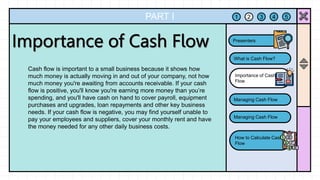
Cash flow is important to a small business because it shows how
much money is actually moving in and out of your company, not how
much money you're awaiting from accounts receivable. If your cash
flow is positive, you'll know you're earning more money than you’re
spending, and you'll have cash on hand to cover payroll, equipment
purchases and upgrades, loan repayments and other key business
needs. If your cash flow is negative, you may find yourself unable to
pay your employees and suppliers, cover your monthly rent and have
the money needed for any other daily business costs.
1 2 3 4 5
What is Cash Flow?
Importance of Cash
Flow
Managing Cash Flow
Managing Cash Flow
How to Calculate Cash
Flow
Presenters
PART I
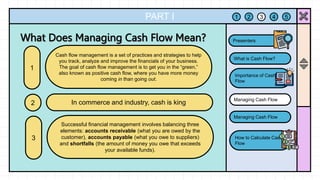
Cash flow management is a set of practices and strategies to help
you track, analyze and improve the financials of your business.
The goal of cash flow management is to get you in the “green,”
also known as positive cash flow, where you have more money
coming in than going out.
1
In commerce and industry, cash is king.
2
1 2 3 4 5
What is Cash Flow?
Importance of Cash
Flow
Managing Cash Flow
Managing Cash Flow
How to Calculate Cash
Flow
Presenters
Successful financial management involves balancing three
elements: accounts receivable (what you are owed by the
customer), accounts payable (what you owe to suppliers)
and shortfalls (the amount of money you owe that exceeds
your available funds).
3
PART I
Cash flow management is vital to your business’s
success. If you can accurately project cash flow, you will
steer your company in the right direction
1
Every business has high and low seasons; understanding
upcoming expenses for employee overtime, replacement
equipment and other needs goes a long way to ensure your
business is well positioned to handle any bump in the road.
2
1 2 3 4 5
What is Cash Flow?
Importance of Cash
Flow
Managing Cash Flow
Managing Cash Flow
How to Calculate Cash
Flow
Presenters
PART I
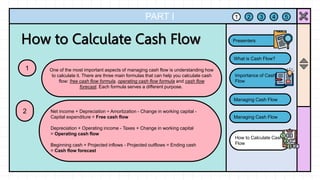
One of the most important aspects of managing cash flow is understanding how
to calculate it. There are three main formulas that can help you calculate cash
flow: free cash flow formula, operating cash flow formula and cash flow
forecast. Each formula serves a different purpose.
1
Net income + Depreciation ÷ Amortization - Change in working capital -
Capital expenditure = Free cash flow
Depreciation + Operating income - Taxes + Change in working capital
= Operating cash flow
Beginning cash + Projected inflows - Projected outflows = Ending cash
= Cash flow forecast
2
1 2 3 4 5
What is Cash Flow?
Importance of Cash
Flow
Managing Cash Flow
Managing Cash Flow
How to Calculate Cash
Flow
Presenters
PART I
Determining when you'll receive – and spend – money is part
of the budgeting process. To successfully project cash flow,
assess your prior year's numbers as a basis of cash flow for
the following year. Then, adjust for anticipated changes, such
as new pricing, and more personnel and funding sources.
Projecting CF
CF Statement
Positive CF
CF Deficit
6
PART II 1 2 3 4 5
Preparing a CF
Statement
Positive CF
CF Deficit
Cash Flow Analysis
.
Types of Cash flow
5 Steps to CF Analysis
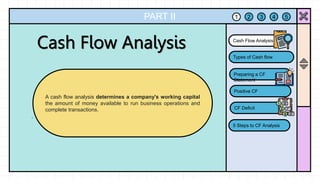
A cash flow analysis determines a company's working capital
the amount of money available to run business operations and
complete transactions.
PART II 1 2 3 4 5
Preparing a CF
Statement
Positive CF
CF Deficit
Cash Flow Analysis
.
Types of Cash flow
5 Steps to CF Analysis
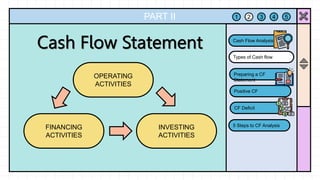
OPERATING
ACTIVITIES
FINANCING
ACTIVITIES
INVESTING
ACTIVITIES
PART II 1 2 3 4 5
Preparing a CF
Statement
Positive CF
CF Deficit
Cash Flow Analysis
.
Types of Cash flow
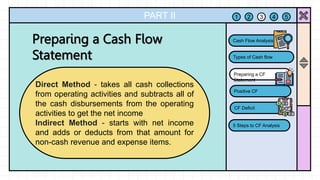
Direct Method - takes all cash collections
from operating activities and subtracts all of
the cash disbursements from the operating
activities to get the net income
Indirect Method - starts with net income
and adds or deducts from that amount for
non-cash revenue and expense items.
5 Steps to CF Analysis
PART II 1 2 3 4 5
Preparing a CF
Statement
Positive CF
CF Deficit
Cash Flow Analysis
.
Types of Cash flow
5 Steps to CF Analysis
How do you get positive cash flow? Sales are obviously the best
way for a business to gain cash flow. If you're not generating
sales, you're not really a business. Of course, saving money in
operational expenses helps, too. It's important to have detailed
budgets and to curb unnecessary spending.
PART II 1 2 3 4 5
Preparing a CF
Statement
Positive CF
CF Deficit
Cash Flow Analysis
.
Types of Cash flow
5 Steps to CF Analysis
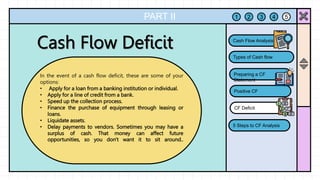
In the event of a cash flow deficit, these are some of your
options:
• Apply for a loan from a banking institution or individual.
• Apply for a line of credit from a bank.
• Speed up the collection process.
• Finance the purchase of equipment through leasing or
loans.
• Liquidate assets.
• Delay payments to vendors. Sometimes you may have a
surplus of cash. That money can affect future
opportunities, so you don't want it to sit around..
PART II 6
Preparing a CF
Statement
Positive CF
CF Deficit
Cash Flow Analysis
.
Types of Cash flow
5 Steps to CF Analysis
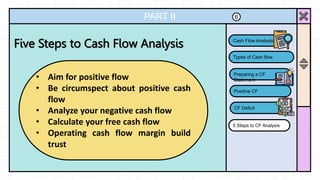
• Aim for positive flow
• Be circumspect about positive cash
flow
• Analyze your negative cash flow
• Calculate your free cash flow
• Operating cash flow margin build
trust
PART III
Main Causes of CF
Problems
How to Manage CF
Problems
CF Management
Advantages
Limitations of CF
Management
Conclusion
1 2 3 4 5
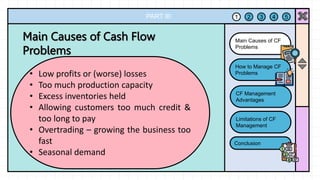
• Low profits or (worse) losses
• Too much production capacity
• Excess inventories held
• Allowing customers too much credit &
too long to pay
• Overtrading – growing the business too
fast
• Seasonal demand
PART III
Main Causes of CF
Problems
How to Manage CF
Problems
CF Management
Advantages
Limitations of CF
Management
Conclusion
1 2 3 4 5
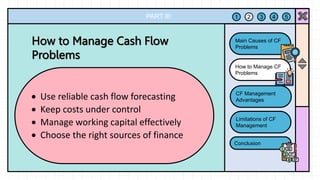
 Use reliable cash flow forecasting
 Keep costs under control
 Manage working capital effectively
 Choose the right sources of finance
PART III
Main Causes of CF
Problems
How to Manage CF
Problems
CF Management
Advantages
Limitations of CF
Management
Conclusion
1 2 3 4 5
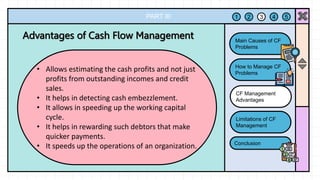
• Allows estimating the cash profits and not just
profits from outstanding incomes and credit
sales.
• It helps in detecting cash embezzlement.
• It allows in speeding up the working capital
cycle.
• It helps in rewarding such debtors that make
quicker payments.
• It speeds up the operations of an organization.
PART III
Main Causes of CF
Problems
How to Manage CF
Problems
CF Management
Advantages
Limitations of CF
Management
Conclusion
1 2 3 4 5
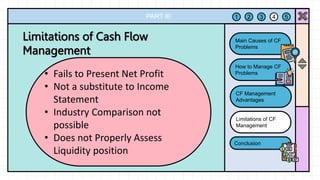
• Fails to Present Net Profit
• Not a substitute to Income
Statement
• Industry Comparison not
possible
• Does not Properly Assess
Liquidity position
PART III
Main Causes of CF
Problems
How to Manage CF
Problems
CF Management
Advantages
Limitations of CF
Management
Conclusion
1 2 3 4 5
Managing Cash Flow.pptx

Managing Cash Flow.pptx

  • 1.
    SCHOOL OF GRADUATEAND PRPFESSIONAL STUDIES- MBA PROGRAM FIN 069: FINANCIAL MANAGEMENT
  • 2.
  • 3.
    I Introduction Joness AngelaBasa Diana Rose V. Meneses Rina Eloisa Laborde Presenters What is Cash Flow? Importance of Cash Flow Managing Cash Flow Managing Cash Flow How to Calculate Cash Flow 1 2 3 4 5
  • 4.
    PART I Cash flowis the money that streams in and out of the business—and it’s a key indicator of the company’s overall financial health. The term cash flow is used to describe the amount of cash that is generated or spent within a certain time frame. 1 2 3 4 5 What is Cash Flow? Importance of Cash Flow Managing Cash Flow Managing Cash Flow How to Calculate Cash Flow Presenters Cash flow is the lifeblood of a business.
  • 5.
    PART I Cash flowis important to a small business because it shows how much money is actually moving in and out of your company, not how much money you're awaiting from accounts receivable. If your cash flow is positive, you'll know you're earning more money than you’re spending, and you'll have cash on hand to cover payroll, equipment purchases and upgrades, loan repayments and other key business needs. If your cash flow is negative, you may find yourself unable to pay your employees and suppliers, cover your monthly rent and have the money needed for any other daily business costs. 1 2 3 4 5 What is Cash Flow? Importance of Cash Flow Managing Cash Flow Managing Cash Flow How to Calculate Cash Flow Presenters
  • 6.
    PART I Cash flowmanagement is a set of practices and strategies to help you track, analyze and improve the financials of your business. The goal of cash flow management is to get you in the “green,” also known as positive cash flow, where you have more money coming in than going out. 1 In commerce and industry, cash is king. 2 1 2 3 4 5 What is Cash Flow? Importance of Cash Flow Managing Cash Flow Managing Cash Flow How to Calculate Cash Flow Presenters Successful financial management involves balancing three elements: accounts receivable (what you are owed by the customer), accounts payable (what you owe to suppliers) and shortfalls (the amount of money you owe that exceeds your available funds). 3
  • 7.
    PART I Cash flowmanagement is vital to your business’s success. If you can accurately project cash flow, you will steer your company in the right direction 1 Every business has high and low seasons; understanding upcoming expenses for employee overtime, replacement equipment and other needs goes a long way to ensure your business is well positioned to handle any bump in the road. 2 1 2 3 4 5 What is Cash Flow? Importance of Cash Flow Managing Cash Flow Managing Cash Flow How to Calculate Cash Flow Presenters
  • 8.
    PART I One ofthe most important aspects of managing cash flow is understanding how to calculate it. There are three main formulas that can help you calculate cash flow: free cash flow formula, operating cash flow formula and cash flow forecast. Each formula serves a different purpose. 1 Net income + Depreciation ÷ Amortization - Change in working capital - Capital expenditure = Free cash flow Depreciation + Operating income - Taxes + Change in working capital = Operating cash flow Beginning cash + Projected inflows - Projected outflows = Ending cash = Cash flow forecast 2 1 2 3 4 5 What is Cash Flow? Importance of Cash Flow Managing Cash Flow Managing Cash Flow How to Calculate Cash Flow Presenters
  • 9.
    PART I Determining whenyou'll receive – and spend – money is part of the budgeting process. To successfully project cash flow, assess your prior year's numbers as a basis of cash flow for the following year. Then, adjust for anticipated changes, such as new pricing, and more personnel and funding sources. Projecting CF CF Statement Positive CF CF Deficit 6
  • 10.
    PART II 12 3 4 5 Preparing a CF Statement Positive CF CF Deficit Cash Flow Analysis . Types of Cash flow 5 Steps to CF Analysis A cash flow analysis determines a company's working capital the amount of money available to run business operations and complete transactions.
  • 11.
    PART II 12 3 4 5 Preparing a CF Statement Positive CF CF Deficit Cash Flow Analysis . Types of Cash flow 5 Steps to CF Analysis OPERATING ACTIVITIES FINANCING ACTIVITIES INVESTING ACTIVITIES
  • 12.
    PART II 12 3 4 5 Preparing a CF Statement Positive CF CF Deficit Cash Flow Analysis . Types of Cash flow Direct Method - takes all cash collections from operating activities and subtracts all of the cash disbursements from the operating activities to get the net income Indirect Method - starts with net income and adds or deducts from that amount for non-cash revenue and expense items. 5 Steps to CF Analysis
  • 13.
    PART II 12 3 4 5 Preparing a CF Statement Positive CF CF Deficit Cash Flow Analysis . Types of Cash flow 5 Steps to CF Analysis How do you get positive cash flow? Sales are obviously the best way for a business to gain cash flow. If you're not generating sales, you're not really a business. Of course, saving money in operational expenses helps, too. It's important to have detailed budgets and to curb unnecessary spending.
  • 14.
    PART II 12 3 4 5 Preparing a CF Statement Positive CF CF Deficit Cash Flow Analysis . Types of Cash flow 5 Steps to CF Analysis In the event of a cash flow deficit, these are some of your options: • Apply for a loan from a banking institution or individual. • Apply for a line of credit from a bank. • Speed up the collection process. • Finance the purchase of equipment through leasing or loans. • Liquidate assets. • Delay payments to vendors. Sometimes you may have a surplus of cash. That money can affect future opportunities, so you don't want it to sit around..
  • 15.
    PART II 6 Preparinga CF Statement Positive CF CF Deficit Cash Flow Analysis . Types of Cash flow 5 Steps to CF Analysis • Aim for positive flow • Be circumspect about positive cash flow • Analyze your negative cash flow • Calculate your free cash flow • Operating cash flow margin build trust
  • 16.
    PART III Main Causesof CF Problems How to Manage CF Problems CF Management Advantages Limitations of CF Management Conclusion 1 2 3 4 5 • Low profits or (worse) losses • Too much production capacity • Excess inventories held • Allowing customers too much credit & too long to pay • Overtrading – growing the business too fast • Seasonal demand
  • 17.
    PART III Main Causesof CF Problems How to Manage CF Problems CF Management Advantages Limitations of CF Management Conclusion 1 2 3 4 5  Use reliable cash flow forecasting  Keep costs under control  Manage working capital effectively  Choose the right sources of finance
  • 18.
    PART III Main Causesof CF Problems How to Manage CF Problems CF Management Advantages Limitations of CF Management Conclusion 1 2 3 4 5 • Allows estimating the cash profits and not just profits from outstanding incomes and credit sales. • It helps in detecting cash embezzlement. • It allows in speeding up the working capital cycle. • It helps in rewarding such debtors that make quicker payments. • It speeds up the operations of an organization.
  • 19.
    PART III Main Causesof CF Problems How to Manage CF Problems CF Management Advantages Limitations of CF Management Conclusion 1 2 3 4 5 • Fails to Present Net Profit • Not a substitute to Income Statement • Industry Comparison not possible • Does not Properly Assess Liquidity position
  • 20.
    PART III Main Causesof CF Problems How to Manage CF Problems CF Management Advantages Limitations of CF Management Conclusion 1 2 3 4 5