Relevant Cost to Decision
Making
Prepared by:
Jairus Paul A. Querido
Relene Shema D. Salazar
Relevant Cost Concept
 A relevant cost is a cost that only relates to a specific management
decision, and which will change in the future as a result of that
decision.
 It is extremely useful for eliminating irrelevant information from a
particular decision-making process. Thereby, management is
prevented from focusing on information that might otherwise
incorrectly affect its decision.
 It is only applicable to management accounting activities; it is is not
used in financial accounting, since no spending decisions are involved
in the
Decision-Making
it is the process of choosing a course of action
from at least two alternatives
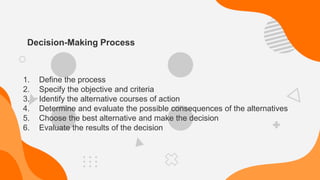
Decision-Making Process
1. Define the process
2. Specify the objective and criteria
3. Identify the alternative courses of action
4. Determine and evaluate the possible consequences of the alternatives
5. Choose the best alternative and make the decision
6. Evaluate the results of the decision
In short term decision making the relevant cost could
incur in following ways:
Incremental cost
Incremental cost is the additional cost that should be incurred due
to a management decision.
Opportunity cost
Opportunity cost can be explained as the value of the next best
alternative sacrificed when one course of action is chosen in
preference of others.
Factors to Consider in Decision-Making
Qualitative Factors
those that cannot easily and accurately be expressed in
terms of money or any other numerical unit of measure
Quantitative Factors
those that can easily be expressed in terms of money or
other numerical unit of measure
Relevant Costs
future costs expected to be different between or among alternatives
Differential Costs
increases (increments) or decreases (decrements) in total costs that result
from selecting one alternative instead of another
Avoidable Costs
costs that will be saved or those that will not be incurred if a certain
decision is made
Types of Costs and Terminologies
Sunk Costs
costs that are incurred already and cannot be avoided regardless of what
decision is made
Out-of-Pocket Costs
costs that will require expenditure of cash or incurrence of a liability as a
consequence of a management decision
Opportunity Costs
income sacrificed or foregone when a certain alternative is chosen over another
alternative
Types of Costs and Terminologies
Joint Costs
costs incurred in simultaneously manufacturing two or more (joint)
products that are difficult to identify individually as separate types of
products until the products reach the split-off point
Slit-Off Point
a point in the manufacturing process where some or all of joint products
can be recognized as distinct and separate products
Types of Costs and Terminologies
Further Processing Costs
costs incurred beyond the split-off point as separated joint products are to
be processed further
Bottleneck Resources
any resource or operation where the capacity is less than the demand
placed upon it
Types of Costs and Terminologies
1. Accept or reject a special order
2. Sell or process further a product line
3. Make or buy a part or a product line
4. Continue or shutdown a business segment
5. Choosing the best product combination
6. Selecting a change in profit factors
Short-Term Decision Making Alternatives
• Highest
Revenues
• Lowest Costs
Best Profit
Decision
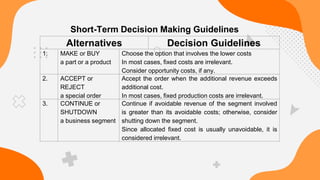
Short-Term Decision Making Guidelines
Alternatives Decision Guidelines
1. MAKE or BUY
a part or a product
Choose the option that involves the lower costs
In most cases, fixed costs are irrelevant.
Consider opportunity costs, if any.
2. ACCEPT or
REJECT
a special order
Accept the order when the additional revenue exceeds
additional cost.
In most cases, fixed production costs are irrelevant.
3. CONTINUE or
SHUTDOWN
a business segment
Continue if avoidable revenue of the segment involved
is greater than its avoidable costs; otherwise, consider
shutting down the segment.
Since allocated fixed cost is usually unavoidable, it is
considered irrelevant.
Short-Term Decision Making Guidelines
Alternatives Decision Guidelines
4. SELL or PROCESS
a product
Process further if additional revenue from processing
further is greater than further processing costs.
Joint costs are considered sunk costs and irrelevant.
5. PRODUCT
COMBINATION
Optimization of
Scarce Resource
Identify and measure the constraint on limited
resources. Rank the products according to the highest
contribution margin per unit of limited resources.
6. CHANGES IN
PROFIT FACTORS
Cost-Volume-Profit
Relationships
Identify the factor to be changed and the amount of
contemplated change.
Change the profit factor if it will cause an improvement
on the company’s overall profit position.
Thank you!

Relevant Cost to Decision Making.pptx

  • 1.
    Relevant Cost toDecision Making Prepared by: Jairus Paul A. Querido Relene Shema D. Salazar
  • 2.
    Relevant Cost Concept A relevant cost is a cost that only relates to a specific management decision, and which will change in the future as a result of that decision.  It is extremely useful for eliminating irrelevant information from a particular decision-making process. Thereby, management is prevented from focusing on information that might otherwise incorrectly affect its decision.  It is only applicable to management accounting activities; it is is not used in financial accounting, since no spending decisions are involved in the
  • 3.
    Decision-Making it is theprocess of choosing a course of action from at least two alternatives
  • 4.
    Decision-Making Process 1. Definethe process 2. Specify the objective and criteria 3. Identify the alternative courses of action 4. Determine and evaluate the possible consequences of the alternatives 5. Choose the best alternative and make the decision 6. Evaluate the results of the decision
  • 5.
    In short termdecision making the relevant cost could incur in following ways: Incremental cost Incremental cost is the additional cost that should be incurred due to a management decision. Opportunity cost Opportunity cost can be explained as the value of the next best alternative sacrificed when one course of action is chosen in preference of others.
  • 6.
    Factors to Considerin Decision-Making Qualitative Factors those that cannot easily and accurately be expressed in terms of money or any other numerical unit of measure Quantitative Factors those that can easily be expressed in terms of money or other numerical unit of measure
  • 7.
    Relevant Costs future costsexpected to be different between or among alternatives Differential Costs increases (increments) or decreases (decrements) in total costs that result from selecting one alternative instead of another Avoidable Costs costs that will be saved or those that will not be incurred if a certain decision is made Types of Costs and Terminologies
  • 8.
    Sunk Costs costs thatare incurred already and cannot be avoided regardless of what decision is made Out-of-Pocket Costs costs that will require expenditure of cash or incurrence of a liability as a consequence of a management decision Opportunity Costs income sacrificed or foregone when a certain alternative is chosen over another alternative Types of Costs and Terminologies
  • 9.
    Joint Costs costs incurredin simultaneously manufacturing two or more (joint) products that are difficult to identify individually as separate types of products until the products reach the split-off point Slit-Off Point a point in the manufacturing process where some or all of joint products can be recognized as distinct and separate products Types of Costs and Terminologies
  • 10.
    Further Processing Costs costsincurred beyond the split-off point as separated joint products are to be processed further Bottleneck Resources any resource or operation where the capacity is less than the demand placed upon it Types of Costs and Terminologies
  • 11.
    1. Accept orreject a special order 2. Sell or process further a product line 3. Make or buy a part or a product line 4. Continue or shutdown a business segment 5. Choosing the best product combination 6. Selecting a change in profit factors Short-Term Decision Making Alternatives • Highest Revenues • Lowest Costs Best Profit Decision
  • 12.
    Short-Term Decision MakingGuidelines Alternatives Decision Guidelines 1. MAKE or BUY a part or a product Choose the option that involves the lower costs In most cases, fixed costs are irrelevant. Consider opportunity costs, if any. 2. ACCEPT or REJECT a special order Accept the order when the additional revenue exceeds additional cost. In most cases, fixed production costs are irrelevant. 3. CONTINUE or SHUTDOWN a business segment Continue if avoidable revenue of the segment involved is greater than its avoidable costs; otherwise, consider shutting down the segment. Since allocated fixed cost is usually unavoidable, it is considered irrelevant.
  • 13.
    Short-Term Decision MakingGuidelines Alternatives Decision Guidelines 4. SELL or PROCESS a product Process further if additional revenue from processing further is greater than further processing costs. Joint costs are considered sunk costs and irrelevant. 5. PRODUCT COMBINATION Optimization of Scarce Resource Identify and measure the constraint on limited resources. Rank the products according to the highest contribution margin per unit of limited resources. 6. CHANGES IN PROFIT FACTORS Cost-Volume-Profit Relationships Identify the factor to be changed and the amount of contemplated change. Change the profit factor if it will cause an improvement on the company’s overall profit position.
  • 14.