Introduction to vaccines
By :
M.jenifer
B.tech biotechnology.
DSIRT
Introduction to vaccines :
The biological preparation which when introduced into the body induces artificial
active immunity and this process is called immunization.
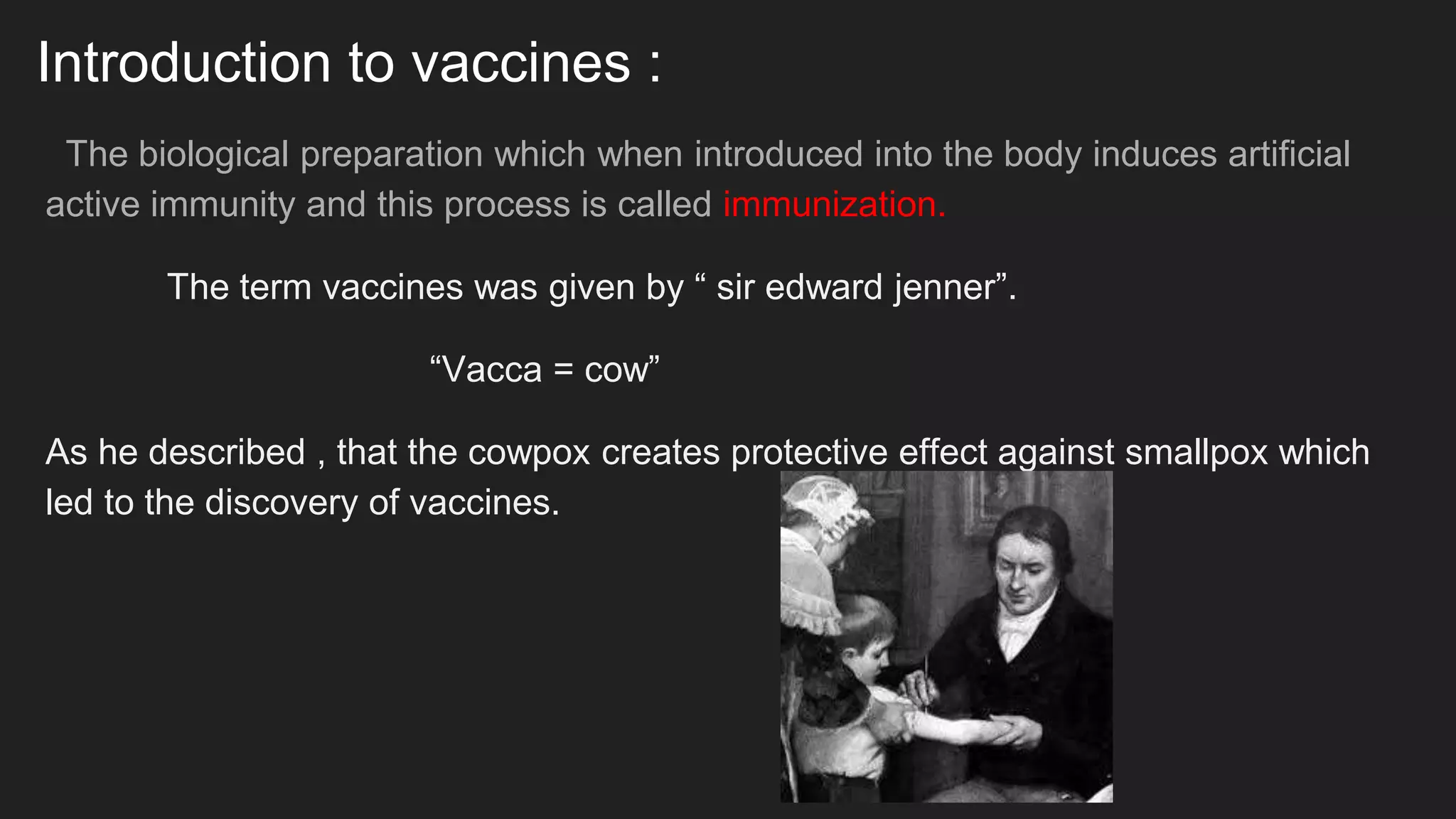
The term vaccines was given by “ sir edward jenner”.
“Vacca = cow”
As he described , that the cowpox creates protective effect against smallpox which
led to the discovery of vaccines.
Principle:
The aim of the vaccine is to provoke our immune response against an
antigen and to generate memory cells, so that when the individual is again
exposed to the same antigen, or much more stronger secondary immune
response will result .
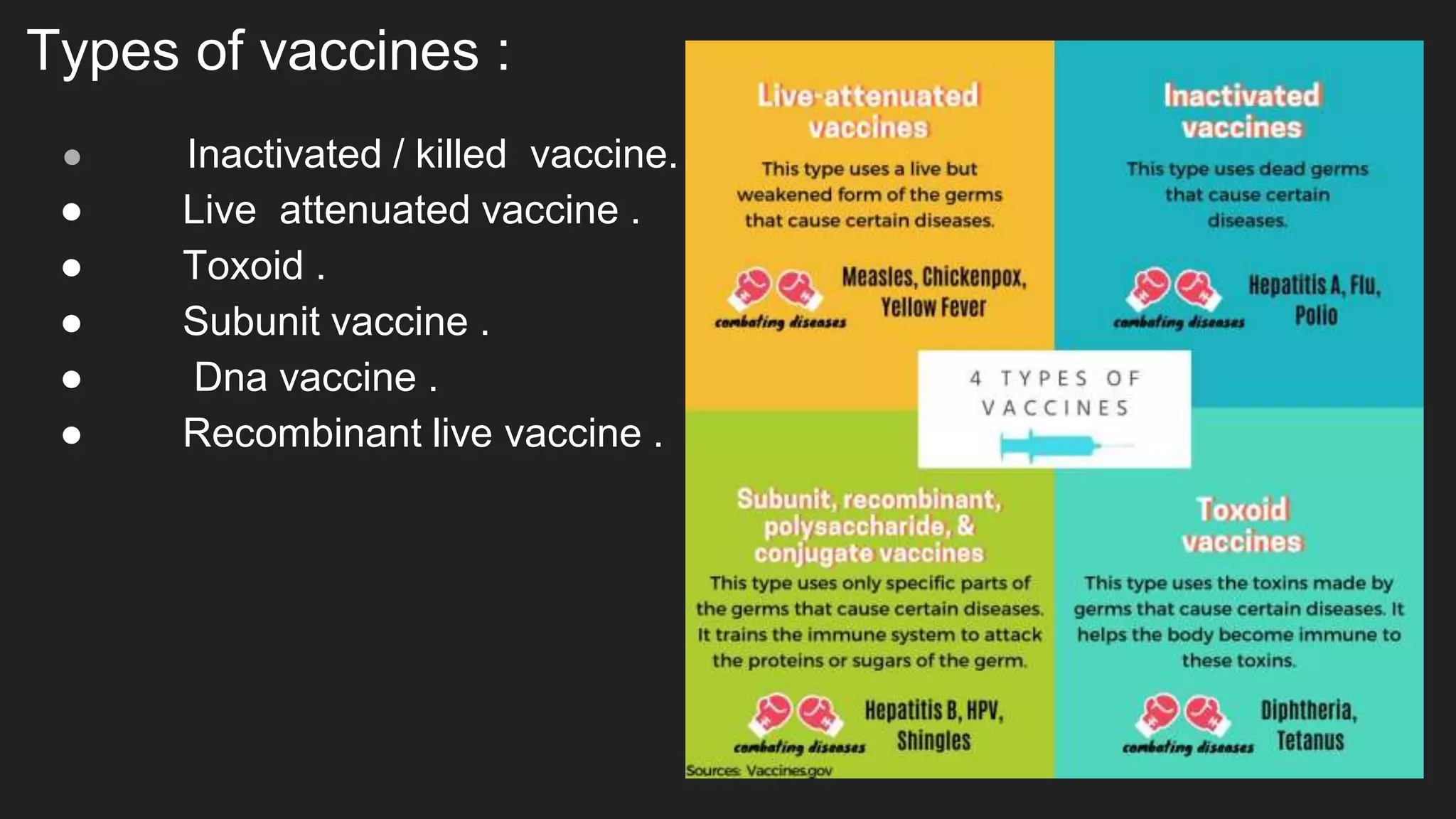
Types of vaccines :
● Inactivated / killed vaccine.
● Live attenuated vaccine .
● Toxoid .
● Subunit vaccine .
● Dna vaccine .
● Recombinant live vaccine .
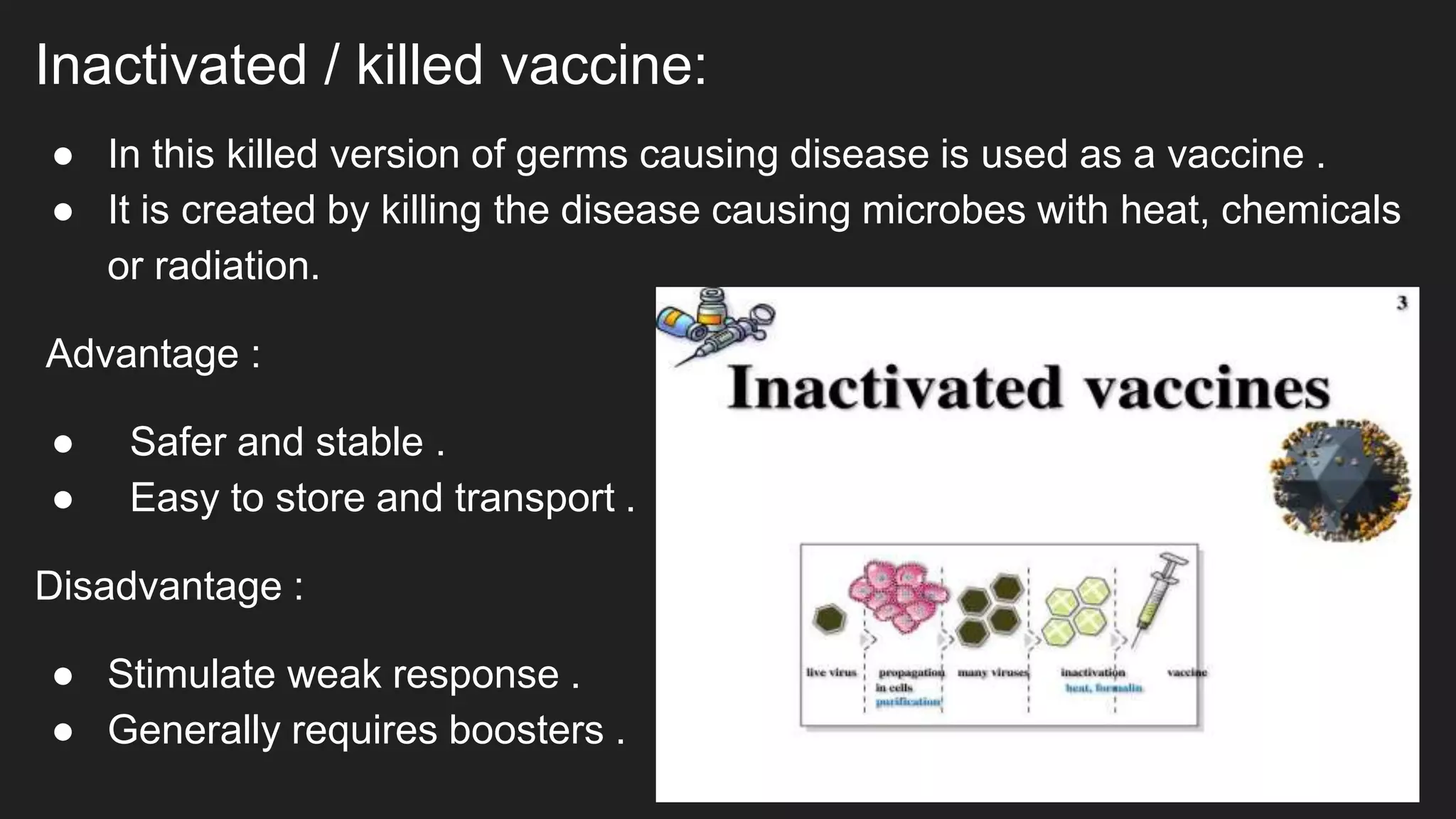
Inactivated / killed vaccine:
● In this killed version of germs causing disease is used as a vaccine .
● It is created by killing the disease causing microbes with heat, chemicals
or radiation.
Advantage :
● Safer and stable .
● Easy to store and transport .
Disadvantage :
● Stimulate weak response .
● Generally requires boosters .
Example for inactivated vaccine:
❖ Polio
❖ Rabies
❖ Pertusis
❖ Typhoid fever
❖ Paratyphoid fever
Live attenuated vaccine :
★ This is made by live organism that have been attenuated( weakened).
★ This attenuation is done by mixing the organism in different
concentration of formaldehyde .
Advantage :
★ Stimulate excellent response .
★ Often confer lifelong immunity .
Disadvantage :
★ If attenuation has not been done properly then is chance of full blown
Dieases within the individual .
cont...
➢ Need to be refrigerated to stay potent .
➢ Difficulty in transportation.
Cold chain :
The equipment and procedure that is use to keep vaccines within
proper conditions ( temp,storage ).
Vaccine examples :
Tuberculosis ,oral polio vaccine , measles , mumps rubella
(MMR), rotavirus , yellow fever, zoster.
Toxoid vaccine ;
Vaccines created using inactivated toxins is called toxoids .
Advantage :
❏ Vaccine cannot cause disease it prevent .
❏ Safe and stable .
Disadvantage : Examples :
❏ Booster dosage requires . Tetanus toxid .
❏ May require adjuvants . Diptheria toxid and Anthrax .
DNA vaccine ;
It is used as the genetic materials of the pathogen directly to be
used as vaccines that fragment of the genome . which coded for
antigen proteins are isolated and injected directly into the host cells
Construction: DNA vaccines are composed of a bacterial plasmids.
Expression plasmids used in DNA-based vaccination normally contain two unites: the antigen expression
unit composed of promoter/enhancer sequences, followed by antigen-encoding and polyadenylation
sequences and the production unit composed of of bacterial sequences necessary for plamid amplification
and selection
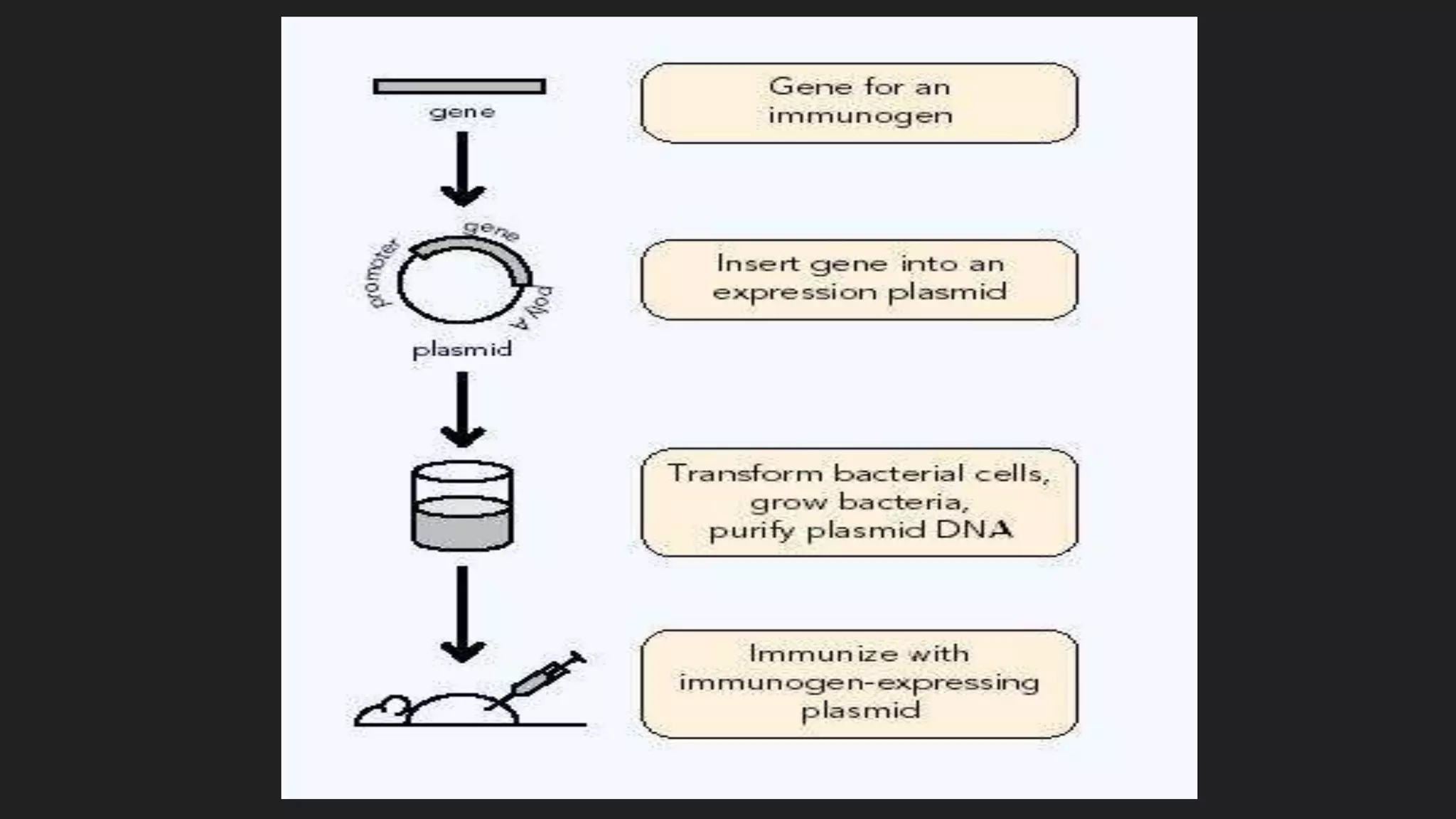
The construction of bacterial plasmids with vaccine inserts is accomplished using recombinant DNA
technology. Once constructed, the vaccine plasmid is transformed into bacteria, where bacterial growth
produces multiple plasmid copies. The plasmid DNA is then purified from the bacteria, by separating the
circular plasmid from the much larger bacterial DNA and other bacterial impurities. This purifies DNA acts
as the vaccine
Advantage :
Rapid and large-scale production are available at costs
considerably lower than traditional vaccines, and they are also
very temperature stable making storage and transport much
easier.
Another important advantage of genetic vaccines is their
therapeutic potential for ongoing chronic viral infections.
DNA vaccination may provide an important tool for stimulating an
immune response in HBV, HCV and HIV patients.
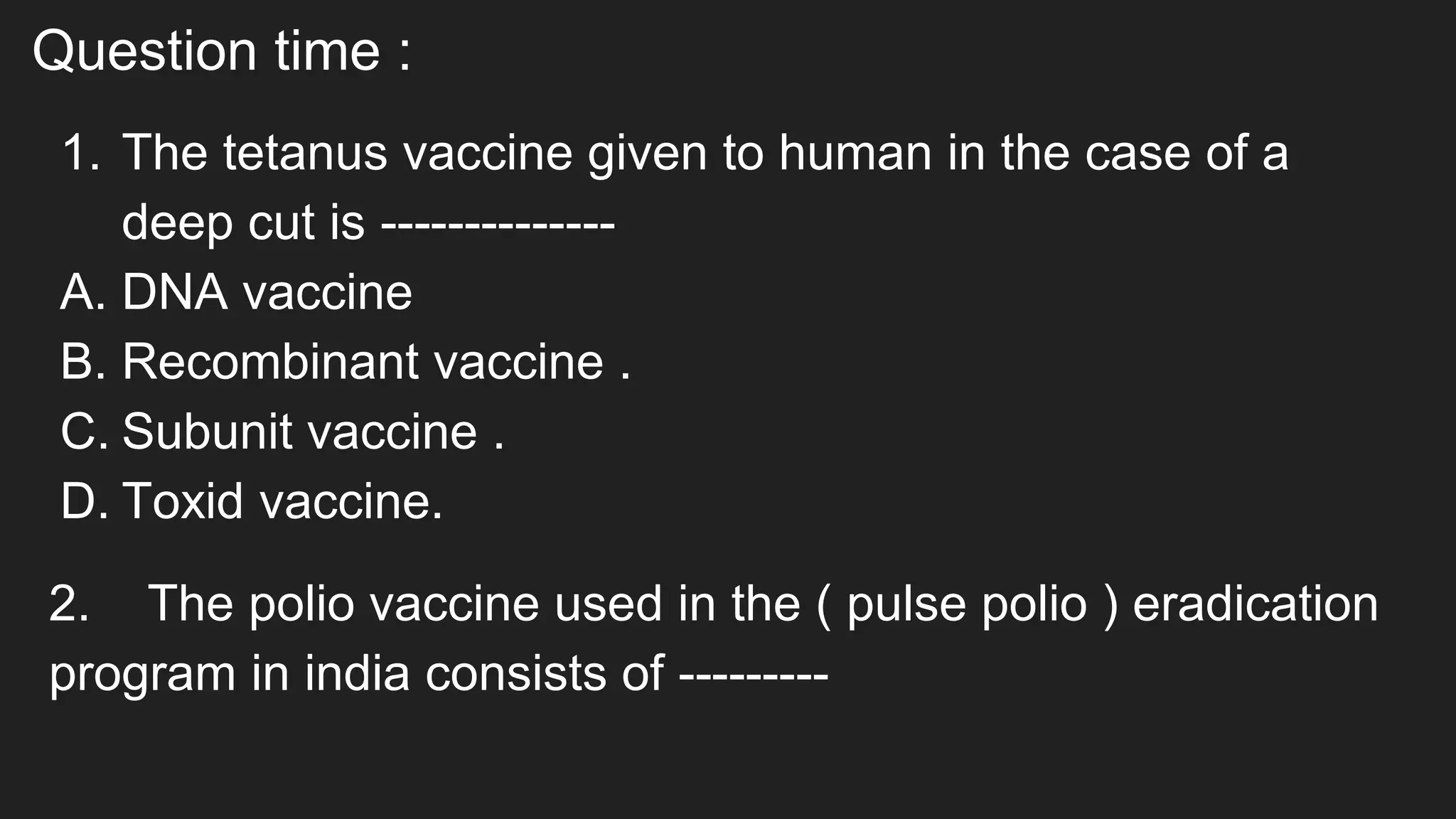
Question time :
1. The tetanus vaccine given to human in the case of a
deep cut is --------------
A. DNA vaccine
B. Recombinant vaccine .
C. Subunit vaccine .
D. Toxid vaccine.
2. The polio vaccine used in the ( pulse polio ) eradication
program in india consists of ---------
cont..
A. Inactivated polio virus .
B. Attenuated polio virus
C. Recombinant polio virus .
D. Polio virus antigen.
Yes the answer is ……………..
Introduction to vaccines

Introduction to vaccines

  • 1.
    Introduction to vaccines By: M.jenifer B.tech biotechnology. DSIRT
  • 2.
    Introduction to vaccines: The biological preparation which when introduced into the body induces artificial active immunity and this process is called immunization. The term vaccines was given by “ sir edward jenner”. “Vacca = cow” As he described , that the cowpox creates protective effect against smallpox which led to the discovery of vaccines.
  • 3.
    Principle: The aim ofthe vaccine is to provoke our immune response against an antigen and to generate memory cells, so that when the individual is again exposed to the same antigen, or much more stronger secondary immune response will result .
  • 4.
    Types of vaccines: ● Inactivated / killed vaccine. ● Live attenuated vaccine . ● Toxoid . ● Subunit vaccine . ● Dna vaccine . ● Recombinant live vaccine .
  • 5.
    Inactivated / killedvaccine: ● In this killed version of germs causing disease is used as a vaccine . ● It is created by killing the disease causing microbes with heat, chemicals or radiation. Advantage : ● Safer and stable . ● Easy to store and transport . Disadvantage : ● Stimulate weak response . ● Generally requires boosters .
  • 6.
    Example for inactivatedvaccine: ❖ Polio ❖ Rabies ❖ Pertusis ❖ Typhoid fever ❖ Paratyphoid fever
  • 7.
    Live attenuated vaccine: ★ This is made by live organism that have been attenuated( weakened). ★ This attenuation is done by mixing the organism in different concentration of formaldehyde . Advantage : ★ Stimulate excellent response . ★ Often confer lifelong immunity . Disadvantage : ★ If attenuation has not been done properly then is chance of full blown Dieases within the individual .
  • 8.
    cont... ➢ Need tobe refrigerated to stay potent . ➢ Difficulty in transportation. Cold chain : The equipment and procedure that is use to keep vaccines within proper conditions ( temp,storage ). Vaccine examples : Tuberculosis ,oral polio vaccine , measles , mumps rubella (MMR), rotavirus , yellow fever, zoster.
  • 9.
    Toxoid vaccine ; Vaccinescreated using inactivated toxins is called toxoids . Advantage : ❏ Vaccine cannot cause disease it prevent . ❏ Safe and stable . Disadvantage : Examples : ❏ Booster dosage requires . Tetanus toxid . ❏ May require adjuvants . Diptheria toxid and Anthrax .
  • 10.
    DNA vaccine ; Itis used as the genetic materials of the pathogen directly to be used as vaccines that fragment of the genome . which coded for antigen proteins are isolated and injected directly into the host cells Construction: DNA vaccines are composed of a bacterial plasmids. Expression plasmids used in DNA-based vaccination normally contain two unites: the antigen expression unit composed of promoter/enhancer sequences, followed by antigen-encoding and polyadenylation sequences and the production unit composed of of bacterial sequences necessary for plamid amplification and selection The construction of bacterial plasmids with vaccine inserts is accomplished using recombinant DNA technology. Once constructed, the vaccine plasmid is transformed into bacteria, where bacterial growth produces multiple plasmid copies. The plasmid DNA is then purified from the bacteria, by separating the circular plasmid from the much larger bacterial DNA and other bacterial impurities. This purifies DNA acts as the vaccine
  • 12.
    Advantage : Rapid andlarge-scale production are available at costs considerably lower than traditional vaccines, and they are also very temperature stable making storage and transport much easier. Another important advantage of genetic vaccines is their therapeutic potential for ongoing chronic viral infections. DNA vaccination may provide an important tool for stimulating an immune response in HBV, HCV and HIV patients.
  • 13.
    Question time : 1.The tetanus vaccine given to human in the case of a deep cut is -------------- A. DNA vaccine B. Recombinant vaccine . C. Subunit vaccine . D. Toxid vaccine. 2. The polio vaccine used in the ( pulse polio ) eradication program in india consists of ---------
  • 14.
    cont.. A. Inactivated poliovirus . B. Attenuated polio virus C. Recombinant polio virus . D. Polio virus antigen. Yes the answer is ……………..