VACCINE
S
TYPES
AND
PRODUCTIO
N BY:
M.Priya Dharshana
Research Scholar (Botany)
V.O.Chidambaram College
Thoothukudi.
INTRODUCTION
 A vaccine is a biological preparation
that improves immunity to a particular
disease
 It contains certain agents that
stimulates body’s immune system to
recognize the foreign agents.
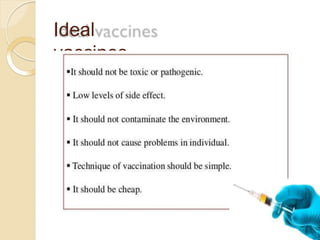
Ideal
vaccines
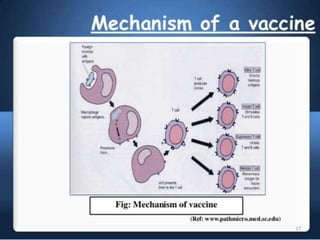
Mechanism of
vaccine When disease causing
microorganism enter the body they
intiate the immune response.
 These antigens(vaccines) trigger the
production of antibodies by the
immune system.
 Antibodies bind to the corresponding
antigens and induce their destruction
by other immune cells.
TYPES OF
VACCINES There are several types of vaccines in
use. They are:
 Live attentuated vaccine
 Killed vaccines
 Recombinant vaccines
 DNA vaccines
 Cock tail vaccines
Live Attentuated
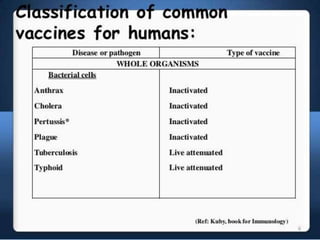
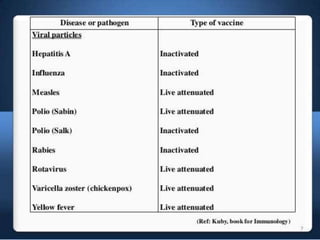
Vaccine These vaccines are composed of
live microorganisms
 They cause limited infection to their
hosts to induce the immune system
but insufficient to cause disease
 Tomake an attentuated vaccine, the
pathogen is grown in foreign host
such as animals, eggs or tissue
culture under condition that makes it
less virulent.
Killed/Inactivated
Vaccines When it is unsafe to use live
microorganisms to prepare vaccines,
they are killed or inactivated.
 The micro organisms are made non
pathogenic by giving treatment with
heat so that they cannot replicate at
all.
Recombinant
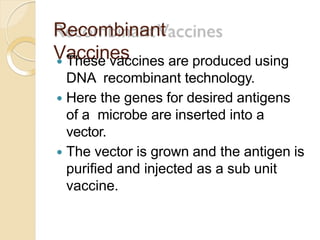
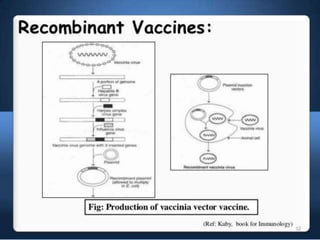
Vaccines These vaccines are produced using
DNA recombinant technology.
 Here the genes for desired antigens
of a microbe are inserted into a
vector.
 The vector is grown and the antigen is
purified and injected as a sub unit
vaccine.
DNA
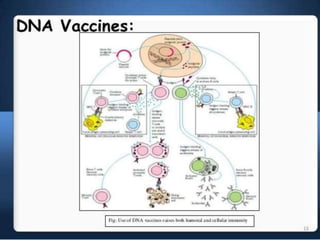
Vaccines DNA vaccines have induced
both humoral and cellular
immunity.
 The DNA is injected into the
animals usually with a gene gun.
 DNA can be introduced into the
tissues by bombarding the skin with
DNA coated gold particles/The DNA
is introduced into the nasal tissue as
nose drops.
Cocktail
vaccines A cock tail vaccine is a mixture
of different vaccines
 They are effective against more than
one disease.
 For example- MMR vaccine is
effective against Mumps, Measles
and Rubella
EDIBLE
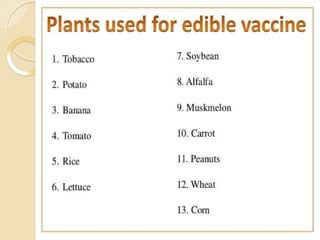
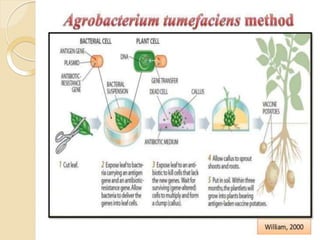
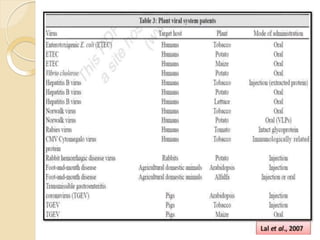
VACCINES Here transgenic plants are
used as vaccine production
system.
 Edible vaccines are currently
developed for number of human and
animal diseases.
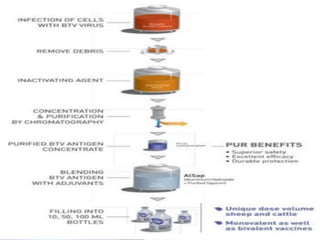
Production of
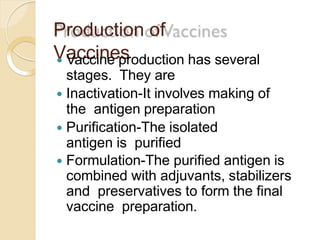
Vaccines Vaccine production has several
stages. They are
 Inactivation-It involves making of
the antigen preparation
 Purification-The isolated
antigen is purified
 Formulation-The purified antigen is
combined with adjuvants, stabilizers
and preservatives to form the final
vaccine preparation.
GROWING
MICROORGANISMS:
 Bacteria- Batch culture /
Continuous culture.
 Virus-Cultured in cell tissue cultures,
Bird embryos and live animal tissue.
Attentuation
: It is the process of elimination or
reducing the virulence of the
pathogen.
 It is achieved by
a) Chemical treatment(with
formaldehyde or acetone.)
b) Heat treatment
c) Growing under adverse conditions
d) Propagation in unnatural host
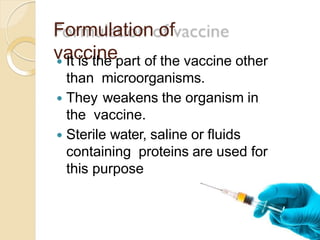
Formulation of
vaccine It is the part of the vaccine other
than microorganisms.
 They weakens the organism in
the vaccine.
 Sterile water, saline or fluids
containing proteins are used for
this purpose
PRESERVATIVES AND
STABILISERS
 Monosodium glutamate and 2-
phenoxy ethanol are used as
stabilisers to help the vaccine remain
unchanged even when it is exposed
to heat, light, acidity and humidity.
Adjuvant
s Adjuvants enhance the
vaccine immunogenecity
 Aluminium gels or salts(Alum) is
used as an enhancer in several
vaccines such as
a) Haemophilus influenza
b) Inactivated polio virus
c) HepatitisA
Risks associated with
Vaccines: Sometimes the vaccine itself
causes illness.
 It may over stimulate the immune
system
 Some individuals may have an
allergic reaction to the vaccines
produced from chicken
eggs/transgenic plants.
Vaccines

Vaccines

  • 1.
    VACCINE S TYPES AND PRODUCTIO N BY: M.Priya Dharshana ResearchScholar (Botany) V.O.Chidambaram College Thoothukudi.
  • 2.
    INTRODUCTION  A vaccineis a biological preparation that improves immunity to a particular disease  It contains certain agents that stimulates body’s immune system to recognize the foreign agents.
  • 3.
  • 4.
    Mechanism of vaccine Whendisease causing microorganism enter the body they intiate the immune response.  These antigens(vaccines) trigger the production of antibodies by the immune system.  Antibodies bind to the corresponding antigens and induce their destruction by other immune cells.
  • 6.
    TYPES OF VACCINES Thereare several types of vaccines in use. They are:  Live attentuated vaccine  Killed vaccines  Recombinant vaccines  DNA vaccines  Cock tail vaccines
  • 7.
    Live Attentuated Vaccine Thesevaccines are composed of live microorganisms  They cause limited infection to their hosts to induce the immune system but insufficient to cause disease  Tomake an attentuated vaccine, the pathogen is grown in foreign host such as animals, eggs or tissue culture under condition that makes it less virulent.
  • 8.
    Killed/Inactivated Vaccines When itis unsafe to use live microorganisms to prepare vaccines, they are killed or inactivated.  The micro organisms are made non pathogenic by giving treatment with heat so that they cannot replicate at all.
  • 11.
    Recombinant Vaccines These vaccinesare produced using DNA recombinant technology.  Here the genes for desired antigens of a microbe are inserted into a vector.  The vector is grown and the antigen is purified and injected as a sub unit vaccine.
  • 13.
    DNA Vaccines DNA vaccineshave induced both humoral and cellular immunity.  The DNA is injected into the animals usually with a gene gun.  DNA can be introduced into the tissues by bombarding the skin with DNA coated gold particles/The DNA is introduced into the nasal tissue as nose drops.
  • 15.
    Cocktail vaccines A cocktail vaccine is a mixture of different vaccines  They are effective against more than one disease.  For example- MMR vaccine is effective against Mumps, Measles and Rubella
  • 16.
    EDIBLE VACCINES Here transgenicplants are used as vaccine production system.  Edible vaccines are currently developed for number of human and animal diseases.
  • 20.
    Production of Vaccines Vaccineproduction has several stages. They are  Inactivation-It involves making of the antigen preparation  Purification-The isolated antigen is purified  Formulation-The purified antigen is combined with adjuvants, stabilizers and preservatives to form the final vaccine preparation.
  • 21.
    GROWING MICROORGANISMS:  Bacteria- Batchculture / Continuous culture.  Virus-Cultured in cell tissue cultures, Bird embryos and live animal tissue.
  • 22.
    Attentuation : It isthe process of elimination or reducing the virulence of the pathogen.  It is achieved by a) Chemical treatment(with formaldehyde or acetone.) b) Heat treatment c) Growing under adverse conditions d) Propagation in unnatural host
  • 23.
    Formulation of vaccine Itis the part of the vaccine other than microorganisms.  They weakens the organism in the vaccine.  Sterile water, saline or fluids containing proteins are used for this purpose
  • 24.
    PRESERVATIVES AND STABILISERS  Monosodiumglutamate and 2- phenoxy ethanol are used as stabilisers to help the vaccine remain unchanged even when it is exposed to heat, light, acidity and humidity.
  • 25.
    Adjuvant s Adjuvants enhancethe vaccine immunogenecity  Aluminium gels or salts(Alum) is used as an enhancer in several vaccines such as a) Haemophilus influenza b) Inactivated polio virus c) HepatitisA
  • 27.
    Risks associated with Vaccines:Sometimes the vaccine itself causes illness.  It may over stimulate the immune system  Some individuals may have an allergic reaction to the vaccines produced from chicken eggs/transgenic plants.