Food Processing and Preserving
Canning
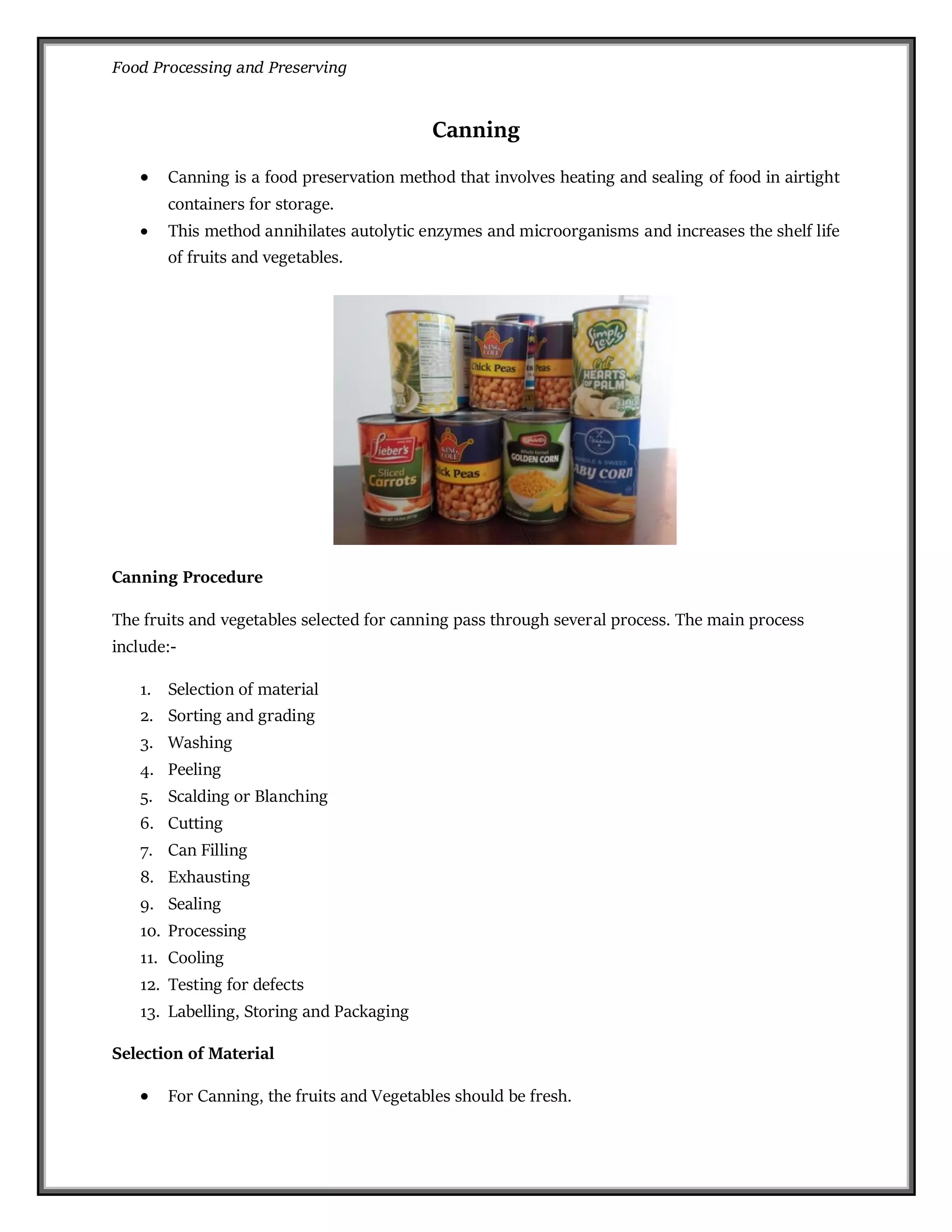
 Canning is a food preservation method that involves heating and sealing of food in airtight
containers for storage.
 This method annihilates autolytic enzymes and microorganisms and increases the shelf life
of fruits and vegetables.
Canning Procedure
The fruits and vegetables selected for canning pass through several process. The main process
include:-
1. Selection of material
2. Sorting and grading
3. Washing
4. Peeling
5. Scalding or Blanching
6. Cutting
7. Can Filling
8. Exhausting
9. Sealing
10. Processing
11. Cooling
12. Testing for defects
13. Labelling, Storing and Packaging
Selection of Material
 For Canning, the fruits and Vegetables should be fresh.
Food Processing and Preserving
 The Fruits should be ripe, firm and evenly matured. It should be free from blemishes,
insect damage and malformation.
 The Vegetables should be tender and free from soil, dirt, etc.
Sorting and Grading
 After preliminary sorting, the fruits and vegetables are graded. This is necessary to obtain
a pack of uniform quality as regards size, colour, etc.
 It is done by hand or with the help of grading machines (Screen graders, Roller graders,
rope graders, Cable graders).
 Soft and berry fruits are generally graded by hand.
 Fruits like berries, plum and cherries are graded whole while peaches, pears, mango, etc.
are generally graded after cutting them into slices.
Washing
 The graded fruits and Vegetables are washed with water.
 The different methods of washing are by soaking in water, by agitating in water or by
water spray.
Peeling
 The washed fruits and vegetables are prepared for canning by peeling.
 The peeling may be done by hand with the help of peeling knives or by machines or by lye
peeling [dipping the material in 1 to 2% of hot lye solution(solution of caustic soda) for 2
minutes to loosen the outer skin].
Scalding or blanching
 The fruits and vegetables are blanched in boiling water or live steam to remove the skin.
 The blanching cleans the products and removes microorganisms.
 It also inactivates the enzymes and improves the texture and flavor of the material.
Cutting
 Sometimes cutting is carried out at the time of the peeling by the same machine.
 Mango or other fruits are usually cut into equal slices with the help of knives.
Can Filling
 The cans are washed with water or subjected to steam to remove any dust before filling.
Food Processing and Preserving
 The cans are filled with hot sugar syrup in case of fruits and with hot brine in case of
vegetables.
 The cans are filled using automatic can filling machines or by hand using rubber gloves.
Exhausting
 The process of removing all the air from the can before sealing is called exhausting.
 Exhausting reduces the risks of corrosion of tin plates, discolouration of the contents,
prevents bulging of cans and oxidation.
 The exhausting is carried out in two ways
i. By heat treatment: The cans are passed through a tank of hot water at about 1700
to 1900
F. The time of exhaust varies from 5 to 25 minutes.
ii. By Vacuum: This method is followed for exhausting the products packed in glass
jars.
Sealing
 After exhausting, the cans are sealed by double seamer.
Processing
 The processing is the process in which cans are heated to inactivate the bacteria contained
in the preserved fruits and vegetables.
 In processing, the time and temperature are the most important things to be considered.
The processing time and temperature will depend upon the condition of the raw material.
 Three types of cookers namely open discontinuous cooker, Continuous non-agitating
cookers and continuous agitating cookers is used for processing of cans.
Cooling
 After processing the cans are cooled rapidly to stop the cooking process.
 Cooling of the cans may be done by passing the cans through cold water tanks or by
spraying the cans with jets of cold water.
Testing for defects
 The cans should be checked for leakage. A simple way to do this is to strike the top of a can
with a short iron rod. A clear ringing sound indicates a perfect seal, while dull and hollow
sound show leakage.
Food Processing and Preserving
Labelling, Storing and Packaging
 The cooled cans are then labelled and stored at low temperature.
Canning of Mango
 India is the home of mangoes. A large number of varieties are found in almost all parts of
the country.
 Among the numerous varieties “Safaida” of Mysore, “Benishan” of east coast and Raspuri,
Neelam and Mulgoa of Tamil Ndu and Karnataka are the most important varieties for
canning.
 Juicy and Fibrous varieties are not suitable for canning.
 Firm ripe mangoes that are just developing colour are picked and allowed to ripe.
 As they ripen, best fruits are selected and are washed in water and peeled with hand.
 The pulps are then cut into 6 to 8 longitudinal slices.
 The slices are placed in 2% common salt solution to prevent enzymatic browning.
 The can are first sterilized in the open cooker and then sterilized in the close cooker at 1 to
2 pounds steam pressure.
 Then the cans are filled with slices along with syrup and sealed with a double seamer.
 It is then processed, cooled, labeled, packed and stored
Canning of Tomatoes
 For canning, the tomatoes selected should be ripe, medium size, regular shape and
uniform red color.
 They should have a plenty of pulp and should be free from blemishes.
 The selected tomatoes are washed in water and scalded in boiling water or steam for 2 to 3
minutes to remove the skin.
Food Processing and Preserving
 The peeled tomatoes are then placed in shallow pans to prevent crushing.
 The peeled and trimmed tomatoes are then filled into cans and 1% common salt is added.
Sometimes a little sugar also is added.
 Tomatoes are canned either without the addition of tomato juice or as a standard pack
with the addition of tomato juice.
 Generally for safe processing of tomatoes, long cooking for 45 to 60 minutes in boiling
water is necessary.
M.Priyadharshana
8/3/2021

Canning

  • 1.
    Food Processing andPreserving Canning  Canning is a food preservation method that involves heating and sealing of food in airtight containers for storage.  This method annihilates autolytic enzymes and microorganisms and increases the shelf life of fruits and vegetables. Canning Procedure The fruits and vegetables selected for canning pass through several process. The main process include:- 1. Selection of material 2. Sorting and grading 3. Washing 4. Peeling 5. Scalding or Blanching 6. Cutting 7. Can Filling 8. Exhausting 9. Sealing 10. Processing 11. Cooling 12. Testing for defects 13. Labelling, Storing and Packaging Selection of Material  For Canning, the fruits and Vegetables should be fresh.
  • 2.
    Food Processing andPreserving  The Fruits should be ripe, firm and evenly matured. It should be free from blemishes, insect damage and malformation.  The Vegetables should be tender and free from soil, dirt, etc. Sorting and Grading  After preliminary sorting, the fruits and vegetables are graded. This is necessary to obtain a pack of uniform quality as regards size, colour, etc.  It is done by hand or with the help of grading machines (Screen graders, Roller graders, rope graders, Cable graders).  Soft and berry fruits are generally graded by hand.  Fruits like berries, plum and cherries are graded whole while peaches, pears, mango, etc. are generally graded after cutting them into slices. Washing  The graded fruits and Vegetables are washed with water.  The different methods of washing are by soaking in water, by agitating in water or by water spray. Peeling  The washed fruits and vegetables are prepared for canning by peeling.  The peeling may be done by hand with the help of peeling knives or by machines or by lye peeling [dipping the material in 1 to 2% of hot lye solution(solution of caustic soda) for 2 minutes to loosen the outer skin]. Scalding or blanching  The fruits and vegetables are blanched in boiling water or live steam to remove the skin.  The blanching cleans the products and removes microorganisms.  It also inactivates the enzymes and improves the texture and flavor of the material. Cutting  Sometimes cutting is carried out at the time of the peeling by the same machine.  Mango or other fruits are usually cut into equal slices with the help of knives. Can Filling  The cans are washed with water or subjected to steam to remove any dust before filling.
  • 3.
    Food Processing andPreserving  The cans are filled with hot sugar syrup in case of fruits and with hot brine in case of vegetables.  The cans are filled using automatic can filling machines or by hand using rubber gloves. Exhausting  The process of removing all the air from the can before sealing is called exhausting.  Exhausting reduces the risks of corrosion of tin plates, discolouration of the contents, prevents bulging of cans and oxidation.  The exhausting is carried out in two ways i. By heat treatment: The cans are passed through a tank of hot water at about 1700 to 1900 F. The time of exhaust varies from 5 to 25 minutes. ii. By Vacuum: This method is followed for exhausting the products packed in glass jars. Sealing  After exhausting, the cans are sealed by double seamer. Processing  The processing is the process in which cans are heated to inactivate the bacteria contained in the preserved fruits and vegetables.  In processing, the time and temperature are the most important things to be considered. The processing time and temperature will depend upon the condition of the raw material.  Three types of cookers namely open discontinuous cooker, Continuous non-agitating cookers and continuous agitating cookers is used for processing of cans. Cooling  After processing the cans are cooled rapidly to stop the cooking process.  Cooling of the cans may be done by passing the cans through cold water tanks or by spraying the cans with jets of cold water. Testing for defects  The cans should be checked for leakage. A simple way to do this is to strike the top of a can with a short iron rod. A clear ringing sound indicates a perfect seal, while dull and hollow sound show leakage.
  • 4.
    Food Processing andPreserving Labelling, Storing and Packaging  The cooled cans are then labelled and stored at low temperature. Canning of Mango  India is the home of mangoes. A large number of varieties are found in almost all parts of the country.  Among the numerous varieties “Safaida” of Mysore, “Benishan” of east coast and Raspuri, Neelam and Mulgoa of Tamil Ndu and Karnataka are the most important varieties for canning.  Juicy and Fibrous varieties are not suitable for canning.  Firm ripe mangoes that are just developing colour are picked and allowed to ripe.  As they ripen, best fruits are selected and are washed in water and peeled with hand.  The pulps are then cut into 6 to 8 longitudinal slices.  The slices are placed in 2% common salt solution to prevent enzymatic browning.  The can are first sterilized in the open cooker and then sterilized in the close cooker at 1 to 2 pounds steam pressure.  Then the cans are filled with slices along with syrup and sealed with a double seamer.  It is then processed, cooled, labeled, packed and stored Canning of Tomatoes  For canning, the tomatoes selected should be ripe, medium size, regular shape and uniform red color.  They should have a plenty of pulp and should be free from blemishes.  The selected tomatoes are washed in water and scalded in boiling water or steam for 2 to 3 minutes to remove the skin.
  • 5.
    Food Processing andPreserving  The peeled tomatoes are then placed in shallow pans to prevent crushing.  The peeled and trimmed tomatoes are then filled into cans and 1% common salt is added. Sometimes a little sugar also is added.  Tomatoes are canned either without the addition of tomato juice or as a standard pack with the addition of tomato juice.  Generally for safe processing of tomatoes, long cooking for 45 to 60 minutes in boiling water is necessary. M.Priyadharshana 8/3/2021