Chapter 1 - 1
EGN 3365: Materials in Engineering
- Introduction
Course Objective...
Introduce fundamental concepts and methods in
materials engineering (and science)
• Instructor: Dr. Zhe Cheng
– Phone: 305-348-1973
– Email: zhcheng@fiu.edu
– Office: EC3172
• Course website (for lecture slides and review information):
https://ac.fiu.edu/teaching/egn3365/
• Instagram chat group:
• Prerequisites:
– CHEM1045 General Chemistry I;
– MAC 2311 Calculus I;
– PHY 2048 Physics with Calculus I
Chapter 1 -
More About Dr. Zhe Cheng
• Education & Experiences:
– PhD in Materials Science & Engineering, Georgia Tech 2008
– Research scientist at DuPont 2008-2013
• Research group website: https://ac.fiu.edu
2
Chapter 1 -
Course Feature
• Interdisciplinary & broad
• Raising awareness & common sense
• Not exactly a specific tool/skill based course
• Every material/application is unique
3
This course will help you to know:
• basic concepts in materials engineering
• major categories of materials
• considerations in materials selection/design/processing
Chapter 1 -
Textbook & Other Materials
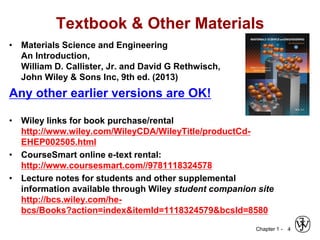
• Materials Science and Engineering
An Introduction,
William D. Callister, Jr. and David G Rethwisch,
John Wiley & Sons Inc, 9th ed. (2013)
Any other earlier versions are OK!
• Wiley links for book purchase/rental
http://www.wiley.com/WileyCDA/WileyTitle/productCd-
EHEP002505.html
• CourseSmart online e-text rental:
http://www.coursesmart.com//9781118324578
• Lecture notes for students and other supplemental
information available through Wiley student companion site
http://bcs.wiley.com/he-
bcs/Books?action=index&itemId=1118324579&bcsId=8580
4
Chapter 1 -
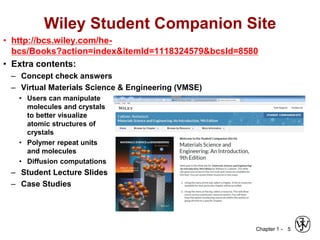
Wiley Student Companion Site
• http://bcs.wiley.com/he-
bcs/Books?action=index&itemId=1118324579&bcsId=8580
• Extra contents:
– Concept check answers
– Virtual Materials Science & Engineering (VMSE)
• Users can manipulate
molecules and crystals
to better visualize
atomic structures of
crystals
• Polymer repeat units
and molecules
• Diffusion computations
– Student Lecture Slides
– Case Studies
5
Chapter 1 -
Grading
• Homework (10 points)
• Attendance (8 points, in the form of class exercises)
• Group presentation (7 points)
• Three closed-book exams (25 points each for each)
• Final Grades:
– A:>=90; A-:87-89.9;
– B+:84-86.9; B:80-83.9; B-:77-79.9;
– C+:74-76.9; C:67-73.9;
– D: 60-66.9;
– F: <60
Past statistics
– 2017 spring: Median: 78.3; Standard deviation: 18.0; Highest: 96.8
– 2016 fall: Median: 77.3; Standard deviation: 17.1; Highest: 98.1
– 2016 spring: Median: 74.8; Standard deviation: 12.2; Highest: 97.0
– 2015 fall: Median: 80.1; Standard deviation: 19.1; Highest: 94.5
– 2015 summer: Median: 81.8; Standard deviation: 11.6; Highest: 95.1
– 2015 spring: Median: 73.6; Standard deviation: 21.3; Highest: 91.7
– 2014 Fall: Median: 76.7; Standard deviation: 9.1; Highest: 90.8
6
Chapter 1 -
Course Policy
• Attendance required, checked in the form of class exercise
• Cell phones and other device on silent mode
• Can discuss homework problems, but must independently
finish them
• Exams will be closed-book, 1 letter page (2-sided OK)
formula/concept sheet allowed
• Grade discrepancies – resolve within the next business day
• “Make-up” exams only for real, life-threatening emergency
with valid proof
• Accommodate disability/religious holidays
• NO cheating or plagiarizing in ANY form
7
Chapter 1 -
Guidelines on Group Presentation
• A 12 min max presentation (~12 slides) about materials evolution/development of
interest to you
– It should be based on one of the two formats below:
• The evolution/development of a SPECIFIC MATERIAL (e.g., man-made diamond), or
• The evolution of materials used for a SPECIFIC APPLICATION (e.g., materials for solar
cell light absorber)
– It should have most of the following (but NOT necessary all)
– Introduction
– Materials development (may have multiple generations)
» The original material and/or application and its limitations
» New materials or processing used in practice (i.e., in manufacturing) and how and why it
exceed original materials
» Limitations with the new materials/processing, if any
– Conclusions and/or directions for future R&D for that material or application
– Contribution of each member (e.g., literature survey, PowerPoint file preparation, others)
• Dates:
– Date 1 (after 2nd exam): Group presentation topics due
– Date 2 (last week of semester): oral presentation
• Grouping: each group should have 3 or 4 students, form group on your own
• Grading: 7 points maximum and all group members get the same grades
• It needs to be at the COLLEGE LEVEL, quantitative, showing the
concepts/knowledge learned in this class and not remaining at the middle-school
or even primary school level!
8
Chapter 1 -
Contents Covered
• Fundamental Concepts (chapter 1-5, 9, 10)
– Structure
– Diffusion
– Phase and phase transformation
• Properties (Chapter 6-8, 17)
– Mechanical
– Corrosion/degradation
• Categories of materials (Chapter 10-16)
– Metals, Ceramics/Glass, Polymer, Composites: their
processing and applications
• Interrelationships between different aspects
9
Chapter 1 - 10
Types of Materials –
By Chemistry/Composition
• Metals: Pure elements or compounds consist of metallic elements
– Metallic bond
– High thermal & electrical conductivity
– Opaque, reflective
• Polymers: Large molecules contain carbon C as well as other
elements such as H, O, N, Si, S, etc.
– Usually covalent bond between atoms
– Soft, ductile, low strength, low density, low melting point
• Ceramics: – mostly solid compounds consists of at least one non-
metallic elements (oxides, carbides, nitrides, sulfides)
– Ionic or covalent bonding (refractory)
• Composites: Consisting at least two distinctly different materials to
realize optimized properties that combines the advantages of each
components
Chapter 1 - 11
Types of Materials – Other
Classifications
By application or function
• Structural materials
• Electronic materials: Conductors; Semiconductors;
Dielectrics
• Optical materials
• Magnetic materials
• Biomaterials
• …
By certain property
• Electrical: conductor; insulator; semiconductor
• Hardness: hard versus “soft”
• Toughness: brittle versus ductile
• …
By source
• Natural materials
• Man-made
Chapter 1 -
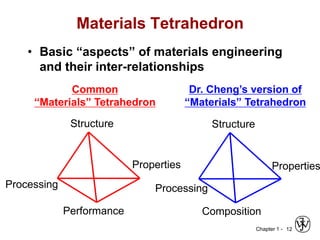
Materials Tetrahedron
• Basic “aspects” of materials engineering
and their inter-relationships
12
Structure
Processing
Properties
Performance
Common
“Materials” Tetrahedron
Dr. Cheng’s version of
“Materials” Tetrahedron
Structure
Processing
Properties
Composition
Chapter 1 -
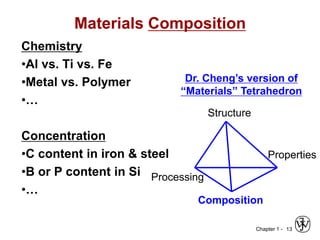
Materials Composition
Chemistry
•Al vs. Ti vs. Fe
•Metal vs. Polymer
•…
Concentration
•C content in iron & steel
•B or P content in Si
•…
13
Dr. Cheng’s version of
“Materials” Tetrahedron
Structure
Processing
Properties
Composition
Chapter 1 -
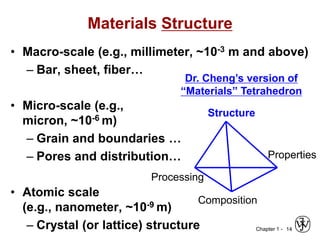
Materials Structure
• Macro-scale (e.g., millimeter, ~10-3 m and above)
– Bar, sheet, fiber…
• Micro-scale (e.g.,
micron, ~10-6 m)
– Grain and boundaries …
– Pores and distribution…
• Atomic scale
(e.g., nanometer, ~10-9 m)
– Crystal (or lattice) structure 14
Dr. Cheng’s version of
“Materials” Tetrahedron
Structure
Processing
Properties
Composition
Chapter 1 -
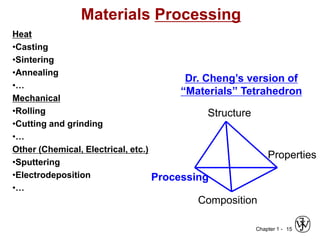
Materials Processing
Heat
•Casting
•Sintering
•Annealing
•…
Mechanical
•Rolling
•Cutting and grinding
•…
Other (Chemical, Electrical, etc.)
•Sputtering
•Electrodeposition
•…
15
Dr. Cheng’s version of
“Materials” Tetrahedron
Structure
Processing
Properties
Composition
Chapter 1 -
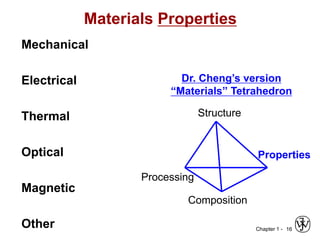
Materials Properties
Mechanical
Electrical
Thermal
Optical
Magnetic
Other 16
Dr. Cheng’s version
“Materials” Tetrahedron
Structure
Processing
Properties
Composition
Chapter 1 - 17
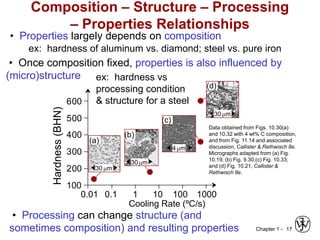
ex: hardness of aluminum vs. diamond; steel vs. pure iron
• Properties largely depends on composition
Data obtained from Figs. 10.30(a)
and 10.32 with 4 wt% C composition,
and from Fig. 11.14 and associated
discussion, Callister & Rethwisch 8e.
Micrographs adapted from (a) Fig.
10.19; (b) Fig. 9.30;(c) Fig. 10.33;
and (d) Fig. 10.21, Callister &
Rethwisch 8e.
• Processing can change structure (and
sometimes composition) and resulting properties
Composition – Structure – Processing
– Properties Relationships
Hardness
(BHN)
Cooling Rate (ºC/s)
100
200
300
400
500
600
0.01 0.1 1 10 100 1000
(d)
30 mm
(c)
4 mm
(b)
30 mm
(a)
30 mm
ex: hardness vs
processing condition
& structure for a steel
• Once composition fixed, properties is also influenced by
(micro)structure
Chapter 1 - 18
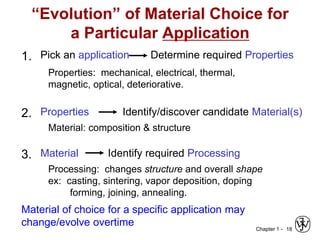
1. Pick an application Determine required Properties
Processing: changes structure and overall shape
ex: casting, sintering, vapor deposition, doping
forming, joining, annealing.
Properties: mechanical, electrical, thermal,
magnetic, optical, deteriorative.
Material: composition & structure
2. Properties Identify/discover candidate Material(s)
3. Material Identify required Processing
“Evolution” of Material Choice for
a Particular Application
Material of choice for a specific application may
change/evolve overtime
Chapter 1 - 19
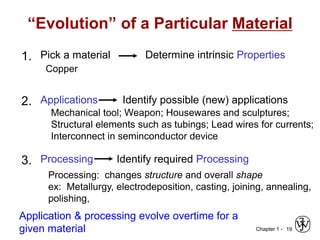
1. Pick a material Determine intrinsic Properties
Processing: changes structure and overall shape
ex: Metallurgy, electrodeposition, casting, joining, annealing,
polishing,
2. Applications Identify possible (new) applications
3. Processing Identify required Processing
“Evolution” of a Particular Material
Copper
Mechanical tool; Weapon; Housewares and sculptures;
Structural elements such as tubings; Lead wires for currents;
Interconnect in seminconductor device
Application & processing evolve overtime for a
given material
Chapter 1 -
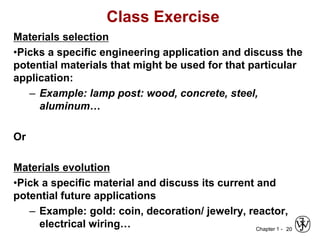
Class Exercise
Materials selection
•Picks a specific engineering application and discuss the
potential materials that might be used for that particular
application:
– Example: lamp post: wood, concrete, steel,
aluminum…
Or
Materials evolution
•Pick a specific material and discuss its current and
potential future applications
– Example: gold: coin, decoration/ jewelry, reactor,
electrical wiring… 20
Chapter 1 - 21
• Be aware of the different aspects (i.e, composition,
properties, structure, and processing.) in material
selection/design/manufacturing considerations
• Understand the basic ways of classification of
engineering materials
Course Goals:
SUMMARY
• Understand the concept of “evolution” for materials
Chapter 1 -
Homework #1
• Read Chapters 1 and then give a
statement in your homework confirming
you finished the required reading
• >100 word short write-up describing a
specific material or an application (for
which material is the limiting factor) that
interests you and explain why
22

Callister chapter 1 slides materials science and engineering

  • 1.
    Chapter 1 -1 EGN 3365: Materials in Engineering - Introduction Course Objective... Introduce fundamental concepts and methods in materials engineering (and science) • Instructor: Dr. Zhe Cheng – Phone: 305-348-1973 – Email: zhcheng@fiu.edu – Office: EC3172 • Course website (for lecture slides and review information): https://ac.fiu.edu/teaching/egn3365/ • Instagram chat group: • Prerequisites: – CHEM1045 General Chemistry I; – MAC 2311 Calculus I; – PHY 2048 Physics with Calculus I
  • 2.
    Chapter 1 - MoreAbout Dr. Zhe Cheng • Education & Experiences: – PhD in Materials Science & Engineering, Georgia Tech 2008 – Research scientist at DuPont 2008-2013 • Research group website: https://ac.fiu.edu 2
  • 3.
    Chapter 1 - CourseFeature • Interdisciplinary & broad • Raising awareness & common sense • Not exactly a specific tool/skill based course • Every material/application is unique 3 This course will help you to know: • basic concepts in materials engineering • major categories of materials • considerations in materials selection/design/processing
  • 4.
    Chapter 1 - Textbook& Other Materials • Materials Science and Engineering An Introduction, William D. Callister, Jr. and David G Rethwisch, John Wiley & Sons Inc, 9th ed. (2013) Any other earlier versions are OK! • Wiley links for book purchase/rental http://www.wiley.com/WileyCDA/WileyTitle/productCd- EHEP002505.html • CourseSmart online e-text rental: http://www.coursesmart.com//9781118324578 • Lecture notes for students and other supplemental information available through Wiley student companion site http://bcs.wiley.com/he- bcs/Books?action=index&itemId=1118324579&bcsId=8580 4
  • 5.
    Chapter 1 - WileyStudent Companion Site • http://bcs.wiley.com/he- bcs/Books?action=index&itemId=1118324579&bcsId=8580 • Extra contents: – Concept check answers – Virtual Materials Science & Engineering (VMSE) • Users can manipulate molecules and crystals to better visualize atomic structures of crystals • Polymer repeat units and molecules • Diffusion computations – Student Lecture Slides – Case Studies 5
  • 6.
    Chapter 1 - Grading •Homework (10 points) • Attendance (8 points, in the form of class exercises) • Group presentation (7 points) • Three closed-book exams (25 points each for each) • Final Grades: – A:>=90; A-:87-89.9; – B+:84-86.9; B:80-83.9; B-:77-79.9; – C+:74-76.9; C:67-73.9; – D: 60-66.9; – F: <60 Past statistics – 2017 spring: Median: 78.3; Standard deviation: 18.0; Highest: 96.8 – 2016 fall: Median: 77.3; Standard deviation: 17.1; Highest: 98.1 – 2016 spring: Median: 74.8; Standard deviation: 12.2; Highest: 97.0 – 2015 fall: Median: 80.1; Standard deviation: 19.1; Highest: 94.5 – 2015 summer: Median: 81.8; Standard deviation: 11.6; Highest: 95.1 – 2015 spring: Median: 73.6; Standard deviation: 21.3; Highest: 91.7 – 2014 Fall: Median: 76.7; Standard deviation: 9.1; Highest: 90.8 6
  • 7.
    Chapter 1 - CoursePolicy • Attendance required, checked in the form of class exercise • Cell phones and other device on silent mode • Can discuss homework problems, but must independently finish them • Exams will be closed-book, 1 letter page (2-sided OK) formula/concept sheet allowed • Grade discrepancies – resolve within the next business day • “Make-up” exams only for real, life-threatening emergency with valid proof • Accommodate disability/religious holidays • NO cheating or plagiarizing in ANY form 7
  • 8.
    Chapter 1 - Guidelineson Group Presentation • A 12 min max presentation (~12 slides) about materials evolution/development of interest to you – It should be based on one of the two formats below: • The evolution/development of a SPECIFIC MATERIAL (e.g., man-made diamond), or • The evolution of materials used for a SPECIFIC APPLICATION (e.g., materials for solar cell light absorber) – It should have most of the following (but NOT necessary all) – Introduction – Materials development (may have multiple generations) » The original material and/or application and its limitations » New materials or processing used in practice (i.e., in manufacturing) and how and why it exceed original materials » Limitations with the new materials/processing, if any – Conclusions and/or directions for future R&D for that material or application – Contribution of each member (e.g., literature survey, PowerPoint file preparation, others) • Dates: – Date 1 (after 2nd exam): Group presentation topics due – Date 2 (last week of semester): oral presentation • Grouping: each group should have 3 or 4 students, form group on your own • Grading: 7 points maximum and all group members get the same grades • It needs to be at the COLLEGE LEVEL, quantitative, showing the concepts/knowledge learned in this class and not remaining at the middle-school or even primary school level! 8
  • 9.
    Chapter 1 - ContentsCovered • Fundamental Concepts (chapter 1-5, 9, 10) – Structure – Diffusion – Phase and phase transformation • Properties (Chapter 6-8, 17) – Mechanical – Corrosion/degradation • Categories of materials (Chapter 10-16) – Metals, Ceramics/Glass, Polymer, Composites: their processing and applications • Interrelationships between different aspects 9
  • 10.
    Chapter 1 -10 Types of Materials – By Chemistry/Composition • Metals: Pure elements or compounds consist of metallic elements – Metallic bond – High thermal & electrical conductivity – Opaque, reflective • Polymers: Large molecules contain carbon C as well as other elements such as H, O, N, Si, S, etc. – Usually covalent bond between atoms – Soft, ductile, low strength, low density, low melting point • Ceramics: – mostly solid compounds consists of at least one non- metallic elements (oxides, carbides, nitrides, sulfides) – Ionic or covalent bonding (refractory) • Composites: Consisting at least two distinctly different materials to realize optimized properties that combines the advantages of each components
  • 11.
    Chapter 1 -11 Types of Materials – Other Classifications By application or function • Structural materials • Electronic materials: Conductors; Semiconductors; Dielectrics • Optical materials • Magnetic materials • Biomaterials • … By certain property • Electrical: conductor; insulator; semiconductor • Hardness: hard versus “soft” • Toughness: brittle versus ductile • … By source • Natural materials • Man-made
  • 12.
    Chapter 1 - MaterialsTetrahedron • Basic “aspects” of materials engineering and their inter-relationships 12 Structure Processing Properties Performance Common “Materials” Tetrahedron Dr. Cheng’s version of “Materials” Tetrahedron Structure Processing Properties Composition
  • 13.
    Chapter 1 - MaterialsComposition Chemistry •Al vs. Ti vs. Fe •Metal vs. Polymer •… Concentration •C content in iron & steel •B or P content in Si •… 13 Dr. Cheng’s version of “Materials” Tetrahedron Structure Processing Properties Composition
  • 14.
    Chapter 1 - MaterialsStructure • Macro-scale (e.g., millimeter, ~10-3 m and above) – Bar, sheet, fiber… • Micro-scale (e.g., micron, ~10-6 m) – Grain and boundaries … – Pores and distribution… • Atomic scale (e.g., nanometer, ~10-9 m) – Crystal (or lattice) structure 14 Dr. Cheng’s version of “Materials” Tetrahedron Structure Processing Properties Composition
  • 15.
    Chapter 1 - MaterialsProcessing Heat •Casting •Sintering •Annealing •… Mechanical •Rolling •Cutting and grinding •… Other (Chemical, Electrical, etc.) •Sputtering •Electrodeposition •… 15 Dr. Cheng’s version of “Materials” Tetrahedron Structure Processing Properties Composition
  • 16.
    Chapter 1 - MaterialsProperties Mechanical Electrical Thermal Optical Magnetic Other 16 Dr. Cheng’s version “Materials” Tetrahedron Structure Processing Properties Composition
  • 17.
    Chapter 1 -17 ex: hardness of aluminum vs. diamond; steel vs. pure iron • Properties largely depends on composition Data obtained from Figs. 10.30(a) and 10.32 with 4 wt% C composition, and from Fig. 11.14 and associated discussion, Callister & Rethwisch 8e. Micrographs adapted from (a) Fig. 10.19; (b) Fig. 9.30;(c) Fig. 10.33; and (d) Fig. 10.21, Callister & Rethwisch 8e. • Processing can change structure (and sometimes composition) and resulting properties Composition – Structure – Processing – Properties Relationships Hardness (BHN) Cooling Rate (ºC/s) 100 200 300 400 500 600 0.01 0.1 1 10 100 1000 (d) 30 mm (c) 4 mm (b) 30 mm (a) 30 mm ex: hardness vs processing condition & structure for a steel • Once composition fixed, properties is also influenced by (micro)structure
  • 18.
    Chapter 1 -18 1. Pick an application Determine required Properties Processing: changes structure and overall shape ex: casting, sintering, vapor deposition, doping forming, joining, annealing. Properties: mechanical, electrical, thermal, magnetic, optical, deteriorative. Material: composition & structure 2. Properties Identify/discover candidate Material(s) 3. Material Identify required Processing “Evolution” of Material Choice for a Particular Application Material of choice for a specific application may change/evolve overtime
  • 19.
    Chapter 1 -19 1. Pick a material Determine intrinsic Properties Processing: changes structure and overall shape ex: Metallurgy, electrodeposition, casting, joining, annealing, polishing, 2. Applications Identify possible (new) applications 3. Processing Identify required Processing “Evolution” of a Particular Material Copper Mechanical tool; Weapon; Housewares and sculptures; Structural elements such as tubings; Lead wires for currents; Interconnect in seminconductor device Application & processing evolve overtime for a given material
  • 20.
    Chapter 1 - ClassExercise Materials selection •Picks a specific engineering application and discuss the potential materials that might be used for that particular application: – Example: lamp post: wood, concrete, steel, aluminum… Or Materials evolution •Pick a specific material and discuss its current and potential future applications – Example: gold: coin, decoration/ jewelry, reactor, electrical wiring… 20
  • 21.
    Chapter 1 -21 • Be aware of the different aspects (i.e, composition, properties, structure, and processing.) in material selection/design/manufacturing considerations • Understand the basic ways of classification of engineering materials Course Goals: SUMMARY • Understand the concept of “evolution” for materials
  • 22.
    Chapter 1 - Homework#1 • Read Chapters 1 and then give a statement in your homework confirming you finished the required reading • >100 word short write-up describing a specific material or an application (for which material is the limiting factor) that interests you and explain why 22