Utilization Focused Eval
(UFE)
Michael Patton: school programs and social welfare programs
Elements of UFE
• Primary purpose is to inform decisions; type of participatory approach
• Personal factor: stakeholders care about the evaluation/in a position to use it
• 1970s study, 20 federal health evaluations; 11 possible factors; 2 main factors: political
considerations & the personal factor
• Critical: evaluator identifies the stakeholders who care/have personal factor
• Involving stakeholders increases ownership and ultimately use of evaluation
(Patton, Cousins, Earle, Greene)
UFE Approach
• Step 1: identify intended users/stakeholders
• Interest in the study (pretty critical, as low interest may result in flaking out)
• Power to do something with the results
• Suggest questions; help them be intentional in design of the evaluation
• Context: high-level government officials (e.g. federal cabinet) vs. lower-key
decision makers who have time and interest to get involved
Is it like Practical Participatory Approach?
• First stage is unique: stakeholder selection & focus on intended use
• Other stages are very similar: ID questions of interest, consider use, involve
stakeholders in design & data collection, ensure questions reflect values, etc.
• Final stage: interpreting results, making recommendations, etc. all involve
stakeholders
• Patton’s UFE (focus on decision makers) is more like Stufflebeam’s CIPP
model (focus on stages & relevant decisions)
Weaknesses
• Staffing turnover, notably of intended users
• To address the matter, suggest a task force of primary users rather than one
• Build in enough time to inform replacements if/when turnover happens
• Finding “the” decision maker isn’t that straightforward
• “ . . .a much less tidy, much more back and forth, in-and-out, around-and-about kind of
process, and all kinds of irrelevancies get tangled in the process . . . Not ‘find the
decision maker and give him the word.’” (Weiss & Mark, 2006, p.480)
Participatory
Approaches
Participatory evaluation: “an overarching term for any evaluation
approach that involves program staff or participants actively in the
decision making and other activities related to planning and
implementation of evaluation studies” (2005, p.291).
• Partnership between decision makers, people with responsibility, or people with vital
interest (Cousins & Earl)
• Often confused with collaborative evaluation, but King identifies 4 characteristics:
1. Stakeholder based, democratizes eval process
2. Participant ownership
3. Evaluator is consultant/partner
4. Eval skills of participants will likely increase
The relationship between stakeholders & evaluators is the difference between collab &
participatory eval
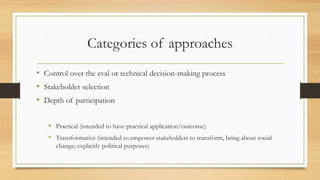
Categories of approaches
• Control over the eval or technical decision-making process
• Stakeholder selection
• Depth of participation
• Practical (intended to have practical application/outcome)
• Transformative (intended to empower stakeholders to transform, bring about social
change; explicitly political purposes)

Utilization Focused Evaluation

  • 1.
    Utilization Focused Eval (UFE) MichaelPatton: school programs and social welfare programs
  • 2.
    Elements of UFE •Primary purpose is to inform decisions; type of participatory approach • Personal factor: stakeholders care about the evaluation/in a position to use it • 1970s study, 20 federal health evaluations; 11 possible factors; 2 main factors: political considerations & the personal factor • Critical: evaluator identifies the stakeholders who care/have personal factor • Involving stakeholders increases ownership and ultimately use of evaluation (Patton, Cousins, Earle, Greene)
  • 3.
    UFE Approach • Step1: identify intended users/stakeholders • Interest in the study (pretty critical, as low interest may result in flaking out) • Power to do something with the results • Suggest questions; help them be intentional in design of the evaluation • Context: high-level government officials (e.g. federal cabinet) vs. lower-key decision makers who have time and interest to get involved
  • 4.
    Is it likePractical Participatory Approach? • First stage is unique: stakeholder selection & focus on intended use • Other stages are very similar: ID questions of interest, consider use, involve stakeholders in design & data collection, ensure questions reflect values, etc. • Final stage: interpreting results, making recommendations, etc. all involve stakeholders • Patton’s UFE (focus on decision makers) is more like Stufflebeam’s CIPP model (focus on stages & relevant decisions)
  • 5.
    Weaknesses • Staffing turnover,notably of intended users • To address the matter, suggest a task force of primary users rather than one • Build in enough time to inform replacements if/when turnover happens • Finding “the” decision maker isn’t that straightforward • “ . . .a much less tidy, much more back and forth, in-and-out, around-and-about kind of process, and all kinds of irrelevancies get tangled in the process . . . Not ‘find the decision maker and give him the word.’” (Weiss & Mark, 2006, p.480)
  • 6.
    Participatory Approaches Participatory evaluation: “anoverarching term for any evaluation approach that involves program staff or participants actively in the decision making and other activities related to planning and implementation of evaluation studies” (2005, p.291).
  • 7.
    • Partnership betweendecision makers, people with responsibility, or people with vital interest (Cousins & Earl) • Often confused with collaborative evaluation, but King identifies 4 characteristics: 1. Stakeholder based, democratizes eval process 2. Participant ownership 3. Evaluator is consultant/partner 4. Eval skills of participants will likely increase The relationship between stakeholders & evaluators is the difference between collab & participatory eval
  • 8.
    Categories of approaches •Control over the eval or technical decision-making process • Stakeholder selection • Depth of participation • Practical (intended to have practical application/outcome) • Transformative (intended to empower stakeholders to transform, bring about social change; explicitly political purposes)