BLENDED & ONLINE LANGUAGE
LEARNING CONCEPTS
• Objectives
– Understand BYU Independent Study and BYU Online language course models
– Explore benefits of synchronous and asynchronous interactions
– Explore elements of independent, collaborative, and apprenticeship-focused learning
environments
Education
BYU: English
Univ. of Wisconsin: French &
International Education
BYU: IP&T Second Lang.
Acquisition
Professional
Teaching abroad and in U.S.
Administrator of charter school
Instructional designer of world
language courses
Academic consultant for BYU
Online, humanities, business,
nursing, Kennedy Center
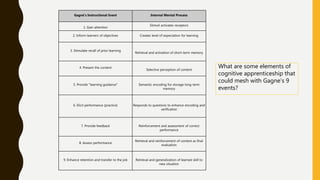
Gagné’s Instructional Event Internal Mental Process
1. Gain attention
Stimuli activates receptors
2. Inform learners of objectives Creates level of expectation for learning
3. Stimulate recall of prior learning
Retrieval and activation of short-term memory
4. Present the content
Selective perception of content
5. Provide "learning guidance" Semantic encoding for storage long-term
memory
6. Elicit performance (practice) Responds to questions to enhance encoding and
verification
7. Provide feedback Reinforcement and assessment of correct
performance
8. Assess performance
Retrieval and reinforcement of content as final
evaluation
9. Enhance retention and transfer to the job Retrieval and generalization of learned skill to
new situation
What are some elements of
cognitive apprenticeship that
could mesh with Gagne’s 9
events?
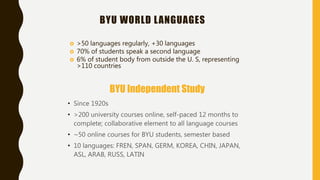
BYU WORLD LANGUAGES
• Since 1920s
• >200 university courses online, self-paced 12 months to
complete; collaborative element to all language courses
• ~50 online courses for BYU students, semester based
• 10 languages: FREN, SPAN, GERM, KOREA, CHIN, JAPAN,
ASL, ARAB, RUSS, LATIN
 >50 languages regularly, +30 languages
 70% of students speak a second language
 6% of student body from outside the U. S, representing
>110 countries
BYU Independent Study
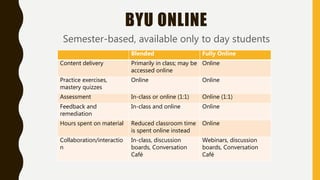
BYU ONLINE
Semester-based, available only to day students
Blended Fully Online
Content delivery Primarily in class; may be
accessed online
Online
Practice exercises,
mastery quizzes
Online Online
Assessment In-class or online (1:1) Online (1:1)
Feedback and
remediation
In-class and online Online
Hours spent on material Reduced classroom time
is spent online instead
Online
Collaboration/interactio
n
In-class, discussion
boards, Conversation
Café
Webinars, discussion
boards, Conversation
Café
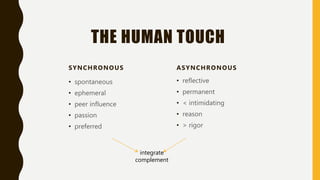
THE HUMAN TOUCH
SYNCHRONOUS
• spontaneous
• ephemeral
• peer influence
• passion
• preferred
ASYNCHRONOUS
• reflective
• permanent
• < intimidating
• reason
• > rigor
integrate
complement
W H A T D O E S
L E A R N E R A U T O N O M Y
F A C I L I T A T E ?
Self-paced structure
Focus on the unique needs of
the learner
Finding one’s own path; self-
directed learning as a life skill
(John Dewey self-directed
learning theories)
W H A T D O E S
C O L L A B O R A T I O N
F A C I L I T A T E ?
Dialogue & discussion
Group problem-solving
Development of social knowledge
Structure/control to the path
W H A T D O E S
A P P R E N T I C E S H I P
F A C I L I T A T E ?
Development of strategic
knowledge
Scaffolded and sequenced
instruction structure
Real-world application
CONVERSATION CAFÉ
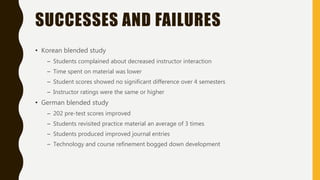
SUCCESSES AND FAILURES
• Korean blended study
– Students complained about decreased instructor interaction
– Time spent on material was lower
– Student scores showed no significant difference over 4 semesters
– Instructor ratings were the same or higher
• German blended study
– 202 pre-test scores improved
– Students revisited practice material an average of 3 times
– Students produced improved journal entries
– Technology and course refinement bogged down development
• Independent Study and BYU Online language course models
• Benefits of synchronous and asynchronous interactions
• Independent, collaborative, and apprenticeship-focused
environments

Blended and Online Language Learning Concepts

  • 1.
    BLENDED & ONLINELANGUAGE LEARNING CONCEPTS • Objectives – Understand BYU Independent Study and BYU Online language course models – Explore benefits of synchronous and asynchronous interactions – Explore elements of independent, collaborative, and apprenticeship-focused learning environments
  • 2.
    Education BYU: English Univ. ofWisconsin: French & International Education BYU: IP&T Second Lang. Acquisition Professional Teaching abroad and in U.S. Administrator of charter school Instructional designer of world language courses Academic consultant for BYU Online, humanities, business, nursing, Kennedy Center
  • 3.
    Gagné’s Instructional EventInternal Mental Process 1. Gain attention Stimuli activates receptors 2. Inform learners of objectives Creates level of expectation for learning 3. Stimulate recall of prior learning Retrieval and activation of short-term memory 4. Present the content Selective perception of content 5. Provide "learning guidance" Semantic encoding for storage long-term memory 6. Elicit performance (practice) Responds to questions to enhance encoding and verification 7. Provide feedback Reinforcement and assessment of correct performance 8. Assess performance Retrieval and reinforcement of content as final evaluation 9. Enhance retention and transfer to the job Retrieval and generalization of learned skill to new situation What are some elements of cognitive apprenticeship that could mesh with Gagne’s 9 events?
  • 4.
    BYU WORLD LANGUAGES •Since 1920s • >200 university courses online, self-paced 12 months to complete; collaborative element to all language courses • ~50 online courses for BYU students, semester based • 10 languages: FREN, SPAN, GERM, KOREA, CHIN, JAPAN, ASL, ARAB, RUSS, LATIN  >50 languages regularly, +30 languages  70% of students speak a second language  6% of student body from outside the U. S, representing >110 countries BYU Independent Study
  • 5.
    BYU ONLINE Semester-based, availableonly to day students Blended Fully Online Content delivery Primarily in class; may be accessed online Online Practice exercises, mastery quizzes Online Online Assessment In-class or online (1:1) Online (1:1) Feedback and remediation In-class and online Online Hours spent on material Reduced classroom time is spent online instead Online Collaboration/interactio n In-class, discussion boards, Conversation Café Webinars, discussion boards, Conversation Café
  • 6.
    THE HUMAN TOUCH SYNCHRONOUS •spontaneous • ephemeral • peer influence • passion • preferred ASYNCHRONOUS • reflective • permanent • < intimidating • reason • > rigor integrate complement
  • 7.
    W H AT D O E S L E A R N E R A U T O N O M Y F A C I L I T A T E ? Self-paced structure Focus on the unique needs of the learner Finding one’s own path; self- directed learning as a life skill (John Dewey self-directed learning theories)
  • 8.
    W H AT D O E S C O L L A B O R A T I O N F A C I L I T A T E ? Dialogue & discussion Group problem-solving Development of social knowledge Structure/control to the path
  • 9.
    W H AT D O E S A P P R E N T I C E S H I P F A C I L I T A T E ? Development of strategic knowledge Scaffolded and sequenced instruction structure Real-world application
  • 10.
  • 13.
    SUCCESSES AND FAILURES •Korean blended study – Students complained about decreased instructor interaction – Time spent on material was lower – Student scores showed no significant difference over 4 semesters – Instructor ratings were the same or higher • German blended study – 202 pre-test scores improved – Students revisited practice material an average of 3 times – Students produced improved journal entries – Technology and course refinement bogged down development
  • 14.
    • Independent Studyand BYU Online language course models • Benefits of synchronous and asynchronous interactions • Independent, collaborative, and apprenticeship-focused environments

Editor's Notes

  • #7 When to incorporate F2F or online learning? Things to consider when designing learning activities in blended environment. Few definitive studies re how to blend synchronous and asynchronous. This is what we are reasonably sure of. This influenced, however, by discipline, level of instruction and contextual constraints. Note Katrina Meyer’s research. Examples: F2F better to get started and organized F2F is can generate energy, motivation Online better to discuss, resolve more complex tasks and abstract ideas Online provides sustained engagement, convenience