Korean 101
Online
A course
development
adventure
How we adapted
asynchronous online world
language courses to enhance
language mastery
Brigham Young
University
 >50 languages taught
regularly, +30 languages
 70% speak a second
language
 6% foreign, >110 countries
BYU Independent Study
 Around since 1920s
 Distance/online/interactive
 Global reach
 11 languages: HS & university
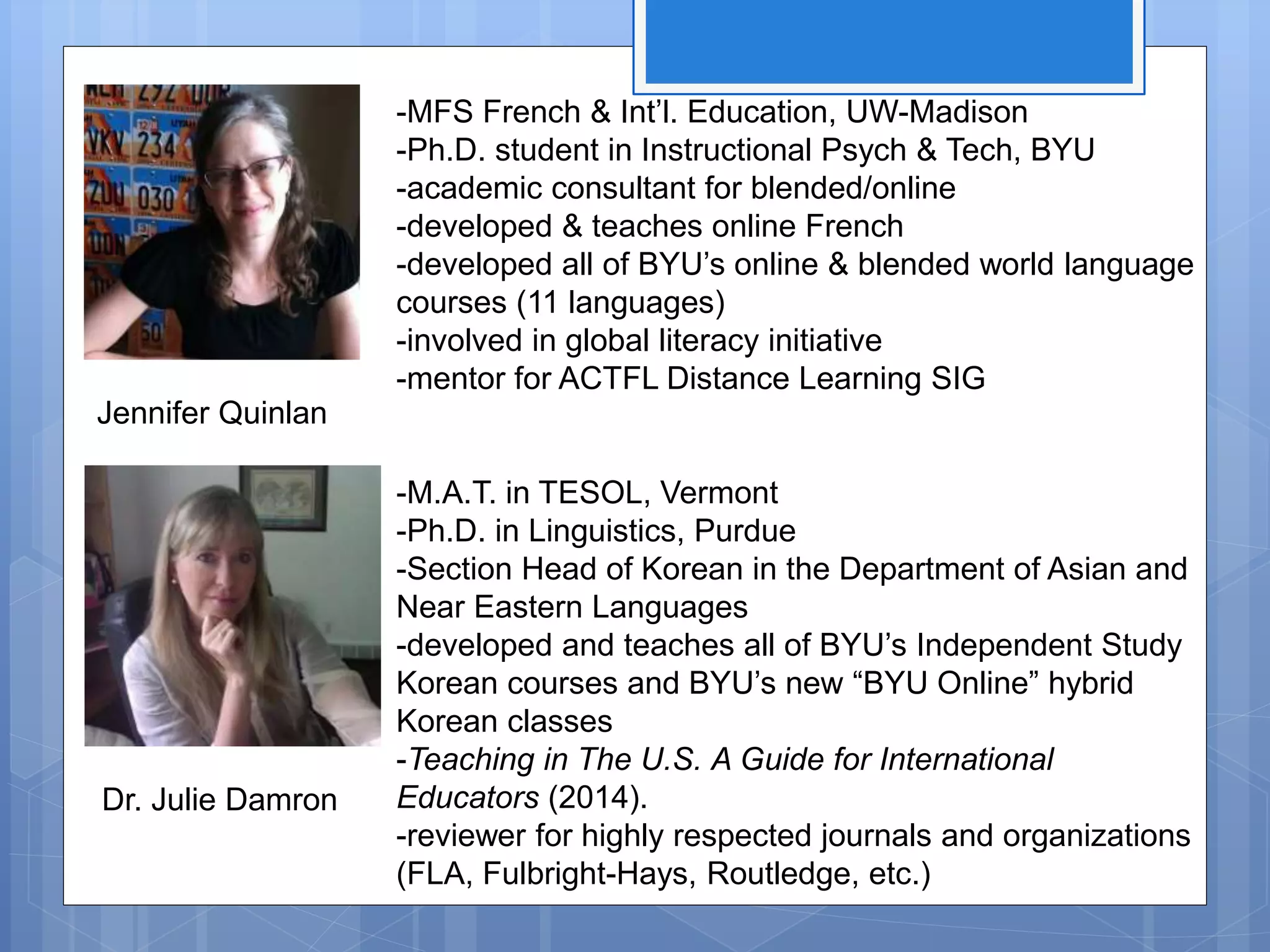
-MFS French & Int’l. Education, UW-Madison
-Ph.D. student in Instructional Psych & Tech, BYU
-academic consultant for blended/online
-developed & teaches online French
-developed all of BYU’s online & blended world language
courses (11 languages)
-involved in global literacy initiative
-mentor for ACTFL Distance Learning SIG
-M.A.T. in TESOL, Vermont
-Ph.D. in Linguistics, Purdue
-Section Head of Korean in the Department of Asian and
Near Eastern Languages
-developed and teaches all of BYU’s Independent Study
Korean courses and BYU’s new “BYU Online” hybrid
Korean classes
-Teaching in The U.S. A Guide for International
Educators (2014).
-reviewer for highly respected journals and organizations
(FLA, Fulbright-Hays, Routledge, etc.)
Jennifer Quinlan
Dr. Julie Damron
I can…
 Identify ways to use technology to enhance
engagement
 Identify ways to create collaboration online
 Explain the ADDIE process
Guiding Instructional Theories
 Gagne’s 9 events
 Lave & Wegner Community of Learners
 Vygotsky Zone of Proximal Development
 Vaughn technology for engagement
 ADDIE design process
 ACTFL 5 C’s
ADDIE
 Analyze
 Design
 Develop
 Implement
 Evaluate
 And revise!
Branch, R. M. (2014). Instructional design: the addie approach. Springer.
Languages Online… really?
A starting point
1. Awareness of ACTFL standards insufficient
2. Dynamic perspective
3. Considerations of student engagement
4. Achieving higher order thinking
5. Adapting content/asynchronous delivery
 Classroom concerns
 Online concerns
Analyze
How do you integrate
technology?
How does it enhance your
course?
Does it impact your teaching?
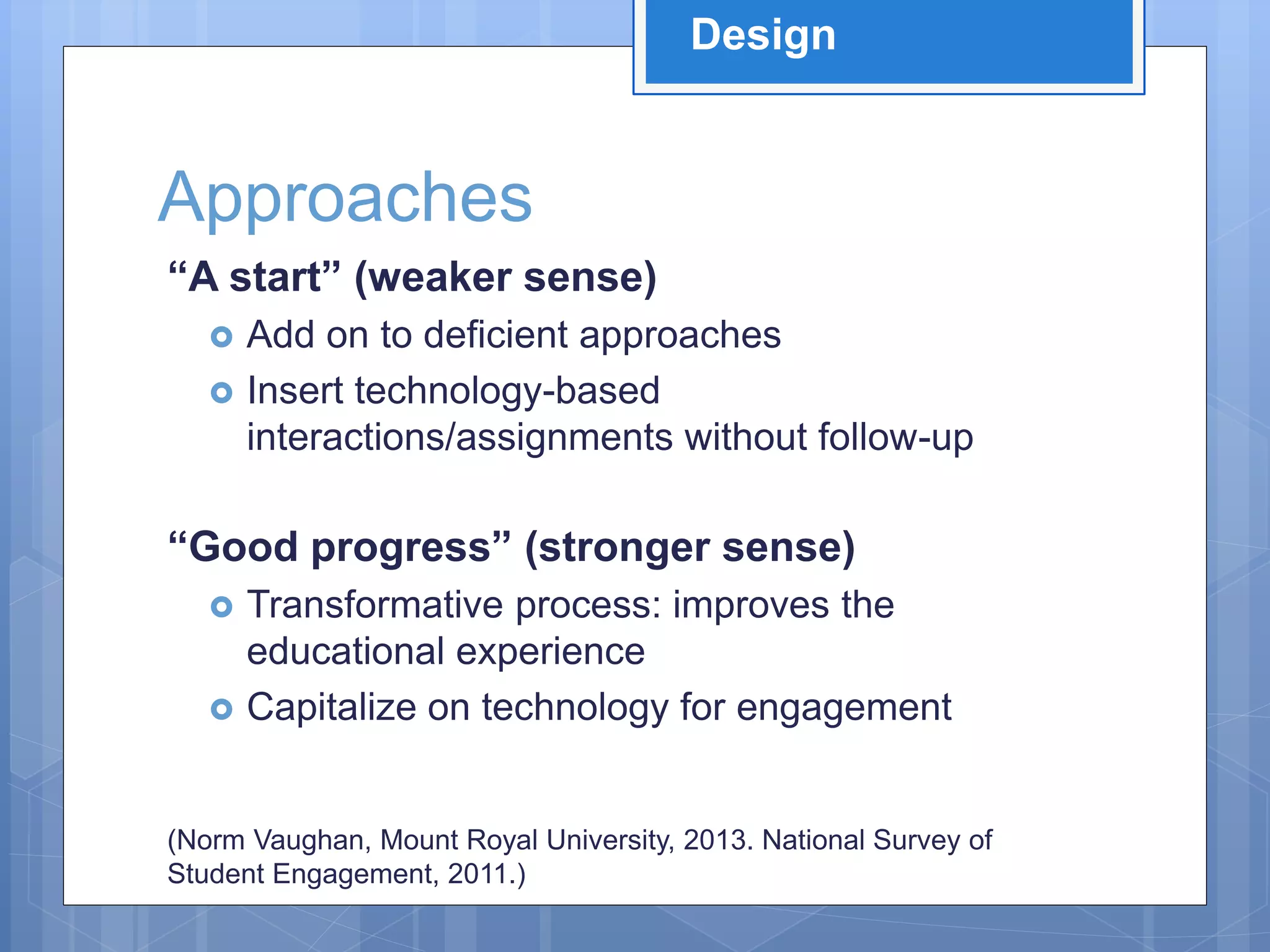
Approaches
“A start” (weaker sense)
 Add on to deficient approaches
 Insert technology-based
interactions/assignments without follow-up
“Good progress” (stronger sense)
 Transformative process: improves the
educational experience
 Capitalize on technology for engagement
(Norm Vaughan, Mount Royal University, 2013. National Survey of
Student Engagement, 2011.)
Design
“Blended” Considerations
Synchronous
 spontaneous
 ephemeral
 peer influence
 passion
 preferred
Asynchronous
 reflective
 permanent
 < intimidating
 reason
 > rigor
integrate
complement
Develop
Live interactions with
instructor/TA
Dynamic assessments
Immediate feedback
Peer interaction
Let’s take a look at the
course…
Implement
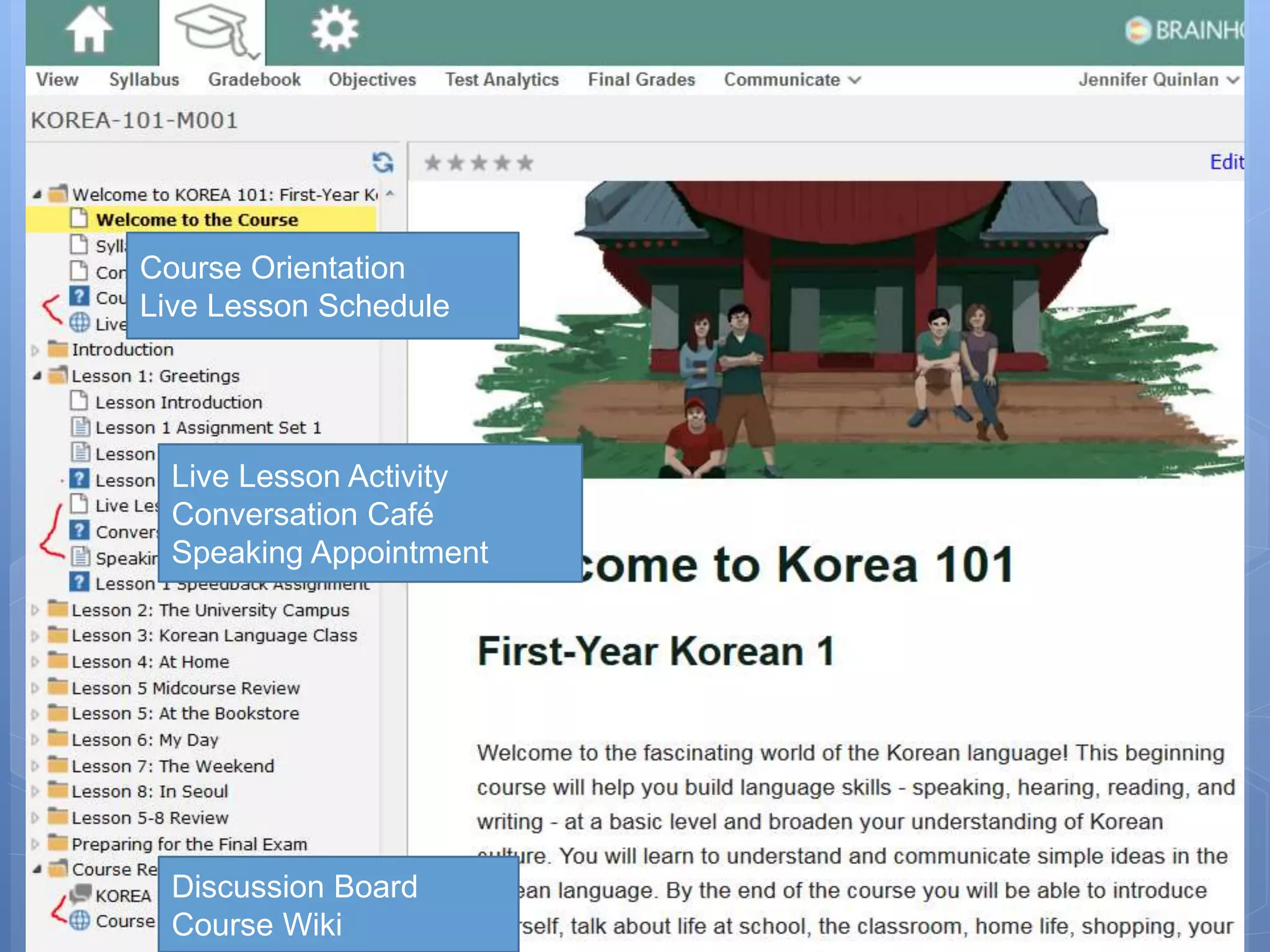
What We Did…
Course Orientation
Live Lesson Schedule
Live Lesson Activity
Conversation Café
Speaking Appointment
Discussion Board
Course Wiki
GOALS:
What do you hope to accomplish in
this course?
When do you want to complete?
How many hours a week WILL you
practice speaking?
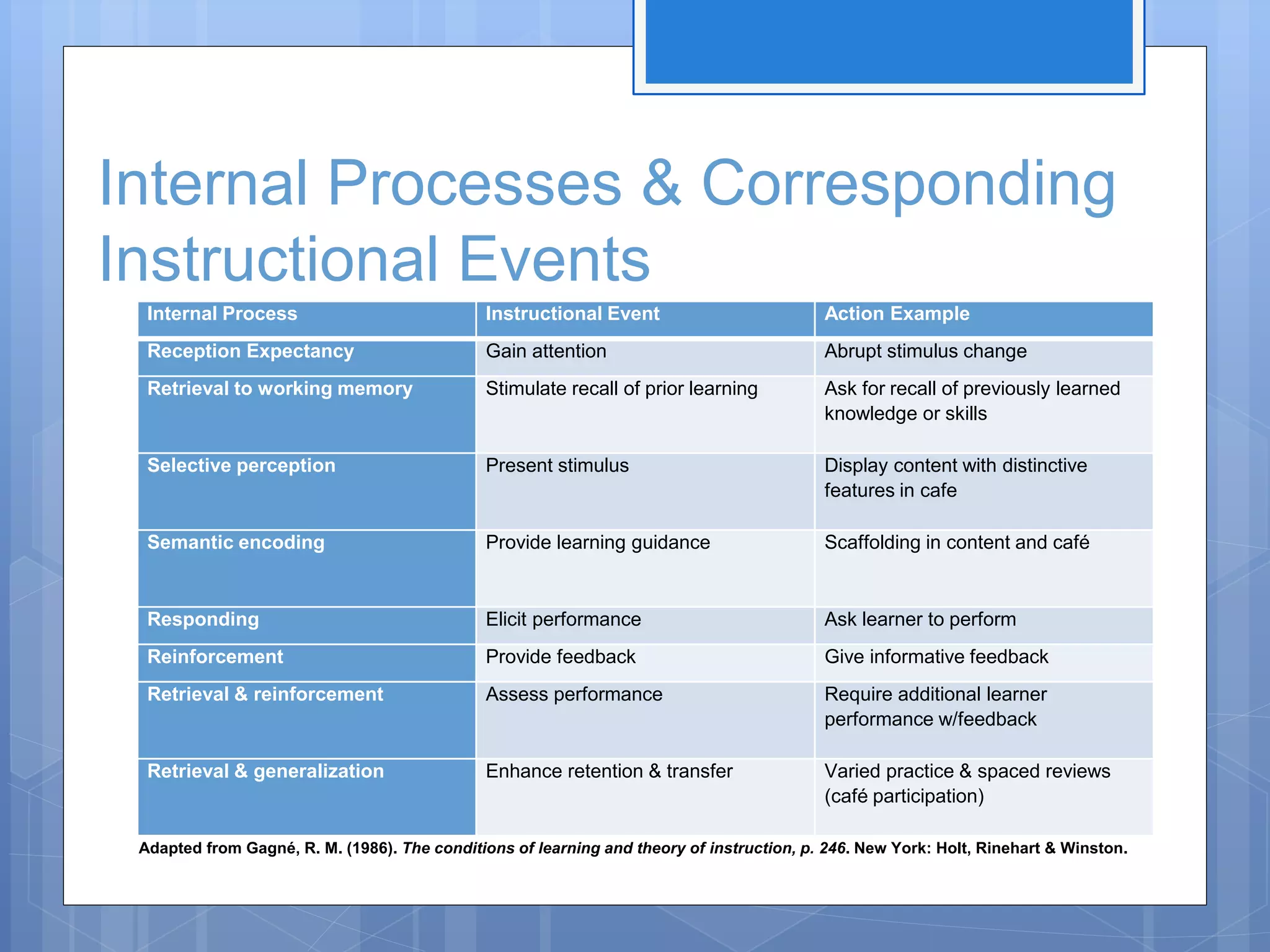
Internal Processes & Corresponding
Instructional Events
Internal Process Instructional Event Action Example
Reception Expectancy Gain attention Abrupt stimulus change
Retrieval to working memory Stimulate recall of prior learning Ask for recall of previously learned
knowledge or skills
Selective perception Present stimulus Display content with distinctive
features in cafe
Semantic encoding Provide learning guidance Scaffolding in content and café
Responding Elicit performance Ask learner to perform
Reinforcement Provide feedback Give informative feedback
Retrieval & reinforcement Assess performance Require additional learner
performance w/feedback
Retrieval & generalization Enhance retention & transfer Varied practice & spaced reviews
(café participation)
Adapted from Gagné, R. M. (1986). The conditions of learning and theory of instruction, p. 246. New York: Holt, Rinehart & Winston.
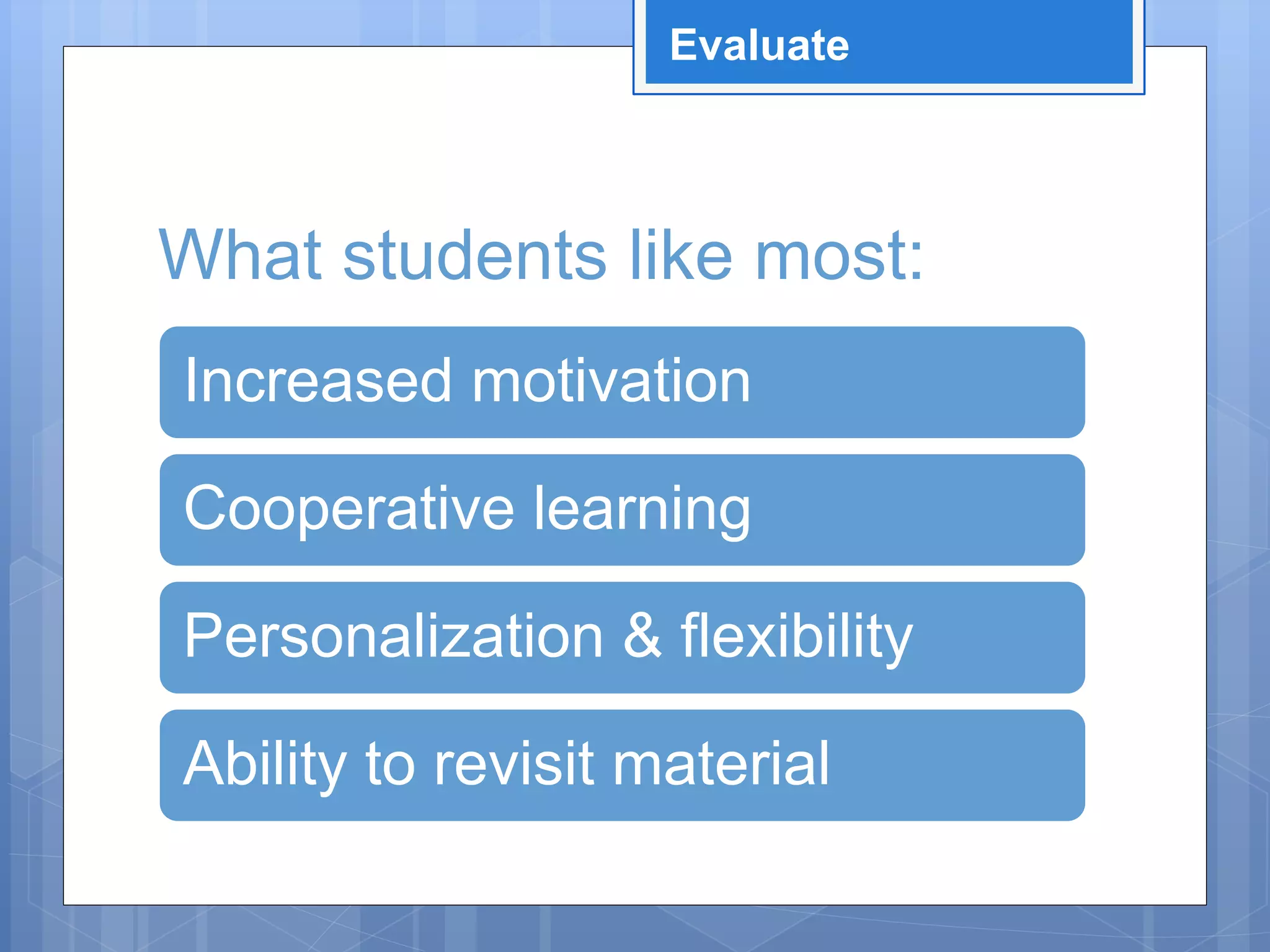
What students like most:
Increased motivation
Cooperative learning
Personalization & flexibility
Ability to revisit material
Evaluate
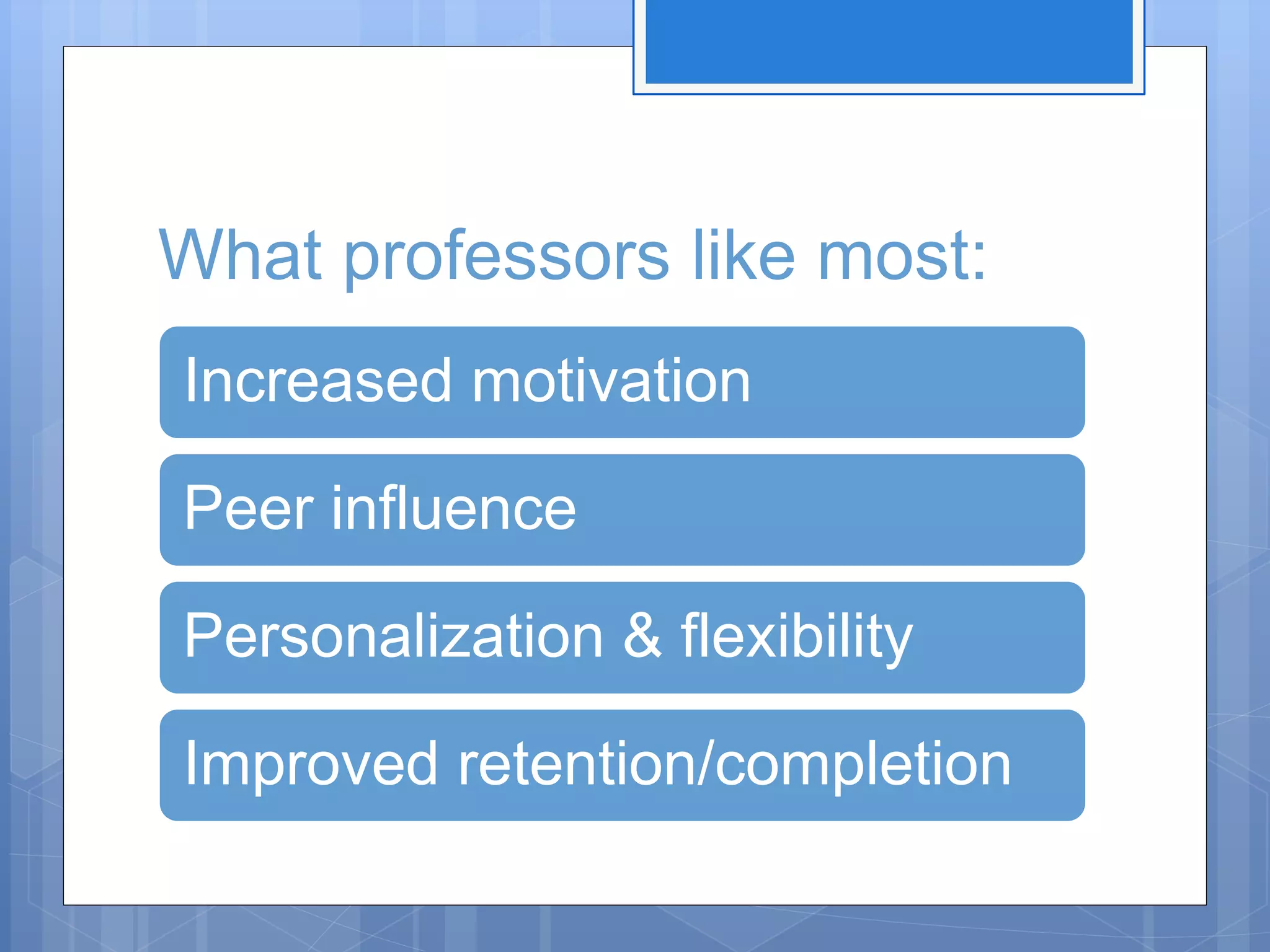
What professors like most:
Increased motivation
Peer influence
Personalization & flexibility
Improved retention/completion
Takeaways:
Challenges (online & F2F)
Practice matters
Collaboration & synergy
Good pedagogy is good!
Evaluate your program:
 What matters?
 Institutional values
 Student/learning values
 Pedagogical values
 What you value
ADDIE model: Analyze, design, develop,
implement, evaluate (+ revise)
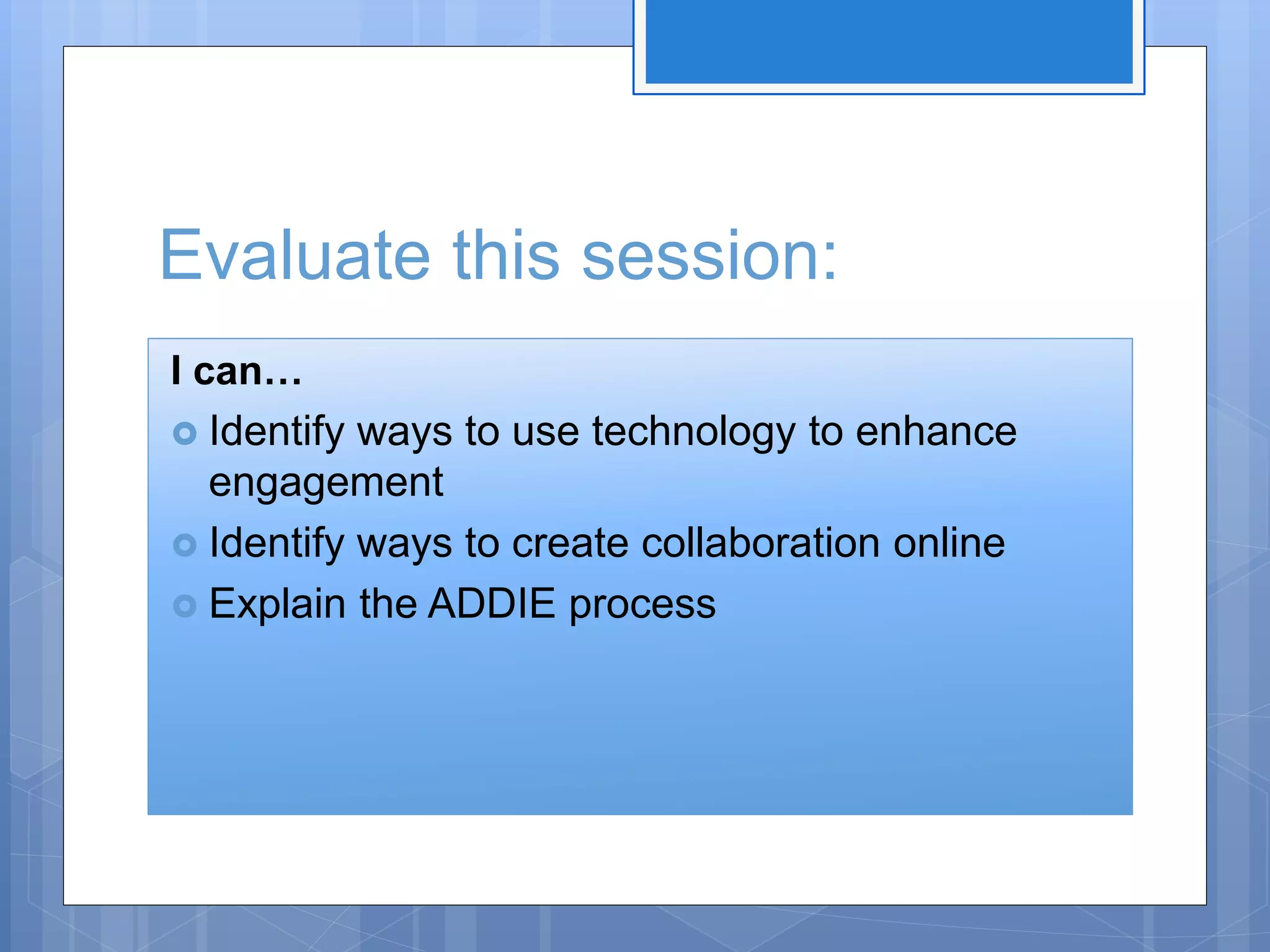
Evaluate this session:
I can…
 Identify ways to use technology to enhance
engagement
 Identify ways to create collaboration online
 Explain the ADDIE process
byu.is/languages
For More Information
 Online: byu.is/languages
Julie Damron
Julie.damron@byu.edu
Jennifer Quinlan
Jennifer.quinlan@byu.edu
References
• ACTFL. (n.d.). Retrieved March 22, 2017, from
https://www.actfl.org/publications/guidelines-and-manuals/actfl-
proficiency-guidelines-2012
• Branch, R. M. (2014). Instructional design: the addie approach.
Springer.
• Lave, J., & Wenger, E. (1998). Situated learning: legitimate peripheral
participation. Cambridge: Cambridge University Press.
• Lloyd, P., & Fernyhough, C. (1999). Lev Vygotsky. critical
assessments: The zone of proximal development. London:
Routledge.
• Vaughan, Norman. Mount Royal University, 2013. National Survey of
Student Engagement, 2011.

Korea 101: A course development adventure

  • 1.
    Korean 101 Online A course development adventure Howwe adapted asynchronous online world language courses to enhance language mastery
  • 2.
    Brigham Young University  >50languages taught regularly, +30 languages  70% speak a second language  6% foreign, >110 countries BYU Independent Study  Around since 1920s  Distance/online/interactive  Global reach  11 languages: HS & university
  • 3.
    -MFS French &Int’l. Education, UW-Madison -Ph.D. student in Instructional Psych & Tech, BYU -academic consultant for blended/online -developed & teaches online French -developed all of BYU’s online & blended world language courses (11 languages) -involved in global literacy initiative -mentor for ACTFL Distance Learning SIG -M.A.T. in TESOL, Vermont -Ph.D. in Linguistics, Purdue -Section Head of Korean in the Department of Asian and Near Eastern Languages -developed and teaches all of BYU’s Independent Study Korean courses and BYU’s new “BYU Online” hybrid Korean classes -Teaching in The U.S. A Guide for International Educators (2014). -reviewer for highly respected journals and organizations (FLA, Fulbright-Hays, Routledge, etc.) Jennifer Quinlan Dr. Julie Damron
  • 4.
    I can…  Identifyways to use technology to enhance engagement  Identify ways to create collaboration online  Explain the ADDIE process
  • 5.
    Guiding Instructional Theories Gagne’s 9 events  Lave & Wegner Community of Learners  Vygotsky Zone of Proximal Development  Vaughn technology for engagement  ADDIE design process  ACTFL 5 C’s
  • 6.
    ADDIE  Analyze  Design Develop  Implement  Evaluate  And revise! Branch, R. M. (2014). Instructional design: the addie approach. Springer.
  • 7.
    Languages Online… really? Astarting point 1. Awareness of ACTFL standards insufficient 2. Dynamic perspective 3. Considerations of student engagement 4. Achieving higher order thinking 5. Adapting content/asynchronous delivery  Classroom concerns  Online concerns Analyze
  • 8.
    How do youintegrate technology? How does it enhance your course? Does it impact your teaching?
  • 9.
    Approaches “A start” (weakersense)  Add on to deficient approaches  Insert technology-based interactions/assignments without follow-up “Good progress” (stronger sense)  Transformative process: improves the educational experience  Capitalize on technology for engagement (Norm Vaughan, Mount Royal University, 2013. National Survey of Student Engagement, 2011.) Design
  • 10.
    “Blended” Considerations Synchronous  spontaneous ephemeral  peer influence  passion  preferred Asynchronous  reflective  permanent  < intimidating  reason  > rigor integrate complement Develop
  • 11.
    Live interactions with instructor/TA Dynamicassessments Immediate feedback Peer interaction Let’s take a look at the course… Implement What We Did…
  • 12.
    Course Orientation Live LessonSchedule Live Lesson Activity Conversation Café Speaking Appointment Discussion Board Course Wiki
  • 16.
    GOALS: What do youhope to accomplish in this course? When do you want to complete? How many hours a week WILL you practice speaking?
  • 17.
    Internal Processes &Corresponding Instructional Events Internal Process Instructional Event Action Example Reception Expectancy Gain attention Abrupt stimulus change Retrieval to working memory Stimulate recall of prior learning Ask for recall of previously learned knowledge or skills Selective perception Present stimulus Display content with distinctive features in cafe Semantic encoding Provide learning guidance Scaffolding in content and café Responding Elicit performance Ask learner to perform Reinforcement Provide feedback Give informative feedback Retrieval & reinforcement Assess performance Require additional learner performance w/feedback Retrieval & generalization Enhance retention & transfer Varied practice & spaced reviews (café participation) Adapted from Gagné, R. M. (1986). The conditions of learning and theory of instruction, p. 246. New York: Holt, Rinehart & Winston.
  • 18.
    What students likemost: Increased motivation Cooperative learning Personalization & flexibility Ability to revisit material Evaluate
  • 19.
    What professors likemost: Increased motivation Peer influence Personalization & flexibility Improved retention/completion
  • 20.
    Takeaways: Challenges (online &F2F) Practice matters Collaboration & synergy Good pedagogy is good!
  • 21.
    Evaluate your program: What matters?  Institutional values  Student/learning values  Pedagogical values  What you value ADDIE model: Analyze, design, develop, implement, evaluate (+ revise)
  • 22.
    Evaluate this session: Ican…  Identify ways to use technology to enhance engagement  Identify ways to create collaboration online  Explain the ADDIE process
  • 23.
  • 24.
    For More Information Online: byu.is/languages Julie Damron Julie.damron@byu.edu Jennifer Quinlan Jennifer.quinlan@byu.edu
  • 25.
    References • ACTFL. (n.d.).Retrieved March 22, 2017, from https://www.actfl.org/publications/guidelines-and-manuals/actfl- proficiency-guidelines-2012 • Branch, R. M. (2014). Instructional design: the addie approach. Springer. • Lave, J., & Wenger, E. (1998). Situated learning: legitimate peripheral participation. Cambridge: Cambridge University Press. • Lloyd, P., & Fernyhough, C. (1999). Lev Vygotsky. critical assessments: The zone of proximal development. London: Routledge. • Vaughan, Norman. Mount Royal University, 2013. National Survey of Student Engagement, 2011.

Editor's Notes

  • #8 Starting point: ANALYZE these are concerns from classroom and from online 1. Dynamic perspective: keeping in mind that this can continue to evolve – get a starting version out there and continue to improve and expand in response to course and student data – this changes how we approach design and development 2. Student engagement (see next slides) 3. Higher order thinking: Historical challenge with languages of getting beyond drill & kill (see subsequent slide) 4. Considerations for potential blended course in the future Peer-to-peer interaction in cafe Creating synchronous interactions using web conferencing & using Camtasia Relay to enhance audio Using campus resources of native speakers to create models
  • #10 Add on to deficient approaches Example: continuing to lecture but adding an optional discussion board interactions/assignments without follow-up Example: complete this assignment and submit it online but no live discussion/feedback or significantly delayed feedback Transformative process that improves the quality of the educational experience Example: redesign deficient approaches or replace them completely with effective approaches Capitalize on the potential of technology for engagement Include immediate/live-feed interactions and feedback to help students progress more successfully
  • #11 When to incorporate F2F or online learning? Things to consider when designing learning activities in blended environment. Few definitive studies re how to blend synchronous and asynchronous. This is what we are reasonably sure of. This influenced, however, by discipline, level of instruction and contextual constraints. Note Katrina Meyer’s research. Examples: F2F better to get started and organized F2F is can generate energy, motivation Online better to discuss, resolve more complex tasks and abstract ideas Online provides sustained engagement, convenience
  • #13 Fostering situated learning (Lave & Wenger) Creating a course community Forum for connection (discussion board, live lessons, café) mixed levels do not impede learning in café but enhance it: Newcomers learn from old timers Mastery of skills/proficiency is evident as learners progress from newcomer to old timer
  • #14 Explains student responsibilities and ways in which they will communicate Interpersonal, interpretive, and presentational
  • #15 Low stakes environment to practice and prepare for graded interactions – a type of formative assessment Elicits performance, feedback, and evaluation, often deficient in classroom setting Implementing Vygotsky: Café students in the zone of proximal development (difference between what a student can do with no help and what they can do with help) – this is an environment where they synthesize and achieve creative output, based on scaffolds and TA/peer support to encourage going beyond their tacit knowledge
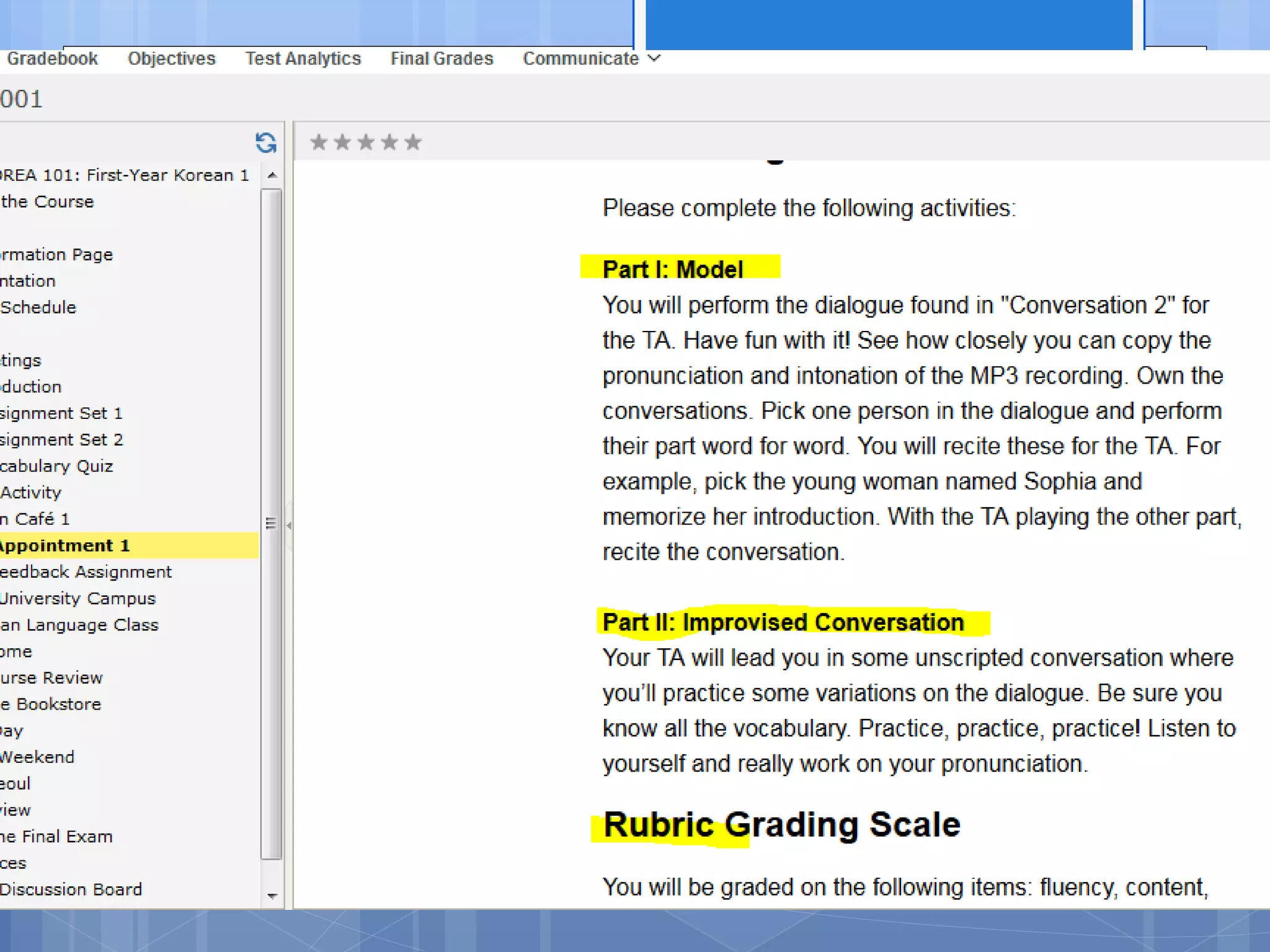
  • #16 Graded one-on-one interactions with two parts. Rubric helps students know exactly what to expect. In future iteration: plan to include video models from past students.
  • #17 Accountability, preparing students for on-going practice & retrieval (gagne)
  • #18 Correlating course model to Gagne’s events and internal processes
  • #19 Students in other language courses have cited café helping increase motivation to speak; enjoy cooperative learning experience Able to get personalized instruction in speaking appointments and live lessons Flexibility to do it at their own pace and work on material any time of day Ability to revisit material over and over, as often as they wish, whenever they wish
  • #20 Students in other language courses have cited café helping increase motivation to speak; enjoy cooperative learning experience Able to get personalized instruction in speaking appointments and live lessons Flexibility to do it at their own pace and work on material any time of day Ability to revisit material over and over, as often as they wish, whenever they wish
  • #21 Students in other language courses have cited café helping increase motivation to speak; enjoy cooperative learning experience Able to get personalized instruction in speaking appointments and live lessons Flexibility to do it at their own pace and work on material any time of day Ability to revisit material over and over, as often as they wish, whenever they wish