Uterine
Compression
Sutures
Dr
Muhammad M El Hennawy
Ob/gyn consultant
Egypt
www.mmhennawy.co.nr
Postpartum hemorrhage (PPH) is the most important
single cause of maternal death in both developing
and developed countries
Excessive bleeding occurs because of an abnormality
in one of four basic processes, referred to in the
“4Ts” mnemonic,either individually or in
combination:
Tone (poor uterine contraction after delivery),
Tissue (retained products of conception or blood
clots),
Trauma (to genital tract), or
Thrombin (coagulation abnormalities).
HAEMOSTASIS algorithm
• H- ask for help
• A- assess (vitals, blood loss) & resuscitate
• E - Establish etiology(tone,tissue,trauma,thrombin)
-Ecbolics (syntometrine,ergometrine)
-Ensure availability of blood
• M - massage the uterus
• O – oxytocin infusion & prostaglandin
• S- shift to operating theatre
Bimanual compression
non pneumatic or pneumatic anti- shock garment
• T- Tissue & trauma to be excluded
• A-apply compression sutures
• S-systematic pelvic devascularisation
• I -interventional radiology
• S-subtotal/total hysterectomy
The golden hour” of
resuscitation:
• “The golden hour” of resuscitation Golden hour is the time by
which resuscitation must be initiated to ensure better survival.
• “Rule of 30” -if
• SBP falls by 30mmHg,
• HR rises by 30beats/min,
• RR ?to 30breaths/min,
• Hct drop by 30%,
• urine output <30ml/hr
• she is likely to have lost at least 30% of her bl vol&is in
moderate shock leading to severe shock.
• Shock index-SBP/HR.normal value-0.5-0.7.with significant
hge -0.9-1.1.better indicator for early acute bl loss.
Stepwise administration of uterotonic drugs
• Starting with intravenous oxytocin, following
with intramuscular Methylergometrin and as
last option prostaglandine derivates as
prostaglandine F2, E2 or misoprostol.
• In hypertensive patients , methylergometrin
should be avoided, as it should be done with
prostaglandins in asthmatic women.
Surgical techniques for controlling
postpartum haemorrhage
• Uterine Fundal massage The left hand is cupped over the uterus and massages it with
a firm motion in a clockwise direction
• Bimanual Uterine compression Bimanual compression,with one hand (made into a fist) in
the vagina and the other compressing the uterus using the other hand to press downwards
• reposition for uterine inversion
• Occlusion of the aorta the surgeon should palpate the aorta a few centimeters superior
to the sacral promontory and compress the aorta just proximal to the bifurcation.
• Uterine tourniquet may be useful as a temporizing measure in PPH to reduce blood loss
• Packing Intrauterine packing was done by using 8-10 meters 8 cm wide gauze starting from
the fundus with the help of sponge holding forceps up to the cervix. Vagina was also firmly
packed to give additional pressure to the uterine packing and balloon Single bakry ,
condom or multiple foley,s no 24F
• Undersuturing placental bed
• Uterine compression suture
• External Elastic Uterine Bandage ( EEUB)
• Uterine artery ligation
• Internal iliac ligation
• Arterial embolisation
• Hysterectomy
• Logethotopulos pack
External Uterine Elastic Bandage
• It is a new approach to control heavy postpartum hemorrhage associated with
coagulopathy
• After circulatory stabilization by external aortic compression , laparotomy ,
identification of the source of bleeding , compression sutures were applied and
intrauterine fibrin glue was administered ,
• two laparotomy pads were placed in front of and behind the uterus and (to avoid
possible diminished myometrial effect of the sutures ) fixed with a gauze
bandage before applying the EUEB
• two wraps of external uterine elastic bandage (EUEB) were placed from the
uterine fundus towards the cervix.
• The use of EUEB reduced the uterine volume by half, which prevented further
uterine bleeding until hemodynamic and hemostatic stabilization was achieved.
• Vascular replacement was performed by balanced infusion of fluids, red blood
cells, plasma, cryoprecipitates and platelets Immediately thereafter ,
• After hemostasis had persisted for some times
• The bandage was removed , and uterus and abdomen were then closed
• Application of external elastic uterine bandage resulted in hemostasis within 45
minutes after aortic compression
• Hysteroscopy 6 months after the procedure showed no signs of uterine
ischemia or endometrial adhesions
• It is a simple tool that seems to improve hemostasis and prevent hysterectomy
in heavy postpartum hemorrhage
Vessels ligation
• Waters – 1952 --selective uterine artery ligation (dissecting out the artery
from the vein ) by chromic
• O’Leary -- 1966 --Bilateral mass ligation of the asending branch of uterine
arteries
(In case of caesarean section, the sutures are placed 2-3 cm below the level of uterine
incision under the reflected peritoneal flap , in non CS-Suture pass At the level of
vesicouterine peritoneal reflection , in bleeding is from a laceration of the uterine vessel, a
similar stitch is placed both above and below the laceration )
• Aleksandrov --1962 --bilateral uterine artery ligation and ligation of one of
utero-ovarian anastmosis
• Tsirulinkov –1975-- bilateral uterine artery ligation and bilateral ligation utero-
ovarian anastmosis and bilateral ligation of arteries in the round ligaments
• AbdRaboo Stepwise uterine devascularization
The steps were (1) unilateral uterine vessel ligation, (2) bilateral uterine vessel
ligation, (3) low uterine vessel ligation( below step one by 3-5 cm), (4)
unilateral ovarian vessel ligation and (5) bilateral ovarian vessel ligation (a
ligature is placed around the utero-ovarian anastomosis )
• Hypogastric artery ligation
First, the UAL ( uterine artery ligation ) success rate 94.7% is likely higher to HAL’s one 69.0%
( hypogastric artery ligation )
Second, to date, no serious adverse events have been reported following UAL contrary to HAL.
Third, UAL is clearly easier to perform and can be rapidly achieved by all physicians similarly to uterine
compression suture and contrary to HAL, which requires a much longer learning curve
Vascular catheters
and embolization
The use of the technique is, of
course, limited by the availability of the
specialized imaging equipment required
(including) a radiology table), and the relative
shortage of suitably trained interventional
radiologists, who must also be on standby to
arrive at short notice for emergency
procedures. Even in units with appropriate
equipment and staff, it will be difficult to
institute such therapy in less than 45 min
Logethotopulos Pack
Uterine
Compression
Sutures
Definition Uterine Compression
Sutures
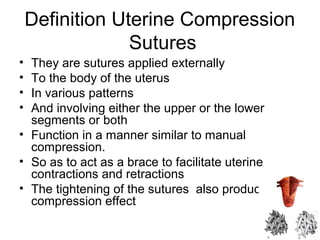
• They are sutures applied externally
• To the body of the uterus
• In various patterns
• And involving either the upper or the lower
segments or both
• Function in a manner similar to manual
compression.
• So as to act as a brace to facilitate uterine
contractions and retractions
• The tightening of the sutures also produce a
compression effect
Epidemiology
• Actual Incidence of the use of this
treatment in the management of
postpartum hemorrhage remains unkown
Pathology
• In cases of normal placentation uncontrolled
hemorrhage from the placental bed can occur due to a
faliure of occlusion of the placenta bed blood vessels
by the contracting myometrium if uterine atony develops
• In cases of abnormal placentation such as placenta
accreta/incerta , retaind adherent placental tissues
interferes with hemeostasis in placental bed , and the
additional effect of uterine atony , whether as a primary
or secondary event , would agrevate the situation
• Therefore , correcting uterine atony and promoting
uterine contraction play key roles in contolling
postpartum hemorrhage
Pathophysiology
• Pathophysiology Blood vessels(spiral arteries)
supplying placental bed pass through an
interlacing network of muscle fibres of
myometrium.
• Myometrial contraction is main driving force for
placental separation & constriction of blood
vessels.
• This hemostasic mechanism is known as
“physiological sutures” or “living ligatures”
• So bleeding occurs from placental beds due to
Uterine atony (myometrium fails to contract) or
Retained products (that interferes contraction)
BIO-PHYSICS FOR CONTROLLING
HAEORRHAGE
• “ YOUNG – LAPELACE “ RELATIONSHIP
• F= 2T/r
• F= The compressive force acting on the uterine vessels.
• T= The wall tension (generated by uterine contraction)
• r = The radius of the uterus
• It is apparent that the force compressing the vessels can not be high
if r is large
• So PPH occurs with atonic overdistended uterus
Indications
• Atonic PPH
• Placenta previa
• Abnormal placentation such as Placenta accreta , increta or
percreta
• Coagulopathy PPh
• Chronic Uterine inversion treatment and prophylaxis against
acute recurrence of uterine inversion
• Prophylactic use in “high risk” patients (high multiples,
suspected accreta )
• With other adjunct treatments for PPH such as intrauterine
balloons or vesels ligation or embolization
• Extension of a low transverse incision
• leiomyomata preventing uterine closure and haemostasis
• Uterine compression sutures can also be used to deal with
uterine trauma secondary to termination of pregnancy in the
second trimester.
Testing of Efficacy for Uterine
Compression Sutures
• With the patient in the semi-lithotomy position
• An assistant , standing between the patient,s legs
• Swabs the vagina to determine the extent of the bleeding
• The operator then exteriorizes the uterus and applies
bimanual compression of the whole uterus down to the
level of the cervix
• If the bleeding is stopped , then the suture has a good
chance of successfully arresting the hemorrhage
Suture Material
• All sutures are classified as either absorbable or non-absorbable depending on
whether the body will naturally degrade and absorb the suture material over time.
• Absorbable suture materials include the original catgut as well as the newer
synthetics polyglycolic acid (Biovek), polylactic acid, polydioxanone, and
caprolactone.
• Non-absorbable sutures are made of special silk or the synthetics polypropylene,
polyester or nylon. Stainless steel wires
• A monocryl suture ( Dexon ,Vicryl ) or catgut , is recommended because it is
user and friendly with uniform tension disribution and it is easy to handle (non-
absorbable sutures that becomes loose in the abdomen after the uterus has involuted
causing problems such as bowel obstruction and stangulation of pelvic organs by cutting
off the blood supply to the tissues /organs trapped within the loose loops also a vascular
necrosis , usually involving partial thickness necrosis of the uterine wall )
• Sutures are sized by the USP (United States Pharmacopoeia) scale
• The available sizes and diameters are:
• 6-0 = 0.07 mm
• 5-0 = 0.10 mm
• 4-0 = 0.15 mm
• 3-0 = 0.20 mm
• 2-0 = 0.30 mm
• 0 = 0.35 mm
• 1 = 0.40 mm
• 2 = 0.5 mm
The Needles
• round
• size 7 or 8
• straight or bend manually to shallow curve
• atraumatic
Clinical approach
• The use of compression uterine sutures should be
considered when ther is a major postpartum hemorrhage
( more than 1000 ml)
• When the uterus has to be conserved
• When conservative and medical methods are unsuccessful
especially
• Following cesarean section for placenta previa , when the
abdomen is already opened
• Compression sutures can be combined with vessel ligation
• Compression sutures can be combined with balloon
tamponade producing uterine sandwich
• In case of vaginal delivery , balloon tamponade can be tried
first , followed by compresion sutures if the former has failed
Types Of Uterine Compression
Sutures
• Vertical
• B-Lynch
• Marasinghe’s
• Bhal
• Hayman,s
• Surabaya Method
• Meydanli
• Nilson and Birch
• Matsubara-Yano
• Tjalma and Jacquemyn
• Muppala
• Hwu
• Pereira
• 4 compression sutures
• Square Sutures
• The Affronti
• Cho
• Single square hemostatic
• Transvere Sutures
• Ouahba
• multiple, interrupted horizontal compression
• Circular isthmic-cervical suture
• Arulkumaran transeverse isthmic-cervical
apposition sutures
• U – Sutures
• Hackethal
• 8 suture
• Single figure-of-eight hemostatic
• multiple 8 suture;
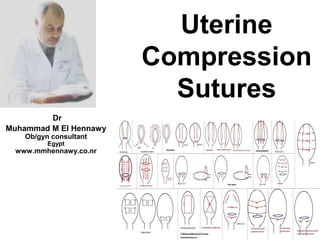
There are different ways of compression suture techniques.
It varies from author to author, from three transversal sutures to different number of longitudinal sutures but all
techniques have the same goal,
the uterus with compressive sutures that is not bleeding any more.
With this procedure the uterus is saved as well as menstrual function and fertility.
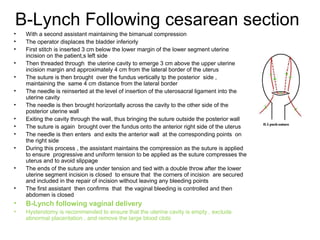
B-Lynch Following cesarean section
• With a second assistant maintaining the bimanual compression
• The operator displaces the bladder inferiorly
• First stitch is inserted 3 cm below the lower margin of the lower segment uterine
incision on the patient,s left side
• Then threaded through the uterine cavity to emerge 3 cm above the upper uterine
incision margin and approximately 4 cm from the lateral border of the uterus
• The suture is then brought over the fundus vertically tp the posterior side ,
maintaining the same 4 cm distance from the lateral border
• The needle is reinserted at the level of insertion of the uterosacral ligament into the
uterine cavity
• The needle is then brought horizontally across the cavity to the other side of the
posterior uterine wall
• Exiting the cavity through the wall, thus bringing the suture outside the posterior wall
• The suture is again brought over the fundus onto the anterior right side of the uterus
• The needle is then enters and exits the anterior wall at the corresponding points on
the right side
• During this process , the assistant maintains the compression as the suture is applied
to ensure progressive and uniform tension to be applied as the suture compresses the
uterus and to avoid slippage
• The ends of the suture are under tension and tied with a double throw after the lower
uterine segment incision is closed to ensure that the corners of incision are secured
and included in the repair of incision without leaving any bleeding points
• The first assistant then confirms that the vaginal bleeding is controlled and then
abdomen is closed
• B-Lynch following vaginal delivery
• Hysterotomy is recommended to ensure that the uterine cavity is empty , exclude
abnormal placentation , and remove the large blood clots
Marasinghe’s procedure
• (A) The needle is inserted into the
inner layer of the anterior wall of
the lower segment and does not
enter into the myometrium.
• (B) The needle is inserted into the
middle layer of the fundus.
• (C) The needle is inserted into the
inner layer of the posterior wall of
the lower segment and does not
enter into the myometrium.
• (D) The two ends of the thread are
tied on the fundus of the uterus.
The procedure is then repeated on
the other side.
Bhal
• After closure of cesarean section incision or
after vaginal delivery
• The suture was inserted at the uterine
fundus , similar to Marasinghe’s procedure
• Do 2 sutures
• Tied the knots side by side
Hayman,s Technique
• Hayman,s technique are 2-4 primary vertical
compression sutures are applied in a similar fashon
to the B-Lynch technique except that the left and
right sides are placed separately without the need to
open up the uterine cavity and knots are tied over
the fundus
• Add Horizontal cervical isthmic sutures
(Arulkumaran ) or Circular isthmic-cervical suture in
case of placenta previa or accreta
• Although quicker to perform
• This method does not allow the uterine cavity to be
explored
Surabaya Method
Surabaya’s Modification B-Lynch surgical technique (Surabaya
Method)
the technique was done by
performing brace suturing way with 3 longitudinally stitches using
chromic catgut no 2 and round needle.
Exteriorize the uterus, after vaginal delivery incision is not needed in
lower uterine segment (LUS)
or the recent lower segment (LS) Cesarean section was sutured.
􀁎 The 1st stitch was placed ± 2 cm below LS incision or at same plane
after vaginal delivery and ± 2 cm medial of the lateral border
The needle was inserted from ventral to dorsal wall of the LUS
􀁎The 2nd stitch was performed using the 1st stitch contra-laterally
􀁎 The 3rd stitch was performed between 1st and 2nd
stitches
􀁎 The assistant compressed the uterus anterior-inferiorly to make
uterus in ante-flexed position.
􀁎 The operator tied the 1st, 2nd and 3rd threads at the fundus while
assistant continued to compress the uterus.
Meydanli
• The suture is placed from the lower
end of the uterus to the top on both
sides to assist in uterine
compression.
• every suture was tied separately
and also tied to each other
• It is used in the surgical
management of postpartum
hemorrhage due to uterine atony
associated with abnormal placental
adherence.
Nilson and Birch 2006
• After a cesarean section
• A large needle with no 2 vicryl thread was inserted 2 cm
below the uterine incision in similar manner to B-Lynch
technique and then brought up vertically and exits the
anterior wall 2cm above the uterine incision , then the
suture was passed through the fundus 3-4 cm medial tp
cornual region and 2-3 cm below the superior aspect of
the fundus
• The needle and suture are then brought back together
the posterior aspect of the lower segment and joined
anteriorly after exiting below the uterine incision
• The process is repeated on the other side
• The suture is tied while bimanual compression of the
uterus is done by an assistant
• The uterus incision is then closed after bleeding has
been seen to be controlled
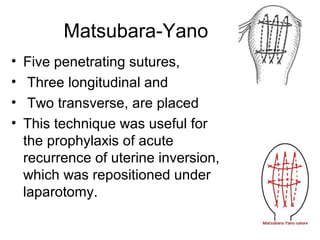
Matsubara-Yano
• Five penetrating sutures,
• Three longitudinal and
• Two transverse, are placed
• This technique was useful for
the prophylaxis of acute
recurrence of uterine inversion,
which was repositioned under
laparotomy.
Tjalma and Jacquemyn 2004
• Placing of short vertical sutures 2 cm
apart in rows of 4 , with the needle
passing from the anterior through the
posterior wall and then back to the
anterior wall , exiting anterior wall about
1 cm medial to the point of initial entry ,
the thread is then tied
Muppala 2006
• 4 parallel vertical sutures
• They were applied to the lower
uterine segment without reopening
the uterine incision
• Using no 1 vicryl suture mounted
on a curved round bodied needle
• The sutures were placed
anteroposteriorly just above the
attachment of the uterosacral
ligament each being 1.5 – 2 cm
apart and the exit point is 2 cm
cranial to entry point in the anterior
wall
Hwu 2006
• 2 sutures
• The needle is placed through
the anterior wall of the lower
segment.
• From inside the uterine cavity,
the stitch is placed in the
middle layer of the posterior
wall of the lower segment.
• The suture is pulled from back
to front through the uterine
cavity and anterior wall of the
lower segment.
Pereira
Pereira et al. (2005) consist of a series of transverse and longitudinal sutures of
multifilament absorbable Vicryl 1 placed around the uterus. Placement of the
sutures involves a series of bites inserted superficially, taking only the
serous membrane and the subserous myometrium without penetrating the
uterine cavity.
Two or three transverse circular sutures are placed first, starting in the anterior
aspect of the uterus, crossing the broad ligament toward the posterior
aspect of the uterus, then crossing the opposite broad ligament toward the
anterior aspect and tying the suture over the anterior aspect of the uterus.
. Furthermore, the small size of the bites applied to the uterus are believed to
reduce the risk of a loop of bowel or the risk of the omentum coming
between the uterus and the suture with puerperal involution.
The combination of several longitudinal and transverse sutures additionally
serves to collapse the lumen of ascending branches of the uterine artery,
reducing thus vascular flow and venous bleeding
Each longitudinal suture started on the dorsal side of the uterus using a knot to
fix it to the lowest circular suture and ended on the ventral side using
another knot attached to the lowest transverse suture
4compression sutures
apply four compression sutures. The first one we start at the back wall
of the uterus from the right sacrouterine ligament, sowing posterior
wall of uterus laterally up to its cornu. , skip the cornu and
continue the same suture on the right front lateral wall , reach the
isthmus of uterus at the level of sascrouterine ligament, sow
through the uterine wall backwards medially of uterine artery,
being careful not to pass through uterine cavity.
With the needle , come at the same spot from which we began. When
we tie the knot, right side of the uterus shrinks.
The second suture is done symmetrically on the left side of uterus.
After these two sutures only the central part of uterus is still stretched.
Two more sutures are applied to press the central part of uterus and
completely stop bleeding.
The third suture begins also from the right sacrouterine ligament one
centimetre medially of the first one. From that spot suture passes
on the back wall of uterus to the left cornu. On the fundus of
uterus it goes medially of the second suture. From the left cornu
suture goes to the right anterior part of isthmus and through the
uterine wall medially of uterine artery is coming backwards at the
spot where it began (
Identically on the other side beginning from the left sacrouterine
ligament
the fourth suture is done.
With these four sutures , the uterus cannot be stretched and the
bleeding stops. Although this surgery needs skilful and
experienced obstetrician
The Affronti suture
The Affronti suture is
essentially a square suture,
limited to the muscular portion of
the uterus and not perforating
the uterine serosa.
CHO Square Sutures
to approximate anteriorand posterior uterine walls until no space is left in the uterine cavity. Thus, bleeding of
the endometrium because of uterine atony or placentation site can be controlled by compression
An arbitrary point in the heavily bleeding area is selected and the entire uterine wall from the serosa of the
anterior wall to the serosa of the posterior wall, through the uterine cavity, is sutured using a number 7
or number 8 surgical straight needle with number 1 atraumatic chromic catgut suture. Another arbitrary point 2
to 3 cm lateral above or below the first suture point is selected, and the entire uterine wall from the
posterior to the anterior is sutured again. From another point in the heavily bleeding area, 2 to 3 cm lateral
above or below the second suture point, we penetrate the uterine cavity walls again, this time from the
anterior to posterior. Then, from the third suture point we set another point so the points form a square
and penetrate the uterine walls from the posterior to the anterior. Finally, a knot is tied as tightly as
possible
If bleeding is caused by uterine atony, four to five square sutures are placed evenly throughout the uterus from
fundus to lower segment.
If bleeding was due to placenta accreta, with bleeding in the placental separation site, the sutures are focused
in two to three areas of heavy bleeding.
By suturing a few areas with this method, the bleeding is controlled by attaching and compressing the anterior
and posterior uterine walls.
If there is bleeding in the lower segment of the transverse incision site of the uterus because of placenta previa,
the hemostatic multiple square sutures can be accomplished by pushing down the bladder
Single Square
Hemostatic Suture
• Single square hemostatic suture
was performed for uterine atony
when postpartum hemorrhage did
not respond to medical therapy
and bilateral uterine artery ligation.
Single Figure-Of-Eight
Hemostatic Suture
Ouahba 2007
4 sutures
• placement of four absorbable uterine compression sutures.
• For each of two transverse sutures, the needle was inserted through
the full thickness of the anterior and posterior walls of the uterus; then
it was continued from a contralateral point (separated by
approximately 8 cm) back through the posterior and anterior walls and
tied, creating a circumferential ligature through the entire body of the
uterus. One transverse suture was placed in the middle of the fundus,
and another was placed in the lower uterine segment (approximately 2
cm below a standard transverse cesarean section incision site).
• The remaining two sutures were placed through the full thickness of
each uterine horn from the middle of the fundus to a point 2 to 3 cm
below each fallopian tube.
Multiple, Interrupted Horizontal
Compression Sutures
• They do not pass through both the anterior
and posterior uterine walls. These sutures
are placed first on the anterior and then on
the posterior wall, if necessary. When tied,
the uterus often gives the appearance of a
contracted uterus
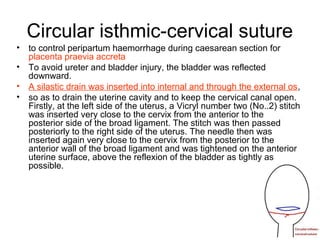
Circular isthmic-cervical suture
• to control peripartum haemorrhage during caesarean section for
placenta praevia accreta
• To avoid ureter and bladder injury, the bladder was reflected
downward.
• A silastic drain was inserted into internal and through the external os,
• so as to drain the uterine cavity and to keep the cervical canal open.
Firstly, at the left side of the uterus, a Vicryl number two (No..2) stitch
was inserted very close to the cervix from the anterior to the
posterior side of the broad ligament. The stitch was then passed
posteriorly to the right side of the uterus. The needle then was
inserted again very close to the cervix from the posterior to the
anterior wall of the broad ligament and was tightened on the anterior
uterine surface, above the reflexion of the bladder as tightly as
possible.
Arulkumaran transeverse full thickness
isthmic-cervical apposition sutures
The uterus was taken out of the abdomen.
The bladder was pushed down to prevent injury to it
and to the ureters. Number 2 chromic catgut
suture on a straight needle was passed through
the uterus above the reflection of the bladder,
about 3 cm below the lower edge of uterine
incision and 2cm medial to the lateral edge of
lower segment, from anterior wall through
posterior wall and brought back from posterior
wall through anterior wall about 1 cm medial to
entry of the suture and tied anteriorly
A pair of closed artery forceps was introduced in the
cervical canal through the uterine incision to
prevent accidental closure of cervical canal.
Similar suture was placed on the other side of
midline
HackethalHackethal et al. 2008 (i.e. Uterine compression using 6–16
horizontal interrupted U-sutures) U-suturing technique
An absorbable Vicryl 0 thread and an XLH needle whose curve had
been straightened manually were used for suturing.
To perform an interrupted single U-suture, the needle was inserted
at the ventral uterine wall, led through the posterior wall and then
passed back to the ventral wall where the thread was joined with
a flat double knot
While the lead surgeon was tying the suture, the assisting
surgeon performed bi-manual uterine compression. The number of
sutures required depended on the size of the uterus and the
persistence of bleeding.
In general, we inserted 6–16 U-sutures in horizontal rows along the
uterus starting at the fundus and ending at the cervix. Thus,
approximately 2–4 cm of tissue was compressed within each suture.
Multiple Figure Of Eight Sutures
• In cases of placenta accreta;
• Post-partum haemorrhage;
• In the transverse lower uterine segment suture
Compression Sutures Of The Lower
Uterine Segment
• Transverse , longitudinal , square or
figure-of-eight are quick and simple
suture techniques seems to be effective in
stopping hemorrhage following complete
placenta previa removal during cesarean
section..
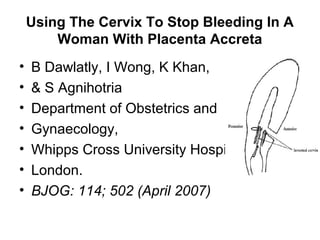
Using The Cervix To Stop Bleeding In A
Woman With Placenta Accreta
• B Dawlatly, I Wong, K Khan,
• & S Agnihotria
• Department of Obstetrics and
• Gynaecology,
• Whipps Cross University Hospital,
• London.
• BJOG: 114; 502 (April 2007)
Uterine Sandwich
• Application of uterine compression suture
in association with intrauterine balloon
tamponade ('uterine sandwich') for
postpartum hemorrhage
• The combined technique was successful in
avoiding hysterectomy in all cases, and there
was no documented postpartum morbidity.
This is a simple and quick surgical technique
that can be used to treat atonic postpartum
hemorrhage, particularly in conjunction with
placenta previa.
The Success Rates Of Preserving uterus
After Uterine Compression Sutures
• 85.1% in uterine atony,
• 80.9% in placenta previa, and
• 40.0% in placenta accreta
Postnatal follow-up
• It should be more frequent
• The first visit preferably at 2 weeks postpartum
• Maternal vital signs and symptoms should be monitored
for the rare complications such as pyometra
• Since absorbable sutures are used , there is no need to
remove them at a later date
• There is no recommendation for routine ultrasound
examination of the uterus and the uterine cavity in
postnatal period, but this should be arranged if there is
any suggestion of complications or if the uterus fails to
involute at the normal rate
Complications
• Asherman syndrome -- It may be linked to the square dead
space in the uterine cavity where endometrial necrosis may
occur
• Haematometra following B-Lynch plus Cho suture
• Pyometra --Occlusion of the cervical lumen is a potential
complication when transverse compression sutures are placed
• Uterine wall partial thickness necrosis--Vertically placed
compression sutures in the uterus using the B-Lynch and
Hayman techniques may obstruct uterine arcuate blood vessels
which run transversely, leading to uterine necrosis.
• Non- absorbable sutures that becomes loose in the abdomen after the
uterus has involuted causing problems such as bowel obstruction and
stangulation of pelvic organs by cutting off the blood supply to the
tissues /organs trapped within the loose loops
• A prolonged delay of 2–6 hours between
delivery and uterine compression suture
was independently associated with a
fourfold increase in the odds of
hysterectomy.
Conclusion
Uterine Compression Sutures are
• Simple
• Effective
• Preserve life
• Preserve uterus
• Preserve menstruation
• Preserve fertility

Uterine compression sutures

  • 1.
    Uterine Compression Sutures Dr Muhammad M ElHennawy Ob/gyn consultant Egypt www.mmhennawy.co.nr
  • 2.
    Postpartum hemorrhage (PPH)is the most important single cause of maternal death in both developing and developed countries Excessive bleeding occurs because of an abnormality in one of four basic processes, referred to in the “4Ts” mnemonic,either individually or in combination: Tone (poor uterine contraction after delivery), Tissue (retained products of conception or blood clots), Trauma (to genital tract), or Thrombin (coagulation abnormalities).
  • 3.
    HAEMOSTASIS algorithm • H-ask for help • A- assess (vitals, blood loss) & resuscitate • E - Establish etiology(tone,tissue,trauma,thrombin) -Ecbolics (syntometrine,ergometrine) -Ensure availability of blood • M - massage the uterus • O – oxytocin infusion & prostaglandin • S- shift to operating theatre Bimanual compression non pneumatic or pneumatic anti- shock garment • T- Tissue & trauma to be excluded • A-apply compression sutures • S-systematic pelvic devascularisation • I -interventional radiology • S-subtotal/total hysterectomy
  • 4.
    The golden hour”of resuscitation: • “The golden hour” of resuscitation Golden hour is the time by which resuscitation must be initiated to ensure better survival. • “Rule of 30” -if • SBP falls by 30mmHg, • HR rises by 30beats/min, • RR ?to 30breaths/min, • Hct drop by 30%, • urine output <30ml/hr • she is likely to have lost at least 30% of her bl vol&is in moderate shock leading to severe shock. • Shock index-SBP/HR.normal value-0.5-0.7.with significant hge -0.9-1.1.better indicator for early acute bl loss.
  • 5.
    Stepwise administration ofuterotonic drugs • Starting with intravenous oxytocin, following with intramuscular Methylergometrin and as last option prostaglandine derivates as prostaglandine F2, E2 or misoprostol. • In hypertensive patients , methylergometrin should be avoided, as it should be done with prostaglandins in asthmatic women.
  • 6.
    Surgical techniques forcontrolling postpartum haemorrhage • Uterine Fundal massage The left hand is cupped over the uterus and massages it with a firm motion in a clockwise direction • Bimanual Uterine compression Bimanual compression,with one hand (made into a fist) in the vagina and the other compressing the uterus using the other hand to press downwards • reposition for uterine inversion • Occlusion of the aorta the surgeon should palpate the aorta a few centimeters superior to the sacral promontory and compress the aorta just proximal to the bifurcation. • Uterine tourniquet may be useful as a temporizing measure in PPH to reduce blood loss • Packing Intrauterine packing was done by using 8-10 meters 8 cm wide gauze starting from the fundus with the help of sponge holding forceps up to the cervix. Vagina was also firmly packed to give additional pressure to the uterine packing and balloon Single bakry , condom or multiple foley,s no 24F • Undersuturing placental bed • Uterine compression suture • External Elastic Uterine Bandage ( EEUB) • Uterine artery ligation • Internal iliac ligation • Arterial embolisation • Hysterectomy • Logethotopulos pack
  • 7.
    External Uterine ElasticBandage • It is a new approach to control heavy postpartum hemorrhage associated with coagulopathy • After circulatory stabilization by external aortic compression , laparotomy , identification of the source of bleeding , compression sutures were applied and intrauterine fibrin glue was administered , • two laparotomy pads were placed in front of and behind the uterus and (to avoid possible diminished myometrial effect of the sutures ) fixed with a gauze bandage before applying the EUEB • two wraps of external uterine elastic bandage (EUEB) were placed from the uterine fundus towards the cervix. • The use of EUEB reduced the uterine volume by half, which prevented further uterine bleeding until hemodynamic and hemostatic stabilization was achieved. • Vascular replacement was performed by balanced infusion of fluids, red blood cells, plasma, cryoprecipitates and platelets Immediately thereafter , • After hemostasis had persisted for some times • The bandage was removed , and uterus and abdomen were then closed • Application of external elastic uterine bandage resulted in hemostasis within 45 minutes after aortic compression • Hysteroscopy 6 months after the procedure showed no signs of uterine ischemia or endometrial adhesions • It is a simple tool that seems to improve hemostasis and prevent hysterectomy in heavy postpartum hemorrhage
  • 8.
    Vessels ligation • Waters– 1952 --selective uterine artery ligation (dissecting out the artery from the vein ) by chromic • O’Leary -- 1966 --Bilateral mass ligation of the asending branch of uterine arteries (In case of caesarean section, the sutures are placed 2-3 cm below the level of uterine incision under the reflected peritoneal flap , in non CS-Suture pass At the level of vesicouterine peritoneal reflection , in bleeding is from a laceration of the uterine vessel, a similar stitch is placed both above and below the laceration ) • Aleksandrov --1962 --bilateral uterine artery ligation and ligation of one of utero-ovarian anastmosis • Tsirulinkov –1975-- bilateral uterine artery ligation and bilateral ligation utero- ovarian anastmosis and bilateral ligation of arteries in the round ligaments • AbdRaboo Stepwise uterine devascularization The steps were (1) unilateral uterine vessel ligation, (2) bilateral uterine vessel ligation, (3) low uterine vessel ligation( below step one by 3-5 cm), (4) unilateral ovarian vessel ligation and (5) bilateral ovarian vessel ligation (a ligature is placed around the utero-ovarian anastomosis ) • Hypogastric artery ligation First, the UAL ( uterine artery ligation ) success rate 94.7% is likely higher to HAL’s one 69.0% ( hypogastric artery ligation ) Second, to date, no serious adverse events have been reported following UAL contrary to HAL. Third, UAL is clearly easier to perform and can be rapidly achieved by all physicians similarly to uterine compression suture and contrary to HAL, which requires a much longer learning curve
  • 9.
    Vascular catheters and embolization Theuse of the technique is, of course, limited by the availability of the specialized imaging equipment required (including) a radiology table), and the relative shortage of suitably trained interventional radiologists, who must also be on standby to arrive at short notice for emergency procedures. Even in units with appropriate equipment and staff, it will be difficult to institute such therapy in less than 45 min
  • 10.
  • 11.
  • 12.
    Definition Uterine Compression Sutures •They are sutures applied externally • To the body of the uterus • In various patterns • And involving either the upper or the lower segments or both • Function in a manner similar to manual compression. • So as to act as a brace to facilitate uterine contractions and retractions • The tightening of the sutures also produce a compression effect
  • 13.
    Epidemiology • Actual Incidenceof the use of this treatment in the management of postpartum hemorrhage remains unkown
  • 14.
    Pathology • In casesof normal placentation uncontrolled hemorrhage from the placental bed can occur due to a faliure of occlusion of the placenta bed blood vessels by the contracting myometrium if uterine atony develops • In cases of abnormal placentation such as placenta accreta/incerta , retaind adherent placental tissues interferes with hemeostasis in placental bed , and the additional effect of uterine atony , whether as a primary or secondary event , would agrevate the situation • Therefore , correcting uterine atony and promoting uterine contraction play key roles in contolling postpartum hemorrhage
  • 15.
    Pathophysiology • Pathophysiology Bloodvessels(spiral arteries) supplying placental bed pass through an interlacing network of muscle fibres of myometrium. • Myometrial contraction is main driving force for placental separation & constriction of blood vessels. • This hemostasic mechanism is known as “physiological sutures” or “living ligatures” • So bleeding occurs from placental beds due to Uterine atony (myometrium fails to contract) or Retained products (that interferes contraction)
  • 16.
    BIO-PHYSICS FOR CONTROLLING HAEORRHAGE •“ YOUNG – LAPELACE “ RELATIONSHIP • F= 2T/r • F= The compressive force acting on the uterine vessels. • T= The wall tension (generated by uterine contraction) • r = The radius of the uterus • It is apparent that the force compressing the vessels can not be high if r is large • So PPH occurs with atonic overdistended uterus
  • 17.
    Indications • Atonic PPH •Placenta previa • Abnormal placentation such as Placenta accreta , increta or percreta • Coagulopathy PPh • Chronic Uterine inversion treatment and prophylaxis against acute recurrence of uterine inversion • Prophylactic use in “high risk” patients (high multiples, suspected accreta ) • With other adjunct treatments for PPH such as intrauterine balloons or vesels ligation or embolization • Extension of a low transverse incision • leiomyomata preventing uterine closure and haemostasis • Uterine compression sutures can also be used to deal with uterine trauma secondary to termination of pregnancy in the second trimester.
  • 18.
    Testing of Efficacyfor Uterine Compression Sutures • With the patient in the semi-lithotomy position • An assistant , standing between the patient,s legs • Swabs the vagina to determine the extent of the bleeding • The operator then exteriorizes the uterus and applies bimanual compression of the whole uterus down to the level of the cervix • If the bleeding is stopped , then the suture has a good chance of successfully arresting the hemorrhage
  • 19.
    Suture Material • Allsutures are classified as either absorbable or non-absorbable depending on whether the body will naturally degrade and absorb the suture material over time. • Absorbable suture materials include the original catgut as well as the newer synthetics polyglycolic acid (Biovek), polylactic acid, polydioxanone, and caprolactone. • Non-absorbable sutures are made of special silk or the synthetics polypropylene, polyester or nylon. Stainless steel wires • A monocryl suture ( Dexon ,Vicryl ) or catgut , is recommended because it is user and friendly with uniform tension disribution and it is easy to handle (non- absorbable sutures that becomes loose in the abdomen after the uterus has involuted causing problems such as bowel obstruction and stangulation of pelvic organs by cutting off the blood supply to the tissues /organs trapped within the loose loops also a vascular necrosis , usually involving partial thickness necrosis of the uterine wall ) • Sutures are sized by the USP (United States Pharmacopoeia) scale • The available sizes and diameters are: • 6-0 = 0.07 mm • 5-0 = 0.10 mm • 4-0 = 0.15 mm • 3-0 = 0.20 mm • 2-0 = 0.30 mm • 0 = 0.35 mm • 1 = 0.40 mm • 2 = 0.5 mm
  • 20.
    The Needles • round •size 7 or 8 • straight or bend manually to shallow curve • atraumatic
  • 21.
    Clinical approach • Theuse of compression uterine sutures should be considered when ther is a major postpartum hemorrhage ( more than 1000 ml) • When the uterus has to be conserved • When conservative and medical methods are unsuccessful especially • Following cesarean section for placenta previa , when the abdomen is already opened • Compression sutures can be combined with vessel ligation • Compression sutures can be combined with balloon tamponade producing uterine sandwich • In case of vaginal delivery , balloon tamponade can be tried first , followed by compresion sutures if the former has failed
  • 23.
    Types Of UterineCompression Sutures • Vertical • B-Lynch • Marasinghe’s • Bhal • Hayman,s • Surabaya Method • Meydanli • Nilson and Birch • Matsubara-Yano • Tjalma and Jacquemyn • Muppala • Hwu • Pereira • 4 compression sutures • Square Sutures • The Affronti • Cho • Single square hemostatic • Transvere Sutures • Ouahba • multiple, interrupted horizontal compression • Circular isthmic-cervical suture • Arulkumaran transeverse isthmic-cervical apposition sutures • U – Sutures • Hackethal • 8 suture • Single figure-of-eight hemostatic • multiple 8 suture; There are different ways of compression suture techniques. It varies from author to author, from three transversal sutures to different number of longitudinal sutures but all techniques have the same goal, the uterus with compressive sutures that is not bleeding any more. With this procedure the uterus is saved as well as menstrual function and fertility.
  • 24.
    B-Lynch Following cesareansection • With a second assistant maintaining the bimanual compression • The operator displaces the bladder inferiorly • First stitch is inserted 3 cm below the lower margin of the lower segment uterine incision on the patient,s left side • Then threaded through the uterine cavity to emerge 3 cm above the upper uterine incision margin and approximately 4 cm from the lateral border of the uterus • The suture is then brought over the fundus vertically tp the posterior side , maintaining the same 4 cm distance from the lateral border • The needle is reinserted at the level of insertion of the uterosacral ligament into the uterine cavity • The needle is then brought horizontally across the cavity to the other side of the posterior uterine wall • Exiting the cavity through the wall, thus bringing the suture outside the posterior wall • The suture is again brought over the fundus onto the anterior right side of the uterus • The needle is then enters and exits the anterior wall at the corresponding points on the right side • During this process , the assistant maintains the compression as the suture is applied to ensure progressive and uniform tension to be applied as the suture compresses the uterus and to avoid slippage • The ends of the suture are under tension and tied with a double throw after the lower uterine segment incision is closed to ensure that the corners of incision are secured and included in the repair of incision without leaving any bleeding points • The first assistant then confirms that the vaginal bleeding is controlled and then abdomen is closed • B-Lynch following vaginal delivery • Hysterotomy is recommended to ensure that the uterine cavity is empty , exclude abnormal placentation , and remove the large blood clots
  • 25.
    Marasinghe’s procedure • (A)The needle is inserted into the inner layer of the anterior wall of the lower segment and does not enter into the myometrium. • (B) The needle is inserted into the middle layer of the fundus. • (C) The needle is inserted into the inner layer of the posterior wall of the lower segment and does not enter into the myometrium. • (D) The two ends of the thread are tied on the fundus of the uterus. The procedure is then repeated on the other side.
  • 26.
    Bhal • After closureof cesarean section incision or after vaginal delivery • The suture was inserted at the uterine fundus , similar to Marasinghe’s procedure • Do 2 sutures • Tied the knots side by side
  • 27.
    Hayman,s Technique • Hayman,stechnique are 2-4 primary vertical compression sutures are applied in a similar fashon to the B-Lynch technique except that the left and right sides are placed separately without the need to open up the uterine cavity and knots are tied over the fundus • Add Horizontal cervical isthmic sutures (Arulkumaran ) or Circular isthmic-cervical suture in case of placenta previa or accreta • Although quicker to perform • This method does not allow the uterine cavity to be explored
  • 28.
    Surabaya Method Surabaya’s ModificationB-Lynch surgical technique (Surabaya Method) the technique was done by performing brace suturing way with 3 longitudinally stitches using chromic catgut no 2 and round needle. Exteriorize the uterus, after vaginal delivery incision is not needed in lower uterine segment (LUS) or the recent lower segment (LS) Cesarean section was sutured. 􀁎 The 1st stitch was placed ± 2 cm below LS incision or at same plane after vaginal delivery and ± 2 cm medial of the lateral border The needle was inserted from ventral to dorsal wall of the LUS 􀁎The 2nd stitch was performed using the 1st stitch contra-laterally 􀁎 The 3rd stitch was performed between 1st and 2nd stitches 􀁎 The assistant compressed the uterus anterior-inferiorly to make uterus in ante-flexed position. 􀁎 The operator tied the 1st, 2nd and 3rd threads at the fundus while assistant continued to compress the uterus.
  • 29.
    Meydanli • The sutureis placed from the lower end of the uterus to the top on both sides to assist in uterine compression. • every suture was tied separately and also tied to each other • It is used in the surgical management of postpartum hemorrhage due to uterine atony associated with abnormal placental adherence.
  • 30.
    Nilson and Birch2006 • After a cesarean section • A large needle with no 2 vicryl thread was inserted 2 cm below the uterine incision in similar manner to B-Lynch technique and then brought up vertically and exits the anterior wall 2cm above the uterine incision , then the suture was passed through the fundus 3-4 cm medial tp cornual region and 2-3 cm below the superior aspect of the fundus • The needle and suture are then brought back together the posterior aspect of the lower segment and joined anteriorly after exiting below the uterine incision • The process is repeated on the other side • The suture is tied while bimanual compression of the uterus is done by an assistant • The uterus incision is then closed after bleeding has been seen to be controlled
  • 31.
    Matsubara-Yano • Five penetratingsutures, • Three longitudinal and • Two transverse, are placed • This technique was useful for the prophylaxis of acute recurrence of uterine inversion, which was repositioned under laparotomy.
  • 32.
    Tjalma and Jacquemyn2004 • Placing of short vertical sutures 2 cm apart in rows of 4 , with the needle passing from the anterior through the posterior wall and then back to the anterior wall , exiting anterior wall about 1 cm medial to the point of initial entry , the thread is then tied
  • 33.
    Muppala 2006 • 4parallel vertical sutures • They were applied to the lower uterine segment without reopening the uterine incision • Using no 1 vicryl suture mounted on a curved round bodied needle • The sutures were placed anteroposteriorly just above the attachment of the uterosacral ligament each being 1.5 – 2 cm apart and the exit point is 2 cm cranial to entry point in the anterior wall
  • 34.
    Hwu 2006 • 2sutures • The needle is placed through the anterior wall of the lower segment. • From inside the uterine cavity, the stitch is placed in the middle layer of the posterior wall of the lower segment. • The suture is pulled from back to front through the uterine cavity and anterior wall of the lower segment.
  • 35.
    Pereira Pereira et al.(2005) consist of a series of transverse and longitudinal sutures of multifilament absorbable Vicryl 1 placed around the uterus. Placement of the sutures involves a series of bites inserted superficially, taking only the serous membrane and the subserous myometrium without penetrating the uterine cavity. Two or three transverse circular sutures are placed first, starting in the anterior aspect of the uterus, crossing the broad ligament toward the posterior aspect of the uterus, then crossing the opposite broad ligament toward the anterior aspect and tying the suture over the anterior aspect of the uterus. . Furthermore, the small size of the bites applied to the uterus are believed to reduce the risk of a loop of bowel or the risk of the omentum coming between the uterus and the suture with puerperal involution. The combination of several longitudinal and transverse sutures additionally serves to collapse the lumen of ascending branches of the uterine artery, reducing thus vascular flow and venous bleeding Each longitudinal suture started on the dorsal side of the uterus using a knot to fix it to the lowest circular suture and ended on the ventral side using another knot attached to the lowest transverse suture
  • 36.
    4compression sutures apply fourcompression sutures. The first one we start at the back wall of the uterus from the right sacrouterine ligament, sowing posterior wall of uterus laterally up to its cornu. , skip the cornu and continue the same suture on the right front lateral wall , reach the isthmus of uterus at the level of sascrouterine ligament, sow through the uterine wall backwards medially of uterine artery, being careful not to pass through uterine cavity. With the needle , come at the same spot from which we began. When we tie the knot, right side of the uterus shrinks. The second suture is done symmetrically on the left side of uterus. After these two sutures only the central part of uterus is still stretched. Two more sutures are applied to press the central part of uterus and completely stop bleeding. The third suture begins also from the right sacrouterine ligament one centimetre medially of the first one. From that spot suture passes on the back wall of uterus to the left cornu. On the fundus of uterus it goes medially of the second suture. From the left cornu suture goes to the right anterior part of isthmus and through the uterine wall medially of uterine artery is coming backwards at the spot where it began ( Identically on the other side beginning from the left sacrouterine ligament the fourth suture is done. With these four sutures , the uterus cannot be stretched and the bleeding stops. Although this surgery needs skilful and experienced obstetrician
  • 37.
    The Affronti suture TheAffronti suture is essentially a square suture, limited to the muscular portion of the uterus and not perforating the uterine serosa.
  • 38.
    CHO Square Sutures toapproximate anteriorand posterior uterine walls until no space is left in the uterine cavity. Thus, bleeding of the endometrium because of uterine atony or placentation site can be controlled by compression An arbitrary point in the heavily bleeding area is selected and the entire uterine wall from the serosa of the anterior wall to the serosa of the posterior wall, through the uterine cavity, is sutured using a number 7 or number 8 surgical straight needle with number 1 atraumatic chromic catgut suture. Another arbitrary point 2 to 3 cm lateral above or below the first suture point is selected, and the entire uterine wall from the posterior to the anterior is sutured again. From another point in the heavily bleeding area, 2 to 3 cm lateral above or below the second suture point, we penetrate the uterine cavity walls again, this time from the anterior to posterior. Then, from the third suture point we set another point so the points form a square and penetrate the uterine walls from the posterior to the anterior. Finally, a knot is tied as tightly as possible If bleeding is caused by uterine atony, four to five square sutures are placed evenly throughout the uterus from fundus to lower segment. If bleeding was due to placenta accreta, with bleeding in the placental separation site, the sutures are focused in two to three areas of heavy bleeding. By suturing a few areas with this method, the bleeding is controlled by attaching and compressing the anterior and posterior uterine walls. If there is bleeding in the lower segment of the transverse incision site of the uterus because of placenta previa, the hemostatic multiple square sutures can be accomplished by pushing down the bladder
  • 39.
    Single Square Hemostatic Suture •Single square hemostatic suture was performed for uterine atony when postpartum hemorrhage did not respond to medical therapy and bilateral uterine artery ligation.
  • 40.
  • 41.
    Ouahba 2007 4 sutures •placement of four absorbable uterine compression sutures. • For each of two transverse sutures, the needle was inserted through the full thickness of the anterior and posterior walls of the uterus; then it was continued from a contralateral point (separated by approximately 8 cm) back through the posterior and anterior walls and tied, creating a circumferential ligature through the entire body of the uterus. One transverse suture was placed in the middle of the fundus, and another was placed in the lower uterine segment (approximately 2 cm below a standard transverse cesarean section incision site). • The remaining two sutures were placed through the full thickness of each uterine horn from the middle of the fundus to a point 2 to 3 cm below each fallopian tube.
  • 42.
    Multiple, Interrupted Horizontal CompressionSutures • They do not pass through both the anterior and posterior uterine walls. These sutures are placed first on the anterior and then on the posterior wall, if necessary. When tied, the uterus often gives the appearance of a contracted uterus
  • 43.
    Circular isthmic-cervical suture •to control peripartum haemorrhage during caesarean section for placenta praevia accreta • To avoid ureter and bladder injury, the bladder was reflected downward. • A silastic drain was inserted into internal and through the external os, • so as to drain the uterine cavity and to keep the cervical canal open. Firstly, at the left side of the uterus, a Vicryl number two (No..2) stitch was inserted very close to the cervix from the anterior to the posterior side of the broad ligament. The stitch was then passed posteriorly to the right side of the uterus. The needle then was inserted again very close to the cervix from the posterior to the anterior wall of the broad ligament and was tightened on the anterior uterine surface, above the reflexion of the bladder as tightly as possible.
  • 44.
    Arulkumaran transeverse fullthickness isthmic-cervical apposition sutures The uterus was taken out of the abdomen. The bladder was pushed down to prevent injury to it and to the ureters. Number 2 chromic catgut suture on a straight needle was passed through the uterus above the reflection of the bladder, about 3 cm below the lower edge of uterine incision and 2cm medial to the lateral edge of lower segment, from anterior wall through posterior wall and brought back from posterior wall through anterior wall about 1 cm medial to entry of the suture and tied anteriorly A pair of closed artery forceps was introduced in the cervical canal through the uterine incision to prevent accidental closure of cervical canal. Similar suture was placed on the other side of midline
  • 45.
    HackethalHackethal et al.2008 (i.e. Uterine compression using 6–16 horizontal interrupted U-sutures) U-suturing technique An absorbable Vicryl 0 thread and an XLH needle whose curve had been straightened manually were used for suturing. To perform an interrupted single U-suture, the needle was inserted at the ventral uterine wall, led through the posterior wall and then passed back to the ventral wall where the thread was joined with a flat double knot While the lead surgeon was tying the suture, the assisting surgeon performed bi-manual uterine compression. The number of sutures required depended on the size of the uterus and the persistence of bleeding. In general, we inserted 6–16 U-sutures in horizontal rows along the uterus starting at the fundus and ending at the cervix. Thus, approximately 2–4 cm of tissue was compressed within each suture.
  • 46.
    Multiple Figure OfEight Sutures • In cases of placenta accreta; • Post-partum haemorrhage; • In the transverse lower uterine segment suture
  • 47.
    Compression Sutures OfThe Lower Uterine Segment • Transverse , longitudinal , square or figure-of-eight are quick and simple suture techniques seems to be effective in stopping hemorrhage following complete placenta previa removal during cesarean section..
  • 48.
    Using The CervixTo Stop Bleeding In A Woman With Placenta Accreta • B Dawlatly, I Wong, K Khan, • & S Agnihotria • Department of Obstetrics and • Gynaecology, • Whipps Cross University Hospital, • London. • BJOG: 114; 502 (April 2007)
  • 49.
    Uterine Sandwich • Applicationof uterine compression suture in association with intrauterine balloon tamponade ('uterine sandwich') for postpartum hemorrhage • The combined technique was successful in avoiding hysterectomy in all cases, and there was no documented postpartum morbidity. This is a simple and quick surgical technique that can be used to treat atonic postpartum hemorrhage, particularly in conjunction with placenta previa.
  • 50.
    The Success RatesOf Preserving uterus After Uterine Compression Sutures • 85.1% in uterine atony, • 80.9% in placenta previa, and • 40.0% in placenta accreta
  • 51.
    Postnatal follow-up • Itshould be more frequent • The first visit preferably at 2 weeks postpartum • Maternal vital signs and symptoms should be monitored for the rare complications such as pyometra • Since absorbable sutures are used , there is no need to remove them at a later date • There is no recommendation for routine ultrasound examination of the uterus and the uterine cavity in postnatal period, but this should be arranged if there is any suggestion of complications or if the uterus fails to involute at the normal rate
  • 52.
    Complications • Asherman syndrome-- It may be linked to the square dead space in the uterine cavity where endometrial necrosis may occur • Haematometra following B-Lynch plus Cho suture • Pyometra --Occlusion of the cervical lumen is a potential complication when transverse compression sutures are placed • Uterine wall partial thickness necrosis--Vertically placed compression sutures in the uterus using the B-Lynch and Hayman techniques may obstruct uterine arcuate blood vessels which run transversely, leading to uterine necrosis. • Non- absorbable sutures that becomes loose in the abdomen after the uterus has involuted causing problems such as bowel obstruction and stangulation of pelvic organs by cutting off the blood supply to the tissues /organs trapped within the loose loops
  • 53.
    • A prolongeddelay of 2–6 hours between delivery and uterine compression suture was independently associated with a fourfold increase in the odds of hysterectomy.
  • 54.
    Conclusion Uterine Compression Suturesare • Simple • Effective • Preserve life • Preserve uterus • Preserve menstruation • Preserve fertility