RECURRENT PREGNANCY LOSS
PANEL DISCUSSION
DR. NIRANJAN CHAVAN
MD, FCPS, DGO, MICOG, DICOG, FICOG, DFP,
DIPLOMA IN ENDOSCOPY (USA)
Professor And Unit Chief, L.T.M.M.C&L.T.M.G.H, Sion Hospital
National Co-ordinator, FOGSI Medical in Pregnancy Committee (2019-
2021)
Chairperson, FOGSI Oncology & TT Committee (2012-2014)
Secretary MOGS (2019-2020), Premises Secretary, AFG (2019-2020)
Chair & Convenor, FOGSI Cell Violence Against Doctors (2015-2016)
Dean and Chairman, Academia of Global Obstetrician &
Gynaecologists
Chief Editors, AFG Times (2015-2016)
Course Coordinator of 11 batches Of MUHS recognised
Certificate Course of B.I.M.I.E at L.T.M.G.H (2010-2016)
Member, Oncology Committee AOFOG (2013-2015)
Member, Managing Committee, IAGE (2013-2017), (2018-2020)
Editorial Board, European Journal of Gynaec. Oncology (Italy)
Course Coordinator of 3 batches 0f Advanced Minimal Access
Gynaec Surgery (AMAS) at LTMGH (2018 -2019)
“………I recall nothing which in times past has caused me
more anxiety and doubt,
or
in regard to which I have found it more difficult to get
any satisfactory rules from books,
than the treatment of
Abortion.”
- T. G. Thomas (1908)
What are the common questions asked by
RPL patients?
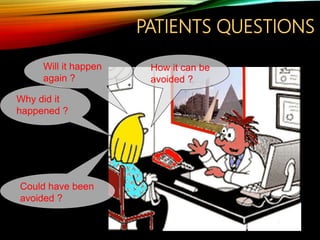
PATIENTS QUESTIONS
Why did it
happened ?
Will it happen
again ?
How it can be
avoided ?
Could have been
avoided ?
What is the incidence of RPL?
• Spontaneous pregnancy loss is, in fact, the most common
complication of pregnancy
• About 70% of human conceptions fail to achieve viability
• estimated 50% are lost before the first missed menstrual
period
• Most of preg. Losses are unrecognized.
• Actual rate of preg. Loss after implantation is 31%(by hCG
assay)
• Clinically recognized, loss occurs in 15% before 20wks of
gestation.
SPONTANEOUS ABORTIONS
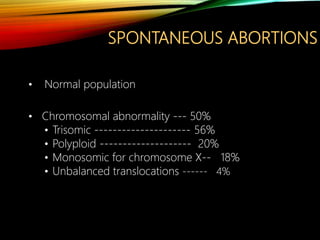
• Normal population
• Chromosomal abnormality --- 50%
• Trisomic --------------------- 56%
• Polyploid -------------------- 20%
• Monosomic for chromosome X-- 18%
• Unbalanced translocations ------ 4%
• What is the Definition of RPL?
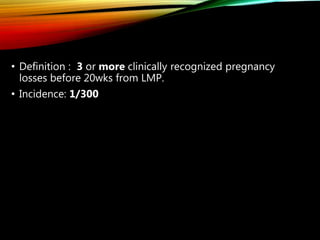
• Definition : 3 or more clinically recognized pregnancy
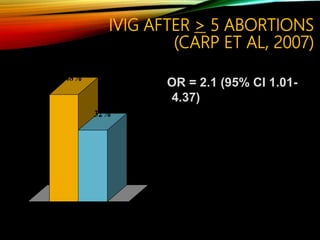
losses before 20wks from LMP.
• Incidence: 1/300
• Primary recurrent pregnancy loss refers to couples that
have never had a live birth
• while "secondary RPL" refers to those who have had
repetitive losses following a successful pregnancy
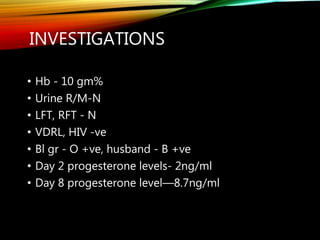
CAUSES OF PREGNANCY LOSS
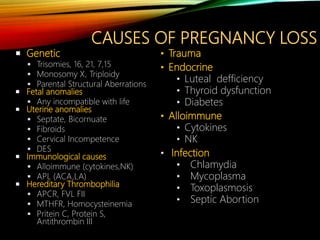
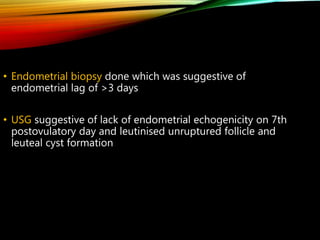
 Genetic
 Trisomies, 16, 21, 7,15
 Monosomy X, Triploidy
 Parental Structural Aberrations
 Fetal anomalies
 Any incompatible with life
 Uterine anomalies
 Septate, Bicornuate
 Fibroids
 Cervical Incompetence
 DES
 Immunological causes
 Alloimmune (cytokines,NK)
 APL (ACA,LA)
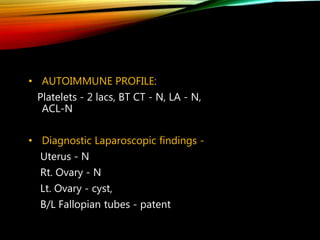
 Hereditary Thrombophilia
 APCR, FVL FII
 MTHFR, Homocysteinemia
 Pritein C, Protein S,
Antithrombin III
• Trauma
• Endocrine
• Luteal defficiency
• Thyroid dysfunction
• Diabetes
• Alloimmune
• Cytokines
• NK
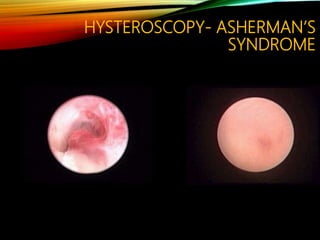
• Infection
• Chlamydia
• Mycoplasma
• Toxoplasmosis
• Septic Abortion
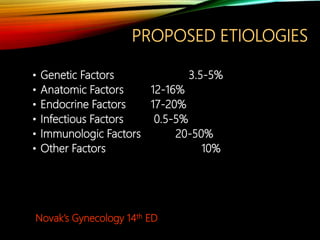
PROPOSED ETIOLOGIES
• Genetic Factors 3.5-5%
• Anatomic Factors 12-16%
• Endocrine Factors 17-20%
• Infectious Factors 0.5-5%
• Immunologic Factors 20-50%
• Other Factors 10%
Novak’s Gynecology 14th ED
• Is it important to establish the gestational age of
these pregnancies ??
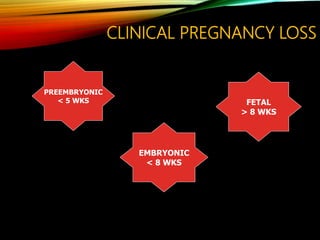
CLINICAL PREGNANCY LOSS
PREEMBRYONIC
< 5 WKS
EMBRYONIC
< 8 WKS
FETAL
> 8 WKS
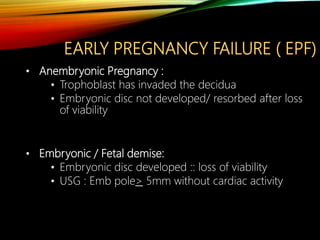
EARLY PREGNANCY FAILURE ( EPF)
• Anembryonic Pregnancy :
• Trophoblast has invaded the decidua
• Embryonic disc not developed/ resorbed after loss
of viability
• Embryonic / Fetal demise:
• Embryonic disc developed :: loss of viability
• USG : Emb pole> 5mm without cardiac activity
• On ultrasound do we have any milestones by which we
can predict the outcome?
THRESHOLD ???
• MSD
• 20 mm without yolk sac
• 25mm without embryo :
• TAS : anembryonic pregnancy
• Rate of increase in MSD : parameter
• < 0.6 mm/day
• Increase of <3 mm over 5 days
• Increase of < 4 mm over 7 days
• When shall we start investigations?
• Clinical Investigation should be started after two
consecutive spontaneous abortions, especially
• When fetal heart activity had been identified prior to
the pregnancy loss
• when the women is older than 35 yrs of age
• when the couple has had difficulty conceiving
Are there any biochemical markers to predict the
outcome?
BIOMARKERS
• HCG
• Progesterone
• 17 α Hydroxy progesterone
• Inhibin A
• Inhibin Pro - α C
• IGFBP I
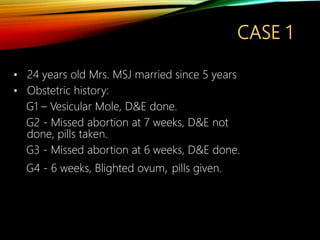
CASE 1
• 24 years old Mrs. MSJ married since 5 years
• Obstetric history:
G1 – Vesicular Mole, D&E done.
G2 - Missed abortion at 7 weeks, D&E not
done, pills taken.
G3 - Missed abortion at 6 weeks, D&E done.
G4 - 6 weeks, Blighted ovum, pills given.
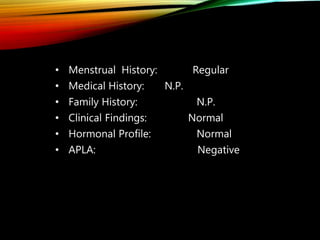
• Menstrual History: Regular
• Medical History: N.P.
• Family History: N.P.
• Clinical Findings: Normal
• Hormonal Profile: Normal
• APLA: Negative
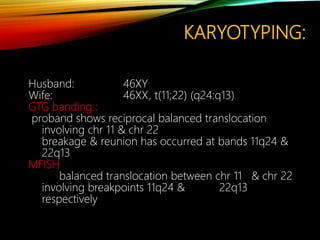
KARYOTYPING:
Husband: 46XY
Wife: 46XX, t(11;22) (q24:q13)
GTG banding :
proband shows reciprocal balanced translocation
involving chr 11 & chr 22
breakage & reunion has occurred at bands 11q24 &
22q13
MFISH
balanced translocation between chr 11 & chr 22
involving breakpoints 11q24 & 22q13
respectively
Cytogenetic Studies of the
conceptus
Should we always do them ?
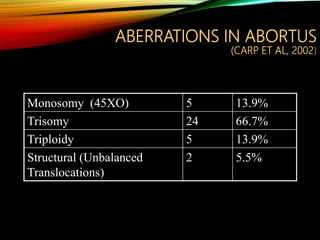
13.9%5Monosomy (45XO)
66.7%24Trisomy
13.9%5Triploidy
5.5%2Structural (Unbalanced
Translocations)
ABERRATIONS IN ABORTUS
(CARP ET AL, 2002)
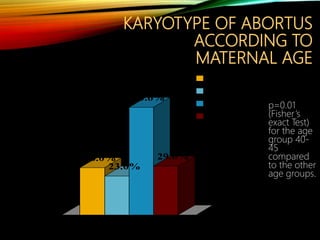
28.0%
23.0%
63.6%
29.0%
0%
10%
20%
30%
40%
50%
60%
70%
20-30
30-40
40-45
Total
KARYOTYPE OF ABORTUS
ACCORDING TO
MATERNAL AGE
p=0.01
(Fisher’s
exact Test)
for the age
group 40-
45
compared
to the other
age groups.
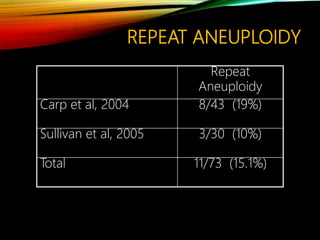
REPEAT ANEUPLOIDY
Repeat
Aneuploidy
8/43 (19%)Carp et al, 2004
3/30 (10%)Sullivan et al, 2005
11/73 (15.1%)Total
• What are the RCOG guidelines?
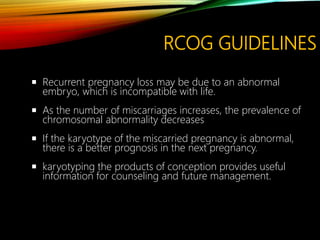
RCOG GUIDELINES
 Recurrent pregnancy loss may be due to an abnormal
embryo, which is incompatible with life.
 As the number of miscarriages increases, the prevalence of
chromosomal abnormality decreases
 If the karyotype of the miscarried pregnancy is abnormal,
there is a better prognosis in the next pregnancy.
 karyotyping the products of conception provides useful
information for counseling and future management.
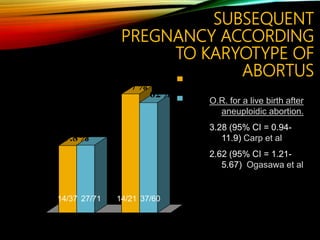
SUBSEQUENT
PREGNANCY ACCORDING
TO KARYOTYPE OF
ABORTUS
37.8%
38%
67%
62%
0%
10%
20%
30%
40%
50%
60%
70%
Euploidy Aneuploidy
Carp
Ogasawara
14/37 14/2127/71 37/60
O.R. for a live birth after
aneuploidic abortion.
3.28 (95% CI = 0.94-
11.9) Carp et al
2.62 (95% CI = 1.21-
5.67) Ogasawa et al
GENETIC COUNSELING
AFTER A MISCARRIAGE
• In all couples with a history of recurrent miscarriage
cytogenetic analysis of the products of conception
should be performed if the next pregnancy fails.
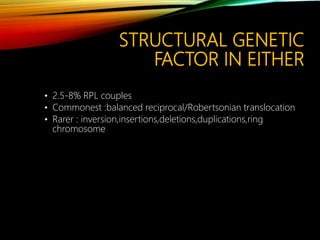
• What is the role of Parenteral karyotype ??
STRUCTURAL GENETIC
FACTOR IN EITHER
• 2.5-8% RPL couples
• Commonest :balanced reciprocal/Robertsonian translocation
• Rarer : inversion,insertions,deletions,duplications,ring
chromosome
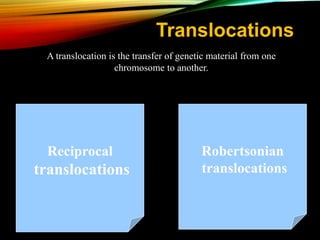
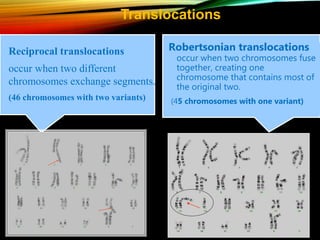
Translocations
Reciprocal
translocations
Robertsonian
translocations
A translocation is the transfer of genetic material from one
chromosome to another.
Robertsonian translocations
occur when two chromosomes fuse
together, creating one
chromosome that contains most of
the original two.
(45 chromosomes with one variant)
Translocations
Reciprocal translocations
occur when two different
chromosomes exchange segments.
(46 chromosomes with two variants)
ROBERTSONIAN
TRANSLOCATION
• Robertsonian translocations between chromosomes 14 and 21,
one of the most common combinations, are of particular clinical
relevance. An individual with this translocation could have a
child with three copies of chromosome 21, resulting in Down’s
syndrome (trisomy 21).
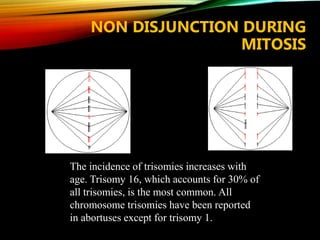
NON DISJUNCTION
• Non disjunction occurs when chromosomes fail to "disjoin"
during meiosis or mitosis.
NON DISJUNCTION DURING
MITOSIS
The incidence of trisomies increases with
age. Trisomy 16, which accounts for 30% of
all trisomies, is the most common. All
chromosome trisomies have been reported
in abortuses except for trisomy 1.
DELETIONS
 Deletions are fragments of chromosomes that are
missing. They are usually lethal when homozygous
and cause abnormalities when heterozygous.
▪ Cri du Chat Syndrome
 Cri du chat syndrome is due to a deletion of a
portion of chromosome 5. Cri du chat individuals
are mentally retarded.
"Cri du chat" is French for "cry of the cat". The infants
cry sounds like a cat.
COUNSELING
• Cytogenetic data
• In balanced translocation there is 5-10% chance of
pregnancy with unbalanced translocation
• Important to evaluate : carriers : >70% LBR.
• Possibility of PGD
• All couples with a history of recurrent miscarriage should
have peripheral blood karyotyping performed. The
finding of an abnormal parental karyotype should
prompt referral to a clinical geneticist.
Genetic counseling after a
miscarriage
CASE 2
• 28 years old Mrs. XYZ married since 6 years G4P1L0A3
• Obstetric history:
G1 - Preterm stillbirth at 7ma abruption
G2 - Missed abortion at 6 weeks
G3 - Missed abortion at 8 weeks
G4 - Spont. Abortion at 8 weeks
• MENSTRUAL HISTORY:
4-5/28 Regular, Moderate, Painless
• MEDICAL HISTORY:
History of childhood Asthma
History of DM and HT in family
TORCH
• ROUTINE INVESTIGATONS
• WNL
 Toxo - IgG +ve, IgM -
ve
 Rubella - IgG Low +ve,
IgM -ve
 CMV - IgG Mod +ve,
IgM -ve
 Herpes - IgG mild +ve,
IgM -ve
AUTOIMMUNE PROFILE
• BT - 3’ 05”, CT - 4’ 25”,
• Platelets - 1.2 lac/cmm
• PT - 13 sec (T) 11 sec ( C )
• ACL - IgG - high +ve (181U)
- IgM - high +ve (221U)
• LA - high +ve
• dsDNA +ve
TORCH
• Toxoplasmosis
• Other infections – parvovirusB19, HIV, Syphillis,
hepatitis, varicella
• Rubella
• Cytomegalovirus
• Herpes Simplex infections
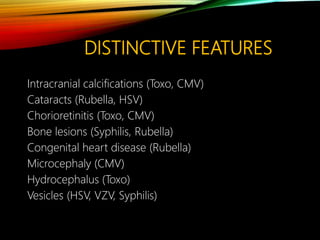
DISTINCTIVE FEATURES
Intracranial calcifications (Toxo, CMV)
Cataracts (Rubella, HSV)
Chorioretinitis (Toxo, CMV)
Bone lesions (Syphilis, Rubella)
Congenital heart disease (Rubella)
Microcephaly (CMV)
Hydrocephalus (Toxo)
Vesicles (HSV, VZV, Syphilis)
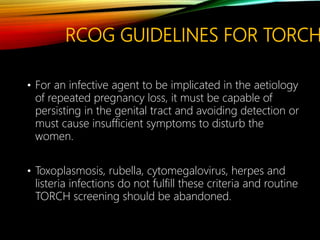
RCOG GUIDELINES FOR TORCH
• For an infective agent to be implicated in the aetiology
of repeated pregnancy loss, it must be capable of
persisting in the genital tract and avoiding detection or
must cause insufficient symptoms to disturb the
women.
• Toxoplasmosis, rubella, cytomegalovirus, herpes and
listeria infections do not fulfill these criteria and routine
TORCH screening should be abandoned.
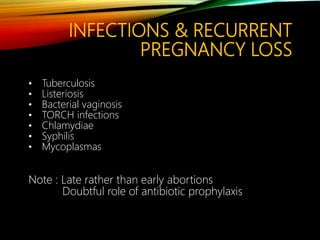
INFECTIONS & RECURRENT
PREGNANCY LOSS
• Tuberculosis
• Listeriosis
• Bacterial vaginosis
• TORCH infections
• Chlamydiae
• Syphilis
• Mycoplasmas
Note : Late rather than early abortions
Doubtful role of antibiotic prophylaxis
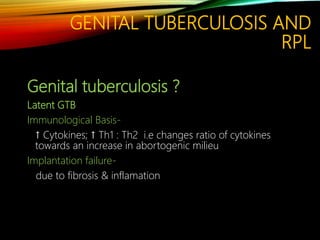
GENITAL TUBERCULOSIS AND
RPL
Genital tuberculosis ?
Latent GTB
Immunological Basis-
↑ Cytokines; ↑ Th1 : Th2 i.e changes ratio of cytokines
towards an increase in abortogenic milieu
Implantation failure-
due to fibrosis & inflamation
Does APLA cause early pregnancy loss ????
MECHANISM
• Inhibition of cytotrophoblast
• invasion
• Differentiation
• Thrombosis: platelets, fibrinolysis & coagulation
cascade
• Arachidonic acid release blocked hence PGI 2
decreased
• Anticytokines action against IL3
• Placental cell Apoptosis
CHARACTER OF PREGNANCY LOSS
 Typical presentation is growth retardation probably
leading to fetal death in the second or third trimesters
(Lockshin, 1993).
 APS in 10% of unselected patients with RPL (Tincani et al
1987)
 APS in 30% (Drakely et al 1998) of patients with
recurrent second trimester pregnancy loss.
OTHER IMMUNOLOGICAL DISORDERS
• SLE
• Higher rate of RPL
• APLA : 37% ≈ poor outcome
• Lupus flares / renal disease
• Counseling
• RAFS: (Reproductive
autoimmune Failure
Syndrome)
• 90% Cannot be dete
cted by routine
antibody estimate
THERAPY IN IMMUNOLOGICAL
DISORDERS
• Aspirin & Low Molecular Heparin
• Antipaternal cell antibodies
• IV IG
MANAGEMENT
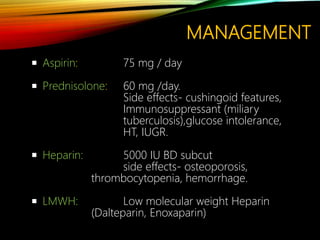
 Aspirin: 75 mg / day
 Prednisolone: 60 mg /day.
Side effects- cushingoid features,
Immunosuppressant (miliary
tuberculosis),glucose intolerance,
HT, IUGR.
 Heparin: 5000 IU BD subcut
side effects- osteoporosis,
thrombocytopenia, hemorrhage.
 LMWH: Low molecular weight Heparin
(Dalteparin, Enoxaparin)
ROLE OF IVIG IN RPL
• 45% of miscarriages and 95% of late pregnancy losses
from women experiencing RPL are chromosomally
normal.
• Large data suggestive of the causes being
immunological.
IMMUNOTHERAPY
• Passive, with immunoglobulin
• NK Cells down-regulated by IVIG
(Ruiz et al, 1996)
• Down regulation associated with improved outcome
• Cytokine balance altered by IVIG
(Bakimer, et al, 2000)
48%
32%
0%
10%
20%
30%
40%
50%
IVIG
33/70
Controls
23/71
IVIG AFTER > 5 ABORTIONS
(CARP ET AL, 2007)
OR = 2.1 (95% CI 1.01-
4.37)
DEFECTS IN COAGULATION FACTORS
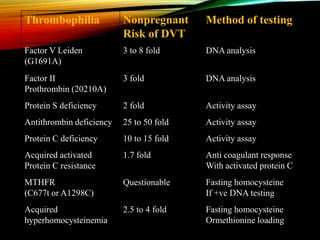
Thrombophilia Nonpregnant
Risk of DVT
Method of testing
Factor V Leiden
(G1691A)
3 to 8 fold DNA analysis
Factor II
Prothrombin (20210A)
3 fold DNA analysis
Protein S deficiency 2 fold Activity assay
Antithrombin deficiency 25 to 50 fold Activity assay
Protein C deficiency 10 to 15 fold Activity assay
Acquired activated
Protein C resistance
1.7 fold Anti coagulant response
With activated protein C
MTHFR
(C677t or A1298C)
Questionable Fasting homocysteine
If +ve DNA testing
Acquired
hyperhomocysteinemia
2.5 to 4 fold Fasting homocysteine
Ormethionine loading
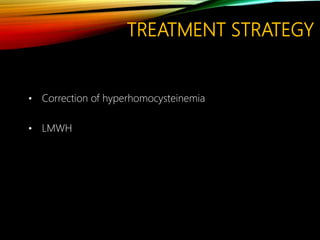
TREATMENT STRATEGY
• Correction of hyperhomocysteinemia
• LMWH
CASE 3
• 35 yrs, A3 with history of previous 3 missed abortions
• A1- 8 weeks missed abortion
• A2- 7 wks missed aboretion
• A3-10 wks missed abortion
INVESTIGATIONS
• Hb - 10 gm%
• Urine R/M-N
• LFT, RFT - N
• VDRL, HIV -ve
• Bl gr - O +ve, husband - B +ve
• Day 2 progesterone levels- 2ng/ml
• Day 8 progesterone level—8.7ng/ml
• Endometrial biopsy done which was suggestive of
endometrial lag of >3 days
• USG suggestive of lack of endometrial echogenicity on 7th
postovulatory day and leutinised unruptured follicle and
leuteal cyst formation
• What is luteal phase defect?
• Diagnostic criteria for leuteal phase defect?
• Role of progesterone and HCG?
• Other hormonal defects to cause RPL?
• Role of Endocrinologic factors ???
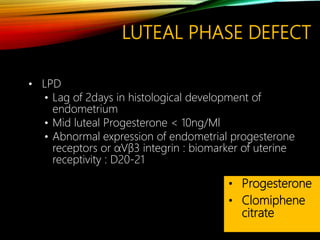
LUTEAL PHASE DEFECT
• LPD
• Lag of 2days in histological development of
endometrium
• Mid luteal Progesterone < 10ng/Ml
• Abnormal expression of endometrial progesterone
receptors or αVβ3 integrin : biomarker of uterine
receptivity : D20-21
• Progesterone
• Clomiphene
citrate
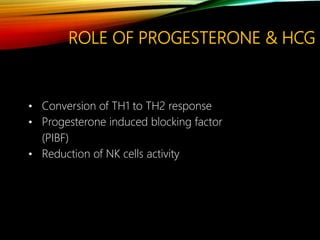
ROLE OF PROGESTERONE & HCG
• Conversion of TH1 to TH2 response
• Progesterone induced blocking factor
(PIBF)
• Reduction of NK cells activity
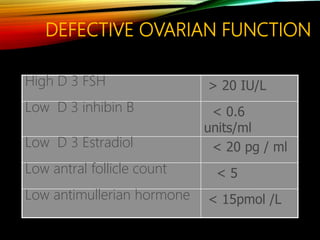
DEFECTIVE OVARIAN FUNCTION
High D 3 FSH > 20 IU/L
Low D 3 inhibin B < 0.6
units/ml
Low D 3 Estradiol < 20 pg / ml
Low antral follicle count < 5
Low antimullerian hormone < 15pmol /L
• Other hormonal defect responsible for RPL?
HYPOTHYROIDISM
• Untreated hypothyroidism
• Sensitive TSH assay
• Antibodies ►►
• Antimicrososmal
• antithyroglobin
R/O
hypothyroidism
During
Pregnancy
hypothyroidism
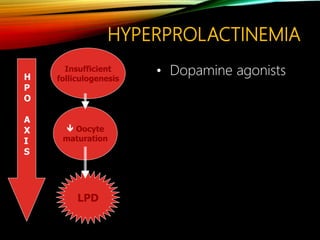
HYPERPROLACTINEMIA
• Dopamine agonistsInsufficient
folliculogenesis
 Oocyte
maturation
LPD
H
P
O
A
X
I
S
INSULIN RESISTANCE
• DM
• Poor glycemic control
• PCOD
• Increased insulin
resistance
CASE 4
• 29 year old Mrs. X working as computer
professional married since last 5 years
• History of primary infertility, K/c/o PCOS, conceived
after ovulation induction with clomiphene citrate
and IUI
• Past obstetric history - G3P0L0A3
G1 - Missed abortion at 2 ma
2 years back
G2 - Spont. Ab at 3 ma 1 year back
G3 - Spont. Ab at 3 ma 6 months back
• Menstrual History
4-5/30 Regular, moderate, painful
INVESTIGATIONS
• Hb - 9.8 gm%
• Urine R/M - NAD
• FBS - 92 mg%, PLBS - 104 mg%
• RFT, LFT - WNL,
• Pap smear - N
• XRC - NAD
• HSA- 20 million per cc, 60- 70% motility
USG
• Uterus: Anterior wall intramural fibroid measuring
1.5 X 1.2 cm,
• Submucosal fibroid from posterior wall
2.1 X 2.2 cm
• ET - 7 mm
• Rt Ovary - N
• Lt Ovary clear cyst 3 X 4 cm,
• POD - N
• AUTOIMMUNE PROFILE:
Platelets - 2 lacs, BT CT - N, LA - N,
ACL-N
• Diagnostic Laparoscopic findings -
Uterus - N
Rt. Ovary - N
Lt. Ovary - cyst,
B/L Fallopian tubes - patent
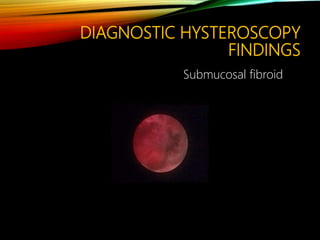
DIAGNOSTIC HYSTEROSCOPY
FINDINGS
Submucosal fibroid
Dr. Sanjay Gupte
• What is the role of other Anatomical factors?
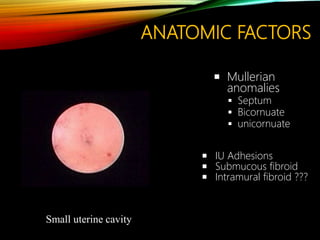
ANATOMIC FACTORS
 Mullerian
anomalies
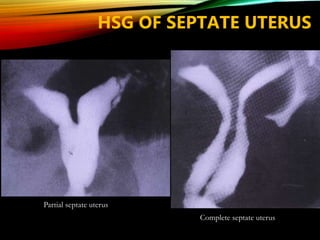
 Septum
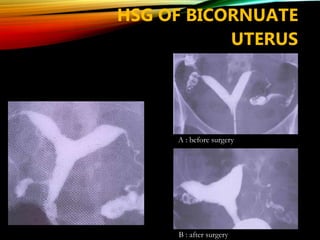
 Bicornuate
 unicornuate
 IU Adhesions
 Submucous fibroid
 Intramural fibroid ???
Small uterine cavity
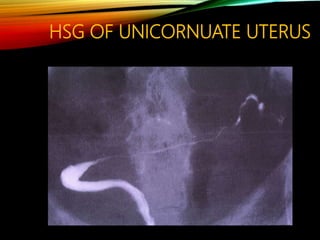
HSG OF UNICORNUATE UTERUS
A : before surgery
B : after surgery
HSG OF BICORNUATE
UTERUS
Partial septate uterus
Complete septate uterus
HSG OF SEPTATE UTERUS
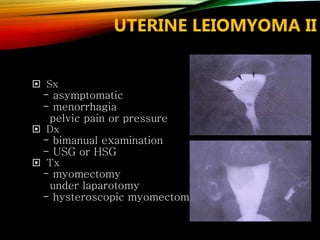
UTERINE LEIOMYOMA II
 Sx
- asymptomatic
- menorrhagia
pelvic pain or pressure
 Dx
- bimanual examination
- USG or HSG
 Tx
- myomectomy
under laparotomy
- hysteroscopic myomectomy
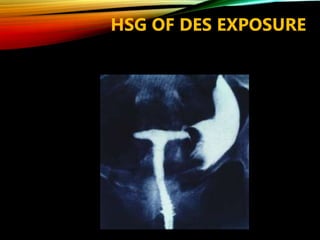
HSG OF DES EXPOSURE
CASE 5
• 33 year old married since 10 years
• G5 P0 L0 A4
• 6 weeks amenorrhea
• Family and personal history not contributory
OBSTETRIC HISTORY
• G1-2ma missed abortion S/E done 9 yrs
back
• G2- 2ma MTP done i/v/o h/o antimalarial
drugs taken 8 years back
• G3 - 2ma missed abortion S/E done 2 years
back
• G4 - 2ma missed abortion S/E done 1 1/2
years back
• G5 - PP
INVESTIGATION
• Hb - 10 gm%
• Urine R/M-N
• LFT, RFT - N
• VDRL, HIV -ve
• Bl gr - O +ve, husband - B +ve
• HSA - N
HYSTEROSCOPY- ASHERMAN’S
SYNDROME
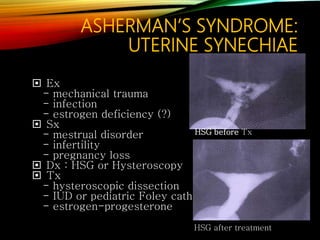
ASHERMAN’S SYNDROME:
UTERINE SYNECHIAE
 Ex
- mechanical trauma
- infection
- estrogen deficiency (?)
 Sx
- mestrual disorder
- infertility
- pregnancy loss
 Dx : HSG or Hysteroscopy
 Tx
- hysteroscopic dissection
- IUD or pediatric Foley catheter
- estrogen-progesterone
HSG before Tx
HSG after treatment
CASE-6
 History indicated:
h/o repeated STL (second trimester losses) or PTB,
Painless cervical dilatation,
Precipitate labor
 USG indicated:
cervical length < 15 mm?
cervical length reduction 1 mm / week
 Physical examination indicated:
shortening of cervix detected on manual
examination in 2nd trimester
INCOMPETENT CERVIX
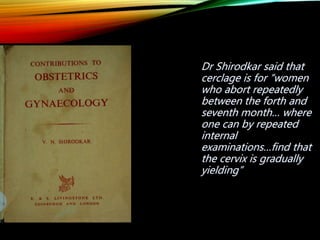
Dr Shirodkar said that
cerclage is for “women
who abort repeatedly
between the forth and
seventh month… where
one can by repeated
internal
examinations…find that
the cervix is gradually
yielding”
CONCLUSION
• Cerclage is beneficial in 2 or more STL/PTB
• Beneficial if cervical length is 15mm or less or
internal os > 5 mm
• Not useful in twins or placenta previa
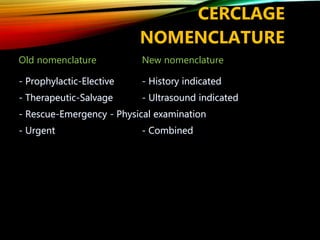
CERCLAGE
NOMENCLATURE
Old nomenclature New nomenclature
- Prophylactic-Elective - History indicated
- Therapeutic-Salvage - Ultrasound indicated
- Rescue-Emergency - Physical examination
- Urgent - Combined
INTERVENSIONS
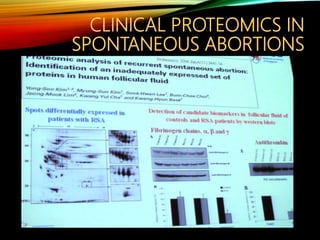
CLINICAL PROTEOMICS IN
SPONTANEOUS ABORTIONS
PROGESTERONE
• Temptations of its use
• RU486
• Immunomodulatory action ????
• Pregnancy support
ROLE OF NK CELLS
• RPL: high activity of NK cells at the uterine lining as
well as peripheral blood
• NK cells lead to release of pro-inflammatory
cytokines.
• These lead to placental blood vessel clotting and
subsequent pregnancy loss.
• CD8 type T cells Th2 cytokines are protective against
NK cytokine-dependent miscarriage.
• How does the fetus escape rejection by NK
cells??
• Following trophoblastic invasion the fetal semi-
allograft induces PgR in γ/δ T cells.
• This enhances the interaction with high levels of
progesterone
• Progesterone causes expression of PIBF
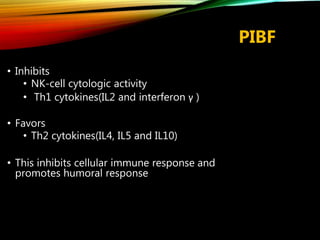
PIBF
• Inhibits
• NK-cell cytologic activity
• Th1 cytokines(IL2 and interferon γ )
• Favors
• Th2 cytokines(IL4, IL5 and IL10)
• This inhibits cellular immune response and
promotes humoral response
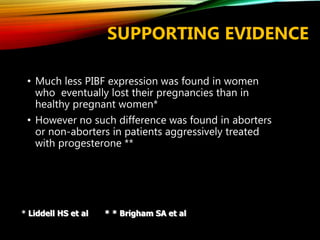
SUPPORTING EVIDENCE
• Much less PIBF expression was found in women
who eventually lost their pregnancies than in
healthy pregnant women*
• However no such difference was found in aborters
or non-aborters in patients aggressively treated
with progesterone **
* Liddell HS et al * * Brigham SA et al
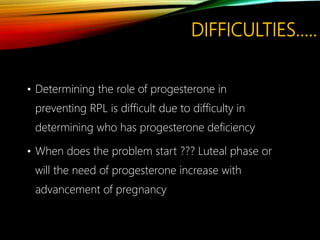
DIFFICULTIES…..
• Determining the role of progesterone in
preventing RPL is difficult due to difficulty in
determining who has progesterone deficiency
• When does the problem start ??? Luteal phase or
will the need of progesterone increase with
advancement of pregnancy
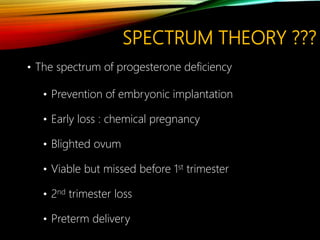
SPECTRUM THEORY ???
• The spectrum of progesterone deficiency
• Prevention of embryonic implantation
• Early loss : chemical pregnancy
• Blighted ovum
• Viable but missed before 1st trimester
• 2nd trimester loss
• Preterm delivery
BENEFITS OF
PROGESTERONE
It is better to treat a woman with a benign treatment that
is later found not to be effective than not treat her, have
her miscarry and later find studies showing unequivocally
that with such treatment definitely reduces the risk of
miscarriage.
-Shulman (2008 yearbook)
• ROLE OF HCG ??
INTERVENTION : HCG
• HCG is the hormone responsible for CL support
in early pregnancy
• If pregnancy is failing levels of HCG may be low
resulting in low progesterone.
• Rather than giving progestrone HCG could be
used directly in order to stimulate natural
hormone to reduce ab normal fetal effects.
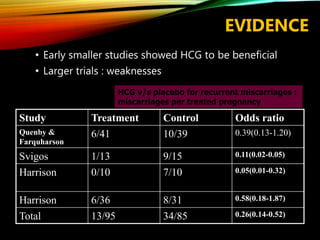
EVIDENCE
Study Treatment Control Odds ratio
Quenby &
Farquharson
6/41 10/39 0.39(0.13-1.20)
Svigos 1/13 9/15 0.11(0.02-0.05)
Harrison 0/10 7/10 0.05(0.01-0.32)
Harrison 6/36 8/31 0.58(0.18-1.87)
Total 13/95 34/85 0.26(0.14-0.52)
• Early smaller studies showed HCG to be beneficial
• Larger trials : weaknesses
HCG v/s placebo for recurrent miscarriages :
miscarriages per treated pregnancy
• HCG is not a panacea to all patients of RPL
• Beneficial in particular group
• How to diagnose these patients?
• irregular cycles : more benefits
• HCG or Pr : HCG more natural
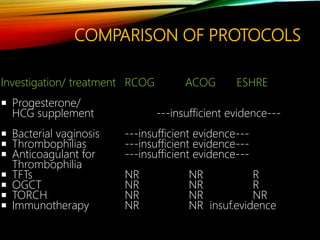
COMPARISON OF PROTOCOLS
Investigation/ treatment RCOG ACOG ESHRE
 Progesterone/
HCG supplement ---insufficient evidence---
 Bacterial vaginosis ---insufficient evidence---
 Thrombophilias ---insufficient evidence---
 Anticoagulant for ---insufficient evidence---
Thrombophilia
 TFTs NR NR R
 OGCT NR NR R
 TORCH NR NR NR
 Immunotherapy NR NR insuf.evidence
Summary of Evaluation And
Management of RPL
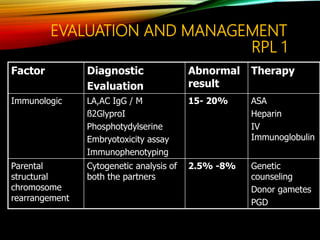
EVALUATION AND MANAGEMENT
RPL 1
Factor Diagnostic
Evaluation
Abnormal
result
Therapy
Immunologic LA,AC IgG / M
ß2GlyproI
Phosphotydylserine
Embryotoxicity assay
Immunophenotyping
15- 20% ASA
Heparin
IV
Immunoglobulin
Parental
structural
chromosome
rearrangement
Cytogenetic analysis of
both the partners
2.5% -8% Genetic
counseling
Donor gametes
PGD
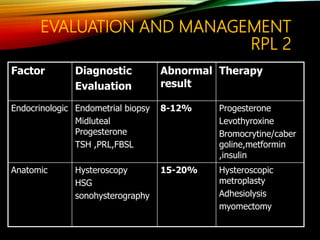
EVALUATION AND MANAGEMENT
RPL 2
Factor Diagnostic
Evaluation
Abnormal
result
Therapy
Endocrinologic Endometrial biopsy
Midluteal
Progesterone
TSH ,PRL,FBSL
8-12% Progesterone
Levothyroxine
Bromocrytine/caber
goline,metformin
,insulin
Anatomic Hysteroscopy
HSG
sonohysterography
15-20% Hysteroscopic
metroplasty
Adhesiolysis
myomectomy
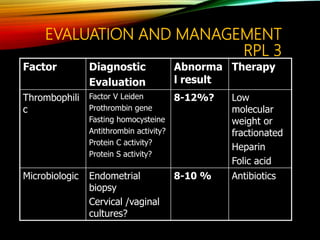
EVALUATION AND MANAGEMENT
RPL 3
Factor Diagnostic
Evaluation
Abnorma
l result
Therapy
Thrombophili
c
Factor V Leiden
Prothrombin gene
Fasting homocysteine
Antithrombin activity?
Protein C activity?
Protein S activity?
8-12%? Low
molecular
weight or
fractionated
Heparin
Folic acid
Microbiologic Endometrial
biopsy
Cervical /vaginal
cultures?
8-10 % Antibiotics
EVALUATION AND MANAGEMENT
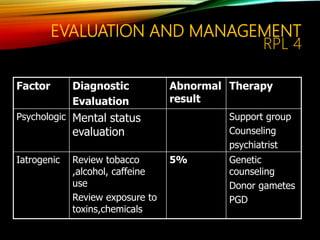
RPL 4
Factor Diagnostic
Evaluation
Abnormal
result
Therapy
Psychologic Mental status
evaluation
Support group
Counseling
psychiatrist
Iatrogenic Review tobacco
,alcohol, caffeine
use
Review exposure to
toxins,chemicals
5% Genetic
counseling
Donor gametes
PGD
THANK YOU

Recurrent pregnancy loss panel discussion

  • 1.
  • 2.
    DR. NIRANJAN CHAVAN MD,FCPS, DGO, MICOG, DICOG, FICOG, DFP, DIPLOMA IN ENDOSCOPY (USA) Professor And Unit Chief, L.T.M.M.C&L.T.M.G.H, Sion Hospital National Co-ordinator, FOGSI Medical in Pregnancy Committee (2019- 2021) Chairperson, FOGSI Oncology & TT Committee (2012-2014) Secretary MOGS (2019-2020), Premises Secretary, AFG (2019-2020) Chair & Convenor, FOGSI Cell Violence Against Doctors (2015-2016) Dean and Chairman, Academia of Global Obstetrician & Gynaecologists Chief Editors, AFG Times (2015-2016) Course Coordinator of 11 batches Of MUHS recognised Certificate Course of B.I.M.I.E at L.T.M.G.H (2010-2016) Member, Oncology Committee AOFOG (2013-2015) Member, Managing Committee, IAGE (2013-2017), (2018-2020) Editorial Board, European Journal of Gynaec. Oncology (Italy) Course Coordinator of 3 batches 0f Advanced Minimal Access Gynaec Surgery (AMAS) at LTMGH (2018 -2019)
  • 3.
    “………I recall nothingwhich in times past has caused me more anxiety and doubt, or in regard to which I have found it more difficult to get any satisfactory rules from books, than the treatment of Abortion.” - T. G. Thomas (1908)
  • 4.
    What are thecommon questions asked by RPL patients?
  • 5.
    PATIENTS QUESTIONS Why didit happened ? Will it happen again ? How it can be avoided ? Could have been avoided ?
  • 6.
    What is theincidence of RPL?
  • 7.
    • Spontaneous pregnancyloss is, in fact, the most common complication of pregnancy • About 70% of human conceptions fail to achieve viability • estimated 50% are lost before the first missed menstrual period • Most of preg. Losses are unrecognized. • Actual rate of preg. Loss after implantation is 31%(by hCG assay) • Clinically recognized, loss occurs in 15% before 20wks of gestation.
  • 8.
    SPONTANEOUS ABORTIONS • Normalpopulation • Chromosomal abnormality --- 50% • Trisomic --------------------- 56% • Polyploid -------------------- 20% • Monosomic for chromosome X-- 18% • Unbalanced translocations ------ 4%
  • 9.
    • What isthe Definition of RPL?
  • 10.
    • Definition :3 or more clinically recognized pregnancy losses before 20wks from LMP. • Incidence: 1/300
  • 11.
    • Primary recurrentpregnancy loss refers to couples that have never had a live birth • while "secondary RPL" refers to those who have had repetitive losses following a successful pregnancy
  • 12.
    CAUSES OF PREGNANCYLOSS  Genetic  Trisomies, 16, 21, 7,15  Monosomy X, Triploidy  Parental Structural Aberrations  Fetal anomalies  Any incompatible with life  Uterine anomalies  Septate, Bicornuate  Fibroids  Cervical Incompetence  DES  Immunological causes  Alloimmune (cytokines,NK)  APL (ACA,LA)  Hereditary Thrombophilia  APCR, FVL FII  MTHFR, Homocysteinemia  Pritein C, Protein S, Antithrombin III • Trauma • Endocrine • Luteal defficiency • Thyroid dysfunction • Diabetes • Alloimmune • Cytokines • NK • Infection • Chlamydia • Mycoplasma • Toxoplasmosis • Septic Abortion
  • 13.
    PROPOSED ETIOLOGIES • GeneticFactors 3.5-5% • Anatomic Factors 12-16% • Endocrine Factors 17-20% • Infectious Factors 0.5-5% • Immunologic Factors 20-50% • Other Factors 10% Novak’s Gynecology 14th ED
  • 14.
    • Is itimportant to establish the gestational age of these pregnancies ??
  • 15.
    CLINICAL PREGNANCY LOSS PREEMBRYONIC <5 WKS EMBRYONIC < 8 WKS FETAL > 8 WKS
  • 16.
    EARLY PREGNANCY FAILURE( EPF) • Anembryonic Pregnancy : • Trophoblast has invaded the decidua • Embryonic disc not developed/ resorbed after loss of viability • Embryonic / Fetal demise: • Embryonic disc developed :: loss of viability • USG : Emb pole> 5mm without cardiac activity
  • 17.
    • On ultrasounddo we have any milestones by which we can predict the outcome?
  • 18.
    THRESHOLD ??? • MSD •20 mm without yolk sac • 25mm without embryo : • TAS : anembryonic pregnancy • Rate of increase in MSD : parameter • < 0.6 mm/day • Increase of <3 mm over 5 days • Increase of < 4 mm over 7 days
  • 19.
    • When shallwe start investigations?
  • 20.
    • Clinical Investigationshould be started after two consecutive spontaneous abortions, especially • When fetal heart activity had been identified prior to the pregnancy loss • when the women is older than 35 yrs of age • when the couple has had difficulty conceiving
  • 21.
    Are there anybiochemical markers to predict the outcome?
  • 22.
    BIOMARKERS • HCG • Progesterone •17 α Hydroxy progesterone • Inhibin A • Inhibin Pro - α C • IGFBP I
  • 23.
    CASE 1 • 24years old Mrs. MSJ married since 5 years • Obstetric history: G1 – Vesicular Mole, D&E done. G2 - Missed abortion at 7 weeks, D&E not done, pills taken. G3 - Missed abortion at 6 weeks, D&E done. G4 - 6 weeks, Blighted ovum, pills given.
  • 24.
    • Menstrual History:Regular • Medical History: N.P. • Family History: N.P. • Clinical Findings: Normal • Hormonal Profile: Normal • APLA: Negative
  • 25.
    KARYOTYPING: Husband: 46XY Wife: 46XX,t(11;22) (q24:q13) GTG banding : proband shows reciprocal balanced translocation involving chr 11 & chr 22 breakage & reunion has occurred at bands 11q24 & 22q13 MFISH balanced translocation between chr 11 & chr 22 involving breakpoints 11q24 & 22q13 respectively
  • 26.
    Cytogenetic Studies ofthe conceptus Should we always do them ?
  • 27.
  • 28.
    28.0% 23.0% 63.6% 29.0% 0% 10% 20% 30% 40% 50% 60% 70% 20-30 30-40 40-45 Total KARYOTYPE OF ABORTUS ACCORDINGTO MATERNAL AGE p=0.01 (Fisher’s exact Test) for the age group 40- 45 compared to the other age groups.
  • 29.
    REPEAT ANEUPLOIDY Repeat Aneuploidy 8/43 (19%)Carpet al, 2004 3/30 (10%)Sullivan et al, 2005 11/73 (15.1%)Total
  • 30.
    • What arethe RCOG guidelines?
  • 31.
    RCOG GUIDELINES  Recurrentpregnancy loss may be due to an abnormal embryo, which is incompatible with life.  As the number of miscarriages increases, the prevalence of chromosomal abnormality decreases  If the karyotype of the miscarried pregnancy is abnormal, there is a better prognosis in the next pregnancy.  karyotyping the products of conception provides useful information for counseling and future management.
  • 32.
    SUBSEQUENT PREGNANCY ACCORDING TO KARYOTYPEOF ABORTUS 37.8% 38% 67% 62% 0% 10% 20% 30% 40% 50% 60% 70% Euploidy Aneuploidy Carp Ogasawara 14/37 14/2127/71 37/60 O.R. for a live birth after aneuploidic abortion. 3.28 (95% CI = 0.94- 11.9) Carp et al 2.62 (95% CI = 1.21- 5.67) Ogasawa et al
  • 33.
    GENETIC COUNSELING AFTER AMISCARRIAGE • In all couples with a history of recurrent miscarriage cytogenetic analysis of the products of conception should be performed if the next pregnancy fails.
  • 34.
    • What isthe role of Parenteral karyotype ??
  • 35.
    STRUCTURAL GENETIC FACTOR INEITHER • 2.5-8% RPL couples • Commonest :balanced reciprocal/Robertsonian translocation • Rarer : inversion,insertions,deletions,duplications,ring chromosome
  • 36.
    Translocations Reciprocal translocations Robertsonian translocations A translocation isthe transfer of genetic material from one chromosome to another.
  • 37.
    Robertsonian translocations occur whentwo chromosomes fuse together, creating one chromosome that contains most of the original two. (45 chromosomes with one variant) Translocations Reciprocal translocations occur when two different chromosomes exchange segments. (46 chromosomes with two variants)
  • 38.
    ROBERTSONIAN TRANSLOCATION • Robertsonian translocationsbetween chromosomes 14 and 21, one of the most common combinations, are of particular clinical relevance. An individual with this translocation could have a child with three copies of chromosome 21, resulting in Down’s syndrome (trisomy 21).
  • 39.
    NON DISJUNCTION • Nondisjunction occurs when chromosomes fail to "disjoin" during meiosis or mitosis.
  • 40.
    NON DISJUNCTION DURING MITOSIS Theincidence of trisomies increases with age. Trisomy 16, which accounts for 30% of all trisomies, is the most common. All chromosome trisomies have been reported in abortuses except for trisomy 1.
  • 41.
    DELETIONS  Deletions arefragments of chromosomes that are missing. They are usually lethal when homozygous and cause abnormalities when heterozygous. ▪ Cri du Chat Syndrome  Cri du chat syndrome is due to a deletion of a portion of chromosome 5. Cri du chat individuals are mentally retarded. "Cri du chat" is French for "cry of the cat". The infants cry sounds like a cat.
  • 42.
    COUNSELING • Cytogenetic data •In balanced translocation there is 5-10% chance of pregnancy with unbalanced translocation • Important to evaluate : carriers : >70% LBR. • Possibility of PGD
  • 43.
    • All coupleswith a history of recurrent miscarriage should have peripheral blood karyotyping performed. The finding of an abnormal parental karyotype should prompt referral to a clinical geneticist. Genetic counseling after a miscarriage
  • 44.
    CASE 2 • 28years old Mrs. XYZ married since 6 years G4P1L0A3 • Obstetric history: G1 - Preterm stillbirth at 7ma abruption G2 - Missed abortion at 6 weeks G3 - Missed abortion at 8 weeks G4 - Spont. Abortion at 8 weeks
  • 45.
    • MENSTRUAL HISTORY: 4-5/28Regular, Moderate, Painless • MEDICAL HISTORY: History of childhood Asthma History of DM and HT in family
  • 46.
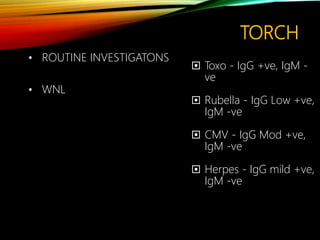
    TORCH • ROUTINE INVESTIGATONS •WNL  Toxo - IgG +ve, IgM - ve  Rubella - IgG Low +ve, IgM -ve  CMV - IgG Mod +ve, IgM -ve  Herpes - IgG mild +ve, IgM -ve
  • 47.
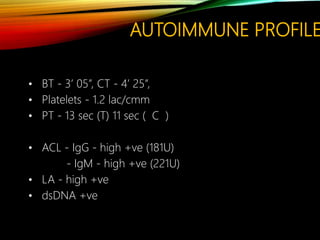
    AUTOIMMUNE PROFILE • BT- 3’ 05”, CT - 4’ 25”, • Platelets - 1.2 lac/cmm • PT - 13 sec (T) 11 sec ( C ) • ACL - IgG - high +ve (181U) - IgM - high +ve (221U) • LA - high +ve • dsDNA +ve
  • 48.
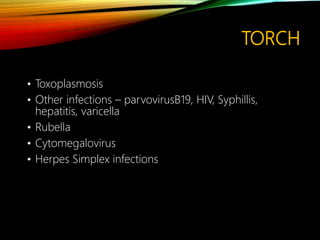
    TORCH • Toxoplasmosis • Otherinfections – parvovirusB19, HIV, Syphillis, hepatitis, varicella • Rubella • Cytomegalovirus • Herpes Simplex infections
  • 49.
    DISTINCTIVE FEATURES Intracranial calcifications(Toxo, CMV) Cataracts (Rubella, HSV) Chorioretinitis (Toxo, CMV) Bone lesions (Syphilis, Rubella) Congenital heart disease (Rubella) Microcephaly (CMV) Hydrocephalus (Toxo) Vesicles (HSV, VZV, Syphilis)
  • 50.
    RCOG GUIDELINES FORTORCH • For an infective agent to be implicated in the aetiology of repeated pregnancy loss, it must be capable of persisting in the genital tract and avoiding detection or must cause insufficient symptoms to disturb the women. • Toxoplasmosis, rubella, cytomegalovirus, herpes and listeria infections do not fulfill these criteria and routine TORCH screening should be abandoned.
  • 51.
    INFECTIONS & RECURRENT PREGNANCYLOSS • Tuberculosis • Listeriosis • Bacterial vaginosis • TORCH infections • Chlamydiae • Syphilis • Mycoplasmas Note : Late rather than early abortions Doubtful role of antibiotic prophylaxis
  • 52.
    GENITAL TUBERCULOSIS AND RPL Genitaltuberculosis ? Latent GTB Immunological Basis- ↑ Cytokines; ↑ Th1 : Th2 i.e changes ratio of cytokines towards an increase in abortogenic milieu Implantation failure- due to fibrosis & inflamation
  • 53.
    Does APLA causeearly pregnancy loss ????
  • 54.
    MECHANISM • Inhibition ofcytotrophoblast • invasion • Differentiation • Thrombosis: platelets, fibrinolysis & coagulation cascade • Arachidonic acid release blocked hence PGI 2 decreased • Anticytokines action against IL3 • Placental cell Apoptosis
  • 55.
    CHARACTER OF PREGNANCYLOSS  Typical presentation is growth retardation probably leading to fetal death in the second or third trimesters (Lockshin, 1993).  APS in 10% of unselected patients with RPL (Tincani et al 1987)  APS in 30% (Drakely et al 1998) of patients with recurrent second trimester pregnancy loss.
  • 56.
    OTHER IMMUNOLOGICAL DISORDERS •SLE • Higher rate of RPL • APLA : 37% ≈ poor outcome • Lupus flares / renal disease • Counseling • RAFS: (Reproductive autoimmune Failure Syndrome) • 90% Cannot be dete cted by routine antibody estimate
  • 57.
    THERAPY IN IMMUNOLOGICAL DISORDERS •Aspirin & Low Molecular Heparin • Antipaternal cell antibodies • IV IG
  • 58.
    MANAGEMENT  Aspirin: 75mg / day  Prednisolone: 60 mg /day. Side effects- cushingoid features, Immunosuppressant (miliary tuberculosis),glucose intolerance, HT, IUGR.  Heparin: 5000 IU BD subcut side effects- osteoporosis, thrombocytopenia, hemorrhage.  LMWH: Low molecular weight Heparin (Dalteparin, Enoxaparin)
  • 59.
    ROLE OF IVIGIN RPL • 45% of miscarriages and 95% of late pregnancy losses from women experiencing RPL are chromosomally normal. • Large data suggestive of the causes being immunological.
  • 60.
    IMMUNOTHERAPY • Passive, withimmunoglobulin • NK Cells down-regulated by IVIG (Ruiz et al, 1996) • Down regulation associated with improved outcome • Cytokine balance altered by IVIG (Bakimer, et al, 2000)
  • 61.
    48% 32% 0% 10% 20% 30% 40% 50% IVIG 33/70 Controls 23/71 IVIG AFTER >5 ABORTIONS (CARP ET AL, 2007) OR = 2.1 (95% CI 1.01- 4.37)
  • 62.
  • 63.
    Thrombophilia Nonpregnant Risk ofDVT Method of testing Factor V Leiden (G1691A) 3 to 8 fold DNA analysis Factor II Prothrombin (20210A) 3 fold DNA analysis Protein S deficiency 2 fold Activity assay Antithrombin deficiency 25 to 50 fold Activity assay Protein C deficiency 10 to 15 fold Activity assay Acquired activated Protein C resistance 1.7 fold Anti coagulant response With activated protein C MTHFR (C677t or A1298C) Questionable Fasting homocysteine If +ve DNA testing Acquired hyperhomocysteinemia 2.5 to 4 fold Fasting homocysteine Ormethionine loading
  • 64.
    TREATMENT STRATEGY • Correctionof hyperhomocysteinemia • LMWH
  • 65.
    CASE 3 • 35yrs, A3 with history of previous 3 missed abortions • A1- 8 weeks missed abortion • A2- 7 wks missed aboretion • A3-10 wks missed abortion
  • 66.
    INVESTIGATIONS • Hb -10 gm% • Urine R/M-N • LFT, RFT - N • VDRL, HIV -ve • Bl gr - O +ve, husband - B +ve • Day 2 progesterone levels- 2ng/ml • Day 8 progesterone level—8.7ng/ml
  • 67.
    • Endometrial biopsydone which was suggestive of endometrial lag of >3 days • USG suggestive of lack of endometrial echogenicity on 7th postovulatory day and leutinised unruptured follicle and leuteal cyst formation
  • 68.
    • What isluteal phase defect? • Diagnostic criteria for leuteal phase defect? • Role of progesterone and HCG? • Other hormonal defects to cause RPL?
  • 69.
    • Role ofEndocrinologic factors ???
  • 70.
    LUTEAL PHASE DEFECT •LPD • Lag of 2days in histological development of endometrium • Mid luteal Progesterone < 10ng/Ml • Abnormal expression of endometrial progesterone receptors or αVβ3 integrin : biomarker of uterine receptivity : D20-21 • Progesterone • Clomiphene citrate
  • 71.
    ROLE OF PROGESTERONE& HCG • Conversion of TH1 to TH2 response • Progesterone induced blocking factor (PIBF) • Reduction of NK cells activity
  • 72.
    DEFECTIVE OVARIAN FUNCTION HighD 3 FSH > 20 IU/L Low D 3 inhibin B < 0.6 units/ml Low D 3 Estradiol < 20 pg / ml Low antral follicle count < 5 Low antimullerian hormone < 15pmol /L
  • 73.
    • Other hormonaldefect responsible for RPL?
  • 74.
    HYPOTHYROIDISM • Untreated hypothyroidism •Sensitive TSH assay • Antibodies ►► • Antimicrososmal • antithyroglobin R/O hypothyroidism During Pregnancy hypothyroidism
  • 75.
  • 76.
    INSULIN RESISTANCE • DM •Poor glycemic control • PCOD • Increased insulin resistance
  • 77.
    CASE 4 • 29year old Mrs. X working as computer professional married since last 5 years • History of primary infertility, K/c/o PCOS, conceived after ovulation induction with clomiphene citrate and IUI
  • 78.
    • Past obstetrichistory - G3P0L0A3 G1 - Missed abortion at 2 ma 2 years back G2 - Spont. Ab at 3 ma 1 year back G3 - Spont. Ab at 3 ma 6 months back • Menstrual History 4-5/30 Regular, moderate, painful
  • 79.
    INVESTIGATIONS • Hb -9.8 gm% • Urine R/M - NAD • FBS - 92 mg%, PLBS - 104 mg% • RFT, LFT - WNL, • Pap smear - N • XRC - NAD • HSA- 20 million per cc, 60- 70% motility
  • 80.
    USG • Uterus: Anteriorwall intramural fibroid measuring 1.5 X 1.2 cm, • Submucosal fibroid from posterior wall 2.1 X 2.2 cm • ET - 7 mm • Rt Ovary - N • Lt Ovary clear cyst 3 X 4 cm, • POD - N
  • 81.
    • AUTOIMMUNE PROFILE: Platelets- 2 lacs, BT CT - N, LA - N, ACL-N • Diagnostic Laparoscopic findings - Uterus - N Rt. Ovary - N Lt. Ovary - cyst, B/L Fallopian tubes - patent
  • 82.
  • 83.
    Dr. Sanjay Gupte •What is the role of other Anatomical factors?
  • 84.
    ANATOMIC FACTORS  Mullerian anomalies Septum  Bicornuate  unicornuate  IU Adhesions  Submucous fibroid  Intramural fibroid ??? Small uterine cavity
  • 85.
  • 86.
    A : beforesurgery B : after surgery HSG OF BICORNUATE UTERUS
  • 87.
    Partial septate uterus Completeseptate uterus HSG OF SEPTATE UTERUS
  • 88.
    UTERINE LEIOMYOMA II Sx - asymptomatic - menorrhagia pelvic pain or pressure  Dx - bimanual examination - USG or HSG  Tx - myomectomy under laparotomy - hysteroscopic myomectomy
  • 89.
    HSG OF DESEXPOSURE
  • 90.
    CASE 5 • 33year old married since 10 years • G5 P0 L0 A4 • 6 weeks amenorrhea • Family and personal history not contributory
  • 91.
    OBSTETRIC HISTORY • G1-2mamissed abortion S/E done 9 yrs back • G2- 2ma MTP done i/v/o h/o antimalarial drugs taken 8 years back • G3 - 2ma missed abortion S/E done 2 years back • G4 - 2ma missed abortion S/E done 1 1/2 years back • G5 - PP
  • 92.
    INVESTIGATION • Hb -10 gm% • Urine R/M-N • LFT, RFT - N • VDRL, HIV -ve • Bl gr - O +ve, husband - B +ve • HSA - N
  • 93.
  • 94.
    ASHERMAN’S SYNDROME: UTERINE SYNECHIAE Ex - mechanical trauma - infection - estrogen deficiency (?)  Sx - mestrual disorder - infertility - pregnancy loss  Dx : HSG or Hysteroscopy  Tx - hysteroscopic dissection - IUD or pediatric Foley catheter - estrogen-progesterone HSG before Tx HSG after treatment
  • 96.
    CASE-6  History indicated: h/orepeated STL (second trimester losses) or PTB, Painless cervical dilatation, Precipitate labor  USG indicated: cervical length < 15 mm? cervical length reduction 1 mm / week  Physical examination indicated: shortening of cervix detected on manual examination in 2nd trimester
  • 97.
  • 98.
    Dr Shirodkar saidthat cerclage is for “women who abort repeatedly between the forth and seventh month… where one can by repeated internal examinations…find that the cervix is gradually yielding”
  • 99.
    CONCLUSION • Cerclage isbeneficial in 2 or more STL/PTB • Beneficial if cervical length is 15mm or less or internal os > 5 mm • Not useful in twins or placenta previa
  • 100.
    CERCLAGE NOMENCLATURE Old nomenclature Newnomenclature - Prophylactic-Elective - History indicated - Therapeutic-Salvage - Ultrasound indicated - Rescue-Emergency - Physical examination - Urgent - Combined
  • 101.
  • 102.
  • 103.
    PROGESTERONE • Temptations ofits use • RU486 • Immunomodulatory action ???? • Pregnancy support
  • 104.
    ROLE OF NKCELLS • RPL: high activity of NK cells at the uterine lining as well as peripheral blood • NK cells lead to release of pro-inflammatory cytokines. • These lead to placental blood vessel clotting and subsequent pregnancy loss. • CD8 type T cells Th2 cytokines are protective against NK cytokine-dependent miscarriage.
  • 105.
    • How doesthe fetus escape rejection by NK cells??
  • 106.
    • Following trophoblasticinvasion the fetal semi- allograft induces PgR in γ/δ T cells. • This enhances the interaction with high levels of progesterone • Progesterone causes expression of PIBF
  • 107.
    PIBF • Inhibits • NK-cellcytologic activity • Th1 cytokines(IL2 and interferon γ ) • Favors • Th2 cytokines(IL4, IL5 and IL10) • This inhibits cellular immune response and promotes humoral response
  • 108.
    SUPPORTING EVIDENCE • Muchless PIBF expression was found in women who eventually lost their pregnancies than in healthy pregnant women* • However no such difference was found in aborters or non-aborters in patients aggressively treated with progesterone ** * Liddell HS et al * * Brigham SA et al
  • 109.
    DIFFICULTIES….. • Determining therole of progesterone in preventing RPL is difficult due to difficulty in determining who has progesterone deficiency • When does the problem start ??? Luteal phase or will the need of progesterone increase with advancement of pregnancy
  • 110.
    SPECTRUM THEORY ??? •The spectrum of progesterone deficiency • Prevention of embryonic implantation • Early loss : chemical pregnancy • Blighted ovum • Viable but missed before 1st trimester • 2nd trimester loss • Preterm delivery
  • 111.
    BENEFITS OF PROGESTERONE It isbetter to treat a woman with a benign treatment that is later found not to be effective than not treat her, have her miscarry and later find studies showing unequivocally that with such treatment definitely reduces the risk of miscarriage. -Shulman (2008 yearbook)
  • 112.
  • 113.
    INTERVENTION : HCG •HCG is the hormone responsible for CL support in early pregnancy • If pregnancy is failing levels of HCG may be low resulting in low progesterone. • Rather than giving progestrone HCG could be used directly in order to stimulate natural hormone to reduce ab normal fetal effects.
  • 114.
    EVIDENCE Study Treatment ControlOdds ratio Quenby & Farquharson 6/41 10/39 0.39(0.13-1.20) Svigos 1/13 9/15 0.11(0.02-0.05) Harrison 0/10 7/10 0.05(0.01-0.32) Harrison 6/36 8/31 0.58(0.18-1.87) Total 13/95 34/85 0.26(0.14-0.52) • Early smaller studies showed HCG to be beneficial • Larger trials : weaknesses HCG v/s placebo for recurrent miscarriages : miscarriages per treated pregnancy
  • 115.
    • HCG isnot a panacea to all patients of RPL • Beneficial in particular group • How to diagnose these patients? • irregular cycles : more benefits • HCG or Pr : HCG more natural
  • 116.
    COMPARISON OF PROTOCOLS Investigation/treatment RCOG ACOG ESHRE  Progesterone/ HCG supplement ---insufficient evidence---  Bacterial vaginosis ---insufficient evidence---  Thrombophilias ---insufficient evidence---  Anticoagulant for ---insufficient evidence--- Thrombophilia  TFTs NR NR R  OGCT NR NR R  TORCH NR NR NR  Immunotherapy NR NR insuf.evidence
  • 117.
    Summary of EvaluationAnd Management of RPL
  • 118.
    EVALUATION AND MANAGEMENT RPL1 Factor Diagnostic Evaluation Abnormal result Therapy Immunologic LA,AC IgG / M ß2GlyproI Phosphotydylserine Embryotoxicity assay Immunophenotyping 15- 20% ASA Heparin IV Immunoglobulin Parental structural chromosome rearrangement Cytogenetic analysis of both the partners 2.5% -8% Genetic counseling Donor gametes PGD
  • 119.
    EVALUATION AND MANAGEMENT RPL2 Factor Diagnostic Evaluation Abnormal result Therapy Endocrinologic Endometrial biopsy Midluteal Progesterone TSH ,PRL,FBSL 8-12% Progesterone Levothyroxine Bromocrytine/caber goline,metformin ,insulin Anatomic Hysteroscopy HSG sonohysterography 15-20% Hysteroscopic metroplasty Adhesiolysis myomectomy
  • 120.
    EVALUATION AND MANAGEMENT RPL3 Factor Diagnostic Evaluation Abnorma l result Therapy Thrombophili c Factor V Leiden Prothrombin gene Fasting homocysteine Antithrombin activity? Protein C activity? Protein S activity? 8-12%? Low molecular weight or fractionated Heparin Folic acid Microbiologic Endometrial biopsy Cervical /vaginal cultures? 8-10 % Antibiotics
  • 121.
    EVALUATION AND MANAGEMENT RPL4 Factor Diagnostic Evaluation Abnormal result Therapy Psychologic Mental status evaluation Support group Counseling psychiatrist Iatrogenic Review tobacco ,alcohol, caffeine use Review exposure to toxins,chemicals 5% Genetic counseling Donor gametes PGD
  • 122.