
Fertility enhancing Laparoscopic
surgeries
Panel Discussion
Indian Fertility society,Vidarbha Chapter -Panel
Discussion
Dr Rajesh Gajbhiye,
Consultant Gynaecologist and Laparoscopic
Surgeon
Mauli Womens Hospital,
Nagpur
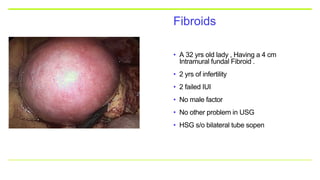
Fibroids
• A 32 yrs old lady , Having a 4 cm
Intramural fundal Fibroid .
• 2 yrs of infertility
• 2 failed IUI
• No male factor
• No other problem in USG
• HSG s/o bilateral tube sopen
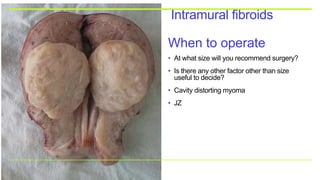
Intramural fibroids
When to operate
• At what size will you recommend surgery?
• Is there any other factor other than size
useful to decide?
• Cavity distorting myoma
• JZ
• Intramural fibroid 3 cm
• operate?
• JZ proximity-3D USG
• Study endometrial biopsy and receptor
assays, away 3 mm from the JZ did not have
effect on fertility
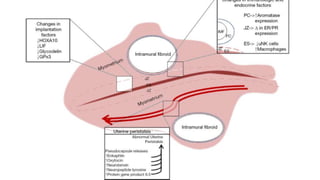
There appears to be enough evidence that NCD IM fibroid affects fertility.
Since disruption of the JZ appears to be an important cause of sub fertility
• Submucosal fibroids of any size ,intramural fibroids of >4cm impair fertility
• The presence of subserosal myomas has little or no effect on fertility
• Myomectomy appears to have an effect in fertility improvement in certain cases
• Endoscopic treatment is the recommended approach, due to its postoperative advantages
• Zepiridis LI,grimbizis GF,Tarlatzis BC, Infertility and uterine fibroids.Best Practice & Research Clinical Obstetrics & Gynaecology.2016
Jul1;34:66-73
Best practices COG
ASRM Guidelines
Fibroids :When to operate
• In asymptomatic women with cavity distorting myomas(intramural with submucosal
component or Submucosal),Myomectomy may be considered to improve pregnancy rates
• Myomectomy is generally not advised to improve pregnancy outcomes in asymptomatic
infertile women with non cavity distorting myomas
• However, myomectomy may be reasonable in some cicumsatnces ,including but not limited to
severe distortion of the pelvic architecture.
Practice committee of the American Society for reproductive Medicine.Removal of myomas in
symptomatic patients to improve fertility and/or reduce miscarriage rates:a guidelineFertility and
sterility 2017 Sep1 : 108(3):416-25
Inscision
Lap myomectomy
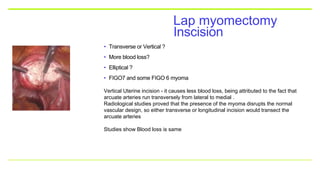
• Transverse or Vertical ?
• More blood loss?
• Elliptical ?
• FIGO7 and some FIGO 6 myoma
Vertical Uterine incision - it causes less blood loss, being attributed to the fact that
arcuate arteries run transversely from lateral to medial .
Radiological studies proved that the presence of the myoma disrupts the normal
vascular design, so either transverse or longitudinal incision would transect the
arcuate arteries
Studies show Blood loss is same
Wound integrity
Lap myomectomy
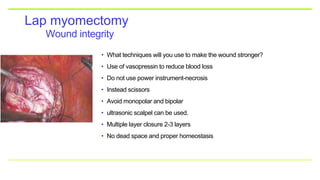
• What techniques will you use to make the wound stronger?
• Use of vasopressin to reduce blood loss
• Do not use power instrument-necrosis
• Instead scissors
• Avoid monopolar and bipolar
• ultrasonic scalpel can be used.
• Multiple layer closure 2-3 layers
• No dead space and proper homeostasis
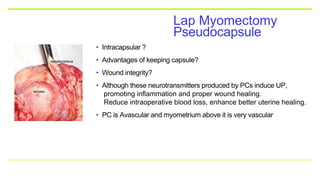
Pseudocapsule
Lap Myomectomy
• Intracapsular ?
• Advantages of keeping capsule?
• Wound integrity?
• Although these neurotransmitters produced by PCs induce UP,
promoting inflammation and proper wound healing.
Reduce intraoperative blood loss, enhance better uterine healing.
• PC is Avascular and myometrium above it is very vascular
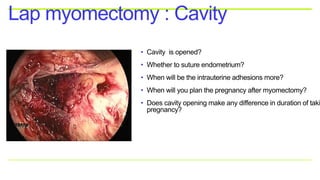
• Cavity is opened?
• Whether to suture endometrium?
• When will be the intrauterine adhesions more?
• When will you plan the pregnancy after myomectomy?
• Does cavity opening make any difference in duration of taki
pregnancy?
Lap myomectomy : Cavity
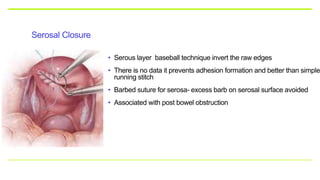
Serosal Closure
• Serous layer baseball technique invert the raw edges
• There is no data it prevents adhesion formation and better than simple
running stitch
• Barbed suture for serosa- excess barb on serosal surface avoided
• Associated with post bowel obstruction
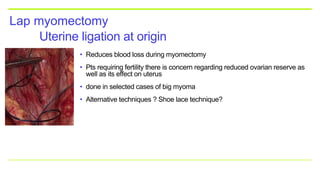
Uterine ligation at origin
Lap myomectomy
• Reduces blood loss during myomectomy
• Pts requiring fertility there is concern regarding reduced ovarian reserve as
well as its effect on uterus
• done in selected cases of big myoma
• Alternative techniques ? Shoe lace technique?
• Adherence to microsurgical principles
• Peritoneal instillate with Icodextrin 4 % (ADEPT)
• Surgical Barriers Interceed,Gore-Tex and Sepra Film
• No evidence to support effectiveness of
• Heparin
• Antibiotics peritoneal instillates
• Hyaluronic acid solution
• fibrin sheets
Adhesion Prevention
• 32 years old
• secondary infertility 5yrs ,tubes patent
• Has an Adenomyoma 4x4 cm fundoposterior wall of uterus
Adenomyoma
• Will you operate?
• How much to remove?
• Pre op GnRha?Post op GnRHa?
• If the age is more what things you can do before surgery?
• MRI/3D scan before you take for surgery?
MRI finding is thickening of junctional zone exceeding 12 mm.
thickness is the best negative predictive factor of implantation failure, and
an increase in JZ diameter is inversely correlated to implantation rate.
Implantation failure was found to be high when the average junctional
zone was greater than 7 m
• How it is different than myomectomy and what surgical techniques will you use?
• How will you identify cavity? any technique?
• carrying pregnancy till term
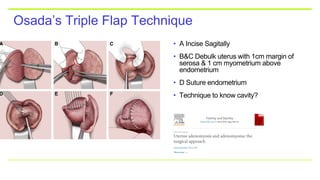
Osada’s Triple Flap Technique
• A Incise Sagitally
• B&C Debulk uterus with 1cm margin of
serosa & 1 cm myometrium above
endometrium
• D Suture endometrium
• Technique to know cavity?
• A well defined adenomyoma -can definitely attempt surgery first
• How would you go about Diffuse Adenomyosis ?
• Evidence suggest - GnRh agonist for 3-6 months reduces inflammatory cytokines
• Studies show Surgery + GnRha compared with GnRha for 3 months outcome of pregnancy were same
• Downregulate for 6 months significant improvement in pregnancy rates
• Diffuse adenomyosis -Try combination medical management plus LNG IUDevice followed by IVF
• Alway keep in mind the obstetric problems the pt can have then decide mode of treatment.
Diffuse Adenomyosis
A literature review suggested that the risk of uterine rupture after uterine adeno
Y. Morimatsu, S. Matsubara, N. Higashiyama, T. Kuwata, A. Ohkuchi, A. Izumi, et al.
Uterine rupture during pregnancy soon after a laroscopic adenomyomectomy
Reprod Med Biol, 6 (2007), pp. 175-177
Lap adenomyomectomy rupture
In a study by Osada H, et al. 2017 in which 113 women were evaluated after surgery
using this method, it was shown that within 6 months the blood flow in the area of
action returned to normal in almost all cases (92/113, 81.4 %). Of the 62 women
planning a pregnancy, 46 became pregnant and 32 gave birth to a healthy baby
through a planned cesarean section. There were no cases of uterine rupture. During
the study period (27 years), only 4 cases (3.5%)
• Recurrences were found as early as a year after surgery.
• Less recurrences were found when medical treatment was started immidiately after surgery
• Recurrence rate is estimate to be 9% in the complete excision technique,19% in partial excision and
32 % in non excision technique
Recurrences
• 3 months after the surgery
When can they conceive
• Mere presence of adenomyosis does it impact success rate?
• The results are conflicting with two studies no effect of adenomyosis(Mijatovic et al 2010,Costello et
al 2011)
• Other two showing increased rates of miscarriage or decreased implantation rates (Tremeel Russell,
2011; Martinez -Conejero et al :2011)
• Generally it affects fertility
IVF success rates in Adenomyoma
• Recurrent abortions
• IVF failures due to implantation failure
• Obstetrical outcomes- Preterm,IUGR,PROM
• Osada et al 2018
Adenomyosis and reproductive
outcome
• Second line of treatment in CC resistant patients
PCO drilling
No risks of ovarian hyperstimulation syndrome and multiple pregnancies.
It improves ovarian responsiveness to successive ovulation induction agents.
Its favorable reproductive and endocrinal effects are sustained long.
Its use in unselected cases of PCOS or for non-fertility indications is not pruden
• In Which patients Lap ovarian drilling will you do?
• CC resistent
• Those needing laparoscopic assessment of the pelvis
• hypersecretion of luteinizing hormone (LH)
• Normal body mass index
who live too far away from the hospital
for the intensive monitoring required during gonadotropin
therapy.
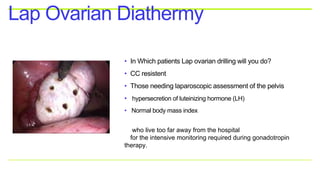
Lap Ovarian Diathermy
• No of Punctures rule of 4 - 40 watts,4 seconds,4 puncture.
• More punctures?
• More than eight punctures seem to increase the occurrence of post-operative pelvic adhesions and decrease the ovarian
reserve
• Hilum should be avoided- compromise ovarian blood supply
• Needle right angle to surface of ovary
• Current applied only when needle is in stroma to avoid damage to cortex
• irrigation and cool ovaries before dropping
Technical considerations-LOD
• Proper technique in properly selected patients do you feel these problems really bother?
• Periovarian adhesions
• Ovarian reserve is concern
• Studies showed no concrete evidence for decreased ovarian reserve
• The reduction in AMH, Inhibin and AFC should be viewed as normalisation of PCOS condition
Adhesions/Reduced ovarian
reserves
• Normalisation of ovulation and pregnancy rates post LOD
normal ovulation in 74% of the cases in the next 3–6 months.
• Meta analysis showed ovulation and pregnancy rates after LOD are similar to those Gonnadotrophins
with reduced risk of Multiple pregnancy
• The benefits are long term 1-3 yrs
• It is good technique in properly selected patient with properly done method
• Second line treatment
• Counselling to be done regarding reduction in ov reserve and adhesion formation.
Outcomes PCOS
Fertility Enhancing Laparoscopic Surgeries Panel Discussion

Fertility Enhancing Laparoscopic Surgeries Panel Discussion

  • 1.
  • 2.
    Indian Fertility society,VidarbhaChapter -Panel Discussion Dr Rajesh Gajbhiye, Consultant Gynaecologist and Laparoscopic Surgeon Mauli Womens Hospital, Nagpur
  • 3.
    Fibroids • A 32yrs old lady , Having a 4 cm Intramural fundal Fibroid . • 2 yrs of infertility • 2 failed IUI • No male factor • No other problem in USG • HSG s/o bilateral tube sopen
  • 4.
    Intramural fibroids When tooperate • At what size will you recommend surgery? • Is there any other factor other than size useful to decide? • Cavity distorting myoma • JZ
  • 5.
    • Intramural fibroid3 cm • operate? • JZ proximity-3D USG • Study endometrial biopsy and receptor assays, away 3 mm from the JZ did not have effect on fertility
  • 7.
    There appears tobe enough evidence that NCD IM fibroid affects fertility. Since disruption of the JZ appears to be an important cause of sub fertility
  • 8.
    • Submucosal fibroidsof any size ,intramural fibroids of >4cm impair fertility • The presence of subserosal myomas has little or no effect on fertility • Myomectomy appears to have an effect in fertility improvement in certain cases • Endoscopic treatment is the recommended approach, due to its postoperative advantages • Zepiridis LI,grimbizis GF,Tarlatzis BC, Infertility and uterine fibroids.Best Practice & Research Clinical Obstetrics & Gynaecology.2016 Jul1;34:66-73 Best practices COG
  • 9.
    ASRM Guidelines Fibroids :Whento operate • In asymptomatic women with cavity distorting myomas(intramural with submucosal component or Submucosal),Myomectomy may be considered to improve pregnancy rates • Myomectomy is generally not advised to improve pregnancy outcomes in asymptomatic infertile women with non cavity distorting myomas • However, myomectomy may be reasonable in some cicumsatnces ,including but not limited to severe distortion of the pelvic architecture. Practice committee of the American Society for reproductive Medicine.Removal of myomas in symptomatic patients to improve fertility and/or reduce miscarriage rates:a guidelineFertility and sterility 2017 Sep1 : 108(3):416-25
  • 10.
    Inscision Lap myomectomy • Transverseor Vertical ? • More blood loss? • Elliptical ? • FIGO7 and some FIGO 6 myoma Vertical Uterine incision - it causes less blood loss, being attributed to the fact that arcuate arteries run transversely from lateral to medial . Radiological studies proved that the presence of the myoma disrupts the normal vascular design, so either transverse or longitudinal incision would transect the arcuate arteries Studies show Blood loss is same
  • 11.
    Wound integrity Lap myomectomy •What techniques will you use to make the wound stronger? • Use of vasopressin to reduce blood loss • Do not use power instrument-necrosis • Instead scissors • Avoid monopolar and bipolar • ultrasonic scalpel can be used. • Multiple layer closure 2-3 layers • No dead space and proper homeostasis
  • 12.
    Pseudocapsule Lap Myomectomy • Intracapsular? • Advantages of keeping capsule? • Wound integrity? • Although these neurotransmitters produced by PCs induce UP, promoting inflammation and proper wound healing. Reduce intraoperative blood loss, enhance better uterine healing. • PC is Avascular and myometrium above it is very vascular
  • 13.
    • Cavity isopened? • Whether to suture endometrium? • When will be the intrauterine adhesions more? • When will you plan the pregnancy after myomectomy? • Does cavity opening make any difference in duration of taki pregnancy? Lap myomectomy : Cavity
  • 14.
    Serosal Closure • Serouslayer baseball technique invert the raw edges • There is no data it prevents adhesion formation and better than simple running stitch • Barbed suture for serosa- excess barb on serosal surface avoided • Associated with post bowel obstruction
  • 15.
    Uterine ligation atorigin Lap myomectomy • Reduces blood loss during myomectomy • Pts requiring fertility there is concern regarding reduced ovarian reserve as well as its effect on uterus • done in selected cases of big myoma • Alternative techniques ? Shoe lace technique?
  • 16.
    • Adherence tomicrosurgical principles • Peritoneal instillate with Icodextrin 4 % (ADEPT) • Surgical Barriers Interceed,Gore-Tex and Sepra Film • No evidence to support effectiveness of • Heparin • Antibiotics peritoneal instillates • Hyaluronic acid solution • fibrin sheets Adhesion Prevention
  • 17.
    • 32 yearsold • secondary infertility 5yrs ,tubes patent • Has an Adenomyoma 4x4 cm fundoposterior wall of uterus Adenomyoma
  • 18.
    • Will youoperate? • How much to remove? • Pre op GnRha?Post op GnRHa? • If the age is more what things you can do before surgery?
  • 19.
    • MRI/3D scanbefore you take for surgery?
  • 20.
    MRI finding isthickening of junctional zone exceeding 12 mm. thickness is the best negative predictive factor of implantation failure, and an increase in JZ diameter is inversely correlated to implantation rate. Implantation failure was found to be high when the average junctional zone was greater than 7 m
  • 21.
    • How itis different than myomectomy and what surgical techniques will you use? • How will you identify cavity? any technique? • carrying pregnancy till term
  • 22.
    Osada’s Triple FlapTechnique • A Incise Sagitally • B&C Debulk uterus with 1cm margin of serosa & 1 cm myometrium above endometrium • D Suture endometrium • Technique to know cavity?
  • 23.
    • A welldefined adenomyoma -can definitely attempt surgery first • How would you go about Diffuse Adenomyosis ? • Evidence suggest - GnRh agonist for 3-6 months reduces inflammatory cytokines • Studies show Surgery + GnRha compared with GnRha for 3 months outcome of pregnancy were same • Downregulate for 6 months significant improvement in pregnancy rates • Diffuse adenomyosis -Try combination medical management plus LNG IUDevice followed by IVF • Alway keep in mind the obstetric problems the pt can have then decide mode of treatment. Diffuse Adenomyosis
  • 24.
    A literature reviewsuggested that the risk of uterine rupture after uterine adeno Y. Morimatsu, S. Matsubara, N. Higashiyama, T. Kuwata, A. Ohkuchi, A. Izumi, et al. Uterine rupture during pregnancy soon after a laroscopic adenomyomectomy Reprod Med Biol, 6 (2007), pp. 175-177
  • 25.
    Lap adenomyomectomy rupture Ina study by Osada H, et al. 2017 in which 113 women were evaluated after surgery using this method, it was shown that within 6 months the blood flow in the area of action returned to normal in almost all cases (92/113, 81.4 %). Of the 62 women planning a pregnancy, 46 became pregnant and 32 gave birth to a healthy baby through a planned cesarean section. There were no cases of uterine rupture. During the study period (27 years), only 4 cases (3.5%)
  • 26.
    • Recurrences werefound as early as a year after surgery. • Less recurrences were found when medical treatment was started immidiately after surgery • Recurrence rate is estimate to be 9% in the complete excision technique,19% in partial excision and 32 % in non excision technique Recurrences
  • 27.
    • 3 monthsafter the surgery When can they conceive
  • 28.
    • Mere presenceof adenomyosis does it impact success rate? • The results are conflicting with two studies no effect of adenomyosis(Mijatovic et al 2010,Costello et al 2011) • Other two showing increased rates of miscarriage or decreased implantation rates (Tremeel Russell, 2011; Martinez -Conejero et al :2011) • Generally it affects fertility IVF success rates in Adenomyoma
  • 29.
    • Recurrent abortions •IVF failures due to implantation failure • Obstetrical outcomes- Preterm,IUGR,PROM • Osada et al 2018 Adenomyosis and reproductive outcome
  • 30.
    • Second lineof treatment in CC resistant patients PCO drilling No risks of ovarian hyperstimulation syndrome and multiple pregnancies. It improves ovarian responsiveness to successive ovulation induction agents. Its favorable reproductive and endocrinal effects are sustained long. Its use in unselected cases of PCOS or for non-fertility indications is not pruden
  • 31.
    • In Whichpatients Lap ovarian drilling will you do? • CC resistent • Those needing laparoscopic assessment of the pelvis • hypersecretion of luteinizing hormone (LH) • Normal body mass index who live too far away from the hospital for the intensive monitoring required during gonadotropin therapy. Lap Ovarian Diathermy
  • 32.
    • No ofPunctures rule of 4 - 40 watts,4 seconds,4 puncture. • More punctures? • More than eight punctures seem to increase the occurrence of post-operative pelvic adhesions and decrease the ovarian reserve • Hilum should be avoided- compromise ovarian blood supply • Needle right angle to surface of ovary • Current applied only when needle is in stroma to avoid damage to cortex • irrigation and cool ovaries before dropping Technical considerations-LOD
  • 33.
    • Proper techniquein properly selected patients do you feel these problems really bother? • Periovarian adhesions • Ovarian reserve is concern • Studies showed no concrete evidence for decreased ovarian reserve • The reduction in AMH, Inhibin and AFC should be viewed as normalisation of PCOS condition Adhesions/Reduced ovarian reserves
  • 34.
    • Normalisation ofovulation and pregnancy rates post LOD normal ovulation in 74% of the cases in the next 3–6 months.
  • 35.
    • Meta analysisshowed ovulation and pregnancy rates after LOD are similar to those Gonnadotrophins with reduced risk of Multiple pregnancy • The benefits are long term 1-3 yrs • It is good technique in properly selected patient with properly done method • Second line treatment • Counselling to be done regarding reduction in ov reserve and adhesion formation. Outcomes PCOS