Learning Outcomes 
Define compounding. 
Describe steps involved in compounding process 
Describe equipment commonly used for 
compounding 
Identify types of preparations commonly 
compounded 
Explain reasons for repackaging medications 
Explain importance of record keeping for 
compounding & repackaging
Key Terms 
Active ingredient 
Batch record (or batch log) 
Batch repackaging 
Beyond-use 
Blister packages 
Compounding 
Compounding environment 
Compounding record
Key Terms 
Extemporaneous repackaging 
Formulation record 
Geometric dilution 
Graduates 
Inactive ingredient 
Levigation. 
Manufacturing 
Nonsterile compounding
Key Terms 
Peristaltic pumps 
Prescription compounding 
Stability 
Sterile compounding 
Trituration 
Unit-dose package 
Unit-of-use packaging 
Volumetric pumps
Prescription Compounding 
Meets unique needs of patient 
Medication strength/dose not commercially available 
Compounding associated with specialty practice areas 
veterinary medicine 
dermatology 
hormone replacement therapy 
pain management 
hospice 
home care
Compound or Manufacture? 
Compounding: prepare small quantity of drug 
based on practitioner’s prescription 
for specific patient 
Manufacturing: prepare bulk quantities 
without prescription or medication order
Types of Compounding 
Sterile compounding 
strict aseptic technique 
 injections 
 ophthalmic solutions 
 irrigation solutions 
Nonsterile compounding 
oral & topical medications
USP-NF Chapter 795 
United States Pharmacopeia-The National Formulary 
Guidelines & an enforceable set of standards 
Describes procedures/requirements for compounding 
Intent of USP is to protect both patients & 
pharmacists
Compounding Environment 
Adequate space 
orderly placement & storage of equipment 
Controlled temperature/lighting 
Clean 
Sink with hot & cold running water 
essential for hand washing & equipment cleaning
Compounding Equipment 
Equipment must be: 
appropriate in design & size for intended purpose 
must always be cleaned immediately after use 
must be properly maintained & calibrated 
Must have separate & distinct areas for compounding 
sterile & nonsterile preparations
Stability of Preparations 
Primary packaging important 
Examples 
 light sensitive drugs or drugs that bind to container 
Beyond-use date (BUD) on label of all medications 
Determining beyond-use dates based on 
aqueous (water-based) or nonaqueous 
expiration dates of ingredients used 
storage temperature 
references with stability data
Ingredient Selection 
USP or National Formulary (NF) chemicals preferred 
Pharmacist responsible for selection 
chemical must meet meets purity & safety standards 
should not use drug withdrawn from market by FDA
Compounded Preparations 
Guideline: 
should contain between 90% & 110% of labeled active 
ingredient 
Guidelines specifically address these dosage forms: 
capsules, powders, lozenges, tablets, emulsions, 
solutions, suspensions, suppositories, creams, topical 
gels, ointments, pastes
Compounding Process 
Goal of compounding process 
“minimize error and maximize prescriber’s intent” 
Pharmacist evaluates appropriateness of order 
Only 1 preparation should be compounded at a time 
avoid errors 
avoid cross-contamination
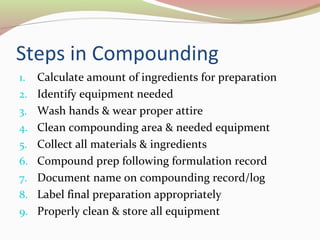
Steps in Compounding 
1. Calculate amount of ingredients for preparation 
2. Identify equipment needed 
3. Wash hands & wear proper attire 
4. Clean compounding area & needed equipment 
5. Collect all materials & ingredients 
6. Compound prep following formulation record 
7. Document name on compounding record/log 
8. Label final preparation appropriately 
9. Properly clean & store all equipment
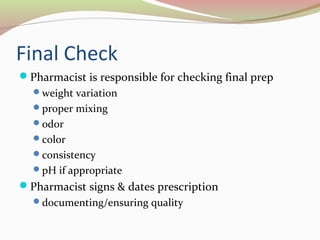
Final Check 
Pharmacist is responsible for checking final prep 
weight variation 
proper mixing 
odor 
color 
consistency 
pH if appropriate 
Pharmacist signs & dates prescription 
documenting/ensuring quality
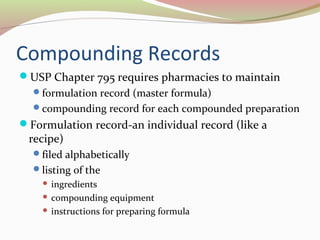
Compounding Records 
USP Chapter 795 requires pharmacies to maintain 
formulation record (master formula) 
compounding record for each compounded preparation 
Formulation record-an individual record (like a 
recipe) 
filed alphabetically 
listing of the 
 ingredients 
 compounding equipment 
 instructions for preparing formula
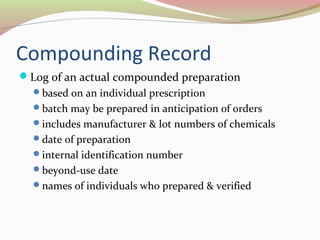
Compounding Record 
Log of an actual compounded preparation 
based on an individual prescription 
batch may be prepared in anticipation of orders 
includes manufacturer & lot numbers of chemicals 
date of preparation 
internal identification number 
beyond-use date 
names of individuals who prepared & verified
Records 
Compounding record for batch (batch record) 
filed by lot number 
Compounding record for an individual prescription 
chronological list of preparations made 
Formulation & compounding records 
maintained as paper copies or electronically
Quality Control 
Final check on preparation 
Pharmacist must evaluate 
finished preparation 
compounding procedure 
Discrepancies should be noted & evaluated 
Patient Counseling 
important with all medications 
correct use, storage, beyond-use date, evidence of 
instability in compounded medication
Inactive Ingredients 
needed to prepare formulation 
not intended to cause pharmacologic response 
Diluents or fillers 
Binders 
Colorants 
Lubricants 
Flavorants 
Sweeteners 
Suspending agents 
Vehicles 
Emulsifying agents or surfactants 
Coating agents 
Preservatives 
Perfumes 
Acidifying agents 
Alkalizing agents 
Wetting agents
Compounding Equipment 
Electronic or class A torsion balance 
Powder papers or weigh boats 
Brass weight sets with class A torsion balances 
Graduates 
Mortars & pestles 
Ointment slab (pill tile) & spatulas 
trituration 
levigation 
geometric dilution
Electronic mortar & pestle 
Hot plates 
Refrigerator with freezer 
Stirring rods 
Stir plates with magnetic stir bars 
Strainers 
Molds for suppository, troche 
Blenders 
Capsule filling equipment 
Mixers 
Motorized stirrers
Compounded Preparations 
Commonly compounded preparations 
ointments 
creams 
solutions 
suspensions 
suppositories 
lozenges/troches 
capsules
Ointments & Creams 
Active ingredient in commercially prepared base 
petrolatum-based products 
emollient creams 
vanishing creams 
Choice of base depends on condition being treated 
Examples of medications in creams & ointments 
corticosteroids 
antifungals 
antibiotics 
hormones
Solutions & Suspensions 
One or more drug ingredients 
Mixed in homogenous or single phase 
No visible undissolved particles 
Solutions 
solid drug that dissolves in liquid 
Suspensions 
two phases: 
 insoluble solid particles (active ingredient) 
 liquid
Suspensions 
Insoluble particles settle to bottom 
Suspending agents 
added to allow insoluble particles to re-suspend 
Suspensions 
levigate insoluble powder to smooth paste 
appropriate wetting agent 
Flavoring & sweetening agents
Suppositories 
Suppositories may contain 
analgesics 
hormones 
anti-nausea agents 
laxatives 
vaginal anti-infectives 
Once inserted, suppository melts or dissolves 
suppositories must remain solid at room temperature & 
melt at body temperature
Lozenges/Troches 
Also known as pastilles 
Small, medicated squares can be soft or hard 
Intended to dissolve slowly between cheek & gum 
Medication(s) absorbed through oral mucosa 
Useful for pediatric & geriatric patients
Capsules 
Capsule-filling machine 
Powders mixed in mortar, zippered plastic bag, or 
specialized blender 
Lids or capsule tops are removed 
Capsules drop even with plate 
Powder is distributed into capsules 
Lids or tops are replaced 
Numerous capsule sizes & colors available
Other Compounds 
Powders are very fine, dry active & inactive 
ingredients 
Granules are powders moistened & passed through 
screen 
Emulsions are mixture of 2 immiscible liquids 
Gels are semi-solid systems consisting of suspensions 
Tablets are made by compression
Repackaging 
Pharmacies repackage medications from bulk 
containers into patient-specific containers 
unit-of-use 
single-unit 
unit-dose
Extemporaneous Versus Batch 
Extemporaneous repackaging 
quantities to be used within short period of time 
done on an “as needed” basis 
based on anticipated immediate need 
also known as “just-in-time” packaging 
Batch repackaging 
periodic repackaging of large quantities of medications 
unit-dose or single-unit packages 
extended stability 
prescribed more frequently
Packaging 
Prepare in advance = pre-packaging 
Saves 
time 
materials 
money
Repackaging Materials 
Must protect drug from 
harmful external elements 
 light 
 heat 
 moisture 
 air 
 microbial contaminants 
USP defines containers & closures 
 based on degree to which contents protected
Repackaging Equipment 
Oral Solid Systems 
blister packages 
pouch packages 
Manual Systems 
Automated Systems 
Oral Liquid Systems 
Semi-automated Systems 
Volumetric pumps 
Peristaltic pumps
Beyond-Use Dating & Labeling 
Labeling-responsibility of dispenser 
storage conditions 
beyond-use date 
USP offers standards for determining an appropriate 
expiration date in absence of published stability data
USP Guidance: 
“For nonsterile solid and liquid dosage forms that are 
packaged in single-unit and unit-dose containers, the 
beyond use date shall be one year from the date 
packaged or the expiration date on the manufacturer’s 
container, whichever is earlier.”
ASHP Guidance 
Current federal labeling requirements 
Described in ASHP Technical Assistance Bulletin on 
Single Unit and Unit Dose Packages of Drugs 
Generic name & brand name 
Dosage form, strength, amount delivered in package, 
notes 
Expiration date 
Control number or lot number 
Bar code
Record Keeping 
Standards of practice & government regulations 
maintaining accurate, complete records 
focal point for quality assurance program 
maximize technician’s role in repackaging 
repackaging record systems 
computerized 
individual state laws & regulations will dictate: 
 what needs to be kept, whether records may be maintained 
as paper or electronic records, how long records must be 
maintained
Quality Control 
Ensures high-quality repackaged medications 
Quality control 
written procedures 
formal training for operators of equipment 
maintenance of equipment 
checkpoints during process 
end product testing 
strict adherence to good manufacturing practices 
(GMP)
GMP 
Refers to guidelines of production 
Manufacturing/repackaging processes clearly defined 
Instructions/procedures are written in clear language 
Documentation of personnel training 
Records: show procedures were followed 
 Storage & distribution of final product minimizes 
negative effects to quality 
System for recalling any batch of product
GMP 
Written Procedures 
Personnel Training and Competency 
Maintenance of Equipment 
End-Product Testing
Checkpoints May Include: 
1. Double-checking drug & dosage 
2. Double-checking fill volumes 
3. Double-checking calculations 
4. Double-checking information on label

Usp795details

  • 2.
    Learning Outcomes Definecompounding. Describe steps involved in compounding process Describe equipment commonly used for compounding Identify types of preparations commonly compounded Explain reasons for repackaging medications Explain importance of record keeping for compounding & repackaging
  • 3.
    Key Terms Activeingredient Batch record (or batch log) Batch repackaging Beyond-use Blister packages Compounding Compounding environment Compounding record
  • 4.
    Key Terms Extemporaneousrepackaging Formulation record Geometric dilution Graduates Inactive ingredient Levigation. Manufacturing Nonsterile compounding
  • 5.
    Key Terms Peristalticpumps Prescription compounding Stability Sterile compounding Trituration Unit-dose package Unit-of-use packaging Volumetric pumps
  • 6.
    Prescription Compounding Meetsunique needs of patient Medication strength/dose not commercially available Compounding associated with specialty practice areas veterinary medicine dermatology hormone replacement therapy pain management hospice home care
  • 7.
    Compound or Manufacture? Compounding: prepare small quantity of drug based on practitioner’s prescription for specific patient Manufacturing: prepare bulk quantities without prescription or medication order
  • 8.
    Types of Compounding Sterile compounding strict aseptic technique  injections  ophthalmic solutions  irrigation solutions Nonsterile compounding oral & topical medications
  • 9.
    USP-NF Chapter 795 United States Pharmacopeia-The National Formulary Guidelines & an enforceable set of standards Describes procedures/requirements for compounding Intent of USP is to protect both patients & pharmacists
  • 10.
    Compounding Environment Adequatespace orderly placement & storage of equipment Controlled temperature/lighting Clean Sink with hot & cold running water essential for hand washing & equipment cleaning
  • 11.
    Compounding Equipment Equipmentmust be: appropriate in design & size for intended purpose must always be cleaned immediately after use must be properly maintained & calibrated Must have separate & distinct areas for compounding sterile & nonsterile preparations
  • 12.
    Stability of Preparations Primary packaging important Examples  light sensitive drugs or drugs that bind to container Beyond-use date (BUD) on label of all medications Determining beyond-use dates based on aqueous (water-based) or nonaqueous expiration dates of ingredients used storage temperature references with stability data
  • 13.
    Ingredient Selection USPor National Formulary (NF) chemicals preferred Pharmacist responsible for selection chemical must meet meets purity & safety standards should not use drug withdrawn from market by FDA
  • 14.
    Compounded Preparations Guideline: should contain between 90% & 110% of labeled active ingredient Guidelines specifically address these dosage forms: capsules, powders, lozenges, tablets, emulsions, solutions, suspensions, suppositories, creams, topical gels, ointments, pastes
  • 15.
    Compounding Process Goalof compounding process “minimize error and maximize prescriber’s intent” Pharmacist evaluates appropriateness of order Only 1 preparation should be compounded at a time avoid errors avoid cross-contamination
  • 16.
    Steps in Compounding 1. Calculate amount of ingredients for preparation 2. Identify equipment needed 3. Wash hands & wear proper attire 4. Clean compounding area & needed equipment 5. Collect all materials & ingredients 6. Compound prep following formulation record 7. Document name on compounding record/log 8. Label final preparation appropriately 9. Properly clean & store all equipment
  • 17.
    Final Check Pharmacistis responsible for checking final prep weight variation proper mixing odor color consistency pH if appropriate Pharmacist signs & dates prescription documenting/ensuring quality
  • 18.
    Compounding Records USPChapter 795 requires pharmacies to maintain formulation record (master formula) compounding record for each compounded preparation Formulation record-an individual record (like a recipe) filed alphabetically listing of the  ingredients  compounding equipment  instructions for preparing formula
  • 19.
    Compounding Record Logof an actual compounded preparation based on an individual prescription batch may be prepared in anticipation of orders includes manufacturer & lot numbers of chemicals date of preparation internal identification number beyond-use date names of individuals who prepared & verified
  • 20.
    Records Compounding recordfor batch (batch record) filed by lot number Compounding record for an individual prescription chronological list of preparations made Formulation & compounding records maintained as paper copies or electronically
  • 21.
    Quality Control Finalcheck on preparation Pharmacist must evaluate finished preparation compounding procedure Discrepancies should be noted & evaluated Patient Counseling important with all medications correct use, storage, beyond-use date, evidence of instability in compounded medication
  • 22.
    Inactive Ingredients neededto prepare formulation not intended to cause pharmacologic response Diluents or fillers Binders Colorants Lubricants Flavorants Sweeteners Suspending agents Vehicles Emulsifying agents or surfactants Coating agents Preservatives Perfumes Acidifying agents Alkalizing agents Wetting agents
  • 23.
    Compounding Equipment Electronicor class A torsion balance Powder papers or weigh boats Brass weight sets with class A torsion balances Graduates Mortars & pestles Ointment slab (pill tile) & spatulas trituration levigation geometric dilution
  • 24.
    Electronic mortar &pestle Hot plates Refrigerator with freezer Stirring rods Stir plates with magnetic stir bars Strainers Molds for suppository, troche Blenders Capsule filling equipment Mixers Motorized stirrers
  • 25.
    Compounded Preparations Commonlycompounded preparations ointments creams solutions suspensions suppositories lozenges/troches capsules
  • 26.
    Ointments & Creams Active ingredient in commercially prepared base petrolatum-based products emollient creams vanishing creams Choice of base depends on condition being treated Examples of medications in creams & ointments corticosteroids antifungals antibiotics hormones
  • 27.
    Solutions & Suspensions One or more drug ingredients Mixed in homogenous or single phase No visible undissolved particles Solutions solid drug that dissolves in liquid Suspensions two phases:  insoluble solid particles (active ingredient)  liquid
  • 28.
    Suspensions Insoluble particlessettle to bottom Suspending agents added to allow insoluble particles to re-suspend Suspensions levigate insoluble powder to smooth paste appropriate wetting agent Flavoring & sweetening agents
  • 29.
    Suppositories Suppositories maycontain analgesics hormones anti-nausea agents laxatives vaginal anti-infectives Once inserted, suppository melts or dissolves suppositories must remain solid at room temperature & melt at body temperature
  • 30.
    Lozenges/Troches Also knownas pastilles Small, medicated squares can be soft or hard Intended to dissolve slowly between cheek & gum Medication(s) absorbed through oral mucosa Useful for pediatric & geriatric patients
  • 31.
    Capsules Capsule-filling machine Powders mixed in mortar, zippered plastic bag, or specialized blender Lids or capsule tops are removed Capsules drop even with plate Powder is distributed into capsules Lids or tops are replaced Numerous capsule sizes & colors available
  • 32.
    Other Compounds Powdersare very fine, dry active & inactive ingredients Granules are powders moistened & passed through screen Emulsions are mixture of 2 immiscible liquids Gels are semi-solid systems consisting of suspensions Tablets are made by compression
  • 33.
    Repackaging Pharmacies repackagemedications from bulk containers into patient-specific containers unit-of-use single-unit unit-dose
  • 34.
    Extemporaneous Versus Batch Extemporaneous repackaging quantities to be used within short period of time done on an “as needed” basis based on anticipated immediate need also known as “just-in-time” packaging Batch repackaging periodic repackaging of large quantities of medications unit-dose or single-unit packages extended stability prescribed more frequently
  • 35.
    Packaging Prepare inadvance = pre-packaging Saves time materials money
  • 36.
    Repackaging Materials Mustprotect drug from harmful external elements  light  heat  moisture  air  microbial contaminants USP defines containers & closures  based on degree to which contents protected
  • 37.
    Repackaging Equipment OralSolid Systems blister packages pouch packages Manual Systems Automated Systems Oral Liquid Systems Semi-automated Systems Volumetric pumps Peristaltic pumps
  • 38.
    Beyond-Use Dating &Labeling Labeling-responsibility of dispenser storage conditions beyond-use date USP offers standards for determining an appropriate expiration date in absence of published stability data
  • 39.
    USP Guidance: “Fornonsterile solid and liquid dosage forms that are packaged in single-unit and unit-dose containers, the beyond use date shall be one year from the date packaged or the expiration date on the manufacturer’s container, whichever is earlier.”
  • 40.
    ASHP Guidance Currentfederal labeling requirements Described in ASHP Technical Assistance Bulletin on Single Unit and Unit Dose Packages of Drugs Generic name & brand name Dosage form, strength, amount delivered in package, notes Expiration date Control number or lot number Bar code
  • 41.
    Record Keeping Standardsof practice & government regulations maintaining accurate, complete records focal point for quality assurance program maximize technician’s role in repackaging repackaging record systems computerized individual state laws & regulations will dictate:  what needs to be kept, whether records may be maintained as paper or electronic records, how long records must be maintained
  • 42.
    Quality Control Ensureshigh-quality repackaged medications Quality control written procedures formal training for operators of equipment maintenance of equipment checkpoints during process end product testing strict adherence to good manufacturing practices (GMP)
  • 43.
    GMP Refers toguidelines of production Manufacturing/repackaging processes clearly defined Instructions/procedures are written in clear language Documentation of personnel training Records: show procedures were followed  Storage & distribution of final product minimizes negative effects to quality System for recalling any batch of product
  • 44.
    GMP Written Procedures Personnel Training and Competency Maintenance of Equipment End-Product Testing
  • 45.
    Checkpoints May Include: 1. Double-checking drug & dosage 2. Double-checking fill volumes 3. Double-checking calculations 4. Double-checking information on label