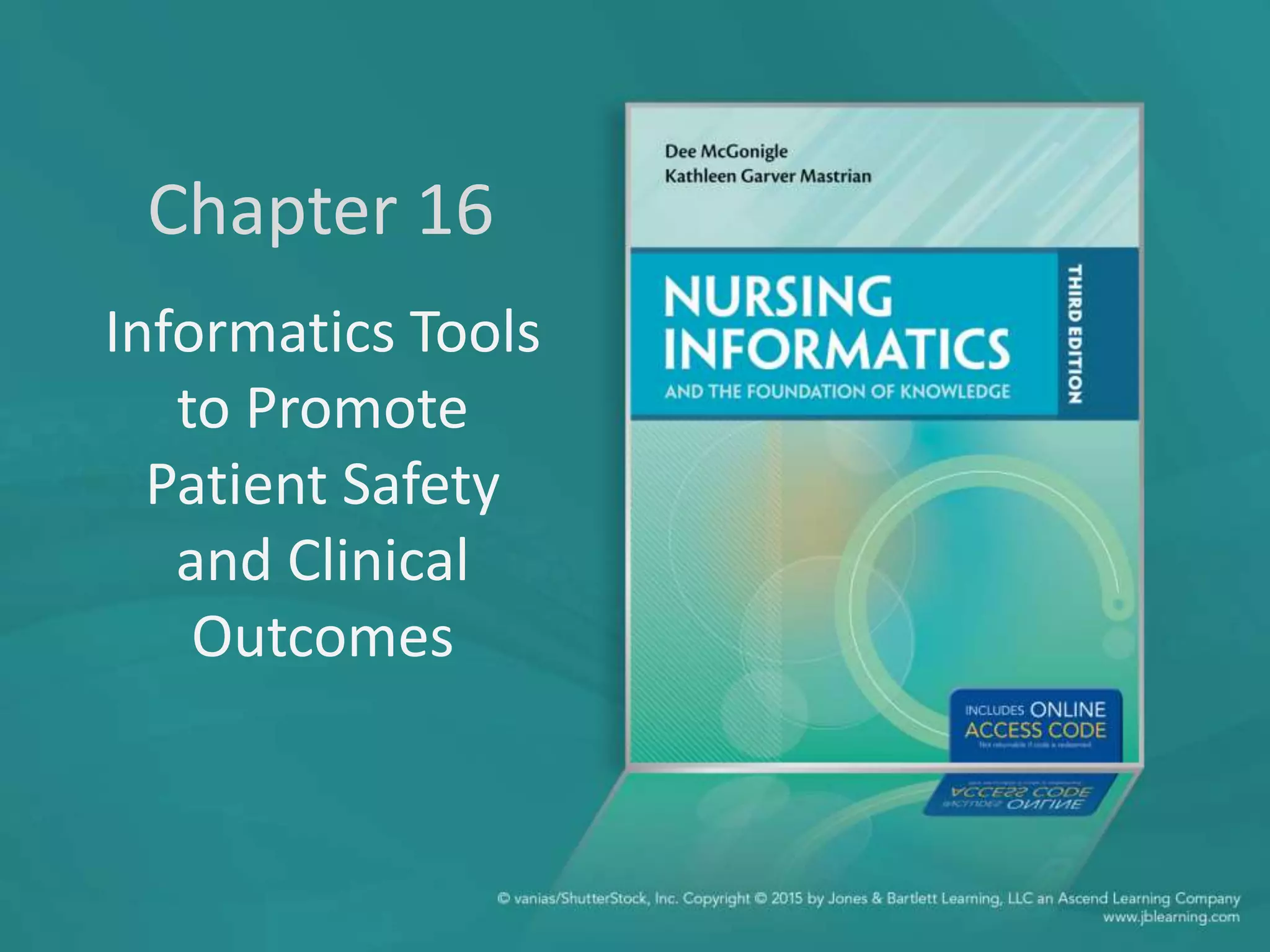
Chapter 16
Informatics Tools
to Promote
Patient Safety
and Clinical
Outcomes
Objectives
• Explore the characteristics of a safety culture
• Examine strategies for developing a safety
culture
• Recognize how human factors contribute to
errors
• Appreciate the impact of informatics
technology on patient safety
Introduction
• Nursing professionals have an ethical duty to ensure
patient safety.
• Increasing demands on professionals in complex and
fast paced health care environments
– May cut corners or develop workarounds that deviate from
accepted and expected practice protocols.
• These deviations are more often practiced in the
interest of saving time or because the organizational
culture is such that risky behaviors are commonplace.
• Occasionally these inappropriate actions or omissions
of appropriate actions result in harm or significant risk
of harm to patients.
Safety Initiatives
• 1999 Institute of Medicine (IOM) report: To Err is Human
• 2001 IOM Quality Chasm report
• Agency for Healthcare Research and Quality (AHRQ)
launched initiatives focused on safety research for patients
• 2002 Joint Commission National Patient Safety Goals
• 2002 National Quality Forum (NQF) adverse events and
‘never events’ list,
• Creation in 2004 of the Office of National Coordinator for
Health IT to computerize health care,
• 2004 World health Organization’s (WHO) Alliance for
patient safety,
Safety Initiatives, con’t
• 2005 Institute for Healthcare Improvement (IHI)
100,000 Lives campaign and 2008 5 Million Lives
Campaign
• 2005 congressional authorization of Patient Safety
Organizations (PSOs) created by the Patient Safety and
Quality Improvement Act
– to promote blameless error reporting and shared learning,
• 2008 “no pay for errors” Medicare initiative
• $19 billion congressional appropriation to support
electronic health records and patient safety
Key Features of a Safety Culture
• acknowledgment of the high-risk nature of an
organization's activities and the determination to
achieve consistently safe operations
• a blame-free environment where individuals are
able to report errors or near misses without fear
of reprimand or punishment
• encouragement of collaboration across ranks and
disciplines to seek solutions to patient safety
problems
• organizational commitment of resources to
address safety concerns (AHRQ, n.d., para. 1)
Failure Modes and Effect analysis
“Failure Modes and Effects Analysis (FMEA) is a
systematic, proactive method for evaluating a
process to identify where and how it might
fail, and to assess the relative impact of
different failures in order to identify the parts
of the process that are most in need of
change”(IHI, n.d.1 para. 1).
• Access the tool here:
Failure Modes and Effects Analysis Tool
What is a Just Culture?
• blame free environment to encourage error
reporting
• system or process issues that lead to unsafe
behaviors and errors are addressed by
changing practices or work-flows processes
• clear message is communicated that reckless
behaviors are not tolerated
Just Culture Error Types
• Human Error (unintentional mistakes)
– perform FMEA to understand error
• Risky Behaviors (work arounds or cutting
corners)
– examine workflow; educate
• Reckless Behavior (total disregard for
established policies and procedures)
– Enact zero tolerance policy; disciplinary measures
Promoting a Safety Culture
• AHRQ suggests that teamwork training, executive
walk-arounds, and unit based safety teams have
improved safety culture perceptions, but have
not demonstrated a significant reduction in error
rates.
• IHI strategies include appointing a safety
champion for every unit, creating an adverse
event response team and reenacting or
simulating adverse events to better understand
the organizational or procedural processes that
failed.
Human Factors Engineering
• “The discipline of applying what is known
about human capabilities and limitations to
the design of products, processes, systems,
and work environments. Its application to
system design improves “ease of use, system
performance and reliability, and user
satisfaction, while reducing operational errors,
operator stress, training requirements, user
fatigue, and product liability” (Ebben, Gieras, and
Gosbee 2008, p 327).
Alarm Fatigue
• Medical equipment alarms frequently and
inappropriately
– May be related to the sensitivity of alarm parameters
• Strategies to improve alarm response
– improving the nurse call system by adding Voice Over
Internet Protocol (VOIP) phones
– feeding alarm data into a reporting database for
further analysis
– encouraging nurses to round with physicians to
provide input into alarm parameters
Informatics Technologies and Safety
• Improve communication
• Reduce errors and adverse events
• Increase the rapidity of response to adverse
events
• Make knowledge more accessible to clinicians
• Assist with decisions
– technology based forcing functions that direct or
restrict actions or orders implemented by computer
technologies.
• Provide feedback on performance
Most Frequent Safety Issues
• The National Patient Safety Foundation
(NPSF.org) top patient safety issues (2013):
– wrong site surgery,
– hospital acquired infections,
– falls,
– hospital readmissions,
– diagnostic error and
– medication errors.
• Many of these issues can be prevented or early
detected using informatics technologies.
TECHNOLOGIES TO SUPPORT THE
MEDICATION ADMINISTRATION CYCLE
Medication Administration cycle
• Assessment of need
• Ordering
• Dispensing
• Distribution
• Administration
• Evaluation
Human Error Factors: Distractions, unclear thinking,
lack of knowledge, short staffing, and fatigue
Five Rights of Medication
Administration
1. the right patient
2. the right time and frequency of
administration
3. the right dose
4. the right route
5. the right drug
Technology Integration into Cycle
• Reduces the potential for human errors by:
– performing electronic checks
– providing alerts to draw attention to potential
errors
• Tracks performance
Computerized Physician Order Entry
(CPOE) Benefits
• Prompts warn against the possibility of drug
interaction, allergy or overdose;
• Accurate, current information that helps
physicians keep up with new drugs as they are
introduced into the market
• Drug-specific information that eliminates
confusion among drug names that sound alike;
• Improved communication between physicians
and pharmacists
• Reduced healthcare costs due to improved
efficiencies (The LeapFrog Group, 2008).
Technology in the Pharmacy
• Verifying function is computer based, and the
medication order is electronically checked via the
knowledge database
– Allergy verification and medication reconciliation with
other drugs already in use
• Barcode Medication labeling or RFID Technology
– Assists with dispensing and administration
• Automated dispensing machines
– storage, dispensing, controlling, and tracking
Barcode Medication Administration
(BCMA)
• Provides a system of checks and balances to ensure
medication safety
• Nurse scans name badge thus logging in as the person
responsible for medication administration.
• patient’s barcode on the patient’s ID bracelet is
scanned prompting the electronic system to pull up the
medication orders.
• the bar code on each of the medications to be
administered is scanned.
This technology checks to ensure that the 5 rights of
medication administration—right patient, right med,
right dose, right route and right time—are met.
Smart Pump Technology
• Designed for safe administration of high-hazard
drugs and to reduce adverse drug events (ADE)
during intravenous (IV) medication administration
• Software is programmed to reflect the facility’s
infusion parameters, and includes a drug library
that compares normal dosing rates with those
programmed into the pump.
• Discrepancies generate an alarm alerting the
clinician to a safety issue.
Clinical Decision Support (CDS)
• Help a clinician select an appropriate medication
• Will ensure that the order is complete (checks for
drug interactions, duplications, or allergy
contraindications, the right dose and right route
• Provides double checks for interactions, allergies and
appropriate dose orders during verification and
dispensing.
• Assists with infusion pump programming issues such
as incompatibilities during infusion and proper
notation and dispensing when portions of a dose
must be wasted.
Clinical Decision Support (CDS), con’t.
• Assists with patient identification and current
assessment parameters (i.e. blood pressure,
glucose level) that may contraindicate the use of
the medication at that point in time.
• Checks for interactions with foods or other
medications
• Provides patient education guidelines and
printable handouts
• The monitoring functions of the CDS provide a
structured data reporting system to track side-
effects and adverse events across the population
Technologies for Home Medication
Compliance
• eMedonline
– collects patient medication compliance data by
scanning package barcodes or RFID medication
tags and using PDA or smart phone technology to
send compliance data to the server
• SIMpill® Medication Adherence System
– uses web based technology to monitor patient
compliance and provide reminders about taking
medications or to refill prescriptions by sending
text messages to the patient or caregivers
Home Medication Compliance, con’t
• Caps of pill bottles may contain RFID tags that
monitor and collect data on when the bottle is
opened, or contain flashing time reminders
when a dose is due (Blankenhorn, 2010).
• Smart inhalers track asthma medication
compliance using a microprocessor that
records and stores medication compliance.
Other CDS Patient Safety Uses
• data collection and data management
functions help to ensure quality approaches to
patient health challenges based on research
evidence and clinical guidelines.
• may also ensure cost-effectiveness by alerting
clinicians to duplicate testing orders, or
suggesting the most cost effective diagnostic
test based on specific patient data
Expanded RFID Uses
• patient tracking during procedures and testing, or function as part
of the EHR communicating pertinent information to clinicians at the
bedside
• track medical supplies and equipment
• imbedded into surgical supplies to automate supply counting
procedures
• reduce the likelihood of wrong patient, wrong site surgical
procedures
• reducing the potential that a counterfeit medication is inadvertently
introduced into the supply, and providing for efficient medication
recalls
• specialized tags can detect temperature fluctuations and thus
ensure that the blood or blood product was stored at the optimum
temperature for safe administration
Smart Room Technology
• RFID tag on employee name badge announces to the
patient on a monitor exactly who has entered the room
and triggers ‘need to know’ data by caregiver status to
be displayed on the monitor in the room
• Clinicians review patient data in real time and chart at
the bedside using touch screen technology
• alert clinicians as they enter the room about
procedures that need to be implemented for the
patient and can track individual clinician efficiency and
effectiveness by aggregating data over time
Patient Monitoring Technologies
• Body Area Networks or Patient Area Networks
provide the ability to wear a small unobtrusive
monitor that collects and transmits physiologic
data via a cell phone to a server for clinician
review
• wireless chip on a disposable band-aid with a 5-7
day battery promises to be able to monitor the
patient’s heart rate and electrocardiogram, blood
glucose, blood pH, and blood pressure, allowing
for the collection of important clinical data
outside the hospital
Informatics Nurse Specialist Role
• Ensure that the technology systems are properly
configured and maintained.
• Routinely monitor and check these systems while
making sure that their human potential, the users, are
capable of using the systems accurately to avoid errors.
Nurse informaticists must be involved in all stages of the
system development life cycle (SDLC) with a focus on
safety; safety concerns and remedies need to be
analyzed, synthesized and integrated throughout the
SDLC to have a robust tool that provides meaningful
information and enhances patient care while
preventing errors and promoting patient safety.
Patient Safety Websites
Title URL
AHRQ Patient Safety Network http://www.psnet.ahrq.gov/primerHome.aspx
National Patient Safety Foundation http://www.npsf.org/
National Center for Patient Safety http://www.patientsafety.gov/
Institute for healthcare Improvement http://www.ihi.org/explore/patientsafety/Pages/default.aspx
Center for Patient Safety http://www.centerforpatientsafety.org/
QSEN Institute (Quality and Safety Education for Nurses) http://qsen.org/
Thought Provoking Questions
1. What are the current patient safety characteristics of
your organizational culture? Identify at least 3
aspects of your culture that need to be changed with
regard to patient safety, and suggest strategies for
change.
2. Describe a current technology that you use in patient
care that would benefit from human factors
engineering concepts. What are some ways this
technology should be improved?
3. Identify a workaround that you have used and analyze
why you chose this risk-taking behavior over behavior
that conforms to a safety culture.

Chapter 16

  • 1.
    Chapter 16 Informatics Tools toPromote Patient Safety and Clinical Outcomes
  • 2.
    Objectives • Explore thecharacteristics of a safety culture • Examine strategies for developing a safety culture • Recognize how human factors contribute to errors • Appreciate the impact of informatics technology on patient safety
  • 3.
    Introduction • Nursing professionalshave an ethical duty to ensure patient safety. • Increasing demands on professionals in complex and fast paced health care environments – May cut corners or develop workarounds that deviate from accepted and expected practice protocols. • These deviations are more often practiced in the interest of saving time or because the organizational culture is such that risky behaviors are commonplace. • Occasionally these inappropriate actions or omissions of appropriate actions result in harm or significant risk of harm to patients.
  • 4.
    Safety Initiatives • 1999Institute of Medicine (IOM) report: To Err is Human • 2001 IOM Quality Chasm report • Agency for Healthcare Research and Quality (AHRQ) launched initiatives focused on safety research for patients • 2002 Joint Commission National Patient Safety Goals • 2002 National Quality Forum (NQF) adverse events and ‘never events’ list, • Creation in 2004 of the Office of National Coordinator for Health IT to computerize health care, • 2004 World health Organization’s (WHO) Alliance for patient safety,
  • 5.
    Safety Initiatives, con’t •2005 Institute for Healthcare Improvement (IHI) 100,000 Lives campaign and 2008 5 Million Lives Campaign • 2005 congressional authorization of Patient Safety Organizations (PSOs) created by the Patient Safety and Quality Improvement Act – to promote blameless error reporting and shared learning, • 2008 “no pay for errors” Medicare initiative • $19 billion congressional appropriation to support electronic health records and patient safety
  • 6.
    Key Features ofa Safety Culture • acknowledgment of the high-risk nature of an organization's activities and the determination to achieve consistently safe operations • a blame-free environment where individuals are able to report errors or near misses without fear of reprimand or punishment • encouragement of collaboration across ranks and disciplines to seek solutions to patient safety problems • organizational commitment of resources to address safety concerns (AHRQ, n.d., para. 1)
  • 7.
    Failure Modes andEffect analysis “Failure Modes and Effects Analysis (FMEA) is a systematic, proactive method for evaluating a process to identify where and how it might fail, and to assess the relative impact of different failures in order to identify the parts of the process that are most in need of change”(IHI, n.d.1 para. 1). • Access the tool here: Failure Modes and Effects Analysis Tool
  • 8.
    What is aJust Culture? • blame free environment to encourage error reporting • system or process issues that lead to unsafe behaviors and errors are addressed by changing practices or work-flows processes • clear message is communicated that reckless behaviors are not tolerated
  • 9.
    Just Culture ErrorTypes • Human Error (unintentional mistakes) – perform FMEA to understand error • Risky Behaviors (work arounds or cutting corners) – examine workflow; educate • Reckless Behavior (total disregard for established policies and procedures) – Enact zero tolerance policy; disciplinary measures
  • 10.
    Promoting a SafetyCulture • AHRQ suggests that teamwork training, executive walk-arounds, and unit based safety teams have improved safety culture perceptions, but have not demonstrated a significant reduction in error rates. • IHI strategies include appointing a safety champion for every unit, creating an adverse event response team and reenacting or simulating adverse events to better understand the organizational or procedural processes that failed.
  • 11.
    Human Factors Engineering •“The discipline of applying what is known about human capabilities and limitations to the design of products, processes, systems, and work environments. Its application to system design improves “ease of use, system performance and reliability, and user satisfaction, while reducing operational errors, operator stress, training requirements, user fatigue, and product liability” (Ebben, Gieras, and Gosbee 2008, p 327).
  • 12.
    Alarm Fatigue • Medicalequipment alarms frequently and inappropriately – May be related to the sensitivity of alarm parameters • Strategies to improve alarm response – improving the nurse call system by adding Voice Over Internet Protocol (VOIP) phones – feeding alarm data into a reporting database for further analysis – encouraging nurses to round with physicians to provide input into alarm parameters
  • 13.
    Informatics Technologies andSafety • Improve communication • Reduce errors and adverse events • Increase the rapidity of response to adverse events • Make knowledge more accessible to clinicians • Assist with decisions – technology based forcing functions that direct or restrict actions or orders implemented by computer technologies. • Provide feedback on performance
  • 14.
    Most Frequent SafetyIssues • The National Patient Safety Foundation (NPSF.org) top patient safety issues (2013): – wrong site surgery, – hospital acquired infections, – falls, – hospital readmissions, – diagnostic error and – medication errors. • Many of these issues can be prevented or early detected using informatics technologies.
  • 15.
    TECHNOLOGIES TO SUPPORTTHE MEDICATION ADMINISTRATION CYCLE
  • 16.
    Medication Administration cycle •Assessment of need • Ordering • Dispensing • Distribution • Administration • Evaluation Human Error Factors: Distractions, unclear thinking, lack of knowledge, short staffing, and fatigue
  • 17.
    Five Rights ofMedication Administration 1. the right patient 2. the right time and frequency of administration 3. the right dose 4. the right route 5. the right drug
  • 18.
    Technology Integration intoCycle • Reduces the potential for human errors by: – performing electronic checks – providing alerts to draw attention to potential errors • Tracks performance
  • 19.
    Computerized Physician OrderEntry (CPOE) Benefits • Prompts warn against the possibility of drug interaction, allergy or overdose; • Accurate, current information that helps physicians keep up with new drugs as they are introduced into the market • Drug-specific information that eliminates confusion among drug names that sound alike; • Improved communication between physicians and pharmacists • Reduced healthcare costs due to improved efficiencies (The LeapFrog Group, 2008).
  • 20.
    Technology in thePharmacy • Verifying function is computer based, and the medication order is electronically checked via the knowledge database – Allergy verification and medication reconciliation with other drugs already in use • Barcode Medication labeling or RFID Technology – Assists with dispensing and administration • Automated dispensing machines – storage, dispensing, controlling, and tracking
  • 21.
    Barcode Medication Administration (BCMA) •Provides a system of checks and balances to ensure medication safety • Nurse scans name badge thus logging in as the person responsible for medication administration. • patient’s barcode on the patient’s ID bracelet is scanned prompting the electronic system to pull up the medication orders. • the bar code on each of the medications to be administered is scanned. This technology checks to ensure that the 5 rights of medication administration—right patient, right med, right dose, right route and right time—are met.
  • 22.
    Smart Pump Technology •Designed for safe administration of high-hazard drugs and to reduce adverse drug events (ADE) during intravenous (IV) medication administration • Software is programmed to reflect the facility’s infusion parameters, and includes a drug library that compares normal dosing rates with those programmed into the pump. • Discrepancies generate an alarm alerting the clinician to a safety issue.
  • 23.
    Clinical Decision Support(CDS) • Help a clinician select an appropriate medication • Will ensure that the order is complete (checks for drug interactions, duplications, or allergy contraindications, the right dose and right route • Provides double checks for interactions, allergies and appropriate dose orders during verification and dispensing. • Assists with infusion pump programming issues such as incompatibilities during infusion and proper notation and dispensing when portions of a dose must be wasted.
  • 24.
    Clinical Decision Support(CDS), con’t. • Assists with patient identification and current assessment parameters (i.e. blood pressure, glucose level) that may contraindicate the use of the medication at that point in time. • Checks for interactions with foods or other medications • Provides patient education guidelines and printable handouts • The monitoring functions of the CDS provide a structured data reporting system to track side- effects and adverse events across the population
  • 25.
    Technologies for HomeMedication Compliance • eMedonline – collects patient medication compliance data by scanning package barcodes or RFID medication tags and using PDA or smart phone technology to send compliance data to the server • SIMpill® Medication Adherence System – uses web based technology to monitor patient compliance and provide reminders about taking medications or to refill prescriptions by sending text messages to the patient or caregivers
  • 26.
    Home Medication Compliance,con’t • Caps of pill bottles may contain RFID tags that monitor and collect data on when the bottle is opened, or contain flashing time reminders when a dose is due (Blankenhorn, 2010). • Smart inhalers track asthma medication compliance using a microprocessor that records and stores medication compliance.
  • 27.
    Other CDS PatientSafety Uses • data collection and data management functions help to ensure quality approaches to patient health challenges based on research evidence and clinical guidelines. • may also ensure cost-effectiveness by alerting clinicians to duplicate testing orders, or suggesting the most cost effective diagnostic test based on specific patient data
  • 28.
    Expanded RFID Uses •patient tracking during procedures and testing, or function as part of the EHR communicating pertinent information to clinicians at the bedside • track medical supplies and equipment • imbedded into surgical supplies to automate supply counting procedures • reduce the likelihood of wrong patient, wrong site surgical procedures • reducing the potential that a counterfeit medication is inadvertently introduced into the supply, and providing for efficient medication recalls • specialized tags can detect temperature fluctuations and thus ensure that the blood or blood product was stored at the optimum temperature for safe administration
  • 29.
    Smart Room Technology •RFID tag on employee name badge announces to the patient on a monitor exactly who has entered the room and triggers ‘need to know’ data by caregiver status to be displayed on the monitor in the room • Clinicians review patient data in real time and chart at the bedside using touch screen technology • alert clinicians as they enter the room about procedures that need to be implemented for the patient and can track individual clinician efficiency and effectiveness by aggregating data over time
  • 30.
    Patient Monitoring Technologies •Body Area Networks or Patient Area Networks provide the ability to wear a small unobtrusive monitor that collects and transmits physiologic data via a cell phone to a server for clinician review • wireless chip on a disposable band-aid with a 5-7 day battery promises to be able to monitor the patient’s heart rate and electrocardiogram, blood glucose, blood pH, and blood pressure, allowing for the collection of important clinical data outside the hospital
  • 31.
    Informatics Nurse SpecialistRole • Ensure that the technology systems are properly configured and maintained. • Routinely monitor and check these systems while making sure that their human potential, the users, are capable of using the systems accurately to avoid errors. Nurse informaticists must be involved in all stages of the system development life cycle (SDLC) with a focus on safety; safety concerns and remedies need to be analyzed, synthesized and integrated throughout the SDLC to have a robust tool that provides meaningful information and enhances patient care while preventing errors and promoting patient safety.
  • 32.
    Patient Safety Websites TitleURL AHRQ Patient Safety Network http://www.psnet.ahrq.gov/primerHome.aspx National Patient Safety Foundation http://www.npsf.org/ National Center for Patient Safety http://www.patientsafety.gov/ Institute for healthcare Improvement http://www.ihi.org/explore/patientsafety/Pages/default.aspx Center for Patient Safety http://www.centerforpatientsafety.org/ QSEN Institute (Quality and Safety Education for Nurses) http://qsen.org/
  • 33.
    Thought Provoking Questions 1.What are the current patient safety characteristics of your organizational culture? Identify at least 3 aspects of your culture that need to be changed with regard to patient safety, and suggest strategies for change. 2. Describe a current technology that you use in patient care that would benefit from human factors engineering concepts. What are some ways this technology should be improved? 3. Identify a workaround that you have used and analyze why you chose this risk-taking behavior over behavior that conforms to a safety culture.