PREVENTING
DISPENSING ERRORS
BY
DR. BEEGUM SHEENA KARIM (PharmD)
DR. RACHANA SHETTY (PharmD)
DR. ANAM SOHAIL (PharmD)
Learning Objectives
 Describe dispensing errors related to the work environment
 Discuss the roles of computerization in the prevention of
dispensing errors
 Explain the steps involved for ensuring dispensing
accuracy
Dispensing Errors: The Numbers
 98.3% accuracy in dispensing medications
 Therefore, 1.7% inaccuracy rate
 Over 3 billion medications dispensed per year
 4 errors per day per 250 prescriptions filled
 Over 51 million dispensing errors per year
Flynn E, et al. J Am Pharm Assoc. 2003;43:191–200.
Most Prevalent Dispensing Errors
 Dispensing incorrect medication, dosage
strength, or dosage form
 Dosage miscalculations
Types of Dispensing Errors
 Commission versus omission
 Mistake versus slip
 Potential versus actual
Omission vs Commission
 Omission
 Failure to counsel the patient
 Commission
 Miscalculation of a dose
 Dispensing the incorrect medication, dosage strength,
or dosage form
Mistakes and Slips
 Mistake
 Do things intentionally but actions are incorrect
because of a knowledge or judgment deficit
 Example: dose prescribed that exceeds maximum
safe limit
 Slip
 Do things unintentionally incorrect because of an
attention deficit
 Example: dispense CHLORPROMAZINE when
prescription was clearly written for
CHLORPROPAMIDE
Dispensing Errors:
Common Causes
 Work environment
 Workload
 Distractions
 Work area
 Use of outdated or incorrect
references
Dispensing Errors:
Improving Workload
 Ensure adequate staffing levels
 Eliminate dispensing time limits
 Examples of limiting workload
 Dispense ≤150 prescriptions per pharmacist per day
 Require rest breaks every 2–3 hours
 Brief warm-up period before restarting work tasks
 Require 30-minute meal breaks
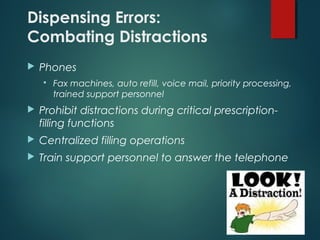
Dispensing Errors:
Combating Distractions
 Phones
 Fax machines, auto refill, voice mail, priority processing,
trained support personnel
 Prohibit distractions during critical prescription-
filling functions
 Centralized filling operations
 Train support personnel to answer the telephone
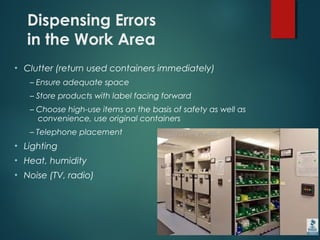
Dispensing Errors
in the Work Area
• Clutter (return used containers immediately)
– Ensure adequate space
– Store products with label facing forward
– Choose high-use items on the basis of safety as well as
convenience, use original containers
– Telephone placement
• Lighting
• Heat, humidity
• Noise (TV, radio)
Dispensing Errors
in the Work Area
• Labels on shelves
• Separate by route of administration
(external/internal/injectable, etc.)
• Use labels for externals
– Amoxicillin oral suspension for ear infection thought by parents
to be drops administered in child’s ear
• Review published safety alerts for look-alike/
sound-alike drugs and frequent dispensing errors
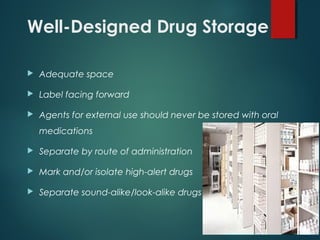
Well-Designed Drug Storage
 Adequate space
 Label facing forward
 Agents for external use should never be stored with oral
medications
 Separate by route of administration
 Mark and/or isolate high-alert drugs
 Separate sound-alike/look-alike drugs
Errors Related to Information
About the Drug or Patient
 Misleading or wrong references
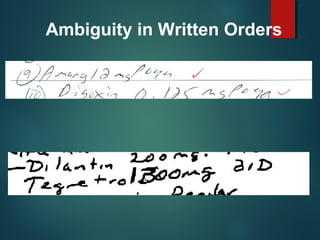
 Ambiguity in handwritten and typed documents
 Computerized prescribing
 Wrong patient errors
 Errors in dosage
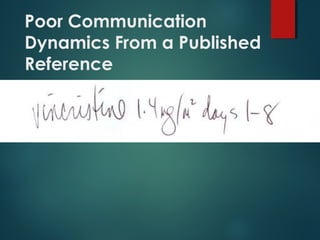
Poor Communication
Dynamics From a Published
Reference
Ambiguity in Written Orders
Computerized Prescribing Errors
 Computerized prescriber order entry (CPOE)
improves communication and reduces some
types of errors
 However, this technology may have its own
pitfalls:
 Lower case L may look like the numeral 1
 Letter O may look like the numeral 0 (zero)
 Letter Z and the numeral 2 may be misread
 Wrong patient or wrong drug chosen from list
Errors in Dosage
 Mathematical errors and decimal point
misplacement are common causes of errors,
(eg: mcg and mg)
 Oral liquid medications can be dispensed
improperly
 Misunderstandings with reading/ labeling
Outpatient Label Content
 Patient name
 Medication name
 Dosage strength
 Dosage form
 Quantity
Errors Related to
Dispensing Methods
 Unit-dose dispensing should be utilized (CCU)
 Requiring multiple tablets to be taken for one
dose may result in an under-dose
(example: Tab PROLMET 12.5 mg ordered, 50mg dispensed instead
of 25 mg)
Task to reduce dispensing
errors
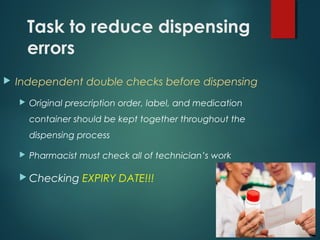
 Independent double checks before dispensing
 Original prescription order, label, and medication
container should be kept together throughout the
dispensing process
 Pharmacist must check all of technician’s work
 Checking EXPIRY DATE!!!
Counseling Patients
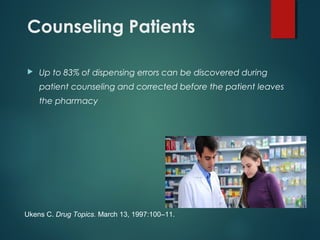
 Up to 83% of dispensing errors can be discovered during
patient counseling and corrected before the patient leaves
the pharmacy
Ukens C. Drug Topics. March 13, 1997:100–11.
Good Patient Education
 Inform patients of drug names, purpose, dose and
management methods
 Suggest readings for patient
 Inform patient about right to ask questions and expect
answers
 Listen to what patient is saying and provide follow-up!
Assessing Prescriptions
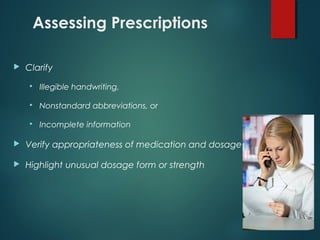
 Clarify
 Illegible handwriting,
 Nonstandard abbreviations, or
 Incomplete information
 Verify appropriateness of medication and dosage
 Highlight unusual dosage form or strength
8 Steps to Maximize
Dispensing Accuracy
1. Lock up drugs that could cause disastrous errors
2. Develop and implement thorough procedures for drug storage
3. Reduce distractions, design a safe dispensing environment, and
maintain optimum workflow
4. Use reminders such as labels and computer notes to prevent mix-
ups between look-alike and sound-alike drug names
8 Steps to Maximize
Dispensing Accuracy
5. Keep the original prescription order, label, and
medication container together throughout the
dispensing process
6. Compare the contents of the medication container with
the information on the prescription
7. Perform a final check on the
 prescription,
 prescription label, and
 manufacturer’s container
8 Provide patient counseling
Dispensing errors and Its Prevention

Dispensing errors and Its Prevention

  • 1.
    PREVENTING DISPENSING ERRORS BY DR. BEEGUMSHEENA KARIM (PharmD) DR. RACHANA SHETTY (PharmD) DR. ANAM SOHAIL (PharmD)
  • 2.
    Learning Objectives  Describedispensing errors related to the work environment  Discuss the roles of computerization in the prevention of dispensing errors  Explain the steps involved for ensuring dispensing accuracy
  • 3.
    Dispensing Errors: TheNumbers  98.3% accuracy in dispensing medications  Therefore, 1.7% inaccuracy rate  Over 3 billion medications dispensed per year  4 errors per day per 250 prescriptions filled  Over 51 million dispensing errors per year Flynn E, et al. J Am Pharm Assoc. 2003;43:191–200.
  • 4.
    Most Prevalent DispensingErrors  Dispensing incorrect medication, dosage strength, or dosage form  Dosage miscalculations
  • 5.
    Types of DispensingErrors  Commission versus omission  Mistake versus slip  Potential versus actual
  • 6.
    Omission vs Commission Omission  Failure to counsel the patient  Commission  Miscalculation of a dose  Dispensing the incorrect medication, dosage strength, or dosage form
  • 7.
    Mistakes and Slips Mistake  Do things intentionally but actions are incorrect because of a knowledge or judgment deficit  Example: dose prescribed that exceeds maximum safe limit  Slip  Do things unintentionally incorrect because of an attention deficit  Example: dispense CHLORPROMAZINE when prescription was clearly written for CHLORPROPAMIDE
  • 8.
    Dispensing Errors: Common Causes Work environment  Workload  Distractions  Work area  Use of outdated or incorrect references
  • 9.
    Dispensing Errors: Improving Workload Ensure adequate staffing levels  Eliminate dispensing time limits  Examples of limiting workload  Dispense ≤150 prescriptions per pharmacist per day  Require rest breaks every 2–3 hours  Brief warm-up period before restarting work tasks  Require 30-minute meal breaks
  • 10.
    Dispensing Errors: Combating Distractions Phones  Fax machines, auto refill, voice mail, priority processing, trained support personnel  Prohibit distractions during critical prescription- filling functions  Centralized filling operations  Train support personnel to answer the telephone
  • 11.
    Dispensing Errors in theWork Area • Clutter (return used containers immediately) – Ensure adequate space – Store products with label facing forward – Choose high-use items on the basis of safety as well as convenience, use original containers – Telephone placement • Lighting • Heat, humidity • Noise (TV, radio)
  • 12.
    Dispensing Errors in theWork Area • Labels on shelves • Separate by route of administration (external/internal/injectable, etc.) • Use labels for externals – Amoxicillin oral suspension for ear infection thought by parents to be drops administered in child’s ear • Review published safety alerts for look-alike/ sound-alike drugs and frequent dispensing errors
  • 13.
    Well-Designed Drug Storage Adequate space  Label facing forward  Agents for external use should never be stored with oral medications  Separate by route of administration  Mark and/or isolate high-alert drugs  Separate sound-alike/look-alike drugs
  • 14.
    Errors Related toInformation About the Drug or Patient  Misleading or wrong references  Ambiguity in handwritten and typed documents  Computerized prescribing  Wrong patient errors  Errors in dosage
  • 15.
    Poor Communication Dynamics Froma Published Reference
  • 16.
  • 17.
    Computerized Prescribing Errors Computerized prescriber order entry (CPOE) improves communication and reduces some types of errors  However, this technology may have its own pitfalls:  Lower case L may look like the numeral 1  Letter O may look like the numeral 0 (zero)  Letter Z and the numeral 2 may be misread  Wrong patient or wrong drug chosen from list
  • 18.
    Errors in Dosage Mathematical errors and decimal point misplacement are common causes of errors, (eg: mcg and mg)  Oral liquid medications can be dispensed improperly  Misunderstandings with reading/ labeling
  • 19.
    Outpatient Label Content Patient name  Medication name  Dosage strength  Dosage form  Quantity
  • 20.
    Errors Related to DispensingMethods  Unit-dose dispensing should be utilized (CCU)  Requiring multiple tablets to be taken for one dose may result in an under-dose (example: Tab PROLMET 12.5 mg ordered, 50mg dispensed instead of 25 mg)
  • 21.
    Task to reducedispensing errors  Independent double checks before dispensing  Original prescription order, label, and medication container should be kept together throughout the dispensing process  Pharmacist must check all of technician’s work  Checking EXPIRY DATE!!!
  • 22.
    Counseling Patients  Upto 83% of dispensing errors can be discovered during patient counseling and corrected before the patient leaves the pharmacy Ukens C. Drug Topics. March 13, 1997:100–11.
  • 23.
    Good Patient Education Inform patients of drug names, purpose, dose and management methods  Suggest readings for patient  Inform patient about right to ask questions and expect answers  Listen to what patient is saying and provide follow-up!
  • 24.
    Assessing Prescriptions  Clarify Illegible handwriting,  Nonstandard abbreviations, or  Incomplete information  Verify appropriateness of medication and dosage  Highlight unusual dosage form or strength
  • 25.
    8 Steps toMaximize Dispensing Accuracy 1. Lock up drugs that could cause disastrous errors 2. Develop and implement thorough procedures for drug storage 3. Reduce distractions, design a safe dispensing environment, and maintain optimum workflow 4. Use reminders such as labels and computer notes to prevent mix- ups between look-alike and sound-alike drug names
  • 26.
    8 Steps toMaximize Dispensing Accuracy 5. Keep the original prescription order, label, and medication container together throughout the dispensing process 6. Compare the contents of the medication container with the information on the prescription 7. Perform a final check on the  prescription,  prescription label, and  manufacturer’s container 8 Provide patient counseling

Editor's Notes

  • #5 The top three dispensing errors include (1) dispensing an incorrect medication, dosage strength, or dosage form, (2) dosage miscalculations, and (3) failure to identify drug interactions or contraindications.1 The first step to preventing dispensing errors is to identify the causes. Then, new policies and procedures can be instituted and the staff can be educated. 1
  • #6 The are various ways dispensing errors can be classified: Commission/Omission- Dispensing the wrong drug or dose would be an error of commission. Whereas, failure to counsel a patient or screen for drug interactions would be considered an error of omission. 1 Mechanical/Judgmental- Mechanical errors are those which occur during the preparation and processing of a prescription. Judgmental errors, on the other hand, are those involving patient counseling, screening, or monitoring. 1 Slip/Mistake- Slips are often caused by poor design or distraction. An error related to reliance on automatic behavior, after a distraction has occurred or poor system design, would be considered a slip. An error due to conscious deliberation, perhaps because of a lack of knowledge, would be considered a mistake. For example, a mistake may occur if a pharmacist does not know that there are 2 strengths of Prozac® available. 1, 3 Potential/Actual- Potential errors are those which are detected and corrected prior to the administration of the medication. Whereas, actual errors are those which actually reach the patient. 1
  • #9 The most common causes of dispensing errors are related to either the work environment or the use of outdated or incorrect references. Factors in the work environment that may contribute to dispensing errors include work load, distractions, and the design of the work area. 1
  • #10 Solutions to work overload would include ensuring adequate staffing levels and eliminating time limits on dispensing. One state pharmacy association has issued an Employee Model Contract. This contract states that no pharmacist should routinely dispense more than an average of 15 prescriptions per hour. Additionally, pharmacists should be required to take rest breaks every 2-3 hours and 30 minute meal breaks. 1 Although, profession-wide acceptance of these recommendations is not likely, employers have been disciplined by state boards of pharmacy and the courts of law when unreasonable workloads have led to dispensing errors. 1
  • #14 A well-designed drug storage area may also reduce dispensing errors. Since crowded medications are more likely to be interchanged or returned to the wrong place, adequate space should be allotted for each medication and each strength.4 All prescription bottles should be stored with the label facing forward. If only the storage label is used for identification, medications in similar packaging can be mistaken for one another. Therefore, shelves, bins, cabinets, or drawers with external storage labels should not be used for storage.5 Medication storage should be separated according to route of administration (i.e., oral, injectable, inhaled, topical, otic, ophthalmic, and rectal). Some pharmacies even separate oral liquids from other oral medications. Auxiliary labels indicating the route of administration should be used to differentiate medications upon dispensing.1 “High-alert” medications (i.e., warfarin, injectable potassium chloride, lidocaine, heparin, and controlled substances) should be specially marked and placed in an isolated or locked area. If this is not possible, auxiliary labels should be used to draw attention to the product and warn the pharmacist to use additional caution.1, 8 Ideally, frequently confused drug pairs (i.e., thiamine 100 mg and thioridiazine 100 mg) should be separated.8 Although lists of frequently confused drug-name pairs are available [www.usp.org/reporting/review/qr76.pdf], their utility is limited because it is impossible for pharmacists to memorize them. Computer warnings, however, can prevent mix-ups between products with similar names and strengths. Many computer systems have a “clinical flag” or “formulary note” screen that can show important information. This feature can alert the pharmacist entering the order when a look-alike or sound-alike potential is present. For example, when Norvasc® is entered into the computer, a formulary note screen can appear to alert the pharmacist that it often looks like Navane®. This should then prompt the pharmacist to verify the order.1
  • #17 Top image: Amaryl 2 mg (top line) was misread as 12 mg. Bottom image: Tegretol 300 mg was misread as Tegretol 1300 mg
  • #20 Computer order entry involves the selection of the correct medication, dosage strength, dosage form, quantity, directions for use, number of refills, and prescriber name. All of these parameters should be included on the label. If possible, the purpose of the medication should be printed on the dispensing label. Including the purpose on the label provides the patient with an additional means to verify and distinguish among their prescriptions. 1
  • #25 Illegible handwriting, nonstandard abbreviations, or incomplete orders must be clarified with the prescriber. Any clarification should be documented in writing. 1 The pharmacist should then analyze the patient’s profile. This will allow the pharmacist to review any potential drug interactions and allergies. The pharmacist can then verify the appropriateness of the medication and its dosage. Computer alerts must also be considered at this time. An additional precautionary task is to highlight any unusual dosage form or strength that is prescribed. 1