Basic principles of compounding and dispensing: Prescription and Labeling
Prepared By: Md. Imran Nur Manik; M.Pharm. (R.U.)
manikrupharmacy@gmail.com; Lecturer; Department of Pharmacy; Primeasia University.
Basic principles of compounding and dispensing: Prescription and Labeling
Prepared By: Md. Imran Nur Manik; M.Pharm. (R.U.) Page 1
manikrupharmacy@gmail.com; Lecturer; Department of Pharmacy; Primeasia University.
PRESCRIPTION
Definition
A prescription is an order form a registered practitioner o0r other properly licensed practitioner such as
physician, dentist, veterinarian or dermatologists etc to a pharmacist to compound and dispense a
specific medicine for the patient.
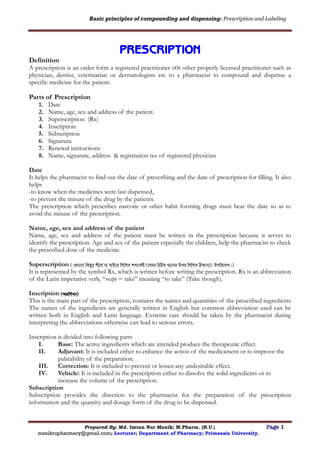
Parts of Prescription
1. Date
2. Name, age, sex and address of the patient.
3. Superscription (Rx)
4. Inscription
5. Subscription
6. Signatura
7. Renewal instructions
8. Name, signature, address & registration no. of registered physician
Date
It helps the pharmacist to find out the date of prescribing and the date of prescription for filling. It also
helps
-to know when the medicines were last dispensed,
-to prevent the misuse of the drug by the patients.
The prescription which prescribes narcotic or other habit forming drugs must bear the date so as to
avoid the misuse of the prescription.
Name, age, sex and address of the patient
Name, age, sex and address of the patient must be written in the prescription because it serves to
identify the prescription. Age and sex of the patient especially the children, help the pharmacist to check
the prescribed dose of the medicine.
Superscription (
It is represented by the symbol Rx, which is written before writing the prescription. Rx is an abbreviation
of the Latin imperative verb, “recipe = take” meaning “to take” (Take though).
Inscription (
This is the main part of the prescription, contains the names and quantities of the prescribed ingredients
The names of the ingredients are generally written in English but common abbreviation used can be
written both in English and Latin language. Extreme care should be taken by the pharmacist during
interpreting the abbreviations otherwise can lead to serious errors.
Inscription is divided into following parts
I. Base: The active ingredients which are intended produce the therapeutic effect.
II. Adjuvant: It is included either to enhance the action of the medicament or to improve the
palatability of the preparation.
III. Correction: It is included to prevent or lessen any undesirable effect.
IV. Vehicle: It is included in the prescription either to dissolve the solid ingredients or to
increase the volume of the prescription.
Subscription
Subscription provides the direction to the pharmacist for the preparation of the prescription
information and the quantity and dosage form of the drug to be dispensed.
Basic principles of compounding and dispensing: Prescription and Labeling
Prepared By: Md. Imran Nur Manik; M.Pharm. (R.U.) Page 2
manikrupharmacy@gmail.com; Lecturer; Department of Pharmacy; Primeasia University.
Signatura
This consists of the direction to be given to the patient regarding the administration of the drugs. The
instruction may include
a. The quantity to be taken or the amount to be used.
b. The frequency and timing of drug administration
c. The route of drug administration
d. The special instruction such as dilution direction.
Renewal instruction
The prescriber indicates on every prescription, whether it may be renewed and if so how many times. It
is particularly important for the prescriptions containing the narcotic and other habit forming drugs to
prevent its misuse.
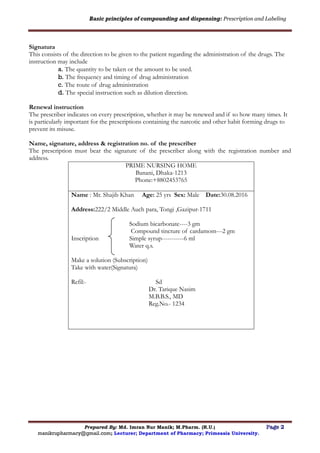
Name, signature, address & registration no. of the prescriber
The prescription must bear the signature of the prescriber along with the registration number and
address.
PRIME NURSING HOME
Banani, Dhaka-1213
Phone:+8802453765
Name : Mr. Shajib Khan Age: 25 yrs Sex: Male Date:30.08.2016
Address:222/2 Middle Auch para, Tongi ,Gazipur-1711
Sodium bicarbonate----3 gm
Compound tincture of cardamom---2 gm
Inscription Simple syrup-----------6 ml
Water q.s.
Make a solution (Subscription)
Take with water(Signatura)
Refil:- Sd
Dr. Tarique Nasim
M.B.B.S., MD
Reg.No.- 1234
Basic principles of compounding and dispensing: Prescription and Labeling
Prepared By: Md. Imran Nur Manik; M.Pharm. (R.U.) Page 3
manikrupharmacy@gmail.com; Lecturer; Department of Pharmacy; Primeasia University.
Types of prescription
Prescriptions may be of the following types
1. National Health Service Prescriptions.
2. Private prescriptions from doctors, dentists or veterinary practitioner.
3. Prescription for hospital in patients
4. Prescription for medicine to be taken at home by the patient, discharged from the hospital ward.
5. Hospital outpatient prescription.
Labeling of Dispensed Medications
The label for a dispensed product should provide the patient with all the information required for its
proper use. The information include
1. Accurate: The label should be checked immediately after writing and again before fixing to the
container.
2. Legible: It should be easily readable, it should be either type written or printed.
Basic principles of compounding and dispensing: Prescription and Labeling
Prepared By: Md. Imran Nur Manik; M.Pharm. (R.U.) Page 4
manikrupharmacy@gmail.com; Lecturer; Department of Pharmacy; Primeasia University.
3. Intelligible: The information given on the label should be completely unambiguous ( ) and
arranged to avoid any confusion.
4. Adequate and relevant: The information provided should be adequate and relevant in order to
avoid confusion and anxiety.
Information on the label
The followings are the important things which should be included in the label
1. Indicate clearly the patient, for whom it has been prescribed.
The patient’s title, forename (নামের প্রথে অংশ), initial name or surname (পদবি) should appear on the label of
each medicine dispensed.
2. Indicate the name and address of the supplier and the date of supply.
The name and address of the pharmacy may be printed on the dispensing labels.
3. In most of the cases give precise details as to the contents of the container when dispensed.
This includes
a. The quantity in the container: The total quantity of the product dispensed in the container
should be indicated on the label.
b. The name of the product /medicine: In the community pharmacy the name written by the
prescriber should appear on the label. In the hospital pharmacy only non-proprietary name is
used.
c. The strength of the medicine: It is essential for preparations that are essential in different
strengths of medicine. e.g. amount in each tablet/capsule.
d. Units: Wherever possible quantities should be expressed as whole numbers of unit. e.g. 100 mg
rather than 1gm.
e. Batch identification: The batch reference should be included in the labeling (UK).
f. Diluted products: Particular care should be taken when labeling medicines prepared by the
dilution of more concentrated products.
4. State the storage condition and shelf life of the medicine.
This includes
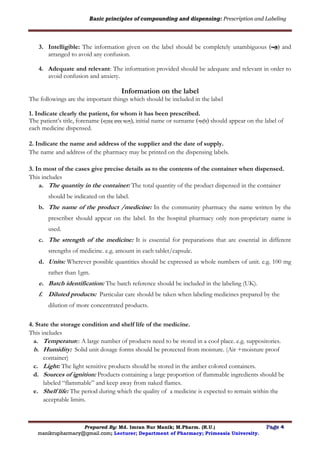
a. Temperature: A large number of products need to be stored in a cool place. e.g. suppositories.
b. Humidity: Solid unit dosage forms should be protected from moisture. (Air +moisture proof
container)
c. Light: The light sensitive products should be stored in the amber colored containers.
d. Sources of ignition: Products containing a large proportion of flammable ingredients should be
labeled “flammable” and keep away from naked flames.
e. Shelf life: The period during which the quality of a medicine is expected to remain within the
acceptable limits.
Basic principles of compounding and dispensing: Prescription and Labeling
Prepared By: Md. Imran Nur Manik; M.Pharm. (R.U.) Page 5
manikrupharmacy@gmail.com; Lecturer; Department of Pharmacy; Primeasia University.
5. Give clear and complete instruction to the patient on how and when to take or use the
preparation.
This Includes
a. Directions: Includes quantity to be taken or amount to be used, frequency and timing of
application, route of administration etc.
b. Shake the bottle: Emulsion, suspension etc.
c. Take with water: Mixtures that can cause gastric irritation. E.g. Disprin (Aspirin)
Cautionary and Advisory Label
In general the patient requires adequate information, so that the medicine can be taken safely and
effectively. Guidelines for the pharmacist on the Cautionary and Advisory Label to be applied to the
dispensed medicine are provided by the Royal pharmaceutical society of Great Britain.
The guidelines are as follows
1. For external use only
This label must be applied to the liquid preparations or gels for external application. The label is also
applied to all semisolid or solid medicinal products for external use. e.g. Ointments, Creams, Dusting
powders etc.
2. Not to be taken
This label may be used on preparations that’s are neither administered by mouth nor used on the skin.
This label may be confused with the words “For external use”. Therefore “For nasal use only”
“For rectal use only” “For vaginal use only” label may be preferred.
“Not to be swallowed in a large amount” is a better label for the mouth washes and gargles where
swallowing of a small amount is ineffective but swallowing in a large quantity is undesirable.
3. Hexachlorophane warning
Products containing Hexachlorophane should not be used indiscriminately in every young child or in
certain animals because of the possibility of the serious toxicity. A warning to this effect should be
included on the labels of the products containing the substances.
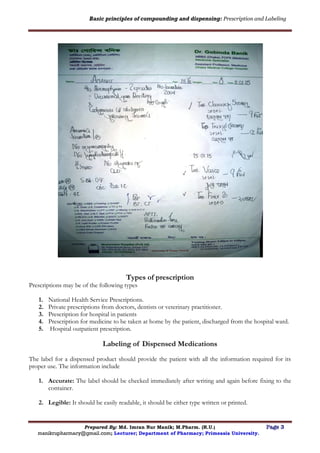
[A topical antibacterial formerly widely used in wound care and as a surgical scrub. Application to mucousmemb
ranes, denuded or burned surfaces, and intact skin in newborns has resulted in fatal CNS lesions. Use iscurrentl
y restricted to disinfection of intact adult skin. Products containing more than 0.1% hexachlorophene areavailable
only by prescription.]
4. Keep out of reach of children
All medicine should be stored in the place inaccessible to the children and must be so labeled.
5. For animal use/treatment only
A clear distinction must be made between the medicine intended for human use and those for veterinary
use.
Basic principles of compounding and dispensing: Prescription and Labeling
Prepared By: Md. Imran Nur Manik; M.Pharm. (R.U.) Page 6
manikrupharmacy@gmail.com; Lecturer; Department of Pharmacy; Primeasia University.
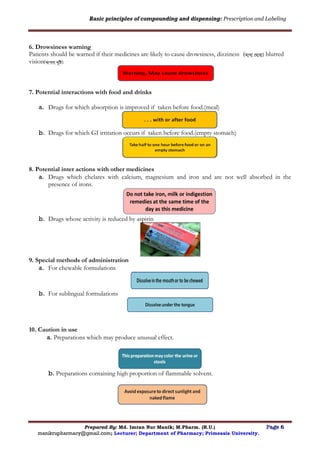
6. Drowsiness warning
Patients should be warned if their medicines are likely to cause drowsiness, dizziness (োথা ঘ ারা) blurred
vision( .
7. Potential interactions with food and drinks
a. Drugs for which absorption is improved if taken before food.(meal)
b. Drugs for which GI irritation occurs if taken before food.(empty stomach)
8. Potential inter actions with other medicines
a. Drugs which chelates with calcium, magnesium and iron and are not well absorbed in the
presence of irons.
b. Drugs whose activity is reduced by aspirin
9. Special methods of administration
a. For chewable formulations
b. For sublingual formulations
10. Caution in use
a. Preparations which may produce unusual effect.
b. Preparations containing high proportion of flammable solvent.

Prescription Writing MANIK

  • 1.
    Basic principles ofcompounding and dispensing: Prescription and Labeling Prepared By: Md. Imran Nur Manik; M.Pharm. (R.U.) manikrupharmacy@gmail.com; Lecturer; Department of Pharmacy; Primeasia University.
  • 2.
    Basic principles ofcompounding and dispensing: Prescription and Labeling Prepared By: Md. Imran Nur Manik; M.Pharm. (R.U.) Page 1 manikrupharmacy@gmail.com; Lecturer; Department of Pharmacy; Primeasia University. PRESCRIPTION Definition A prescription is an order form a registered practitioner o0r other properly licensed practitioner such as physician, dentist, veterinarian or dermatologists etc to a pharmacist to compound and dispense a specific medicine for the patient. Parts of Prescription 1. Date 2. Name, age, sex and address of the patient. 3. Superscription (Rx) 4. Inscription 5. Subscription 6. Signatura 7. Renewal instructions 8. Name, signature, address & registration no. of registered physician Date It helps the pharmacist to find out the date of prescribing and the date of prescription for filling. It also helps -to know when the medicines were last dispensed, -to prevent the misuse of the drug by the patients. The prescription which prescribes narcotic or other habit forming drugs must bear the date so as to avoid the misuse of the prescription. Name, age, sex and address of the patient Name, age, sex and address of the patient must be written in the prescription because it serves to identify the prescription. Age and sex of the patient especially the children, help the pharmacist to check the prescribed dose of the medicine. Superscription ( It is represented by the symbol Rx, which is written before writing the prescription. Rx is an abbreviation of the Latin imperative verb, “recipe = take” meaning “to take” (Take though). Inscription ( This is the main part of the prescription, contains the names and quantities of the prescribed ingredients The names of the ingredients are generally written in English but common abbreviation used can be written both in English and Latin language. Extreme care should be taken by the pharmacist during interpreting the abbreviations otherwise can lead to serious errors. Inscription is divided into following parts I. Base: The active ingredients which are intended produce the therapeutic effect. II. Adjuvant: It is included either to enhance the action of the medicament or to improve the palatability of the preparation. III. Correction: It is included to prevent or lessen any undesirable effect. IV. Vehicle: It is included in the prescription either to dissolve the solid ingredients or to increase the volume of the prescription. Subscription Subscription provides the direction to the pharmacist for the preparation of the prescription information and the quantity and dosage form of the drug to be dispensed.
  • 3.
    Basic principles ofcompounding and dispensing: Prescription and Labeling Prepared By: Md. Imran Nur Manik; M.Pharm. (R.U.) Page 2 manikrupharmacy@gmail.com; Lecturer; Department of Pharmacy; Primeasia University. Signatura This consists of the direction to be given to the patient regarding the administration of the drugs. The instruction may include a. The quantity to be taken or the amount to be used. b. The frequency and timing of drug administration c. The route of drug administration d. The special instruction such as dilution direction. Renewal instruction The prescriber indicates on every prescription, whether it may be renewed and if so how many times. It is particularly important for the prescriptions containing the narcotic and other habit forming drugs to prevent its misuse. Name, signature, address & registration no. of the prescriber The prescription must bear the signature of the prescriber along with the registration number and address. PRIME NURSING HOME Banani, Dhaka-1213 Phone:+8802453765 Name : Mr. Shajib Khan Age: 25 yrs Sex: Male Date:30.08.2016 Address:222/2 Middle Auch para, Tongi ,Gazipur-1711 Sodium bicarbonate----3 gm Compound tincture of cardamom---2 gm Inscription Simple syrup-----------6 ml Water q.s. Make a solution (Subscription) Take with water(Signatura) Refil:- Sd Dr. Tarique Nasim M.B.B.S., MD Reg.No.- 1234
  • 4.
    Basic principles ofcompounding and dispensing: Prescription and Labeling Prepared By: Md. Imran Nur Manik; M.Pharm. (R.U.) Page 3 manikrupharmacy@gmail.com; Lecturer; Department of Pharmacy; Primeasia University. Types of prescription Prescriptions may be of the following types 1. National Health Service Prescriptions. 2. Private prescriptions from doctors, dentists or veterinary practitioner. 3. Prescription for hospital in patients 4. Prescription for medicine to be taken at home by the patient, discharged from the hospital ward. 5. Hospital outpatient prescription. Labeling of Dispensed Medications The label for a dispensed product should provide the patient with all the information required for its proper use. The information include 1. Accurate: The label should be checked immediately after writing and again before fixing to the container. 2. Legible: It should be easily readable, it should be either type written or printed.
  • 5.
    Basic principles ofcompounding and dispensing: Prescription and Labeling Prepared By: Md. Imran Nur Manik; M.Pharm. (R.U.) Page 4 manikrupharmacy@gmail.com; Lecturer; Department of Pharmacy; Primeasia University. 3. Intelligible: The information given on the label should be completely unambiguous ( ) and arranged to avoid any confusion. 4. Adequate and relevant: The information provided should be adequate and relevant in order to avoid confusion and anxiety. Information on the label The followings are the important things which should be included in the label 1. Indicate clearly the patient, for whom it has been prescribed. The patient’s title, forename (নামের প্রথে অংশ), initial name or surname (পদবি) should appear on the label of each medicine dispensed. 2. Indicate the name and address of the supplier and the date of supply. The name and address of the pharmacy may be printed on the dispensing labels. 3. In most of the cases give precise details as to the contents of the container when dispensed. This includes a. The quantity in the container: The total quantity of the product dispensed in the container should be indicated on the label. b. The name of the product /medicine: In the community pharmacy the name written by the prescriber should appear on the label. In the hospital pharmacy only non-proprietary name is used. c. The strength of the medicine: It is essential for preparations that are essential in different strengths of medicine. e.g. amount in each tablet/capsule. d. Units: Wherever possible quantities should be expressed as whole numbers of unit. e.g. 100 mg rather than 1gm. e. Batch identification: The batch reference should be included in the labeling (UK). f. Diluted products: Particular care should be taken when labeling medicines prepared by the dilution of more concentrated products. 4. State the storage condition and shelf life of the medicine. This includes a. Temperature: A large number of products need to be stored in a cool place. e.g. suppositories. b. Humidity: Solid unit dosage forms should be protected from moisture. (Air +moisture proof container) c. Light: The light sensitive products should be stored in the amber colored containers. d. Sources of ignition: Products containing a large proportion of flammable ingredients should be labeled “flammable” and keep away from naked flames. e. Shelf life: The period during which the quality of a medicine is expected to remain within the acceptable limits.
  • 6.
    Basic principles ofcompounding and dispensing: Prescription and Labeling Prepared By: Md. Imran Nur Manik; M.Pharm. (R.U.) Page 5 manikrupharmacy@gmail.com; Lecturer; Department of Pharmacy; Primeasia University. 5. Give clear and complete instruction to the patient on how and when to take or use the preparation. This Includes a. Directions: Includes quantity to be taken or amount to be used, frequency and timing of application, route of administration etc. b. Shake the bottle: Emulsion, suspension etc. c. Take with water: Mixtures that can cause gastric irritation. E.g. Disprin (Aspirin) Cautionary and Advisory Label In general the patient requires adequate information, so that the medicine can be taken safely and effectively. Guidelines for the pharmacist on the Cautionary and Advisory Label to be applied to the dispensed medicine are provided by the Royal pharmaceutical society of Great Britain. The guidelines are as follows 1. For external use only This label must be applied to the liquid preparations or gels for external application. The label is also applied to all semisolid or solid medicinal products for external use. e.g. Ointments, Creams, Dusting powders etc. 2. Not to be taken This label may be used on preparations that’s are neither administered by mouth nor used on the skin. This label may be confused with the words “For external use”. Therefore “For nasal use only” “For rectal use only” “For vaginal use only” label may be preferred. “Not to be swallowed in a large amount” is a better label for the mouth washes and gargles where swallowing of a small amount is ineffective but swallowing in a large quantity is undesirable. 3. Hexachlorophane warning Products containing Hexachlorophane should not be used indiscriminately in every young child or in certain animals because of the possibility of the serious toxicity. A warning to this effect should be included on the labels of the products containing the substances. [A topical antibacterial formerly widely used in wound care and as a surgical scrub. Application to mucousmemb ranes, denuded or burned surfaces, and intact skin in newborns has resulted in fatal CNS lesions. Use iscurrentl y restricted to disinfection of intact adult skin. Products containing more than 0.1% hexachlorophene areavailable only by prescription.] 4. Keep out of reach of children All medicine should be stored in the place inaccessible to the children and must be so labeled. 5. For animal use/treatment only A clear distinction must be made between the medicine intended for human use and those for veterinary use.
  • 7.
    Basic principles ofcompounding and dispensing: Prescription and Labeling Prepared By: Md. Imran Nur Manik; M.Pharm. (R.U.) Page 6 manikrupharmacy@gmail.com; Lecturer; Department of Pharmacy; Primeasia University. 6. Drowsiness warning Patients should be warned if their medicines are likely to cause drowsiness, dizziness (োথা ঘ ারা) blurred vision( . 7. Potential interactions with food and drinks a. Drugs for which absorption is improved if taken before food.(meal) b. Drugs for which GI irritation occurs if taken before food.(empty stomach) 8. Potential inter actions with other medicines a. Drugs which chelates with calcium, magnesium and iron and are not well absorbed in the presence of irons. b. Drugs whose activity is reduced by aspirin 9. Special methods of administration a. For chewable formulations b. For sublingual formulations 10. Caution in use a. Preparations which may produce unusual effect. b. Preparations containing high proportion of flammable solvent.