Pharmacopoeia and formularies used in Nepal
• Pharmacopoeia is the official book of standards for
drugs prepared by any country or regulatory body to
specify the standards of identity, purity and strength
for the drugs imported, manufactured or distributed
throughout the country or a specific region.
• It is a book containing collection of monographs and
published by an authorized body like government or
Pharmaceutical society.
• The term Pharmacopoeia comes from the Greek
word “Pharmakon” meaning drug and “Poieo”
meaning make, and the combination means any
formula or standards required to make a drug.
• A monograph is a collection of detailed information
on a particular drug, its dosage forms and methods of
analysis.
• A monograph contains:
1. Chemical name 6. Assay
2. Formula 7. Specific optical rotation
3. Solubility 8. Loss on Drying
4. Identification 9. Sulphated ash
5. pH 10. Dose
Importance of pharmacopoeia
1. To maintain the uniformity and control the
standards of the drugs available in market.
2. Avoid adulterated drugs.
3. Complete information on drugs and their
dosage forms.
4. Reference for laboratory, industry and
academic institutions.
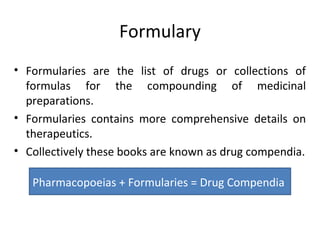
Formulary
• Formularies are the list of drugs or collections of
formulas for the compounding of medicinal
preparations.
• Formularies contains more comprehensive details on
therapeutics.
• Collectively these books are known as drug compendia.
Pharmacopoeias + Formularies = Drug Compendia
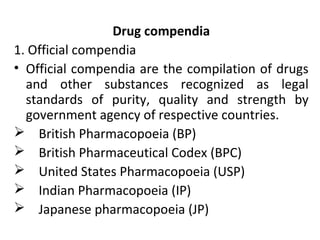
Drug compendia
1. Official compendia
• Official compendia are the compilation of drugs
and other substances recognized as legal
standards of purity, quality and strength by
government agency of respective countries.
 British Pharmacopoeia (BP)
 British Pharmaceutical Codex (BPC)
 United States Pharmacopoeia (USP)
 Indian Pharmacopoeia (IP)
 Japanese pharmacopoeia (JP)
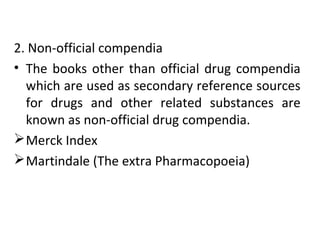
2. Non-official compendia
• The books other than official drug compendia
which are used as secondary reference sources
for drugs and other related substances are
known as non-official drug compendia.
Merck Index
Martindale (The extra Pharmacopoeia)
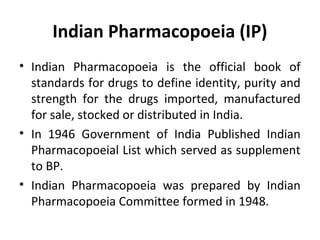
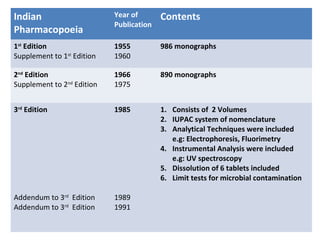
Indian Pharmacopoeia (IP)
• Indian Pharmacopoeia is the official book of
standards for drugs to define identity, purity and
strength for the drugs imported, manufactured
for sale, stocked or distributed in India.
• In 1946 Government of India Published Indian
Pharmacopoeial List which served as supplement
to BP.
• Indian Pharmacopoeia was prepared by Indian
Pharmacopoeia Committee formed in 1948.
Indian
Pharmacopoeia
Year of
Publication
Contents
1st
Edition
Supplement to 1st
Edition
1955
1960
986 monographs
2nd
Edition
Supplement to 2nd
Edition
1966
1975
890 monographs
3rd
Edition
Addendum to 3rd
Edition
Addendum to 3rd
Edition
1985
1989
1991
1. Consists of 2 Volumes
2. IUPAC system of nomenclature
3. Analytical Techniques were included
e.g: Electrophoresis, Fluorimetry
4. Instrumental Analysis were included
e.g: UV spectroscopy
5. Dissolution of 6 tablets included
6. Limit tests for microbial contamination
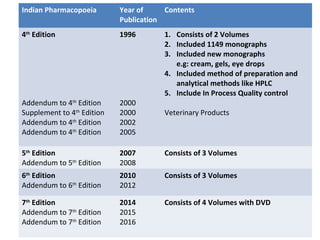
Indian Pharmacopoeia Year of
Publication
Contents
4th
Edition
Addendum to 4th
Edition
Supplement to 4th
Edition
Addendum to 4th
Edition
Addendum to 4th
Edition
1996
2000
2000
2002
2005
1. Consists of 2 Volumes
2. Included 1149 monographs
3. Included new monographs
e.g: cream, gels, eye drops
4. Included method of preparation and
analytical methods like HPLC
5. Include In Process Quality control
Veterinary Products
5th
Edition
Addendum to 5th
Edition
2007
2008
Consists of 3 Volumes
6th
Edition
Addendum to 6th
Edition
2010
2012
Consists of 3 Volumes
7th
Edition
Addendum to 7th
Edition
Addendum to 7th
Edition
2014
2015
2016
Consists of 4 Volumes with DVD
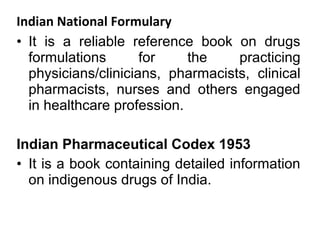
Indian National Formulary
• It is a reliable reference book on drugs
formulations for the practicing
physicians/clinicians, pharmacists, clinical
pharmacists, nurses and others engaged
in healthcare profession.
Indian Pharmaceutical Codex 1953
• It is a book containing detailed information
on indigenous drugs of India.
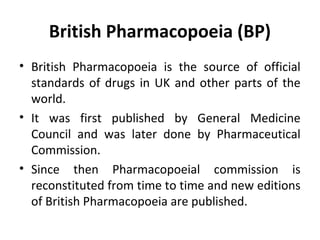
British Pharmacopoeia (BP)
• British Pharmacopoeia is the source of official
standards of drugs in UK and other parts of the
world.
• It was first published by General Medicine
Council and was later done by Pharmaceutical
Commission.
• Since then Pharmacopoeial commission is
reconstituted from time to time and new editions
of British Pharmacopoeia are published.
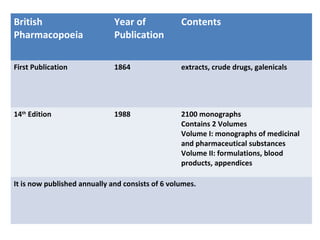
British
Pharmacopoeia
Year of
Publication
Contents
First Publication 1864 extracts, crude drugs, galenicals
14th
Edition 1988 2100 monographs
Contains 2 Volumes
Volume I: monographs of medicinal
and pharmaceutical substances
Volume II: formulations, blood
products, appendices
It is now published annually and consists of 6 volumes.
British Pharmaceutical Codex (BPC)
• British Pharmaceutical Codex was prepared as a
reference book to physicians and dispensing
pharmacists in 1907 as per the Council of
Pharmaceutical Society.
• Since then subsequent revisions of these books
are published.
• The decision of medicine commission stated that
there should be only one book of standards of
medicine, so BPC was discontinued.
• Later BPC was published as “The Pharmaceutical
Codex” and plans to be encyclopedia.
The BPC differs from BP in:
• BPC contains more drugs and preparations.
• It contains additional information on standard
of drugs, surgical dressing, pharmaceutical
preparations, etc
• It provides action and uses of drugs.
• It contains formula and preparation methods
of some other formulations.
British National Formulary (BNF)
• British National Formulary is a source of essential
information on drugs and medicines published by
pharmaceutical society of Great Britain and
British Medical Association.
• Pharmacological classification of drugs are given.
• It includes preparations as per Pharmaceutical
forms.
• It provides information about actions, uses,
dosage & adverse reactions.
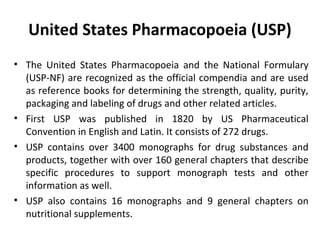
United States Pharmacopoeia (USP)
• The United States Pharmacopoeia and the National Formulary
(USP-NF) are recognized as the official compendia and are used
as reference books for determining the strength, quality, purity,
packaging and labeling of drugs and other related articles.
• First USP was published in 1820 by US Pharmaceutical
Convention in English and Latin. It consists of 272 drugs.
• USP contains over 3400 monographs for drug substances and
products, together with over 160 general chapters that describe
specific procedures to support monograph tests and other
information as well.
• USP also contains 16 monographs and 9 general chapters on
nutritional supplements.
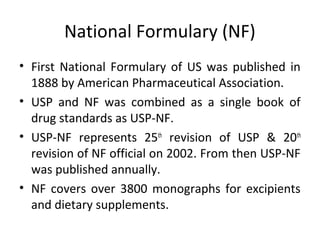
National Formulary (NF)
• First National Formulary of US was published in
1888 by American Pharmaceutical Association.
• USP and NF was combined as a single book of
drug standards as USP-NF.
• USP-NF represents 25th
revision of USP & 20th
revision of NF official on 2002. From then USP-NF
was published annually.
• NF covers over 3800 monographs for excipients
and dietary supplements.
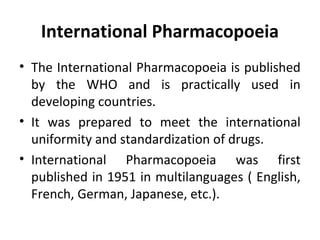
International Pharmacopoeia
• The International Pharmacopoeia is published
by the WHO and is practically used in
developing countries.
• It was prepared to meet the international
uniformity and standardization of drugs.
• International Pharmacopoeia was first
published in 1951 in multilanguages ( English,
French, German, Japanese, etc.).
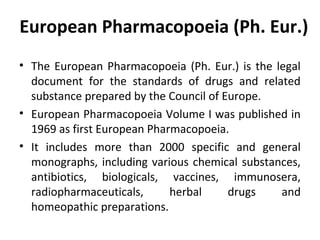
European Pharmacopoeia (Ph. Eur.)
• The European Pharmacopoeia (Ph. Eur.) is the legal
document for the standards of drugs and related
substance prepared by the Council of Europe.
• European Pharmacopoeia Volume I was published in
1969 as first European Pharmacopoeia.
• It includes more than 2000 specific and general
monographs, including various chemical substances,
antibiotics, biologicals, vaccines, immunosera,
radiopharmaceuticals, herbal drugs and
homeopathic preparations.
Japanese Pharmacopoeia (JP)
• Japanese Pharmacopoeia is established and
published to regulate the properties and
quality of drugs by Ministry of Health, Labour
and Welfare of Japan.
• It consists of general notices, rules for crude
drugs, rules for preparations, general tests,
processes, apparatus and official monographs.
• First published in 1886, JP has been revised
many times.

Pharmacopoeia

  • 1.
    Pharmacopoeia and formulariesused in Nepal • Pharmacopoeia is the official book of standards for drugs prepared by any country or regulatory body to specify the standards of identity, purity and strength for the drugs imported, manufactured or distributed throughout the country or a specific region. • It is a book containing collection of monographs and published by an authorized body like government or Pharmaceutical society. • The term Pharmacopoeia comes from the Greek word “Pharmakon” meaning drug and “Poieo” meaning make, and the combination means any formula or standards required to make a drug.
  • 2.
    • A monographis a collection of detailed information on a particular drug, its dosage forms and methods of analysis. • A monograph contains: 1. Chemical name 6. Assay 2. Formula 7. Specific optical rotation 3. Solubility 8. Loss on Drying 4. Identification 9. Sulphated ash 5. pH 10. Dose
  • 3.
    Importance of pharmacopoeia 1.To maintain the uniformity and control the standards of the drugs available in market. 2. Avoid adulterated drugs. 3. Complete information on drugs and their dosage forms. 4. Reference for laboratory, industry and academic institutions.
  • 4.
    Formulary • Formularies arethe list of drugs or collections of formulas for the compounding of medicinal preparations. • Formularies contains more comprehensive details on therapeutics. • Collectively these books are known as drug compendia. Pharmacopoeias + Formularies = Drug Compendia
  • 5.
    Drug compendia 1. Officialcompendia • Official compendia are the compilation of drugs and other substances recognized as legal standards of purity, quality and strength by government agency of respective countries.  British Pharmacopoeia (BP)  British Pharmaceutical Codex (BPC)  United States Pharmacopoeia (USP)  Indian Pharmacopoeia (IP)  Japanese pharmacopoeia (JP)
  • 6.
    2. Non-official compendia •The books other than official drug compendia which are used as secondary reference sources for drugs and other related substances are known as non-official drug compendia. Merck Index Martindale (The extra Pharmacopoeia)
  • 7.
    Indian Pharmacopoeia (IP) •Indian Pharmacopoeia is the official book of standards for drugs to define identity, purity and strength for the drugs imported, manufactured for sale, stocked or distributed in India. • In 1946 Government of India Published Indian Pharmacopoeial List which served as supplement to BP. • Indian Pharmacopoeia was prepared by Indian Pharmacopoeia Committee formed in 1948.
  • 8.
    Indian Pharmacopoeia Year of Publication Contents 1st Edition Supplement to1st Edition 1955 1960 986 monographs 2nd Edition Supplement to 2nd Edition 1966 1975 890 monographs 3rd Edition Addendum to 3rd Edition Addendum to 3rd Edition 1985 1989 1991 1. Consists of 2 Volumes 2. IUPAC system of nomenclature 3. Analytical Techniques were included e.g: Electrophoresis, Fluorimetry 4. Instrumental Analysis were included e.g: UV spectroscopy 5. Dissolution of 6 tablets included 6. Limit tests for microbial contamination
  • 9.
    Indian Pharmacopoeia Yearof Publication Contents 4th Edition Addendum to 4th Edition Supplement to 4th Edition Addendum to 4th Edition Addendum to 4th Edition 1996 2000 2000 2002 2005 1. Consists of 2 Volumes 2. Included 1149 monographs 3. Included new monographs e.g: cream, gels, eye drops 4. Included method of preparation and analytical methods like HPLC 5. Include In Process Quality control Veterinary Products 5th Edition Addendum to 5th Edition 2007 2008 Consists of 3 Volumes 6th Edition Addendum to 6th Edition 2010 2012 Consists of 3 Volumes 7th Edition Addendum to 7th Edition Addendum to 7th Edition 2014 2015 2016 Consists of 4 Volumes with DVD
  • 10.
    Indian National Formulary •It is a reliable reference book on drugs formulations for the practicing physicians/clinicians, pharmacists, clinical pharmacists, nurses and others engaged in healthcare profession. Indian Pharmaceutical Codex 1953 • It is a book containing detailed information on indigenous drugs of India.
  • 11.
    British Pharmacopoeia (BP) •British Pharmacopoeia is the source of official standards of drugs in UK and other parts of the world. • It was first published by General Medicine Council and was later done by Pharmaceutical Commission. • Since then Pharmacopoeial commission is reconstituted from time to time and new editions of British Pharmacopoeia are published.
  • 12.
    British Pharmacopoeia Year of Publication Contents First Publication1864 extracts, crude drugs, galenicals 14th Edition 1988 2100 monographs Contains 2 Volumes Volume I: monographs of medicinal and pharmaceutical substances Volume II: formulations, blood products, appendices It is now published annually and consists of 6 volumes.
  • 13.
    British Pharmaceutical Codex(BPC) • British Pharmaceutical Codex was prepared as a reference book to physicians and dispensing pharmacists in 1907 as per the Council of Pharmaceutical Society. • Since then subsequent revisions of these books are published. • The decision of medicine commission stated that there should be only one book of standards of medicine, so BPC was discontinued. • Later BPC was published as “The Pharmaceutical Codex” and plans to be encyclopedia.
  • 14.
    The BPC differsfrom BP in: • BPC contains more drugs and preparations. • It contains additional information on standard of drugs, surgical dressing, pharmaceutical preparations, etc • It provides action and uses of drugs. • It contains formula and preparation methods of some other formulations.
  • 15.
    British National Formulary(BNF) • British National Formulary is a source of essential information on drugs and medicines published by pharmaceutical society of Great Britain and British Medical Association. • Pharmacological classification of drugs are given. • It includes preparations as per Pharmaceutical forms. • It provides information about actions, uses, dosage & adverse reactions.
  • 16.
    United States Pharmacopoeia(USP) • The United States Pharmacopoeia and the National Formulary (USP-NF) are recognized as the official compendia and are used as reference books for determining the strength, quality, purity, packaging and labeling of drugs and other related articles. • First USP was published in 1820 by US Pharmaceutical Convention in English and Latin. It consists of 272 drugs. • USP contains over 3400 monographs for drug substances and products, together with over 160 general chapters that describe specific procedures to support monograph tests and other information as well. • USP also contains 16 monographs and 9 general chapters on nutritional supplements.
  • 17.
    National Formulary (NF) •First National Formulary of US was published in 1888 by American Pharmaceutical Association. • USP and NF was combined as a single book of drug standards as USP-NF. • USP-NF represents 25th revision of USP & 20th revision of NF official on 2002. From then USP-NF was published annually. • NF covers over 3800 monographs for excipients and dietary supplements.
  • 18.
    International Pharmacopoeia • TheInternational Pharmacopoeia is published by the WHO and is practically used in developing countries. • It was prepared to meet the international uniformity and standardization of drugs. • International Pharmacopoeia was first published in 1951 in multilanguages ( English, French, German, Japanese, etc.).
  • 19.
    European Pharmacopoeia (Ph.Eur.) • The European Pharmacopoeia (Ph. Eur.) is the legal document for the standards of drugs and related substance prepared by the Council of Europe. • European Pharmacopoeia Volume I was published in 1969 as first European Pharmacopoeia. • It includes more than 2000 specific and general monographs, including various chemical substances, antibiotics, biologicals, vaccines, immunosera, radiopharmaceuticals, herbal drugs and homeopathic preparations.
  • 20.
    Japanese Pharmacopoeia (JP) •Japanese Pharmacopoeia is established and published to regulate the properties and quality of drugs by Ministry of Health, Labour and Welfare of Japan. • It consists of general notices, rules for crude drugs, rules for preparations, general tests, processes, apparatus and official monographs. • First published in 1886, JP has been revised many times.