Please notify us in the
SlideShare comments below if
you identify errors or believe
additional information in an
area would be valuable.
• Annually, 8 million US healthcare workers experience potential
exposed to hazardous drugs (HDs).
• HD worker safety has been discussed since the early 1970s when
chemotherapy drugs were mixed on countertops or in horizontal
laminar airflow workbenches that directed HD-contaminated air
toward compounding personnel.
• In 2004, the National Institute of Occupational Safety and Health
(NIOSH) published a NIOSH , Preventing Occupational Exposures to
Antineoplastic and Other Hazardous Drugs in Health Care Settings.
This was 11 months after USP Chapter <797> was published.
HISTORY OF USP<800>
• In 2008, USP Chapter <797> was revised to include a
specific section for HD preparation. However, this
scope was limited to sterile preparations.
• Protection of HD-exposed workers continued to be a
challenge due to little clear evidence of HD effects
due to no tracking or documentation of healthcare
worker exposure or health complications results.
• In 2010, the Journal of Occupational and Environmental
Medicine published 2 key studies:
• Study of antineoplastic drug exposure of US healthcare workers
at 3 university-based healthcare centers. Showed continuing
surface contamination in pharmacy and nursing areas despite HD
handling guidelines.
• Study that reported damage to healthcare workers’ chromosomes
that are related to secondary cancers in treated patients
• On April 8, 2011, NIOSH, OSHA, and The Joint Commission
sent a jointly drafted letter discussing the safe handling of
HDs.
HISTORY OF USP<800>, CONT’D
• Also, in 2010, an investigative reporter
exposed the tribulations of Sue Crump, a
Seattle-area pharmacist who died at age 55 of
pancreatic cancer.
• The report had the desired effect resulting in the Washington
State legislature passing two HD rules in 2012 for HD-handling
requirements and a HD worker registry to track adverse
experiences.
• On March 28, 2014, USP posted a proposed General Chapter
<800> Hazardous Drugs—Handling in Healthcare Settings on
its website and in the May–June issue of Pharmacopeial
Forum to more fully cover HD handling in sterile and non-
sterile environments.
• Public comments closed July 31, 2014, and a revision
incorporating comments was posted in December 2014.
• Chapter <800> builds on 2 USP compounding General
Chapters:
 <795> Pharmaceutical Compounding – Nonsterile Preparations
 <797> Pharmaceutical Compounding – Sterile Preparations
 See comparison of USP <797> and <800>.
HISTORY OF USP<800>, CONT’D
• Goal is to promote patient safety, worker safety,
and environmental protection.
• Includes any hazardous drug (HD) handling:
receipt, storage, compounding, dispensing,
administration, and disposal of sterile and non-
sterile products and preparations.
• Applies to all healthcare workers who handle HD
preparations such as pharmacies or hospitals.
• Chapter<800> does not list specific HDs, but
refers to the NIOSH List of Antineoplastic and
Other Hazardous Drugs in Healthcare Settings.
• A radiation safety principle called ALARA was
utilized to accurately explain the proposed
chapter <800>.
SCOPE OF USP<800>
• Train personnel to utilize related practices
• Incorporate USP<800> standards into an
occupational safety plan which includes:
 Engineering controls
 Safe work practices
 Proper use of Personal Protective Equipment (PPE)
 Policies for HD waste segregation and disposal
USP<800> REQUIREMENTS
• Must be stored separately from non-HDs (as per <797>).
• Possible exception is HDs on NIOSH list that are:
• Not listed as antineoplastic agents,
• Are in final dosage forms,
• And are not manipulated other than counting for dispensing.
• Restricted-access storage room must be under negative
pressure, externally vented, and have at least 12 air
changes per hour.
• Injectable HDs may be stored in the negative-pressure
buffer room used for sterile preparations if all particle-
generating packaging is removed prior to storing.
• Refrigerated antineoplastics must be
stored be in a HD-dedicated refrigerator.
USP<800> STORAGE OF HD
USP<800> COMPOUNDING HD
• Must be performed in a containment primary engineering
control (C-PEC)
• Within a separate room that provides personnel protection.
• A restricted-access room under negative pressure, externally vented,
and have an appropriate number of air changes per hour based on
the type of compounding and the C-PEC in which it is being done.
• Applies to sterile and non-sterile compounding.
• C-PECs include:
• Containment ventilated enclosures (commonly called a powder hood)
• Class I biological safety cabinets (BSC)
• Class II BSC dedicated to use for non-sterile compounding.
USP<800> COMPOUNDING HD, CONT’D
• Allows occasional use of the sterile designated
C-PEC provided mitigating steps are taken to
safely return the use of the BSC or compounding
aseptic containment isolator (CACI) to sterile
compounding.
• <800> removed exemption that permitted low-
volume sterile compounding sites to use a BSC
or CACI in a positive pressure room.
• However, a containment segregated compounding area (C-SCA) can
be created.
• Currently not allowed by <797>, but a BSC can be placed in the C-
SCA if a facility meets these criteria:
 prepares only low- to medium-risk HD compounded sterile preparations
 finds a limit of a 12-hour beyond-use time acceptable,
USP<800> COMPOUNDING HD
Source: Pharmacy Purchasing & Products Magazine
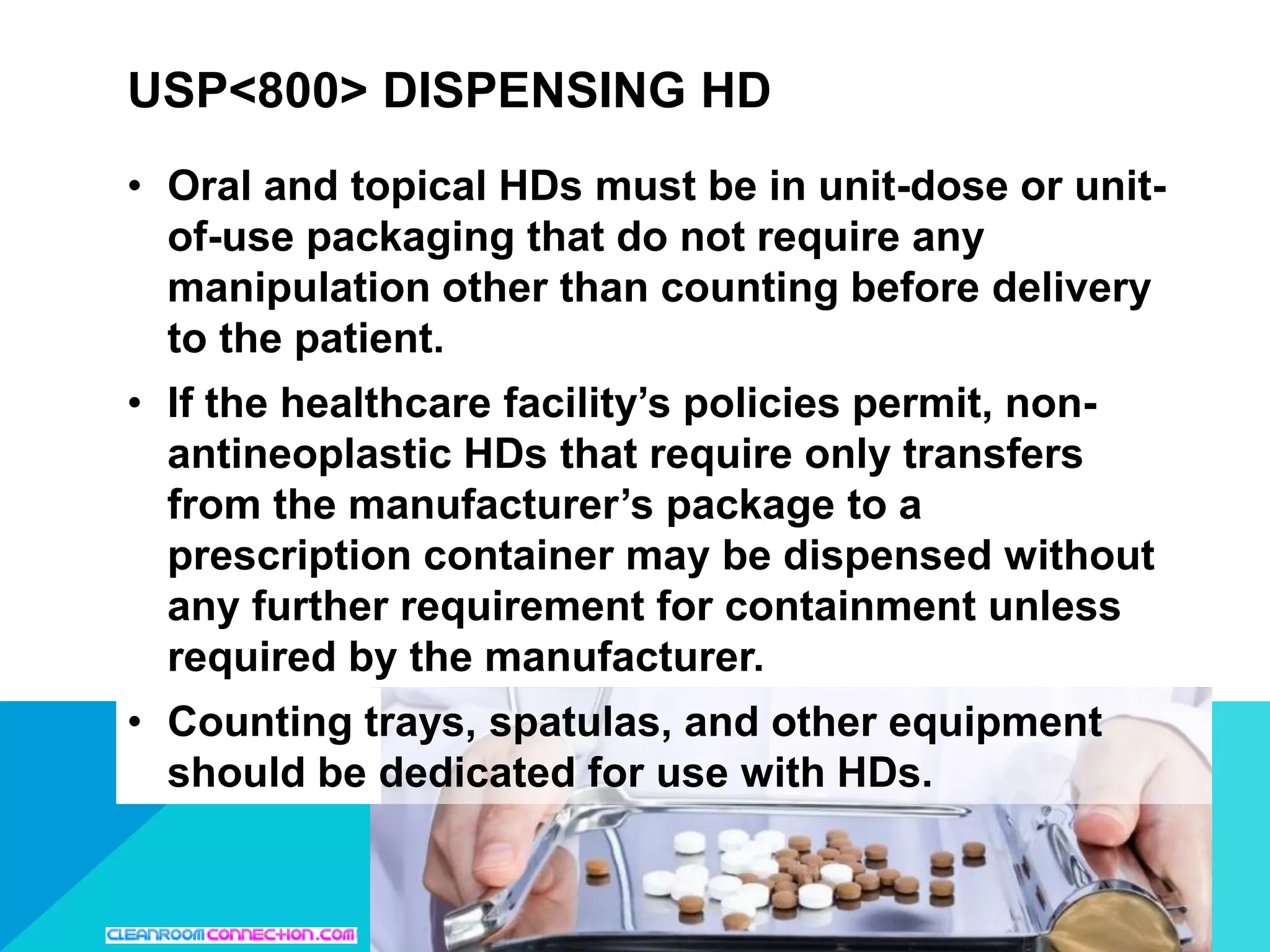
USP<800> DISPENSING HD
• Oral and topical HDs must be in unit-dose or unit-
of-use packaging that do not require any
manipulation other than counting before delivery
to the patient.
• If the healthcare facility’s policies permit, non-
antineoplastic HDs that require only transfers
from the manufacturer’s package to a
prescription container may be dispensed without
any further requirement for containment unless
required by the manufacturer.
• Counting trays, spatulas, and other equipment
should be dedicated for use with HDs.
• This new chapter expands the <797>
requirements for primary and secondary
engineering controls to contain HDs for storage
and compounding.
• <800> extends consideration to all personnel in
healthcare settings, including HD adminstration.
• Use of closed-system drug transfer devices
(CSTDs) are supplemental engineering controls
are required during HD administration and
recommended for compounding processes.
USP<800> ADMINISTERING HD
• Training for compliance available.
• Cleanroom supplies specifically for USP<800>
compliance are available.
• Free samples of cleanroom supplies available
before you buy new consumables for USP<800>.
• Complimentary consulting on USP<797> and
USP<800> compliance and cleanroom supplies
selection.
USP<800> COMPLIANCE

USP 800 History and Compliance

  • 2.
    Please notify usin the SlideShare comments below if you identify errors or believe additional information in an area would be valuable.
  • 3.
    • Annually, 8million US healthcare workers experience potential exposed to hazardous drugs (HDs). • HD worker safety has been discussed since the early 1970s when chemotherapy drugs were mixed on countertops or in horizontal laminar airflow workbenches that directed HD-contaminated air toward compounding personnel. • In 2004, the National Institute of Occupational Safety and Health (NIOSH) published a NIOSH , Preventing Occupational Exposures to Antineoplastic and Other Hazardous Drugs in Health Care Settings. This was 11 months after USP Chapter <797> was published. HISTORY OF USP<800> • In 2008, USP Chapter <797> was revised to include a specific section for HD preparation. However, this scope was limited to sterile preparations. • Protection of HD-exposed workers continued to be a challenge due to little clear evidence of HD effects due to no tracking or documentation of healthcare worker exposure or health complications results.
  • 4.
    • In 2010,the Journal of Occupational and Environmental Medicine published 2 key studies: • Study of antineoplastic drug exposure of US healthcare workers at 3 university-based healthcare centers. Showed continuing surface contamination in pharmacy and nursing areas despite HD handling guidelines. • Study that reported damage to healthcare workers’ chromosomes that are related to secondary cancers in treated patients • On April 8, 2011, NIOSH, OSHA, and The Joint Commission sent a jointly drafted letter discussing the safe handling of HDs. HISTORY OF USP<800>, CONT’D • Also, in 2010, an investigative reporter exposed the tribulations of Sue Crump, a Seattle-area pharmacist who died at age 55 of pancreatic cancer.
  • 5.
    • The reporthad the desired effect resulting in the Washington State legislature passing two HD rules in 2012 for HD-handling requirements and a HD worker registry to track adverse experiences. • On March 28, 2014, USP posted a proposed General Chapter <800> Hazardous Drugs—Handling in Healthcare Settings on its website and in the May–June issue of Pharmacopeial Forum to more fully cover HD handling in sterile and non- sterile environments. • Public comments closed July 31, 2014, and a revision incorporating comments was posted in December 2014. • Chapter <800> builds on 2 USP compounding General Chapters:  <795> Pharmaceutical Compounding – Nonsterile Preparations  <797> Pharmaceutical Compounding – Sterile Preparations  See comparison of USP <797> and <800>. HISTORY OF USP<800>, CONT’D
  • 6.
    • Goal isto promote patient safety, worker safety, and environmental protection. • Includes any hazardous drug (HD) handling: receipt, storage, compounding, dispensing, administration, and disposal of sterile and non- sterile products and preparations. • Applies to all healthcare workers who handle HD preparations such as pharmacies or hospitals. • Chapter<800> does not list specific HDs, but refers to the NIOSH List of Antineoplastic and Other Hazardous Drugs in Healthcare Settings. • A radiation safety principle called ALARA was utilized to accurately explain the proposed chapter <800>. SCOPE OF USP<800>
  • 7.
    • Train personnelto utilize related practices • Incorporate USP<800> standards into an occupational safety plan which includes:  Engineering controls  Safe work practices  Proper use of Personal Protective Equipment (PPE)  Policies for HD waste segregation and disposal USP<800> REQUIREMENTS
  • 8.
    • Must bestored separately from non-HDs (as per <797>). • Possible exception is HDs on NIOSH list that are: • Not listed as antineoplastic agents, • Are in final dosage forms, • And are not manipulated other than counting for dispensing. • Restricted-access storage room must be under negative pressure, externally vented, and have at least 12 air changes per hour. • Injectable HDs may be stored in the negative-pressure buffer room used for sterile preparations if all particle- generating packaging is removed prior to storing. • Refrigerated antineoplastics must be stored be in a HD-dedicated refrigerator. USP<800> STORAGE OF HD
  • 9.
    USP<800> COMPOUNDING HD •Must be performed in a containment primary engineering control (C-PEC) • Within a separate room that provides personnel protection. • A restricted-access room under negative pressure, externally vented, and have an appropriate number of air changes per hour based on the type of compounding and the C-PEC in which it is being done. • Applies to sterile and non-sterile compounding. • C-PECs include: • Containment ventilated enclosures (commonly called a powder hood) • Class I biological safety cabinets (BSC) • Class II BSC dedicated to use for non-sterile compounding.
  • 10.
    USP<800> COMPOUNDING HD,CONT’D • Allows occasional use of the sterile designated C-PEC provided mitigating steps are taken to safely return the use of the BSC or compounding aseptic containment isolator (CACI) to sterile compounding. • <800> removed exemption that permitted low- volume sterile compounding sites to use a BSC or CACI in a positive pressure room. • However, a containment segregated compounding area (C-SCA) can be created. • Currently not allowed by <797>, but a BSC can be placed in the C- SCA if a facility meets these criteria:  prepares only low- to medium-risk HD compounded sterile preparations  finds a limit of a 12-hour beyond-use time acceptable,
  • 11.
    USP<800> COMPOUNDING HD Source:Pharmacy Purchasing & Products Magazine
  • 12.
    USP<800> DISPENSING HD •Oral and topical HDs must be in unit-dose or unit- of-use packaging that do not require any manipulation other than counting before delivery to the patient. • If the healthcare facility’s policies permit, non- antineoplastic HDs that require only transfers from the manufacturer’s package to a prescription container may be dispensed without any further requirement for containment unless required by the manufacturer. • Counting trays, spatulas, and other equipment should be dedicated for use with HDs.
  • 13.
    • This newchapter expands the <797> requirements for primary and secondary engineering controls to contain HDs for storage and compounding. • <800> extends consideration to all personnel in healthcare settings, including HD adminstration. • Use of closed-system drug transfer devices (CSTDs) are supplemental engineering controls are required during HD administration and recommended for compounding processes. USP<800> ADMINISTERING HD
  • 14.
    • Training forcompliance available. • Cleanroom supplies specifically for USP<800> compliance are available. • Free samples of cleanroom supplies available before you buy new consumables for USP<800>. • Complimentary consulting on USP<797> and USP<800> compliance and cleanroom supplies selection. USP<800> COMPLIANCE