INTRODUCTION TO
PHARMACY
PHARM I
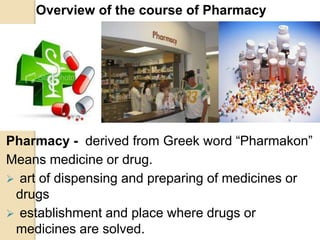
Overview of the course of Pharmacy
Pharmacy - derived from Greek word “Pharmakon”
Means medicine or drug.
 art of dispensing and preparing of medicines or
drugs
 establishment and place where drugs or
medicines are solved.
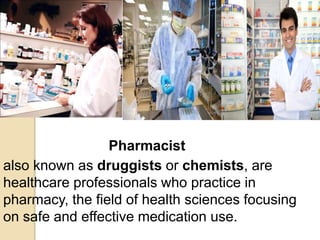
Pharmacist
also known as druggists or chemists, are
healthcare professionals who practice in
pharmacy, the field of health sciences focusing
on safe and effective medication use.
COMMON SYMBOLS USED
IN PHARMAC Y
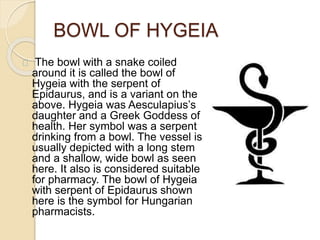
BOWL OF HYGEIA
The bowl with a snake coiled
around it is called the bowl of
Hygeia with the serpent of
Epidaurus, and is a variant on the
above. Hygeia was Aesculapius’s
daughter and a Greek Goddess of
health. Her symbol was a serpent
drinking from a bowl. The vessel is
usually depicted with a long stem
and a shallow, wide bowl as seen
here. It also is considered suitable
for pharmacy. The bowl of Hygeia
with serpent of Epidaurus shown
here is the symbol for Hungarian
pharmacists.
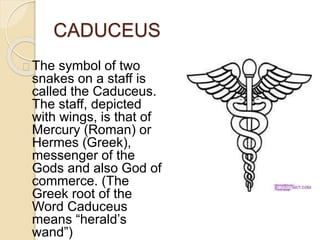
CADUCEUS
The symbol of two
snakes on a staff is
called the Caduceus.
The staff, depicted
with wings, is that of
Mercury (Roman) or
Hermes (Greek),
messenger of the
Gods and also God of
commerce. (The
Greek root of the
Word Caduceus
means “herald’s
wand”)
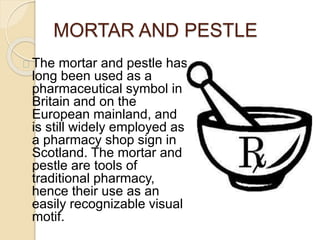
MORTAR AND PESTLE
The mortar and pestle has
long been used as a
pharmaceutical symbol in
Britain and on the
European mainland, and
is still widely employed as
a pharmacy shop sign in
Scotland. The mortar and
pestle are tools of
traditional pharmacy,
hence their use as an
easily recognizable visual
motif.
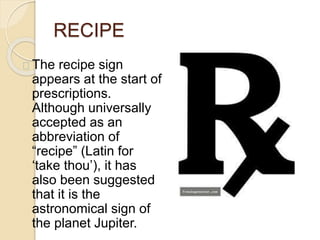
RECIPE
The recipe sign
appears at the start of
prescriptions.
Although universally
accepted as an
abbreviation of
“recipe” (Latin for
‘take thou’), it has
also been suggested
that it is the
astronomical sign of
the planet Jupiter.
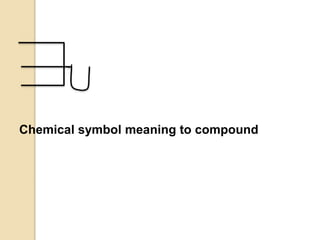
Chemical symbol meaning to compound
Helmet – Denoting wisdom and surety of
action
Unicorn – Horn of which has medical effect
Secundum Artem – according to art. Pharmacy
is both science and art.
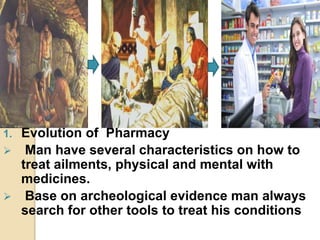
1. Evolution of Pharmacy
 Man have several characteristics on how to
treat ailments, physical and mental with
medicines.
 Base on archeological evidence man always
search for other tools to treat his conditions
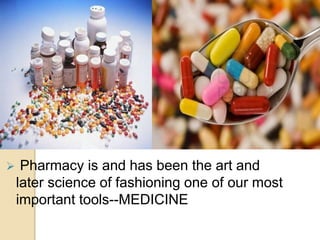
 Pharmacy is and has been the art and
later science of fashioning one of our most
important tools--MEDICINE
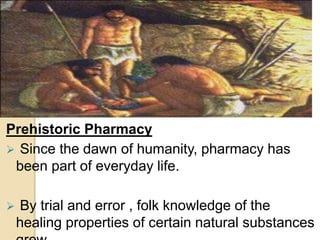
Prehistoric Pharmacy
 Since the dawn of humanity, pharmacy has
been part of everyday life.
 By trial and error , folk knowledge of the
healing properties of certain natural substances
Shamans
 Faith Healers
Concept of outside force in the form of remedies
Drugs influencing bodily functions may considered
one of humanity’s greatest advances
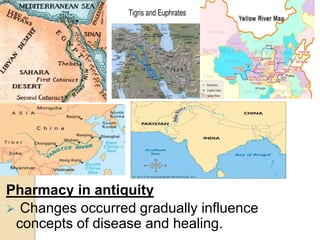
Pharmacy in antiquity
 Changes occurred gradually influence
concepts of disease and healing.
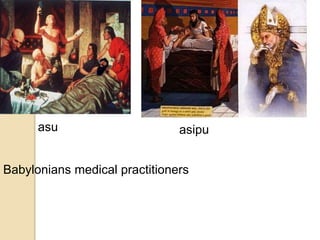
asu asipu
Babylonians medical practitioners
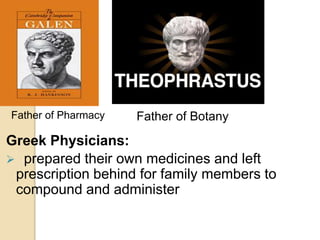
Greek Physicians:
 prepared their own medicines and left
prescription behind for family members to
compound and administer
Father of Pharmacy Father of Botany
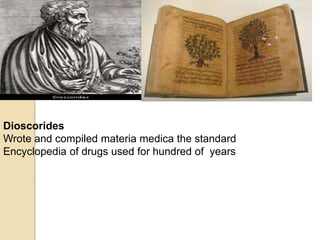
Dioscorides
Wrote and compiled materia medica the standard
Encyclopedia of drugs used for hundred of years
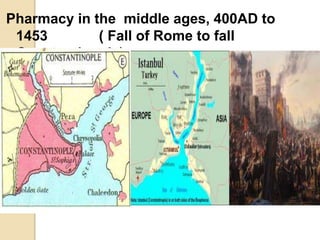
Pharmacy in the middle ages, 400AD to
1453 ( Fall of Rome to fall
Constantinople)
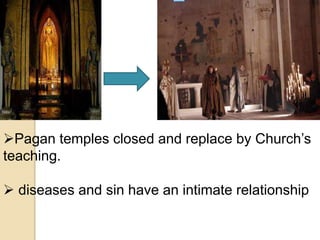
Pagan temples closed and replace by Church’s
teaching.
 diseases and sin have an intimate relationship
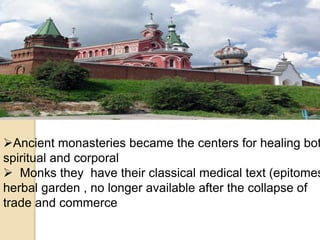
Ancient monasteries became the centers for healing bot
spiritual and corporal
 Monks they have their classical medical text (epitomes
herbal garden , no longer available after the collapse of
trade and commerce
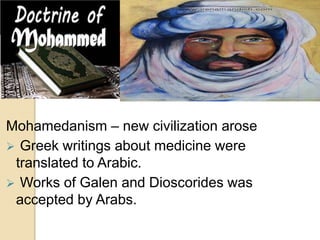
Mohamedanism – new civilization arose
 Greek writings about medicine were
translated to Arabic.
 Works of Galen and Dioscorides was
accepted by Arabs.
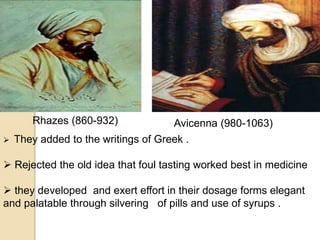
Rhazes (860-932) Avicenna (980-1063)
 They added to the writings of Greek .
 Rejected the old idea that foul tasting worked best in medicine
 they developed and exert effort in their dosage forms elegant
and palatable through silvering of pills and use of syrups .
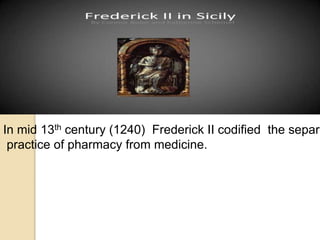
In mid 13th century (1240) Frederick II codified the separa
practice of pharmacy from medicine.
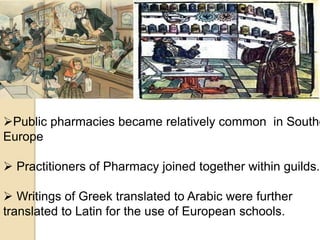
Public pharmacies became relatively common in Southe
Europe
 Practitioners of Pharmacy joined together within guilds.
 Writings of Greek translated to Arabic were further
translated to Latin for the use of European schools.
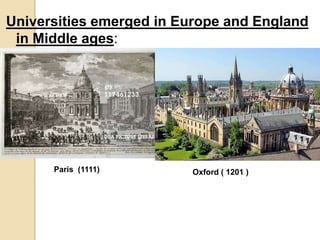
Universities emerged in Europe and England
in Middle ages:
Paris (1111) Oxford ( 1201 )
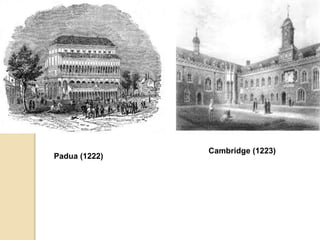
Padua (1222)
Cambridge (1223)
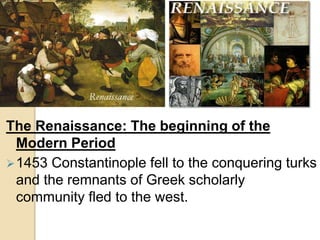
The Renaissance: The beginning of the
Modern Period
1453 Constantinople fell to the conquering turks
and the remnants of Greek scholarly
community fled to the west.
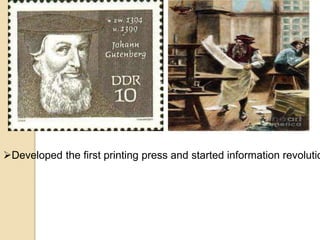
Developed the first printing press and started information revolutio
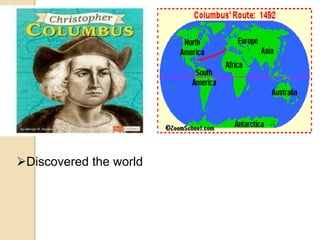
Discovered the world
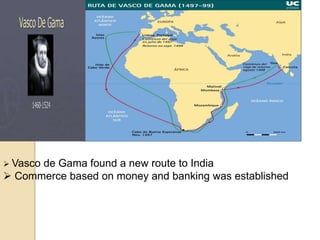
 Vasco de Gama found a new route to India
 Commerce based on money and banking was established
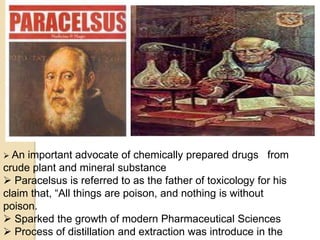
 An important advocate of chemically prepared drugs from
crude plant and mineral substance
 Paracelsus is referred to as the father of toxicology for his
claim that, “All things are poison, and nothing is without
poison.
 Sparked the growth of modern Pharmaceutical Sciences
 Process of distillation and extraction was introduce in the
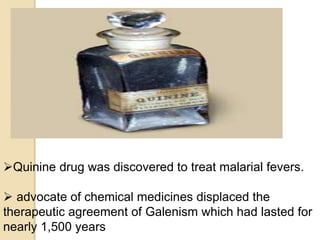
Quinine drug was discovered to treat malarial fevers.
 advocate of chemical medicines displaced the
therapeutic agreement of Galenism which had lasted for
nearly 1,500 years
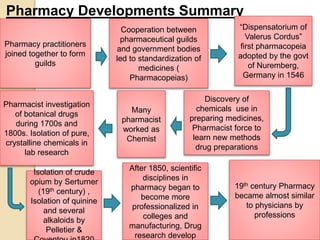
Pharmacy Developments Summary
Pharmacy practitioners
joined together to form
guilds
Cooperation between
pharmaceutical guilds
and government bodies
led to standardization of
medicines (
Pharmacopeias)
“Dispensatorium of
Valerus Cordus”
first pharmacopeia
adopted by the govt
of Nuremberg,
Germany in 1546
Discovery of
chemicals use in
preparing medicines,
Pharmacist force to
learn new methods
drug preparations
Many
pharmacist
worked as
Chemist
Pharmacist investigation
of botanical drugs
during 1700s and
1800s. Isolation of pure,
crystalline chemicals in
lab research
Isolation of crude
opium by Serturner
(19th century) ,
Isolation of quinine
and several
alkaloids by
Pelletier &
After 1850, scientific
disciplines in
pharmacy began to
become more
professionalized in
colleges and
manufacturing, Drug
research develop
19th century Pharmacy
became almost similar
to physicians by
professions
Transition to Modern Profession 1870 to 1920:
 Transitional for both pharmacy and Pharmacy
education.
 5% of pharmacy practitioners had finished formal
schooling in Pharmacy of night courses to
supplement apprenticeship
 1870 state laws were passed requiring the
examination and registration of pharmacist.
 Prestige attached to the diploma attracted
students
 Schools affiliated with local pharmaceutical
organizations provided students with excellent
practical education combining formal education
with apprenticeship.
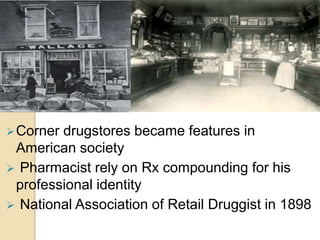
Corner drugstores became features in
American society
 Pharmacist rely on Rx compounding for his
professional identity
 National Association of Retail Druggist in 1898
American Pharmaceutical Association
welcomed and cooperated with retail druggist
first but later on they split.
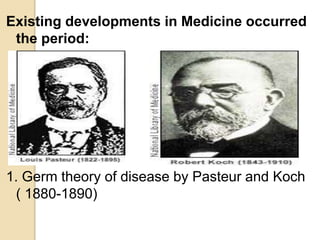
Existing developments in Medicine occurred
the period:
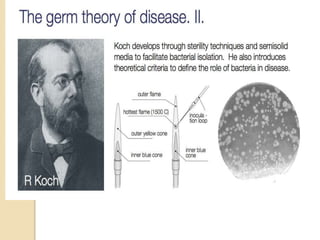
1. Germ theory of disease by Pasteur and Koch
( 1880-1890)
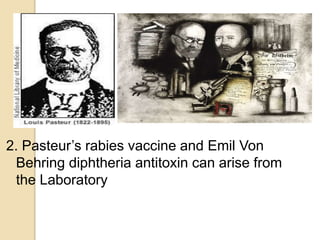
2. Pasteur’s rabies vaccine and Emil Von
Behring diphtheria antitoxin can arise from
the Laboratory
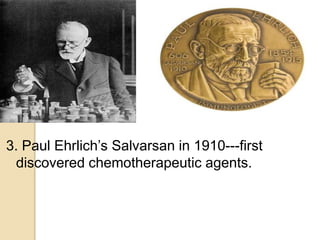
3. Paul Ehrlich’s Salvarsan in 1910---first
discovered chemotherapeutic agents.
4. Industrial research in drugs produced
analgesics and antipyretics in laboratory,
sedative as chloral hydrate.
5. Passage of Pure Foods and Drug Act in 1906
mainly
In response to poor food production methods
expanded to problems in the drug trade
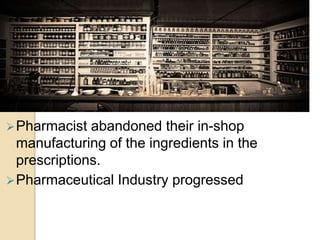
Pharmacist abandoned their in-shop
manufacturing of the ingredients in the
prescriptions.
Pharmaceutical Industry progressed
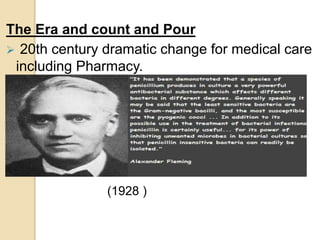
The Era and count and Pour
 20th century dramatic change for medical care
including Pharmacy.
(1928 )
 cortisones, tranquilizers, antihypertensives,
radioisotopes and oral contraceptives was also
discovered
 High technology was applied to the production
of medicines after WWII ( 1941-1942 )
 pharmaceutical Industries became one of the
most advanced industries in the world.
1930s – 75% of Rx required compounding by a
pharmacist
1950s – 25% of Rx required compounding by a
pharmacist
1960s – only 4% (1 in 25 Rx) needed
compounding
1970s – only 1% ( 1 in 100 Rx ) needed
compounding skills
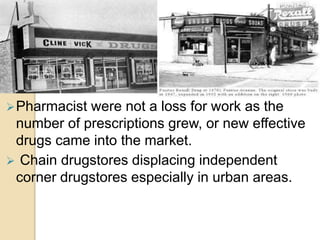
Pharmacist were not a loss for work as the
number of prescriptions grew, or new effective
drugs came into the market.
 Chain drugstores displacing independent
corner drugstores especially in urban areas.
 Laws regulating the production of drugs
and pharmacy were modernized.
 BS Pharmacy was extended to 5 years
and curriculum continued to emphasize
physical sciences which underlie the
making of medicines.
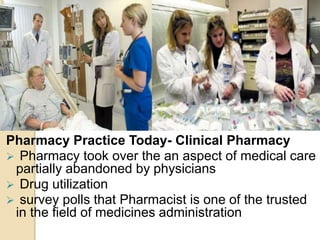
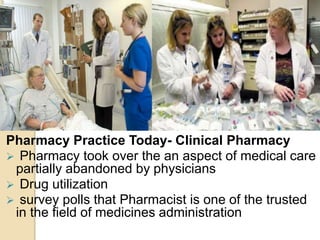
Pharmacy Practice Today- Clinical Pharmacy
 Pharmacy took over the an aspect of medical care
partially abandoned by physicians
 Drug utilization
 survey polls that Pharmacist is one of the trusted
in the field of medicines administration
Pharmacy Practice Today- Clinical Pharmacy
 Pharmacy took over the an aspect of medical care
partially abandoned by physicians
 Drug utilization
 survey polls that Pharmacist is one of the trusted
in the field of medicines administration
ATDPS(Automatic Tablet Dispensing & Packaging
System)
History Of Philippine Pharmacy
Pre-historic Period:
1. Mythical period
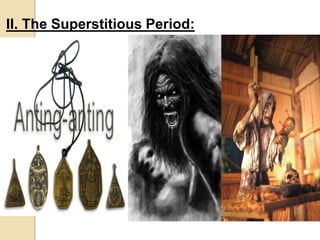
2. Superstitious
3. Empiric
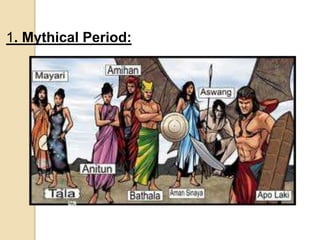
1. Mythical Period:
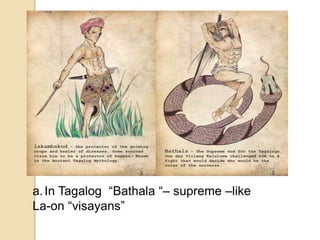
a.In Tagalog “Bathala “– supreme –like
La-on “visayans”
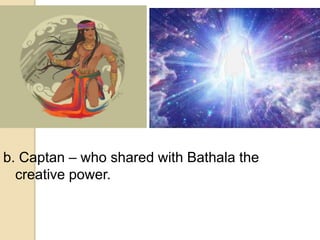
b. Captan – who shared with Bathala the
creative power.
c. Bagobos - - “Daragao”, Tiruray - “Balbol and Saitan”
d. “ Patianak “
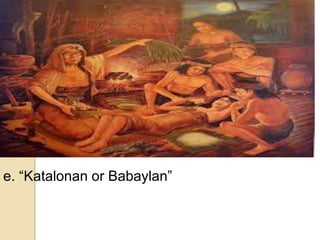
e. “Katalonan or Babaylan”
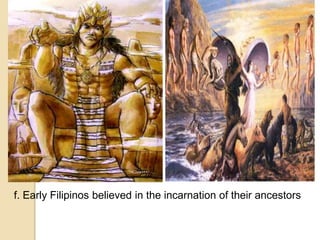
f. Early Filipinos believed in the incarnation of their ancestors
II. The Superstitious Period:
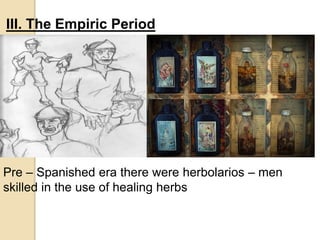
III. The Empiric Period
Pre – Spanished era there were herbolarios – men
skilled in the use of healing herbs
Pharmaceutical forms adopted by the early
cuarenderos or quack doctors were confined to:
1. Macerations in cold and hot water
2. Infusions or decoctions in oil of the curative
plant parts
3. Poultices and some powders
4. Resinous plasters and salves with a waxy
base
5. inhalations and fumigations and a few
empyreumatic products.
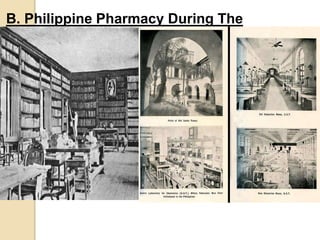
B. Philippine Pharmacy During The
Spanished Period
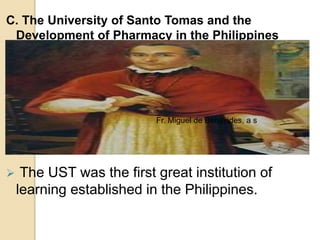
C. The University of Santo Tomas and the
Development of Pharmacy in the Philippines
 The UST was the first great institution of
learning established in the Philippines.
Fr. Miguel de Benavides, a s
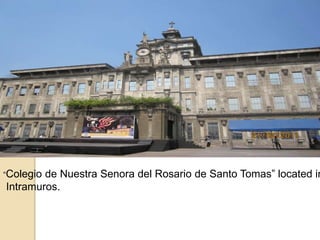
“Colegio de Nuestra Senora del Rosario de Santo Tomas” located in
Intramuros.
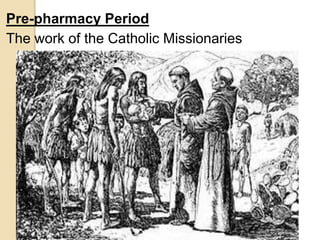
Pre-pharmacy Period
The work of the Catholic Missionaries
Fr. Fernando Santa Maria (1704-1774)
 Dominican priest, native of madrid
 “ Medicinas Caseras” 1st ed. 1786 –
contained suggestions for treatment of certain
diseases.
3 Topics of the book:
1. Medicinal barks and herbs
2. Various sickness
3. Various secrets and rareties worth knowing
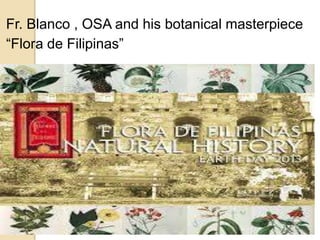
Fr. Blanco , OSA and his botanical masterpiece
“Flora de Filipinas”
Post- Pharmacy Period
Once the was firmly established in July, 1871
its work and teaching mission started
smoothly.
 Professors had to be contracted from Spain.
 1871 there were about 8 students enrolled
and out of these 6 were graduated as
Bachelors in 1875 and as Licenciates in
1876.
 Doctor s degree were granted by the Govt ,
this was reserved only to Universidad
Central de. Madrid.
 Foreign Pharmacist come to
Philippines to do business or to
practice their profession.
 Rector should approve first before
the Foreign Pharmacist to practice
here in the Philippines.
 Examination was given to them
 Foreign Pharmacist was a
blessing for the Philippines
Admission of Spanish and Foreign Pharmacists
to Practice in the Philippines:
 Govt and University immediately took steps to
solve first in connection with the admission of
foreign pharmacists.
Establishment of the school of “
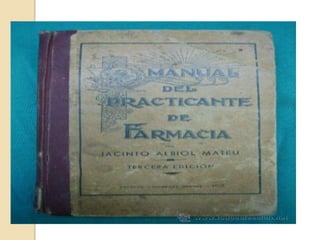
Practicantes de Medicina y Farmacia”
The purpose is to protect the health of the
Filipinos by producing well-trained
practitioners to help the physicians and
pharmacist.
 there were lot of students flocked to the
university to enroll in the new course.
 Superior Gobierno – approve and granted the official permit
in December , 1879.
Rules and Regulation was promulgated by the Rector and
administration of the University among which were the
following important points:
1. The course will be given in 4 semesters
2. Classes shall be daily
3. Students must be able:
a. to read and write and possess a knowledge of the catholic
doctrine
b. 18 years old shown in baptismal certificate and an affidavit
of nationality
c. Must undergo and pass an entrance examination that will
include arithmetic
4. Students must practice in any drug store or laboratory during
the last 3 semester of the course
5. After completion of four semesters study, must pass both
theoretical and a practical examination
The Hospitals and Drugstores in the
Philippines During the Spanish Era
 Many hospitals were already in operation in
the islands during the Pharmacy Period and
in this respect, the Spanish government
deserved some credit.
 The first hospital built by the Spaniards was
the Military Hospital in Cebu, built by Legaspi
in 1565.
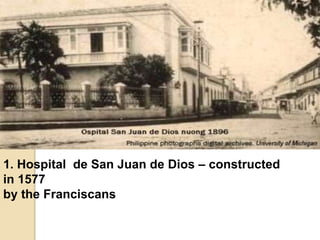
1. Hospital de San Juan de Dios – constructed
in 1577
by the Franciscans
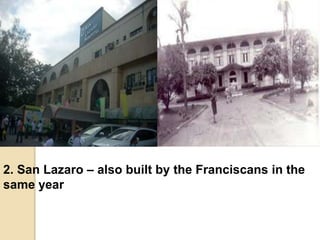
2. San Lazaro – also built by the Franciscans in the
same year
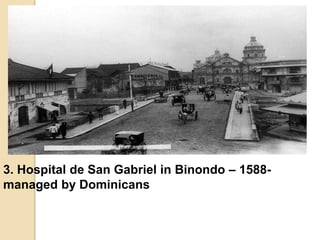
3. Hospital de San Gabriel in Binondo – 1588-
managed by Dominicans
4. Hospital de Aguas Santas at Los Banos-
1596
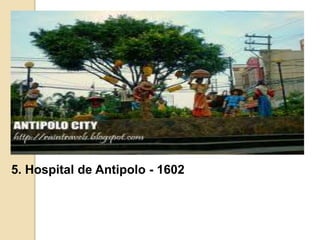
5. Hospital de Antipolo - 1602
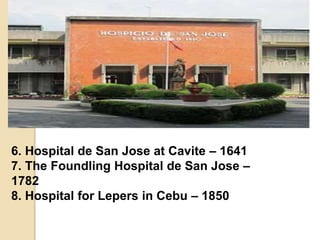
6. Hospital de San Jose at Cavite – 1641
7. The Foundling Hospital de San Jose –
1782
8. Hospital for Lepers in Cebu – 1850
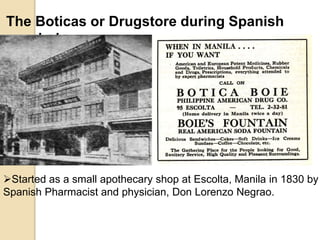
The Boticas or Drugstore during Spanish
period
Started as a small apothecary shop at Escolta, Manila in 1830 by
Spanish Pharmacist and physician, Don Lorenzo Negrao.
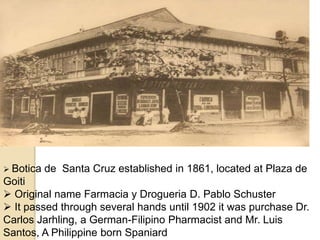
 Botica de Santa Cruz established in 1861, located at Plaza de
Goiti
 Original name Farmacia y Drogueria D. Pablo Schuster
 It passed through several hands until 1902 it was purchase Dr.
Carlos Jarhling, a German-Filipino Pharmacist and Mr. Luis
Santos, A Philippine born Spaniard
Besides from the two drug establishment , there
were smaller business concerns in the City of
Manila and other big cities of the country
1. Botica Zobel, Botica Von Borrie and Botica de
la Divisoria (1878)
2. Farmacia de Quiapo (1883 )
3. Botica Nino in Cebu
4. Botica De Lalloc in Cagayan de Luzon
5. Botica de D. Mariano Kuhnell
6. Botica de D. Oscar Reyman in Binondo
7. Botica de Fernnadez
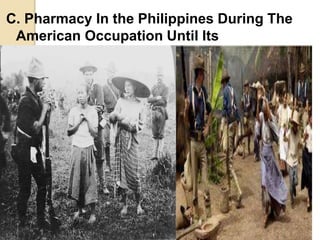
C. Pharmacy In the Philippines During The
American Occupation Until Its
Independence
Establishment of the Board of
pharmaceutical Examiners
 The military government by the American
Army organized the Board of Pharmaceutical
Examiners under a military order in 1903.
 later converted into Act No. 597 of the
Philippine Commission
 Board of examiners composed of a chairman,
and two chairman took charge of the
registration of the pharmacists and supervision
of their practice
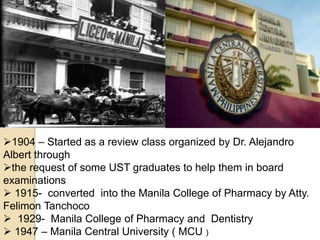
1904 – Started as a review class organized by Dr. Alejandro
Albert through
the request of some UST graduates to help them in board
examinations
 1915- converted into the Manila College of Pharmacy by Atty.
Felimon Tanchoco
 1929- Manila College of Pharmacy and Dentistry
 1947 – Manila Central University ( MCU )
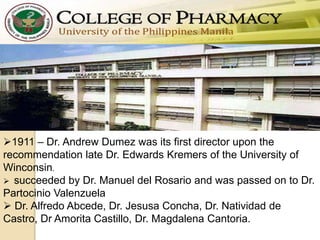
1911 – Dr. Andrew Dumez was its first director upon the
recommendation late Dr. Edwards Kremers of the University of
Winconsin.
 succeeded by Dr. Manuel del Rosario and was passed on to Dr.
Partocinio Valenzuela
 Dr. Alfredo Abcede, Dr. Jesusa Concha, Dr. Natividad de
Castro, Dr Amorita Castillo, Dr. Magdalena Cantoria.

Introduction to Pharmacy ( HistoPhar )

  • 1.
  • 2.
    Overview of thecourse of Pharmacy Pharmacy - derived from Greek word “Pharmakon” Means medicine or drug.  art of dispensing and preparing of medicines or drugs  establishment and place where drugs or medicines are solved.
  • 3.
    Pharmacist also known asdruggists or chemists, are healthcare professionals who practice in pharmacy, the field of health sciences focusing on safe and effective medication use.
  • 4.
  • 5.
    BOWL OF HYGEIA Thebowl with a snake coiled around it is called the bowl of Hygeia with the serpent of Epidaurus, and is a variant on the above. Hygeia was Aesculapius’s daughter and a Greek Goddess of health. Her symbol was a serpent drinking from a bowl. The vessel is usually depicted with a long stem and a shallow, wide bowl as seen here. It also is considered suitable for pharmacy. The bowl of Hygeia with serpent of Epidaurus shown here is the symbol for Hungarian pharmacists.
  • 6.
    CADUCEUS The symbol oftwo snakes on a staff is called the Caduceus. The staff, depicted with wings, is that of Mercury (Roman) or Hermes (Greek), messenger of the Gods and also God of commerce. (The Greek root of the Word Caduceus means “herald’s wand”)
  • 7.
    MORTAR AND PESTLE Themortar and pestle has long been used as a pharmaceutical symbol in Britain and on the European mainland, and is still widely employed as a pharmacy shop sign in Scotland. The mortar and pestle are tools of traditional pharmacy, hence their use as an easily recognizable visual motif.
  • 8.
    RECIPE The recipe sign appearsat the start of prescriptions. Although universally accepted as an abbreviation of “recipe” (Latin for ‘take thou’), it has also been suggested that it is the astronomical sign of the planet Jupiter.
  • 9.
  • 10.
    Helmet – Denotingwisdom and surety of action Unicorn – Horn of which has medical effect Secundum Artem – according to art. Pharmacy is both science and art.
  • 11.
    1. Evolution ofPharmacy  Man have several characteristics on how to treat ailments, physical and mental with medicines.  Base on archeological evidence man always search for other tools to treat his conditions
  • 12.
     Pharmacy isand has been the art and later science of fashioning one of our most important tools--MEDICINE
  • 13.
    Prehistoric Pharmacy  Sincethe dawn of humanity, pharmacy has been part of everyday life.  By trial and error , folk knowledge of the healing properties of certain natural substances
  • 14.
    Shamans  Faith Healers Conceptof outside force in the form of remedies Drugs influencing bodily functions may considered one of humanity’s greatest advances
  • 15.
    Pharmacy in antiquity Changes occurred gradually influence concepts of disease and healing.
  • 16.
  • 17.
    Greek Physicians:  preparedtheir own medicines and left prescription behind for family members to compound and administer Father of Pharmacy Father of Botany
  • 18.
    Dioscorides Wrote and compiledmateria medica the standard Encyclopedia of drugs used for hundred of years
  • 19.
    Pharmacy in themiddle ages, 400AD to 1453 ( Fall of Rome to fall Constantinople)
  • 20.
    Pagan temples closedand replace by Church’s teaching.  diseases and sin have an intimate relationship
  • 21.
    Ancient monasteries becamethe centers for healing bot spiritual and corporal  Monks they have their classical medical text (epitomes herbal garden , no longer available after the collapse of trade and commerce
  • 22.
    Mohamedanism – newcivilization arose  Greek writings about medicine were translated to Arabic.  Works of Galen and Dioscorides was accepted by Arabs.
  • 23.
    Rhazes (860-932) Avicenna(980-1063)  They added to the writings of Greek .  Rejected the old idea that foul tasting worked best in medicine  they developed and exert effort in their dosage forms elegant and palatable through silvering of pills and use of syrups .
  • 24.
    In mid 13thcentury (1240) Frederick II codified the separa practice of pharmacy from medicine.
  • 25.
    Public pharmacies becamerelatively common in Southe Europe  Practitioners of Pharmacy joined together within guilds.  Writings of Greek translated to Arabic were further translated to Latin for the use of European schools.
  • 26.
    Universities emerged inEurope and England in Middle ages: Paris (1111) Oxford ( 1201 )
  • 27.
  • 28.
    The Renaissance: Thebeginning of the Modern Period 1453 Constantinople fell to the conquering turks and the remnants of Greek scholarly community fled to the west.
  • 29.
    Developed the firstprinting press and started information revolutio
  • 30.
  • 31.
     Vasco deGama found a new route to India  Commerce based on money and banking was established
  • 32.
     An importantadvocate of chemically prepared drugs from crude plant and mineral substance  Paracelsus is referred to as the father of toxicology for his claim that, “All things are poison, and nothing is without poison.  Sparked the growth of modern Pharmaceutical Sciences  Process of distillation and extraction was introduce in the
  • 33.
    Quinine drug wasdiscovered to treat malarial fevers.  advocate of chemical medicines displaced the therapeutic agreement of Galenism which had lasted for nearly 1,500 years
  • 34.
    Pharmacy Developments Summary Pharmacypractitioners joined together to form guilds Cooperation between pharmaceutical guilds and government bodies led to standardization of medicines ( Pharmacopeias) “Dispensatorium of Valerus Cordus” first pharmacopeia adopted by the govt of Nuremberg, Germany in 1546 Discovery of chemicals use in preparing medicines, Pharmacist force to learn new methods drug preparations Many pharmacist worked as Chemist Pharmacist investigation of botanical drugs during 1700s and 1800s. Isolation of pure, crystalline chemicals in lab research Isolation of crude opium by Serturner (19th century) , Isolation of quinine and several alkaloids by Pelletier & After 1850, scientific disciplines in pharmacy began to become more professionalized in colleges and manufacturing, Drug research develop 19th century Pharmacy became almost similar to physicians by professions
  • 35.
    Transition to ModernProfession 1870 to 1920:  Transitional for both pharmacy and Pharmacy education.  5% of pharmacy practitioners had finished formal schooling in Pharmacy of night courses to supplement apprenticeship  1870 state laws were passed requiring the examination and registration of pharmacist.
  • 36.
     Prestige attachedto the diploma attracted students  Schools affiliated with local pharmaceutical organizations provided students with excellent practical education combining formal education with apprenticeship.
  • 37.
    Corner drugstores becamefeatures in American society  Pharmacist rely on Rx compounding for his professional identity  National Association of Retail Druggist in 1898
  • 38.
    American Pharmaceutical Association welcomedand cooperated with retail druggist first but later on they split.
  • 39.
    Existing developments inMedicine occurred the period: 1. Germ theory of disease by Pasteur and Koch ( 1880-1890)
  • 41.
    2. Pasteur’s rabiesvaccine and Emil Von Behring diphtheria antitoxin can arise from the Laboratory
  • 42.
    3. Paul Ehrlich’sSalvarsan in 1910---first discovered chemotherapeutic agents.
  • 43.
    4. Industrial researchin drugs produced analgesics and antipyretics in laboratory, sedative as chloral hydrate. 5. Passage of Pure Foods and Drug Act in 1906 mainly In response to poor food production methods expanded to problems in the drug trade
  • 44.
    Pharmacist abandoned theirin-shop manufacturing of the ingredients in the prescriptions. Pharmaceutical Industry progressed
  • 45.
    The Era andcount and Pour  20th century dramatic change for medical care including Pharmacy. (1928 )
  • 46.
     cortisones, tranquilizers,antihypertensives, radioisotopes and oral contraceptives was also discovered  High technology was applied to the production of medicines after WWII ( 1941-1942 )  pharmaceutical Industries became one of the most advanced industries in the world.
  • 47.
    1930s – 75%of Rx required compounding by a pharmacist 1950s – 25% of Rx required compounding by a pharmacist 1960s – only 4% (1 in 25 Rx) needed compounding 1970s – only 1% ( 1 in 100 Rx ) needed compounding skills
  • 48.
    Pharmacist were nota loss for work as the number of prescriptions grew, or new effective drugs came into the market.  Chain drugstores displacing independent corner drugstores especially in urban areas.
  • 49.
     Laws regulatingthe production of drugs and pharmacy were modernized.  BS Pharmacy was extended to 5 years and curriculum continued to emphasize physical sciences which underlie the making of medicines.
  • 50.
    Pharmacy Practice Today-Clinical Pharmacy  Pharmacy took over the an aspect of medical care partially abandoned by physicians  Drug utilization  survey polls that Pharmacist is one of the trusted in the field of medicines administration
  • 51.
    Pharmacy Practice Today-Clinical Pharmacy  Pharmacy took over the an aspect of medical care partially abandoned by physicians  Drug utilization  survey polls that Pharmacist is one of the trusted in the field of medicines administration
  • 52.
  • 53.
    History Of PhilippinePharmacy Pre-historic Period: 1. Mythical period 2. Superstitious 3. Empiric
  • 54.
  • 55.
    a.In Tagalog “Bathala“– supreme –like La-on “visayans”
  • 56.
    b. Captan –who shared with Bathala the creative power.
  • 57.
    c. Bagobos -- “Daragao”, Tiruray - “Balbol and Saitan”
  • 58.
  • 59.
    e. “Katalonan orBabaylan”
  • 60.
    f. Early Filipinosbelieved in the incarnation of their ancestors
  • 61.
  • 62.
    III. The EmpiricPeriod Pre – Spanished era there were herbolarios – men skilled in the use of healing herbs
  • 63.
    Pharmaceutical forms adoptedby the early cuarenderos or quack doctors were confined to: 1. Macerations in cold and hot water 2. Infusions or decoctions in oil of the curative plant parts 3. Poultices and some powders 4. Resinous plasters and salves with a waxy base 5. inhalations and fumigations and a few empyreumatic products.
  • 64.
    B. Philippine PharmacyDuring The Spanished Period
  • 65.
    C. The Universityof Santo Tomas and the Development of Pharmacy in the Philippines  The UST was the first great institution of learning established in the Philippines. Fr. Miguel de Benavides, a s
  • 66.
    “Colegio de NuestraSenora del Rosario de Santo Tomas” located in Intramuros.
  • 67.
    Pre-pharmacy Period The workof the Catholic Missionaries
  • 68.
    Fr. Fernando SantaMaria (1704-1774)  Dominican priest, native of madrid  “ Medicinas Caseras” 1st ed. 1786 – contained suggestions for treatment of certain diseases. 3 Topics of the book: 1. Medicinal barks and herbs 2. Various sickness 3. Various secrets and rareties worth knowing
  • 69.
    Fr. Blanco ,OSA and his botanical masterpiece “Flora de Filipinas”
  • 70.
    Post- Pharmacy Period Oncethe was firmly established in July, 1871 its work and teaching mission started smoothly.  Professors had to be contracted from Spain.  1871 there were about 8 students enrolled and out of these 6 were graduated as Bachelors in 1875 and as Licenciates in 1876.  Doctor s degree were granted by the Govt , this was reserved only to Universidad Central de. Madrid.
  • 71.
     Foreign Pharmacistcome to Philippines to do business or to practice their profession.  Rector should approve first before the Foreign Pharmacist to practice here in the Philippines.  Examination was given to them
  • 72.
     Foreign Pharmacistwas a blessing for the Philippines
  • 73.
    Admission of Spanishand Foreign Pharmacists to Practice in the Philippines:  Govt and University immediately took steps to solve first in connection with the admission of foreign pharmacists.
  • 74.
    Establishment of theschool of “ Practicantes de Medicina y Farmacia” The purpose is to protect the health of the Filipinos by producing well-trained practitioners to help the physicians and pharmacist.  there were lot of students flocked to the university to enroll in the new course.
  • 76.
     Superior Gobierno– approve and granted the official permit in December , 1879. Rules and Regulation was promulgated by the Rector and administration of the University among which were the following important points: 1. The course will be given in 4 semesters 2. Classes shall be daily 3. Students must be able: a. to read and write and possess a knowledge of the catholic doctrine b. 18 years old shown in baptismal certificate and an affidavit of nationality c. Must undergo and pass an entrance examination that will include arithmetic 4. Students must practice in any drug store or laboratory during the last 3 semester of the course 5. After completion of four semesters study, must pass both theoretical and a practical examination
  • 77.
    The Hospitals andDrugstores in the Philippines During the Spanish Era  Many hospitals were already in operation in the islands during the Pharmacy Period and in this respect, the Spanish government deserved some credit.  The first hospital built by the Spaniards was the Military Hospital in Cebu, built by Legaspi in 1565.
  • 78.
    1. Hospital deSan Juan de Dios – constructed in 1577 by the Franciscans
  • 79.
    2. San Lazaro– also built by the Franciscans in the same year
  • 80.
    3. Hospital deSan Gabriel in Binondo – 1588- managed by Dominicans
  • 81.
    4. Hospital deAguas Santas at Los Banos- 1596
  • 82.
    5. Hospital deAntipolo - 1602
  • 83.
    6. Hospital deSan Jose at Cavite – 1641 7. The Foundling Hospital de San Jose – 1782 8. Hospital for Lepers in Cebu – 1850
  • 84.
    The Boticas orDrugstore during Spanish period Started as a small apothecary shop at Escolta, Manila in 1830 by Spanish Pharmacist and physician, Don Lorenzo Negrao.
  • 85.
     Botica deSanta Cruz established in 1861, located at Plaza de Goiti  Original name Farmacia y Drogueria D. Pablo Schuster  It passed through several hands until 1902 it was purchase Dr. Carlos Jarhling, a German-Filipino Pharmacist and Mr. Luis Santos, A Philippine born Spaniard
  • 86.
    Besides from thetwo drug establishment , there were smaller business concerns in the City of Manila and other big cities of the country 1. Botica Zobel, Botica Von Borrie and Botica de la Divisoria (1878) 2. Farmacia de Quiapo (1883 ) 3. Botica Nino in Cebu 4. Botica De Lalloc in Cagayan de Luzon 5. Botica de D. Mariano Kuhnell 6. Botica de D. Oscar Reyman in Binondo 7. Botica de Fernnadez
  • 87.
    C. Pharmacy Inthe Philippines During The American Occupation Until Its Independence
  • 88.
    Establishment of theBoard of pharmaceutical Examiners  The military government by the American Army organized the Board of Pharmaceutical Examiners under a military order in 1903.  later converted into Act No. 597 of the Philippine Commission  Board of examiners composed of a chairman, and two chairman took charge of the registration of the pharmacists and supervision of their practice
  • 89.
    1904 – Startedas a review class organized by Dr. Alejandro Albert through the request of some UST graduates to help them in board examinations  1915- converted into the Manila College of Pharmacy by Atty. Felimon Tanchoco  1929- Manila College of Pharmacy and Dentistry  1947 – Manila Central University ( MCU )
  • 90.
    1911 – Dr.Andrew Dumez was its first director upon the recommendation late Dr. Edwards Kremers of the University of Winconsin.  succeeded by Dr. Manuel del Rosario and was passed on to Dr. Partocinio Valenzuela  Dr. Alfredo Abcede, Dr. Jesusa Concha, Dr. Natividad de Castro, Dr Amorita Castillo, Dr. Magdalena Cantoria.