Simple short note
regarding dispening…
By
Ahmanur s
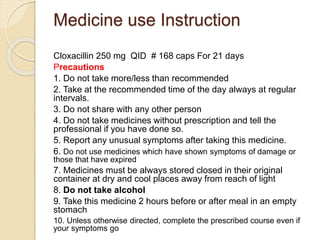
Medicine use Instruction
Cloxacillin 250 mg QID # 168 caps For 21 days
Precautions
1. Do not take more/less than recommended
2. Take at the recommended time of the day always at regular
intervals.
3. Do not share with any other person
4. Do not take medicines without prescription and tell the
professional if you have done so.
5. Report any unusual symptoms after taking this medicine.
6. Do not use medicines which have shown symptoms of damage or
those that have expired
7. Medicines must be always stored closed in their original
container at dry and cool places away from reach of light
8. Do not take alcohol
9. Take this medicine 2 hours before or after meal in an empty
stomach
10. Unless otherwise directed, complete the prescribed course even if
your symptoms go
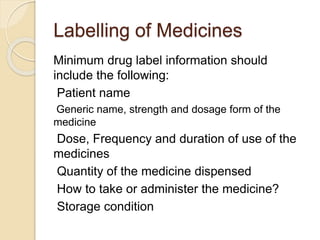
Labelling of Medicines
Minimum drug label information should
include the following:
Patient name
Generic name, strength and dosage form of the
medicine
Dose, Frequency and duration of use of the
medicines
Quantity of the medicine dispensed
How to take or administer the medicine?
Storage condition
Selection and Manipulation
6. While counting, pouring or measuring,
for Selection and Manipulation ,the
following points should be noted:
short and/or over counting should be
avoided
Clean counting tray and/or spoon used
Graduated measuring cylinder and/or flask
must be used for measuring liquid
reduction.
If small volume is to be measured, small
measuring cylinder/flask has to be used (if
compounding is performed in the
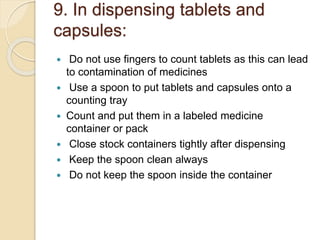
9. In dispensing tablets and
capsules:
 Do not use fingers to count tablets as this can lead
to contamination of medicines
 Use a spoon to put tablets and capsules onto a
counting tray
 Count and put them in a labeled medicine
container or pack
 Close stock containers tightly after dispensing
 Keep the spoon clean always
 Do not keep the spoon inside the container
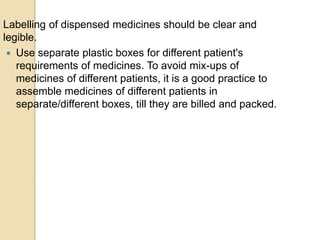
Labelling of dispensed medicines should be clear and
legible.
 Use separate plastic boxes for different patient's
requirements of medicines. To avoid mix-ups of
medicines of different patients, it is a good practice to
assemble medicines of different patients in
separate/different boxes, till they are billed and packed.
Packaging of medicines
 Medicines must be suitably contained,
protected and labelled from the time of
manufacture until they are used by the
patient. The container must maintain
the quality, safety and stability of the
medicine throughout this period.
The selection of packaging for
medicines depends on:
 Nature of the medicine
 Type of patient
 Dosage form
 Method of administering the medicine
 Required shelf-life
 Use, such as for dispensing.
Original containers used by manufacturers are
expected to protect medicines for their specified shelf-
life. Because original containers may contain large
amount of medicines, repackaging of medicines in to
another container may be necessary to dispense
medicines for patients. Such repackaging procedure
can be done at-the –spot or in advance.
Pre packaging is the process by which the pharmacy
professional transfers a medication manually from a
manufacturer's original commercial container to
another type of container in advance (before clients
come to medicine retail out lets)
 The following guidelines are recommended in pre packaging of
medicines:
1. Pre packaging procedures must comply with laws and regulations.
2. The pre packaging operation and area must be clean and separate
from.
Other pharmacy activities.
 Only one medicine product at a time should be pre packaged in a
specific work area.
 Before beginning a pre packaging run, a physical evaluation (color,
odor,
appearance, and markings) of the medicine product being pre packaged
should be made to assure product integrity. The bulk container should
also be examined for evidence of damage, contamination, and other
deleterious effects.
 All pre packaging equipment and systems should be operated and
used
In accordance with the manufacturer's or other
established instructions. There should be valid
justification and authorization by the supervisor for any
deviation from those instructions on the part of the
operator.
o The pharmacy professional must use available data on
the characteristics of all
packaging material used to protect the integrity of the
medicine product. This
information should included at the chemical composition,
light transmission,
moisture permeability, size, thickness (alone or in
laminate), recommended sealing
temperature, and storage requirements
Upon completion of pre packaging, all unused medicine
stock, unused labels and finished packages should be
removed from the pre packaging area.
The packaging equipment should then be completely
emptied, cleaned, and inspected before commencing the
next pre packaging operation. All pre packaged medicines
should be stored in a temperature and humidity-
controlled environment. Pre packaging materials should be
stored and used in accordance with themanufacturer's
instructions
The main advantages of pre packaging medicines
are
 allows enough time for patient counselling and
minimizes dispensing errors resulting from
hectic operation due to heavy patient load.
Unfortunately, the materials commonly used for
repackaging in much medicine retail outlets of
Ethiopia are ordinary papers and the labelling
since complete. In such cases,repackaging of
medicines is likely to have many disadvantages
than advantages.
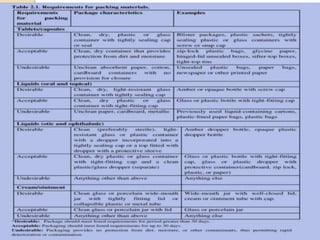
 Packaging aids and materials
 The materials used for repackaging
include: glass bottles, plastic bottles,
collapsible tubes,paper envelops,
plastic envelops, etc.. Paper has the
least value as the primary packaging
material in terms of maintaining the
quality, safety and stability of packaged
medicine.
The nationally approved checklist for counselling has the following 21 counselling points
1. Check for any Allergies in general and this medicine in particular
Ask for any allergies
Obtain past medicines use history
2. Tell name and indication of the medicine: Name is important in case of emergency and visit to more than
one provider
Indication reinforces diagnosis and creates confidence
3. Tell route and frequency of administration:
Prevents taking by the wrong route
Inform if first time or reinforce what they know; Note: ‘take one tablet after meals” may not
work since not everyone eats three meals a day
4. Discuss on what to if the clients miss dose- taking time or if the taken dose is vomited
5. Tell the client how long to take the medicine:
Helps to eliminate unrealistic expectations
Ensures reaching treatment goals
Prevents emergence of microbial resistance6. Tailor medicine regimen to daily routine:
Ask the daily routine before suggestion a plan
Link taking a dose with regular daily task and effect of the medicine
Should not assume a common routine (e. g. eating three meals a day, sleeping night times, etc.)
7. Ask if the client has problem taking this medicine:
Complexity to the dosage regimen affects adherence:
Is there special preference for a dosage form when for example there is swallowing difficulty
due to esophageal ulcers
Consider total cost of care not just the cost of the drug alone
8. Tell how long it will take for the medicine to show an effect:
If not told the client may believe the medicine is not working and may stop taking or increase
dose with subsequent toxicity
9. Tell how many times and when to
refill:
• Number of refills: Check if there is
incontinence
10. Emphasize benefits of the medicine:
• Discuss benefits before potential side
– effects
11. Discuss major side effects of the
medicine:
Side effects that are common and how
long they will stay; those that disappear
with time using
reassurance can help to cope with them.
Measures to recognize, prevent, or
manage side effects and adverse effects:
Tell what to do it side effects don’t go
away or become intolerable
Encourage the patient to report side/
adverse effects of the drugs
12. Discuss drug – drug –food, drug-
disease, drug – herb interactions and
manage it
using appendix IV
Ask if client is taking other
medicines, discuss interference of
other drugs, food or medical
conditions with current medicine and
/or condition being treated
13. Inform clients of devices that can
assist them in taking their
medications regularly
and thereby improve adherence
Alarm devices (wrist watch or cell
phone alarms), pill boxes, associating
doses with daily
activities, leaving medications out
where they can see them, etc
14. Discuss precaution and measures to improve treatment outcome:
Decreased salt intake, dietary requirement, self-monitoring recommended,
exercise, activities to be avoided-
15. Discuss storage recommendation supplementary instructions:
Shake well, refrigerate, avoid heat and humidity, etc.
Duration of use after opining container
16. Discuss religious and cultural issue that may affect medicines use
Fasting and holy water, dosage forms preferences, the ill consequences of
hoarding medicines
at home and sharing of such medicines with other people; etc.
17. Demonstrate and provide adequate information about special dosage forms:
Metered dose inhalers, suppositories, eye drops, ear drops, topical, transdermal
patches,
injections, sublingual tables, nasal sprays, sustained - release tablets /capsules,etc.
18. Educate techniques for self – monitoring
Diabetes signs and symptoms of hypo- and hyper – glycol use of blood glucose
monitoring
devices
Wayfaring therapy to watch for excessive bleeding
Hypertension: use of blood pressure motors
19. Ask if there are any additional concerns or question: listen respectfully and
carefully
and carefully
20. Ask client to repeat key information to check how instructions are understood:
Could you tell me how you are going to take your medicine?
Praising has been shown to reinforce adherence
Examples of advisory/cautionary wordings common to most
medicines/dosage forms
'Shake the bottle', (for pharmaceutical products such as
suspensions and emulsions)
‘Use freshly boiled and cooled water’, (for water used for
constituting powders)
'For external use only', (for topical preparations)
'Keep out of the reach and sight of children'
‘Stains cloths or the skin’
‘Take the tablets with water or other liquid’
‘Do not share with any other person’
‘Do not take more/less than recommended’
‘Do not use medicines not given you by an authorized health
professional’
‘Do not transfer into another container’
‘Store tightly closed in a cool and dark place’ 'Store in a cool
place
Examples of advisory/cautionary labels specific to a drug or its family
/dosage form
Take this medicine with _____ hrs. gap separated from other medicines
Take this medicine with ____ hrs. Gap separated from milk (or other
food types).
Take with or after food
Take half to one hour before food.
Take 2 hours before or after food or on an empty stomach
To be sucked
To be chewed
To be swallowed whole, not chewed
To be dissolved under the tongue
Take with plenty of water
Do not take more than 2 at any one time. Do not take more than 8 in 24
hours
Do not take more than . . . in 24 hours
Do not take more than . . . in 24 hours or . . . in any one week
This medicine may color the urine
Dissolve or mix with water before taking
Avoid exposure of skin to direct sunlight or sun lamps
Take at regular intervals. Complete the prescribed course unless
otherwise directed.
Warning. Avoid alcoholic drinks
Counselling Points for Selected Dosage
Forms
 There are multi factors affecting
counselling. Age, background of the pt,
literacy and DF.
EYE Drop counciling
When two different eye-drop
preparations are used at the same time
of day, dilution and over flow may occur
when one immediately follows the other.
The patient should therefore leave an
interval of at least 5 minutes between
the two.
Administration of Eardrops
 Warm the ear-drops by keeping them
in the hand or the arm pit for several
minutes. Do not use hot water tap, no
temperature control
 After drop to one ear, Wait five
minutes before turning to the other
ear.
Recording the Transaction
All dispensing units should have a
standardized Prescription Registration Book
(PRB) for recording every pharmaceutical
issued to a patient. The prescription
registration book should be used both when
prescriptions are retained in the pharmacy
and when they are returned to the patient.For
a prescription, which is returned to a patient
because all the items in the original
prescription could not be filled, the medicines
that have been dispensed from the pharmacy
should be copied on a blank prescription and
On the original prescription, which is retained
by the patient, the word “dispensed” should be
stamped a adjacent to those items which have
been dispensed. For prescriptions, which are to
be refilled on a later date, the dispensing
information should been tered the registration
book before returning the prescription to the
patient. The official seals of the
pharmacy/Health institution, name and
signature of the dispenser, the date of
dispensing and then extra fill date
should be written on the back of the
prescription
Documentation and reporting
 The receipts for requisition, receiving as
well as the prescription registration book
should be kept properly.
 Blank prescription should be kept
carefully, only prescribers have access to
them. Information obtained from
prescription registration book could be
used for further planning and efficient
utilization of resource.
 The report on physical inventory shall be
documented
Prescription filing
 At the close of each day all dispensed
prescriptions should be organized
 Prescriptions should be filed sequentially by
day in a single container/ carton for each month.
 The container should be labelled with the month
and year.
 Containers should be arranged monthly.
 Normal prescriptions should be filed securely
for two years and special prescriptions for 5
years.
 Prescriptions, patient and medication related
records and information should be documented
and kept in a secure place that is easily
Following the counselling session,
transactions related to the prescriptions
must be
recorded to monitor performances of the
department. The transaction is
documented on
the prescription registration format.
The end of each day, prescriptions
collected during the day need to be filed
chronologically in a way that makes them
traceable whenever required
dispensing pharmacy note to administration

dispensing pharmacy note to administration

  • 1.
    Simple short note regardingdispening… By Ahmanur s
  • 2.
    Medicine use Instruction Cloxacillin250 mg QID # 168 caps For 21 days Precautions 1. Do not take more/less than recommended 2. Take at the recommended time of the day always at regular intervals. 3. Do not share with any other person 4. Do not take medicines without prescription and tell the professional if you have done so. 5. Report any unusual symptoms after taking this medicine. 6. Do not use medicines which have shown symptoms of damage or those that have expired 7. Medicines must be always stored closed in their original container at dry and cool places away from reach of light 8. Do not take alcohol 9. Take this medicine 2 hours before or after meal in an empty stomach 10. Unless otherwise directed, complete the prescribed course even if your symptoms go
  • 3.
    Labelling of Medicines Minimumdrug label information should include the following: Patient name Generic name, strength and dosage form of the medicine Dose, Frequency and duration of use of the medicines Quantity of the medicine dispensed How to take or administer the medicine? Storage condition
  • 4.
    Selection and Manipulation 6.While counting, pouring or measuring, for Selection and Manipulation ,the following points should be noted: short and/or over counting should be avoided Clean counting tray and/or spoon used Graduated measuring cylinder and/or flask must be used for measuring liquid reduction. If small volume is to be measured, small measuring cylinder/flask has to be used (if compounding is performed in the
  • 5.
    9. In dispensingtablets and capsules:  Do not use fingers to count tablets as this can lead to contamination of medicines  Use a spoon to put tablets and capsules onto a counting tray  Count and put them in a labeled medicine container or pack  Close stock containers tightly after dispensing  Keep the spoon clean always  Do not keep the spoon inside the container
  • 6.
    Labelling of dispensedmedicines should be clear and legible.  Use separate plastic boxes for different patient's requirements of medicines. To avoid mix-ups of medicines of different patients, it is a good practice to assemble medicines of different patients in separate/different boxes, till they are billed and packed.
  • 7.
    Packaging of medicines Medicines must be suitably contained, protected and labelled from the time of manufacture until they are used by the patient. The container must maintain the quality, safety and stability of the medicine throughout this period.
  • 8.
    The selection ofpackaging for medicines depends on:  Nature of the medicine  Type of patient  Dosage form  Method of administering the medicine  Required shelf-life  Use, such as for dispensing.
  • 9.
    Original containers usedby manufacturers are expected to protect medicines for their specified shelf- life. Because original containers may contain large amount of medicines, repackaging of medicines in to another container may be necessary to dispense medicines for patients. Such repackaging procedure can be done at-the –spot or in advance. Pre packaging is the process by which the pharmacy professional transfers a medication manually from a manufacturer's original commercial container to another type of container in advance (before clients come to medicine retail out lets)
  • 10.
     The followingguidelines are recommended in pre packaging of medicines: 1. Pre packaging procedures must comply with laws and regulations. 2. The pre packaging operation and area must be clean and separate from. Other pharmacy activities.  Only one medicine product at a time should be pre packaged in a specific work area.  Before beginning a pre packaging run, a physical evaluation (color, odor, appearance, and markings) of the medicine product being pre packaged should be made to assure product integrity. The bulk container should also be examined for evidence of damage, contamination, and other deleterious effects.  All pre packaging equipment and systems should be operated and used
  • 11.
    In accordance withthe manufacturer's or other established instructions. There should be valid justification and authorization by the supervisor for any deviation from those instructions on the part of the operator. o The pharmacy professional must use available data on the characteristics of all packaging material used to protect the integrity of the medicine product. This information should included at the chemical composition, light transmission, moisture permeability, size, thickness (alone or in laminate), recommended sealing temperature, and storage requirements
  • 12.
    Upon completion ofpre packaging, all unused medicine stock, unused labels and finished packages should be removed from the pre packaging area. The packaging equipment should then be completely emptied, cleaned, and inspected before commencing the next pre packaging operation. All pre packaged medicines should be stored in a temperature and humidity- controlled environment. Pre packaging materials should be stored and used in accordance with themanufacturer's instructions
  • 13.
    The main advantagesof pre packaging medicines are  allows enough time for patient counselling and minimizes dispensing errors resulting from hectic operation due to heavy patient load. Unfortunately, the materials commonly used for repackaging in much medicine retail outlets of Ethiopia are ordinary papers and the labelling since complete. In such cases,repackaging of medicines is likely to have many disadvantages than advantages.
  • 14.
     Packaging aidsand materials  The materials used for repackaging include: glass bottles, plastic bottles, collapsible tubes,paper envelops, plastic envelops, etc.. Paper has the least value as the primary packaging material in terms of maintaining the quality, safety and stability of packaged medicine.
  • 16.
    The nationally approvedchecklist for counselling has the following 21 counselling points 1. Check for any Allergies in general and this medicine in particular Ask for any allergies Obtain past medicines use history 2. Tell name and indication of the medicine: Name is important in case of emergency and visit to more than one provider Indication reinforces diagnosis and creates confidence 3. Tell route and frequency of administration: Prevents taking by the wrong route Inform if first time or reinforce what they know; Note: ‘take one tablet after meals” may not work since not everyone eats three meals a day 4. Discuss on what to if the clients miss dose- taking time or if the taken dose is vomited 5. Tell the client how long to take the medicine: Helps to eliminate unrealistic expectations Ensures reaching treatment goals Prevents emergence of microbial resistance6. Tailor medicine regimen to daily routine: Ask the daily routine before suggestion a plan Link taking a dose with regular daily task and effect of the medicine Should not assume a common routine (e. g. eating three meals a day, sleeping night times, etc.) 7. Ask if the client has problem taking this medicine: Complexity to the dosage regimen affects adherence: Is there special preference for a dosage form when for example there is swallowing difficulty due to esophageal ulcers Consider total cost of care not just the cost of the drug alone 8. Tell how long it will take for the medicine to show an effect: If not told the client may believe the medicine is not working and may stop taking or increase dose with subsequent toxicity
  • 17.
    9. Tell howmany times and when to refill: • Number of refills: Check if there is incontinence 10. Emphasize benefits of the medicine: • Discuss benefits before potential side – effects 11. Discuss major side effects of the medicine: Side effects that are common and how long they will stay; those that disappear with time using reassurance can help to cope with them. Measures to recognize, prevent, or manage side effects and adverse effects: Tell what to do it side effects don’t go away or become intolerable Encourage the patient to report side/ adverse effects of the drugs 12. Discuss drug – drug –food, drug- disease, drug – herb interactions and manage it using appendix IV Ask if client is taking other medicines, discuss interference of other drugs, food or medical conditions with current medicine and /or condition being treated 13. Inform clients of devices that can assist them in taking their medications regularly and thereby improve adherence Alarm devices (wrist watch or cell phone alarms), pill boxes, associating doses with daily activities, leaving medications out where they can see them, etc
  • 18.
    14. Discuss precautionand measures to improve treatment outcome: Decreased salt intake, dietary requirement, self-monitoring recommended, exercise, activities to be avoided- 15. Discuss storage recommendation supplementary instructions: Shake well, refrigerate, avoid heat and humidity, etc. Duration of use after opining container 16. Discuss religious and cultural issue that may affect medicines use Fasting and holy water, dosage forms preferences, the ill consequences of hoarding medicines at home and sharing of such medicines with other people; etc. 17. Demonstrate and provide adequate information about special dosage forms: Metered dose inhalers, suppositories, eye drops, ear drops, topical, transdermal patches, injections, sublingual tables, nasal sprays, sustained - release tablets /capsules,etc. 18. Educate techniques for self – monitoring Diabetes signs and symptoms of hypo- and hyper – glycol use of blood glucose monitoring devices Wayfaring therapy to watch for excessive bleeding Hypertension: use of blood pressure motors 19. Ask if there are any additional concerns or question: listen respectfully and carefully and carefully 20. Ask client to repeat key information to check how instructions are understood: Could you tell me how you are going to take your medicine? Praising has been shown to reinforce adherence
  • 19.
    Examples of advisory/cautionarywordings common to most medicines/dosage forms 'Shake the bottle', (for pharmaceutical products such as suspensions and emulsions) ‘Use freshly boiled and cooled water’, (for water used for constituting powders) 'For external use only', (for topical preparations) 'Keep out of the reach and sight of children' ‘Stains cloths or the skin’ ‘Take the tablets with water or other liquid’ ‘Do not share with any other person’ ‘Do not take more/less than recommended’ ‘Do not use medicines not given you by an authorized health professional’ ‘Do not transfer into another container’ ‘Store tightly closed in a cool and dark place’ 'Store in a cool place
  • 20.
    Examples of advisory/cautionarylabels specific to a drug or its family /dosage form Take this medicine with _____ hrs. gap separated from other medicines Take this medicine with ____ hrs. Gap separated from milk (or other food types). Take with or after food Take half to one hour before food. Take 2 hours before or after food or on an empty stomach To be sucked To be chewed To be swallowed whole, not chewed To be dissolved under the tongue Take with plenty of water Do not take more than 2 at any one time. Do not take more than 8 in 24 hours Do not take more than . . . in 24 hours Do not take more than . . . in 24 hours or . . . in any one week This medicine may color the urine Dissolve or mix with water before taking Avoid exposure of skin to direct sunlight or sun lamps Take at regular intervals. Complete the prescribed course unless otherwise directed. Warning. Avoid alcoholic drinks
  • 21.
    Counselling Points forSelected Dosage Forms  There are multi factors affecting counselling. Age, background of the pt, literacy and DF.
  • 22.
    EYE Drop counciling Whentwo different eye-drop preparations are used at the same time of day, dilution and over flow may occur when one immediately follows the other. The patient should therefore leave an interval of at least 5 minutes between the two.
  • 23.
    Administration of Eardrops Warm the ear-drops by keeping them in the hand or the arm pit for several minutes. Do not use hot water tap, no temperature control  After drop to one ear, Wait five minutes before turning to the other ear.
  • 24.
    Recording the Transaction Alldispensing units should have a standardized Prescription Registration Book (PRB) for recording every pharmaceutical issued to a patient. The prescription registration book should be used both when prescriptions are retained in the pharmacy and when they are returned to the patient.For a prescription, which is returned to a patient because all the items in the original prescription could not be filled, the medicines that have been dispensed from the pharmacy should be copied on a blank prescription and
  • 25.
    On the originalprescription, which is retained by the patient, the word “dispensed” should be stamped a adjacent to those items which have been dispensed. For prescriptions, which are to be refilled on a later date, the dispensing information should been tered the registration book before returning the prescription to the patient. The official seals of the pharmacy/Health institution, name and signature of the dispenser, the date of dispensing and then extra fill date should be written on the back of the prescription
  • 26.
    Documentation and reporting The receipts for requisition, receiving as well as the prescription registration book should be kept properly.  Blank prescription should be kept carefully, only prescribers have access to them. Information obtained from prescription registration book could be used for further planning and efficient utilization of resource.  The report on physical inventory shall be documented
  • 27.
    Prescription filing  Atthe close of each day all dispensed prescriptions should be organized  Prescriptions should be filed sequentially by day in a single container/ carton for each month.  The container should be labelled with the month and year.  Containers should be arranged monthly.  Normal prescriptions should be filed securely for two years and special prescriptions for 5 years.  Prescriptions, patient and medication related records and information should be documented and kept in a secure place that is easily
  • 28.
    Following the counsellingsession, transactions related to the prescriptions must be recorded to monitor performances of the department. The transaction is documented on the prescription registration format. The end of each day, prescriptions collected during the day need to be filed chronologically in a way that makes them traceable whenever required